Category: Uncategorized

  • Eight surprise takeaways from the nominations

    Eight surprise takeaways from the nominations


    Steven McIntoshEntertainment reporter

    British actor Delroy Lindo says he was half-asleep when he found out he got his first Oscar nomination

    Awards pundits were taken by surprise from the first two words spoken at the Oscar nominations on Thursday.

    “Elle Fanning, for Sentimental Value,” said hosts Danielle Brooks and Lewis Pullman, as they kicked off the nominations with the best supporting actress category.

    Fanning’s appearance got things off to a spicy start from the earliest possible moment – she had received praise for her performance in the Norwegian family drama but few had predicted a nomination.

    The opening category set the tone for a string of snubs and surprises, which started coming thick and fast. Here are eight of the big takeaways.

    1. Some hot favourites missed out

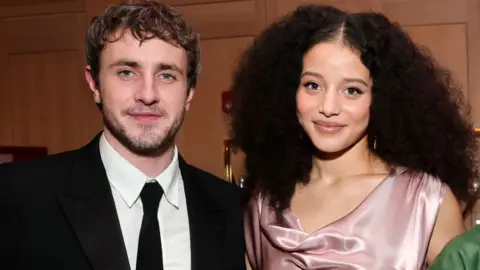
    Getty Images Paul Mescal and Chase Infiniti attend the 37th Annual Palm Springs International Film Awards after party at Parker Palm Springs on January 03, 2026 in Palm Springs, California. Getty Images

    Paul Mescal and Chase Infiniti were two of the day’s biggest acting snubs

    Although Hamnet and One Battle After Another did well, both had a slightly softer showing than expected in the acting categories.

    Paul Mescal missed out on a supporting actor nod for Hamnet – a surprising omission, although we’re confident it won’t have much impact on his co-star Jessie Buckley’s frontrunner status for best actress.

    Meanwhile, four big actors from One Battle After Another were recognised, but its break-out star Chase Infiniti missed best actress despite being a red-hot contender.

    It was an admittedly competitive category. But at 25 years old and with rave reviews for her performance in the film, we’re pretty sure we haven’t heard the last of her.

    Other actors who had momentum but ended up missing included Jesse Plemons for Bugonia and Joel Edgerton for Train Dreams. But both of those movies made it into best picture – so the Academy clearly liked them overall.

    2. F1 is a comfort-food movie
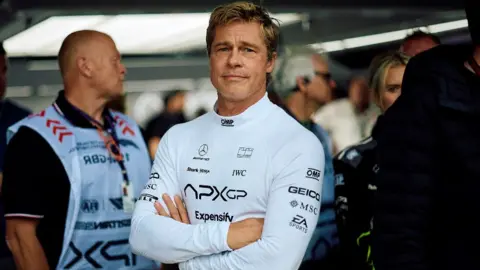
    Getty Images Hollywood actor Brad Pitt, acting in an upcoming Formula One-based movie, follows the second practice session ahead of the Formula One British Grand Prix at the Silverstone motor racing circuit in Silverstone, central England, on July 5, 2024Getty Images

    F1, which stars Brad Pitt as a racing driver brought out of retirement, was the biggest surprise in the best picture category.

    It wasn’t exactly an outsider – many awards pundits expected it to pick up several below-the-line nominations for its impressive technical achievements (we recommend watching the film in a cinema or with surround sound if you can).

    But the fact that it had enough momentum to propel it into best picture was a real show of strength – especially without other major nominations in best director or the acting categories.

    It shows the old guard of the Academy still appreciates traditional, well-made films that can simply be enjoyed with a bucket of popcorn.

    3. Sinners were the big winners
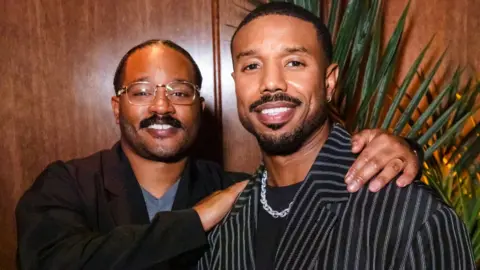
    Getty Images Filmmaker Ryan Coogler and actor Michael B. Jordan attend as Warner Bros. Pictures Celebrates "Sinners" & Proximity Media at Somerville restaurant on November 21, 2025, in Los Angeles, California. Getty Images

    Ryan Coogler was nominated for best director, while Michael B Jordan is up for best actor

    Sinners scored a record-breaking 16 nominations, flying way past the previous joint record holders La La Land, Titanic and All About Eve, which got 14 each.

    Ryan Coogler’s vampire horror has done particularly well to maintain its momentum with voters, considering it was released last spring.

    But it’s exactly the kind of film the Academy would want to recognise. Although vampire movies might not be traditional Oscars bait, Sinners was a real artistic achievement, blending genre horror with 1930s blues music against a backdrop of the Mississippi Delta.

    Coogler also made headlines in the Hollywood trade publications last year for the deal he negotiated with Warner Brothers, which will see the film’s ownership rights return to him after 25 years.

    4. Wicked did not bewitch the Academy
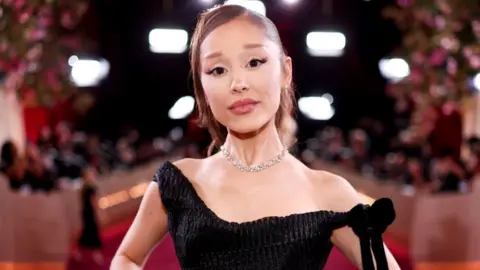
    Getty Images Ariana Grande at the 83rd Annual Golden Globes held at The Beverly Hilton on January 11, 2026 in Beverly Hills, California.Getty Images

    Ariana Grande’s The Girl in the Bubble missed the original song category

    The first Wicked film received 10 Oscar nominations and went on to win two. So it’s an extraordinary fall from grace for its sequel to have got zero.

    This was largely expected, however. Wicked: For Good was far less well received than its predecessor – something it shares with the original musical.

    The second act of the stage show is widely considered weaker than the first, partly because all the big hits appear before the interval.

    But it was still thought that Wicked: For Good could get into some categories, with many predicting a best original song nomination for The Girl in the Bubble, a track performed by Ariana Grande that was newly added for the film adaptation.

    There was better news for another blockbuster, Avatar: Fire and Ash, which at least managed a couple of technical nominations for visual effects and costume design.

    Some of the most mainstream films can instead be found in the animated category. That’s where we find the $1.7bn-grossing Zootopia 2 (known as Zootropolis 2 in the UK) and viral streaming hit KPop Demon Hunters.

    5. The Brits showed up
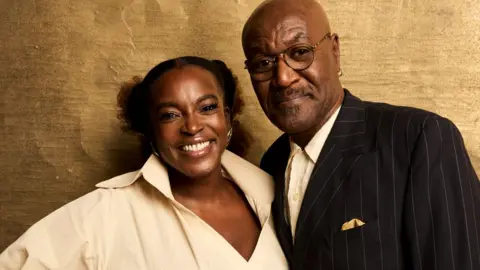
    Getty Images Wunmi Mosaku and Delroy Lindo pose for a portrait during the 2026 Annual Movies for Grownups Awards with AARP at Beverly Wilshire, A Four Seasons Hotel on January 10, 2026 in Beverly Hills, California. Getty Images

    In a year short on Brits, Sinners stars Wunmi Mosaku and Delroy Lindo both scored nominations

    Sinners didn’t just score the highest number of nominations, it also delivered the only two Brits to be nominated in the acting categories.

    Wunmi Mosaku and Delroy Lindo made it into best supporting actress and actor respectively.

    While Mosaku’s was broadly expected, Lindo’s was more of a surprise, and his inclusion is perhaps one of the biggest indicators of how much love there clearly is for Sinners across the Academy.

    Lindo narrowly missed a best actor nomination a few years ago for Spike Lee’s Da 5 Bloods. The 73-year-old’s first ever Oscar nomination feels long overdue.

    6. Several actresses carried their films to a nomination
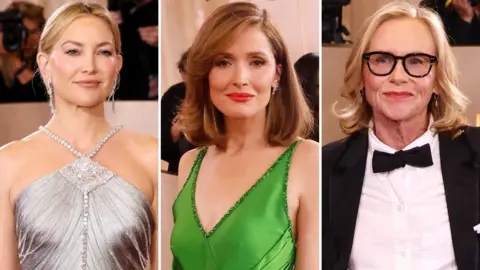
    Getty Images Left to right: Kate Hudson, Rose Byrne and Amy Madigan all seen at the Golden GlobesGetty Images

    Left to right: Kate Hudson, Rose Byrne and Amy Madigan

    Three of the actresses nominated on Thursday ended up being the only recognition their film received.

    Rose Byrne was the sole representation for motherhood drama If I Had Legs I’d Kick You, while Kate Hudson made it in on her own for the touching musical love story Song Sung Blue.

    Meanwhile, Weapons star Amy Madigan was nominated for her role as an eccentric aunt who shows up in a US town just before the local school children go missing.

    Madigan’s nomination is perhaps the most impressive, given that jump-scare horror movies aren’t traditional Oscars fodder.

    But the 75-year-old was a passion pick for many pundits and voters, and her fans have been campaigning hard for her to be recognised for her memorable (and slightly terrifying) performance.

    7. New category is a mixed bag
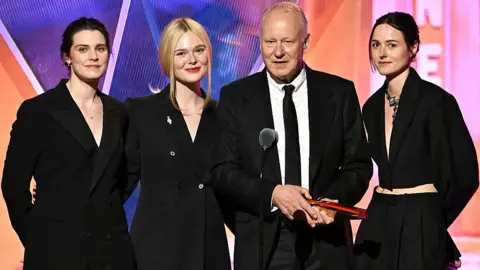
    Getty Images Inga Ibsdotter Lilleaas, Elle Fanning, Stellan Skarsgård, and Renate Reinsve accept Best Intergen/Foreign for "Sentimental Value" onstage during the 2026 Annual Movies for Grownups Awards with AARP at Beverly Wilshire, A Four Seasons Hotel on January 10, 2026 in Beverly Hills, California.Getty Images

    Sentimental Value missed a casting nomination despite four individual acting nods

    The newly introduced casting category overlapped with many of the general frontrunners, with nominations for Marty Supreme, One Battle After Another, Hamnet, Sinners and The Secret Agent.

    We can’t help but feel slightly bemused, however, that one other film in particular missed out.

    Sentimental Value failed to score a casting nomination despite all four of its lead stars scoring individual nods – Stellan Skarsgård, Elle Fanning, Renate Reinsve and Inga Ibsdotter Lilleaas.

    If that quartet was impressive enough to be nominated individually, you might’ve thought there was a good chance of recognition for the casting directors who put them together – Avy Kaufman and Yngvill Kolset Haga.

    8. Timothée is even closer to greatness
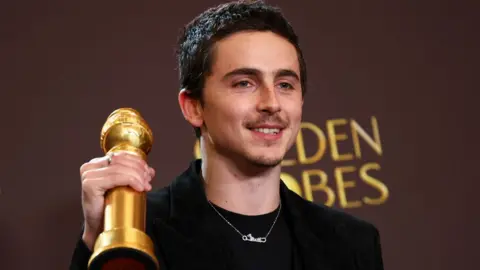
    Getty Images Timothée Chalamet wins the Golden Globe for male actor in a musical or comedy film for "Marty Supreme" at the 83rd Annual Golden Globes held at The Beverly Hilton on January 11, 2026 in Beverly Hills, California. Getty Images

    At the SAG Awards last year, Timothée Chalamet spoke about his desire to eventually be considered “one of the Hollywood greats”.

    He’s a big step closer to that with the likelihood that he will win his first Oscar this year, as the clear frontrunner in best actor for table-tennis drama Marty Supreme.

    Although he’s only been nominated twice before, Chalamet is popular with the Academy, having starred in a whopping eight best picture-nominated films.

    He is also the youngest actor since Marlon Brando to receive three nominations for best leading actor. Brando was 30, the same age as Chalamet, when he got his third in 1954.

    Timothée came close to a win last year for playing Bob Dylan in A Complete Unknown, but we’re confident that 2026 will be his time to reign supreme.
    Source link

  • Trump withdraws Canada’s invite to join Board of Peace

    Trump withdraws Canada’s invite to join Board of Peace


    US President Donald Trump has withdrawn an invite for Canada to join his newly constituted ‘Board of Peace’, in the latest spat between the North American neighbours.

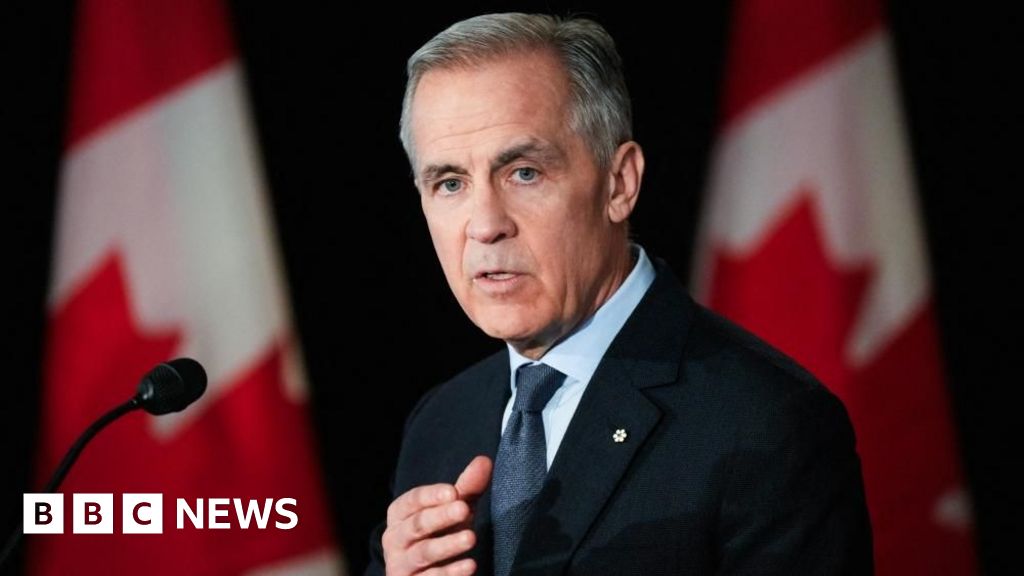
    “Please let this Letter serve to represent that the Board of Peace is withdrawing its invitation to you regarding Canada’s joining,” Trump said on Truth Social in a post addressed to Prime Minister Mark Carney, who made headlines this week when he warned of a “rupture” in the US-led global order.

    Canada had indicated that while it would not pay to be on the board, it would join.

    Meanwhile, EU chief Antonio Costa said European leaders have serious doubts about the scope of the board, but were willing to work with the body in Gaza.

    The board, which gives Trump wide decision-making powers as chairman, is being billed by the US as a new international organisation for resolving conflicts.

    Trump did not give a reason in Thursday evening’s post as to why he had decided to revoke Canada’s offer.

    Carney’s office did not immediately respond. The prime minster had indicated last week he would accept Trump’s invite on principle.

    But Ottawa had indicated in recent days that it would not pay the $1bn (£740m) membership fee which Trump has said permanent members will be asked to pay to help fund the board.

    Trump’s ‘Board of Peace’ was originally thought to be aimed at helping end the two-year war between Israel and Hamas in Gaza and oversee reconstruction.

    But its proposed charter does not mention the Palestinian territory and appears to be designed to supplant functions of the UN. Trump would be chairman for life.

    Some 60 nations have been invited to join the board and about 35 have already signed up, according to the White House.

    Those who have agreed to join so far include Argentina, Belarus, Morocco, Vietnam, Pakistan, Kazakhstan, Uzbekistan, Kosovo, Hungary, Egypt, Turkey, Qatar, Jordan, Indonesia and Saudi Arabia.

    But none of the other permanent members of the UN Security Council – China, France, Russia, and the UK – have committed to participation so far.

    The UK has expressed concerns about the inclusion of Russian President Vladimir Putin, whose forces are fighting in Ukraine after invading in 2022. France said the charter as it currently stood was “incompatible” with its international commitments, especially its UN membership.

    European Council president Antonio Costa said European leaders have doubts about the scope of the board, but were ready to work with the US and the newly founded body in Gaza.

    Speaking on Friday after an EU leaders’ summit in Brussels, Costa said, “We have serious doubts about a number of elements in the charter of the Board of Peace related to its scope, its governance and its compatibility with the UN Charter.”

    But he said the EU was “ready to work together with the US on the implementation of the comprehensive Peace Plan for Gaza, with a Board of Peace carrying out its mission as a transitional administration”.

    After the EU leaders’ summit, Spanish Prime Minister Pedro Sanchez told reporters that his country had “declined” the invitation to participate in the body.

    Watch: Board of Peace, Zelensky and Musk – What happened before Trump left Davos?

    Trump’s withdrawal of Canada’s invitation came after Carney appeared to irk Trump with a speech that won a rare standing ovation this week at the World Economic Forum in Davos.

    The prime minister urged other “middle powers” to band together in the face of economic coercion by “greater powers”, although he did not mention the US president by name.

    A day later Trump told the gathering in the Swiss Alpine resort that Canada gets many “freebies” from the US and it “should be grateful”.

    “Canada lives because of the United States,” Trump said. “Remember that, Mark, the next time you make your statements.”

    On Thursday, Carney swiped back at Trump as he delivered another speech back on home turf.

    Speaking in Quebec, he said: “Canada doesn’t live because of the United States. Canada thrives because we are Canadians.”


    Source link

  • how Australian politics descended into ugliness in attack’s aftermath

    how Australian politics descended into ugliness in attack’s aftermath


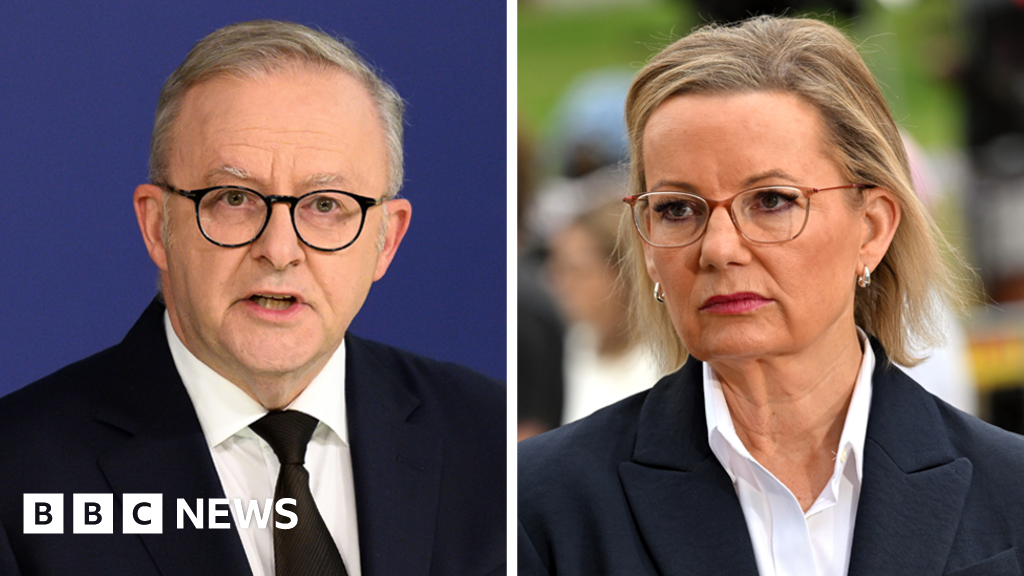
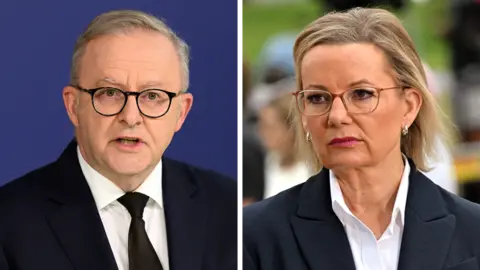
    Steven Markham/ Mick Tsikas/ EPA Anthony Albanese and Sussan LeySteven Markham/ Mick Tsikas/ EPA

    Australians have been disappointed by the politicisation of the Bondi tragedy

    Thursday had been earmarked for Australians to mourn the victims of last month’s Bondi shootings.

    Those who had lost loved ones in the antisemitic attacks wanted it to be a chance to remember the dead, and spread light and kindness in their honour.

    Instead, it was a day dominated by a political row resulting in the collapse of the opposition coalition.

    “I mean, you would have thought they could have put this off for 24 hours,” veteran political commentator Malcolm Farr told the BBC.

    “It’s at the very least unfortunate timing and shows a certain amount of self-indulgence.”

    The fight – which centred around reforms sparked by the tragedy – looks set to sink two leaders and trash their parties’ electoral chances, and caps off what many Australians say has been a disappointing month of politics.

    When two gunmen opened fire on an event marking the Jewish festival of Hanukkah at Bondi Beach, killing 15 people – including a 10-year-old child – the recriminations began almost immediately.

    “The turnaround was amazing in the way they [politicians] politicised it,” says Bondi local Kass Hill, 52. “The fingerpointing isn’t solving anything.”

    Heckles and blame

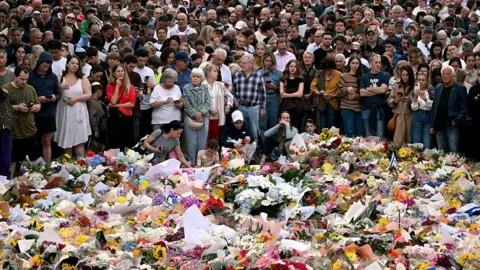
    Getty Images Mourners gather in front of a sea of floral tributes at a makeshift memorial at the Bondi Pavilion in memory of the victims of a shooting at Bondi BeachGetty Images

    Bondi was covered with a sea of floral tributes in the days after the attack

    While families were waiting to bury their loved ones, a conveyer belt of politicians – including the opposition leader – visited the scene to apportion blame. Populist leaders came to rail against immigration. Prominent businesspeople popped by to pose with flowers.

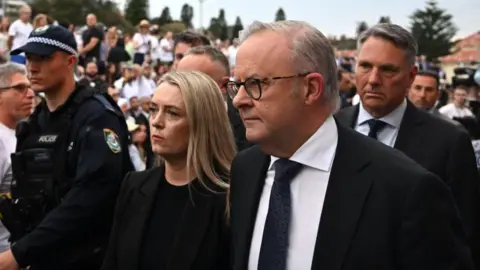
    Prime Minister Anthony Albanese, accused by many Jewish Australians of ignoring their concerns ahead of the attack, spent the weeks after it dismissing calls from many in the community for a national inquiry into antisemitism.

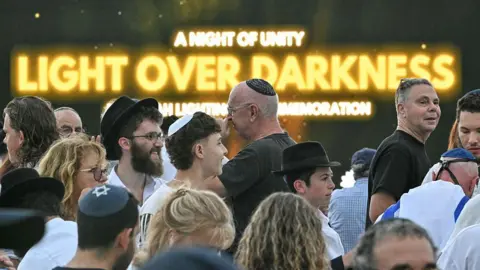
    He was repeatedly heckled in public, arriving at a memorial to a tidal wave of boos and cries of “You’re not welcome”. “You might as well go to a jihadist nation where you can fit in,” one person shouted. Looming over the crowd, a large screen read “a night of unity”.

    Criticised as being overly defensive and slow to listen, Albanese has in turn rebuked his parliamentary rivals for “playing politics” with tragedy.

    The 14 December Bondi attack was Australia’s worst mass shooting since the Port Arthur massacre in 1996, when 35 people were killed, but the responses to the tragedies couldn’t be more different.

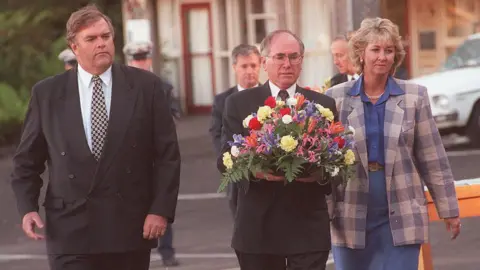
    Then Prime Minister John Howard visited the scene of the shooting in Tasmania to lay wreaths together with opposition leaders, who shortly afterwards united to help him pass firearms laws that made Australia a world leader on gun control.

    “Australian society and politics is very different than it was 30 years ago and we’re just a far more divided society,” says John Warhurst, an emeritus professor of political science at the Australian National University.

    Getty Images Federal Labor Opposition leader Kim Beazley, Prime Minister John Howard, and Democrats leader Cheryl Kernot at Port Arthur. John Howard is holding a wreathGetty Images

    Political leaders presented a united front in the wake of the Port Arthur massacre in 1996

    A society already fractured over Israel-Gaza war

    There are a number of reasons why this attack has divided people in ways Port Arthur didn’t – including the already fraught debate raging in Australia over Israel, Gaza and antisemitism, according to Mark Kenny, a political columnist and host of the Democracy Sausage podcast.

    “Then this event lobs into that, [and] I think it led to it being immediately politicised,” he told the BBC.

    Since the 7 October 2023 attack on Israel by Hamas and protests in Australia against Israel’s war on Gaza which followed, Albanese has consistently been accused of failing to do enough to stamp out antisemitism. The Executive Council of Australian Jewry says antisemitic incidents have increased from an average of 342 before the 7 October attacks in 2023 to 1,654 last year.

    Likewise, he’s been accused of not doing enough to call out Israel’s actions in Gaza, which UN experts have called genocide and Israel denies.

    Hours after the Bondi shooting, the antisemitism commissioner appointed by Albanese linked it to the pro-Palestinian protests that have regularly taken place in Sydney and which Jewish leaders have lobbied against.

    “It began on 9 October 2023 at the Sydney Opera House,” Jillian Segal said in a statement. “Now death has reached Bondi Beach.”

    Investigators have not said there is any link between the alleged gunmen and the pro-Palestinian movement, instead alleging the pair were inspired by the jihadist group Islamic State, with the younger of the father-son duo on intelligence agencies’ radars for a period in 2019.

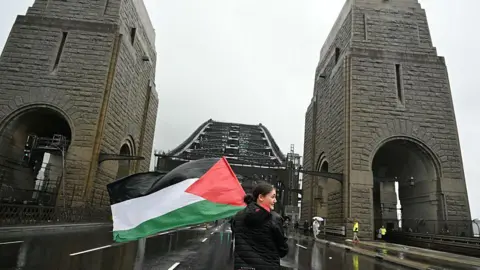
    Getty Images A protester with the Palestinian flag marches on the Sydney Harbour BridgeGetty Images

    Tens of thousands of Pro-Palestinian demonstrators marched across the Sydney Harbour Bridge in August

    No simple solutions and ‘either-or-ism’

    As it was after Port Arthur, gun reform was the first thing on the legislative agenda after the Bondi attack.

    “We know that one of these terrorists held a firearm licence and had six guns, in spite of living in the middle of Sydney’s suburbs… There’s no reason why someone in that situation needed that many guns,” Albanese said as he announced a suite of changes in the following days.

    Unlike Port Arthur, when the measures were broadly popular, Albanese’s focus on gun laws was immediately attacked by the Liberal opposition and parts of the Jewish community as a distraction from what they view as the real cause of the attack – antisemitism. Even Howard, the architect of the 1996 reforms, came out to suggest they were an “attempted diversion”.

    Getty Images Mourners arrive to attend the memorial held for the victims of a shooting at Bondi Beach. A screen reading, "a night of unity", "light over darkness" can be seen in the background.Getty Images

    Tensions were on display at a memorial services a week after the attacks

    “That kind of ‘either or ism’ is a feature about politics these days probably everywhere in the West. Everything becomes supercharged and divisive,” says Kenny.

    “There’s just this fundamental lack of trust that’s almost like we’re in the grip of a toxic cynicism that means that motives of political leaders… the first instinct is to question them, to regard them as disingenuous.”

    The recent decision by a festival in Adelaide to disinvite a Palestinian-Australian author – leading ultimately to the collapse of the entire writers’ week portion of the event – due to “sensitivities” after Bondi and her “past statements” is also a sign of how tense the current circumstances are, adds Kenny.

    Demands for immediate action on antisemitism were loud in the days after the attack, and Albanese did soon announce a crackdown on hate speech, backed by the antisemitism commissioner.

    But some critics said the measures would impinge on free speech, including the right to criticise Israel, and on protest, while others argued they did not go far enough in protecting other minorities.

    “[It’s] a can of worms,” says Warhurst, noting that there has never been “an easy agreement on finding where that balance lies” between free speech and hate speech.

    “Now is the worst time, I think, to be trying to resolve those sorts of issues because you are doing it fairly quickly and you’re doing it in a heated environment.”

    The hate speech laws had the backing of the Jewish community, but many felt it was not enough – with several of the victims’ families pushing Albanese to call a royal commission, Australia’s most powerful form of independent inquiry.

    EPA A grey-haired man in a dark suit and tie and a blond haired woman in dark clothing in a crowd of people.EPA

    Prime Minister Anthony Albanese was booed when he arrived at a memorial for the victims of the Bondi shooting

    For weeks, Albanese argued the measures already announced were enough and that a royal commission would be the wrong tool to unpick what had happened. It could give a platform to antisemites, he said.

    Royal commissions had not been launched into previous tragedies like Port Arthur, Albanese pointed out, comments which were widely dismissed. Promised reviews of intelligence agencies and law enforcement similarly did nothing to dissuade those calling for the inquiry.

    Their pleas were mirrored by a coordinated campaign of letter writing that featured on the front pages of right-wing newspapers. ”I don’t think it’s controversial to say that the News Limited and other parts of the media were certainly stirring the pot,” says Warhurst.

    Albanese’s arguments against a royal commission were “really hard to make in these circumstances”, says Kenny, and it backfired on him when he was ultimately forced to reverse course on the issue.

    Analysts have also suggested his reluctance may have been down to fears it could become complex, controversial and divisive. It could invite discussion of the war in Gaza, while potentially excluding examination of Islamophobia – which exploded after Bondi, with The Islamophobia Register Australia recording a 740% rise in incidents by early January – when many Labor MPs have large Muslim electorates.

    There was likely also a “reluctance to cave to the opposition”, Farr believes: opposition leader Sussan Ley had vociferously demanded the royal commission, asking what Albanese was “hiding”, and revelled in his backflip.

    A political opportunity

    It is fair to say that, before December’s attack, Ley had been struggling to land a punch on the government and assert authority over her own party. In the weeks before the shooting, some pundits were even predicting her imminent ousting.

    “The Bondi attacks offered her an opportunity to prosecute a very strong case against the government,” says Kenny.

    But any momentum she gained over the royal commission collapsed this week when she failed to rally her Coalition behind the very hate speech laws she had so loudly demanded Albanese quickly implement.

    By Thursday – the national day of mourning for the Bondi attacks – things had fallen apart.

    The National Party announced they were leaving the coalition, having refused to vote for the legislation despite a shadow cabinet agreement. They, despite earlier calls for haste, said they had not been given enough time to examine the proposals which they said could threaten free speech.

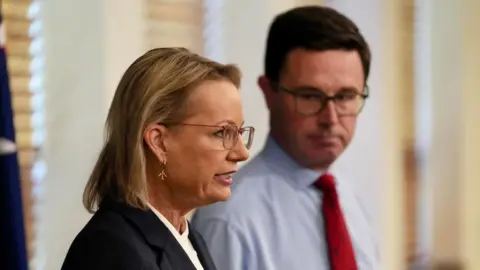
    Australian Broadcasting Corporation Sussan Ley and David LittleproudAustralian Broadcasting Corporation

    David Littleproud on Thursday said his National Party would not work with Sussan Ley

    On his way out the door, Nationals leader David Littleproud suggested the only way his party would consider returning to the fold was if Ley was dumped, leaving her already shaky leadership hanging by a thread.

    “I’m quite sure there are people… who are polishing their shoes and tightening the knot on their ties to step forward should that vacancy occur or be forced,” says Farr.

    However, Littleproud’s bold ultimatum could be an overstep which costs him his own job, with mutterings that Liberals wouldn’t accept him as a leader in any future coalition either.

    But then, it seems all of Australia’s politicians may be on shakier ground.

    The posturing of the main parties over the past month has left a bitter taste in the mouths of many Australians. In a poll released earlier this week, Albanese’s net approval rating had plunged to minus 11 from his previous score of zero in November, while Ley’s approval rating – never high – barely budged at minus 28.

    The repeated calls for unity by politicians who simultaneously fail to heed their own statements will not have gone unnoticed, and Thursday’s display of political infighting is unlikely to improve the fortunes of any party, says Farr.

    “It will reinforce the view of so many Australians who already are cynical about what politicians, no matter their party, actually represent and will reinforce the belief that politicians, MPs, just stand for themselves rather than the national good.”


    Source link