• About WordPress
    • WordPress.org
    • Documentation
    • Learn WordPress
    • Support
    • Feedback
  • Log In
  • Register

AnonymousMedia.org

  • Home
  • Headline News
  • Videos
  • History
  • File Manager
  • Activity
  • Forums
  • Trump expands access to cannabis in a major shift in drug policy

    Trump expands access to cannabis in a major shift in drug policy


    President Donald Trump has signed an executive order that will expand access to cannabis, a long anticipated move that would mark the most significant shift in US drug policy in decades.

    The order directs the US attorney general to reclassify cannabis from a Schedule I narcotic, to a Schedule III drug – placing it under the same category as Tylenol with codeine.

    Cannabis will remain illegal at the federal level. But classifying it as a Schedule III narcotic would allow expanded research to be conducted into its potential benefits.

    Several Republican lawmakers cautioned against the move, with some arguing it could normalise cannabis use.

    The US Drug Enforcement Agency notes that Schedule III narcotics – which also include ketamine and anabolic steroids – have only a “moderate to low potential for physical and psychological dependence”.

    The new classification also has tax implications for state-authorised cannabis dispensaries, as current regulations bar them from some tax deductions if they sell Schedule I products.

    In addition to the rescheduling of cannabis, Trump has ordered White House officials to work with Congress to allow some Americans access to to cannabidiol, commonly known as CBD.

    As part of a new programme announced as part of the order, some Medicaid recipients will be able to access CBD, at a doctor’s recommendation, at no cost.

    Health officials have also been tasked with developing “methods and models” to examine the real-world health benefits and risks of CBD.

    A senior administration official said that the order was a “commonsense action that will let us better understand and study” cannabis and CBD.

    In recent years, a majority of US states have approved cannabis for some medical use, and nearly half – 24 – have legalised recreational use. But since 1971, cannabis has been a Schedule I narcotic, which means it has no accepted medical use and a high potential to be abused.

    The Biden administration proposed a similar reclassification, and in April 2024 the DEA proposed a rule change, but got bogged down under administrative and legal issues.

    Trump has long expressed a desire to change US drug policy regarding cannabis.

    “I believe it is time to end endless arrests and incarcerations of adults for small amounts of marijuana for personal use,” he wrote on Truth Social last year while running for president.

    “We must also implement smart regulations, while providing access for adults, to safe, tested products,” he said.

    The reclassification order has met some resistance from Republican lawmakers.

    On Wednesday, a group of 22 Republican Senators sent an open letter to the president, arguing that marijuana use would mean that “we cannot re-industrialise America”.

    The Senators pointed to lingering concerns over the health impact of cannabis, as well as research suggesting that cannabis can be linked to “impaired judgement” and “lack of concentration”.

    “In light of the documented dangers of marijuana, facilitating the growth of the marijuana industry is at odds with growing our economy and encouraging healthy lifestyles for Americans.”

    In a separate letter sent to Attorney General Pam Bondi in August, nine Republican representatives argued that “no adequate science or data” exists to support the change.

    “Marijuana, while different than heroin, still has the potential for abuse and has no scientifically proven medical value,” the letter said. “Therefore, rescheduling marijuana would not only be objectively wrong, but it would also imply to our children that marijuana is safe. That couldn’t be further from the truth.”

    More broadly, polls show that a majority of Americans support efforts to legalise marijuana.

    One Gallup poll released in November found that 64% of Americans believe that it should be legalised, although support had drifted slightly from previous years because of a 13-point drop among Republicans.


    Source link

    12/18/2025
  • China-Aligned Threat Group Uses Windows Group Policy to Deploy Espionage Malware

    China-Aligned Threat Group Uses Windows Group Policy to Deploy Espionage Malware


    Dec 18, 2025Ravie LakshmananMalware / Cloud Security

    A previously undocumented China-aligned threat cluster dubbed LongNosedGoblin has been attributed to a series of cyber attacks targeting governmental entities in Southeast Asia and Japan.

    The end goal of these attacks is cyber espionage, Slovak cybersecurity company ESET said in a report published today. The threat activity cluster has been assessed to be active since at least September 2023.

    “LongNosedGoblin uses Group Policy to deploy malware across the compromised network, and cloud services (e.g., Microsoft OneDrive and Google Drive) as command and control (C&C) servers,” security researchers Anton Cherepanov and Peter Strýček said.

    Group Policy is a mechanism for managing settings and permissions on Windows machines. According to Microsoft, Group Policy can be used to define configurations for groups of users and client computers, as well as manage server computers.

    Cybersecurity

    The attacks are characterized by the use of a varied custom toolset that mainly consists of C#/.NET applications –

    • NosyHistorian, to collect browser history from Google Chrome, Microsoft Edge, and Mozilla Firefox
    • NosyDoor, a backdoor that uses Microsoft OneDrive as C&C and executes commands that allow it to exfiltrate files, delete files, and execute shell commands
    • NosyStealer, to exfiltrate browser data from Google Chrome and Microsoft Edge to Google Drive in the form of an encrypted TAR archive
    • NosyDownloader, to download and run a payload in memory, such as NosyLogger
    • NosyLogger, a modified version of DuckSharp that’s used to log keystrokes
    NosyDoor execution chain

    ESET said it first detected activity associated with the hacking group in February 2024 on a system of a governmental entity in Southeast Asia, eventually finding that Group Policy was used to deliver the malware to multiple systems from the same organization. The exact initial access methods used in the attacks are presently unknown.

    Further analysis has determined that while many victims were affected by NosyHistorian between January and March 2024, only a subset of these victims were infected with NosyDoor, indicating a more targeted approach. In some cases, the dropper used to deploy the backdoor using AppDomainManager injection has been found to contain “execution guardrails” that are designed to limit operation to specific victims’ machines.

    Also employed by LongNosedGoblin are other tools like a reverse SOCKS5 proxy, a utility that’s used to run a video recorder to capture audio and video, and a Cobalt Strike loader.

    Cybersecurity

    The cybersecurity company noted that the threat actor’s tradecraft shares tenuous overlaps with clusters tracked as ToddyCat and Erudite Mogwai, but emphasized the lack of definitive evidence linking them together. That said, the similarities between NosyDoor and LuckyStrike Agent and the presence of the phrase “Paid Version” in the PDB path of LuckyStrike Agent have raised the possibility that the malware may be sold or licensed to other threat actors.

    “We later identified another instance of a NosyDoor variant targeting an organization in an E.U country, once again employing different TTPs, and using the Yandex Disk cloud service as a C&C server,” the researchers noted. “The use of this NosyDoor variant suggests that the malware may be shared among multiple China-aligned threat groups.”


    Source link

    12/18/2025
  • Trump Media to merge with fusion energy firm in $6bn deal

    Trump Media to merge with fusion energy firm in $6bn deal


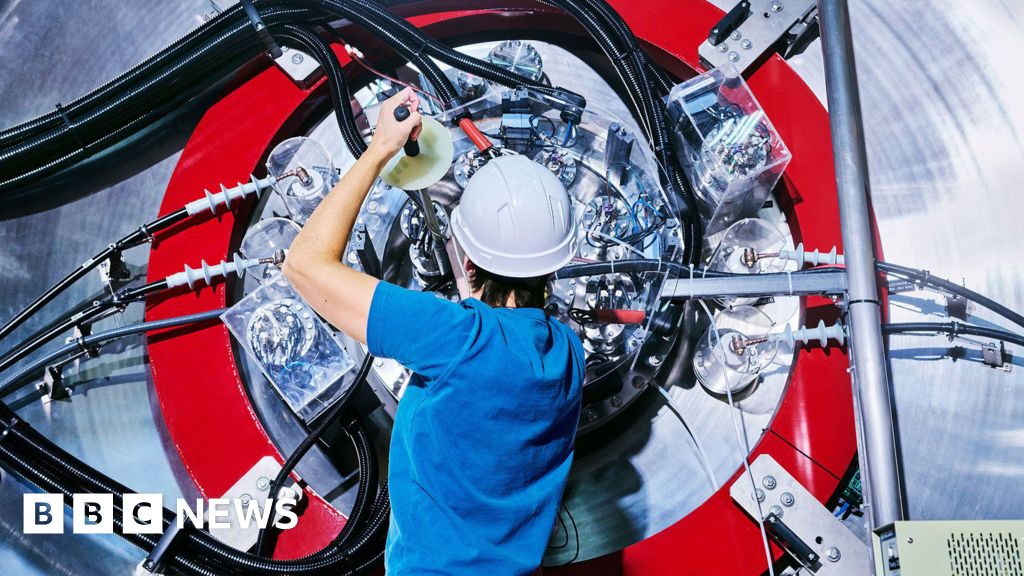
    The firm behind President Donald Trump’s Truth Social platform is merging with a Google-backed energy company in a deal valued at more than $6bn (£4.4bn).

    Trump Media & Technology Group (TMTG) and TAE Technologies announced the plans on Thursday in a joint statement, which said the move would “create one of the world’s first publicly traded fusion companies”.

    Fusion power is a method of generating energy from heat released by nuclear fusion reactions. It could release vast amounts of energy with little associated radioactivity.

    The statement said the combined company planned to begin constructing the “world’s first utility-scale fusion power plant” next year, with further plants to follow.

    Under the merger both firms will have an equal 50% share in ownership after the deal is completed, which is expected by mid-2026 pending regulatory and shareholder approvals.

    The combined company will have a nine-member board including Trump Media’s current chief executive Devin Nunes, who will be co-chief executive of the new firm, and the president’s son Donald Trump Jr.

    TAE Technologies provides technology for energy storage and power delivery systems for batteries and electric vehicles. Its umbrella organisation, TAE Life Sciences, develops technologies and drugs for treating cancer patients.

    The tie-up with the firm signals a bold and surprising shift for Trump Media, as it moves from social media and financial offerings into the energy sector.

    Mr Nunes said his firm was “taking a big step forward toward a revolutionary technology that will cement America’s global energy dominance for generations”.

    Calling fusion power the “most dramatic energy breakthrough” since the 1950s, he said Trump Media would bring “the capital and public market access” to help make TAE’s technology commercial viable.

    As part of the agreement, Trump Media is to provide up to $200m (£149m) of cash to TAE Technologies when completion of the deal is signed. An additional $100m (£74.7m) will be available once the transaction has been registered.

    Surging electricity demand for AI data centers has revived interest in cleaner and reliable nuclear power, including restarting shuttered reactors, expanding existing ones and signing contracts for future small modular reactors.

    The joint statement said TAE Technologies had raised more than $1.3bn of funding from other investors including Google and Goldman Sachs.

    Trump Media, which mainly generates revenue from advertising on the Truth Social platform, has consistently clocked losses since it began. It posted a decline in revenue and a loss of $54.8m (£40.9m) in the third quarter ending September.


    Source link

    12/18/2025
←Previous Page
1 … 369 370 371 372 373 … 403
Next Page→