
 Reuters
It was a Sunday afternoon in April 1996 when a lone gunman armed with semi-automatic rifles killed 35 people in the Australian tourist town of Port Arthur.
The massacre almost 30 years ago, which ushered in some of the strictest gun laws in the world, feels like a bygone age for many Australians.
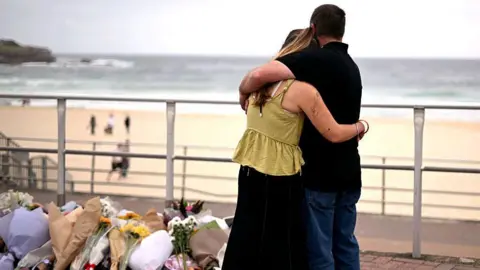
But the Bondi Beach attack on Sunday, which left 15 dead, rekindled memories of the Tasmanian tragedy – none more so than for leading gun control advocate Roland Browne.
As the country’s deadliest modern-day mass shooting was unfolding an hour’s drive away, Mr Browne was meeting fellow gun control advocates at his home, ahead of a government meeting, to lobby for a ban on the exact type of firearm the Port Arthur gunman was using.
Mr Browne, 66, was again at home in Hobart on Sunday when he received news of the shooting at Bondi, targeting a Jewish event celebrating the first night of Hanukkah.
“There’s just a lot of similarities,” Mr Browne, who spent childhood summers in Bondi and still has family there, told the BBC.
“They’re both very public places frequented by tourists from around the nation and around the world.”
“It’s sickening and I’m bitterly disappointed in our political system whereby the voices for tighter gun laws and public health aren’t listened to until there’s a major event like this,” he added.
For decades, Australia has stood as a beacon on the world stage for its strict gun laws, he says, taking a similar path to the UK which experienced its own mass shooting in Dunblane, just one month before Port Arthur.
Even now, Mr Browne remains friends with relatives of some of the 17 victims – mostly children aged five and six – killed at a primary school in Scotland.
But despite being praised for its stringent gun laws, the reality in Australia is not clear-cut.
 Roland Browne
Gun ownership at record high
A report by the Australia Institute earlier this year revealed that there are more than four million privately-owned firearms across the country – almost double the amount from about 20 years ago.
That equates to one gun for every seven Australians, the report says.
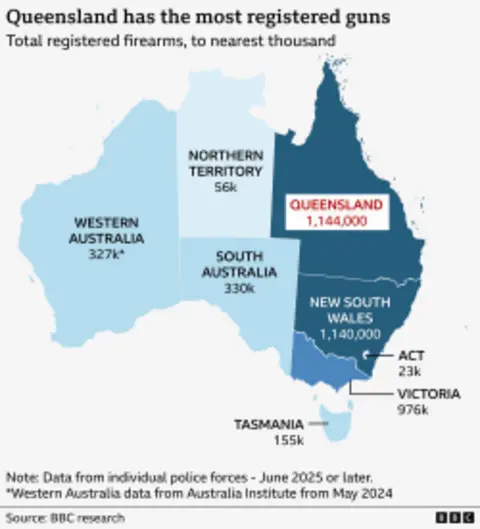
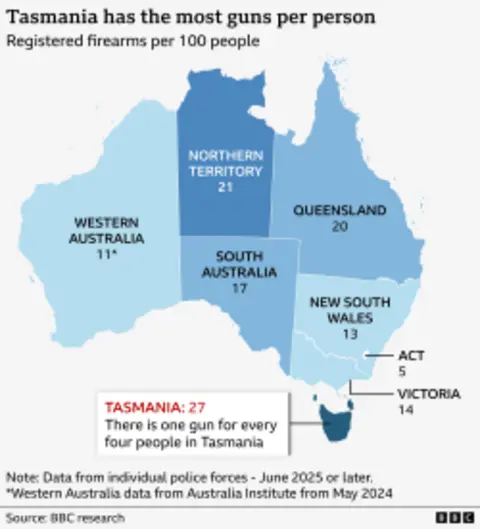
Queensland has the most registered guns, followed by New South Wales (NSW) and Victoria while Tasmania and the Northern Territory have the most guns per person.
The report also dispels a common view that guns are mainly owned by rural residents.
Guns are widespread in metropolitan and suburban areas, with one in three firearms in NSW located in major cities, the report said.
The total figure has risen at a lower rate than population increases, but there are now more guns in fewer hands, with every licence holder owning an average of more than four firearms.
And that’s one of the key issues that Mr Browne wants the government to address.
Currently, only one jurisdiction – Western Australia – has a cap on the number of legal firearms that a licence holder can have. Under new laws introduced in March this year, gun owners can have between five and ten firearms, depending on the type of licence and model of firearm.
Authorities have confirmed that one of the alleged gunmen, Sajid Akram who was killed at the scene of the Bondi attack, owned six registered guns.
Mr Browne wants a cap of one to three guns, depending on the licence category, to be introduced across Australia.
But Tom Kenyon, chief executive of the Sporting Shooters Association of Australia, argues that a cap would be meaningless.
“Limiting the number of guns wouldn’t have made a difference on Sunday,” he says.
“And it wouldn’t have changed the fact that an attack occurred because those two individuals had been radicalised.”
Mr Kenyon argues that people intent on harm, without access to guns, will use other weapons, referencing the 2016 Bastille Day massacre in the French city of Nice where 86 people were killed after a man drove a truck into crowds during fireworks celebrations. The attack was claimed by Islamic State (IS).
The other alleged Bondi gunman, 24-year-old Naveed Akram, was previously investigated over links to IS, according to comments made by Prime Minister Anthony Albanese.
Mr Kenyon also says that more guns are found in cities because most people in Australia live in metropolitan areas and travel to other areas to hunt.
What are Australia’s current gun laws?
Gun control laws in Australia are not uniform across the country, with inconsistent implementation of the rules across states and territories.
But generally, to apply for a gun licence, you must be over 18, a “fit and proper person”, pass a training and safety course and give a “genuine reason” for having a firearm.
The eight accepted reasons include recreational hunting or pest control, target or sport shooting, for work (such as security guards and prison officers), for use in farming or animal welfare and firearms collectors.
But there are loopholes.
For example, anyone under 18 was meant to be barred from owning a firearm under the 1996 gun control reforms, but minors in various jurisdictions can have access to a firearm while under supervision, ranging from age 10 in the Northern Territory to 12 in other states.
Another situation is where a particular type of gun is banned in one state but legal elsewhere.
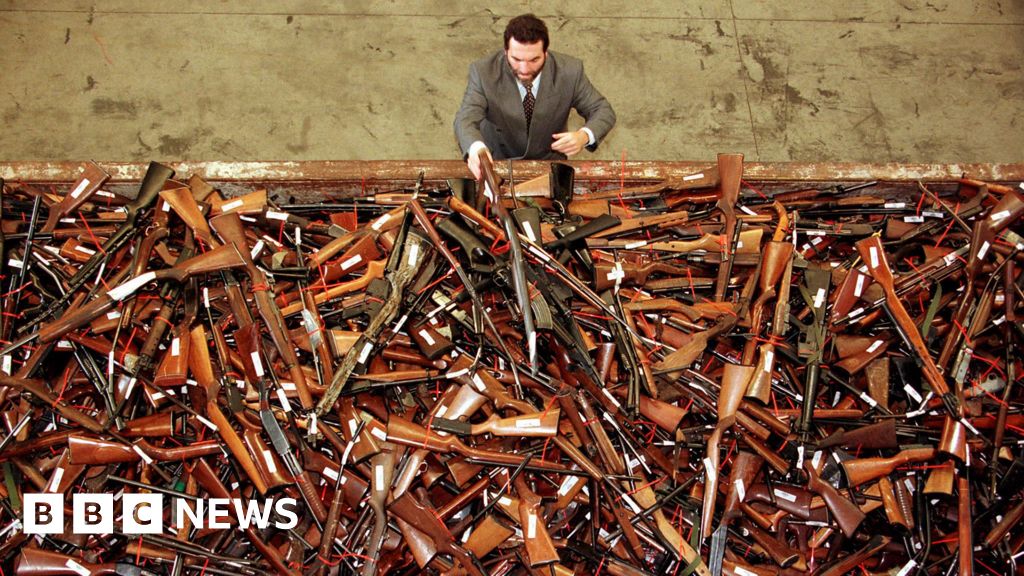
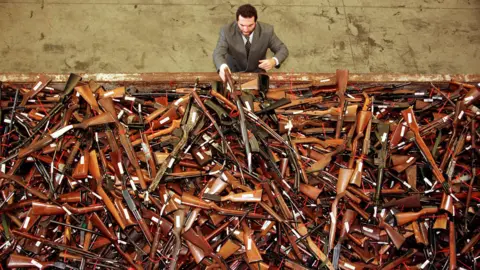
In the days after the Port Arthur massacre, then-Australian prime ministerJohn Howard galvanised every state and territory to overhaul the country’s gun laws.
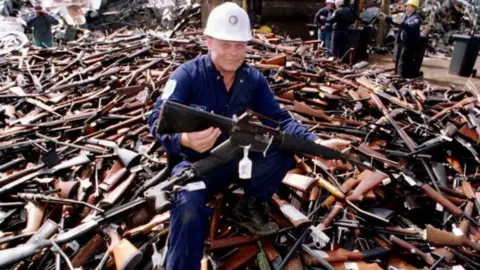
More than 650,000 firearms were voluntarily handed in to authorities and destroyed, as part of a buyback programme. And background checks and a mandatory cooling-off period for gun sales were introduced. Automatic and semi-automatic rifles and shotguns were banned.
Similar gun reforms – a ban on semi-automatic weapons and a buyback scheme – were introduced in New Zealand after a white supremacist killed 51 Muslims at two Christchurch mosques in 2019.
Part of Howard’s reforms included scrapping self-defence as a reason for owning a firearm – a contrast to gun laws in the United States where personal protection is often the main reason for citizens to own guns.
Gun ownership in the US is much higher compared to Australia as is gun violence. The country saw 488 mass shootings – defined as where four or more people are killed or injured – last year.
Recent polling by the Australia Institute showed that seven out of ten Australians think gun laws should make it harder to access a gun and 64% agreed that current gun laws need to be strengthened.
 Getty Images
Fresh reform for gun laws
In the hours after the Bondi shooting, the NSW Premier Chris Minns was unequivocal about the need to tighten the state’s gun laws.
“If you’re not a farmer, you’re not involved in agriculture, why do you need these massive weapons?” he asked.
And less than 24 hours after the shooting, Australia’s Prime Minister Anthony Albanese hosted an emergency meeting where leaders from across the country pledged to tighten gun laws. On Friday he announced a national gun buyback scheme “to help get guns off our streets”, the first scheme of its size since 1996.
Other proposals include:
- limiting the number of guns someone can legally own
- limiting “open-ended” licensing
- making Australian citizenship a condition of owning a firearm
- improving intelligence sharing when licence applications are being assessed
Albanese said there should also be regular reviews of licence holders.
“People’s circumstances can change,” he said. “People can be radicalised over a period of time.”
 Getty
GettyThe swift action prompted Howard – the architect of the 1996 gun laws – to weigh in.
While he supported stricter gun laws, Howard said the move was an “attempted diversion” from the real cause of the tragedy, which he said was a rise in antisemitism in recent years.
Mr Kenyon believes the moves to tighten gun laws are a waste of resources.
“All that time and effort and political capital could be spent combating radicalisation of individuals,” he says.
The only thing that might have prevented Sunday’s attack was better intelligence-sharing that would have flagged the gunmen’s links to extremist ideology to the NSW firearms’ registry, he says.
Elsewhere, one of the headline reforms proposed in 1996 – a national firearms register – is yet to be created, with authorities saying the database is “expected to be operational by mid-2028”.
Little had been done to implement the measure until the 2022 fatal shooting of two police officers and a civilian in Wieambilla became a catalyst to speed the process up.
The Bondi shooting has now propelled the government to list the creation of the register as a priority.
Recreational hunting under spotlight
Mr Browne believes the application process for a gun licence is too easy and that licences for recreational hunting should be abolished as its definition is ambiguous.
Sajid Akram owned a recreational hunting licence.
But recreational hunting contributes a “valuable social good” to Australia, argues Mr Kenyon, saying that hunters remove millions of feral animals such as rabbits, foxes and cats.
He was just 10 when he picked up his first gun. Now 53, he goes on regular hunting trips – often shooting deer in Victoria’s high country – and competes in pistol shooting events six times a year.
Hunting isn’t just a pastime for him, it’s about family and community connections. He taught his three children – all adults now – how to shoot when they were teens.
“All my life I’ve had the opportunity to do it and I’ve enjoyed it,” Mr Kenyon, a former Labour politician in South Australia, says, “so I want my kids to have the same opportunity”.
 Supplied
In the wake of the Port Arthur massacre, self-loading firearms were banned, resulting in a drop in gun-related deaths, but the risk to public safety has now shifted to high-powered fast-loading rifles with magazines that can shoot up to five rounds, of the kind believed to have been used by the gunmen.
“If you watch the video, you’ll see him firing rapidly with his rifle,” Mr Browne says, referring to footage of one of the gunmen shooting from a footbridge leading to Bondi Beach.
“If he didn’t have a magazine in that rifle, he would have had to manually reload each time,” which would dramatically reduce – but not eliminate – the threat of a mass shooting.
Mass shootings remain rare in Australia.
In 2018, a Western Australian grandfather killed his wife, his daughter and four grandchildren before turning the gun on himself in what was, at the time, the worst such incident since Port Arthur.
For Mr Browne, Australia is a safe country but incidents involving firearms are not uncommon, ranging from neighbourhood disputes to gang shootings.
“This is a reflection on guns being in the wrong hands, a legacy of poor storage allowing guns to be stolen and sold – and thus move into black markets.”
But the issue of gun control isn’t just about the physical firearm.
“It’s like a plane crash, it’s never just one thing. It’s a culmination of a lot of factors,” he says. Australia needs better assessment of whether a licence holder is a suitable candidate and more stringent rules on the types of guns that can be legally owned, he says.
Tragedy is a wake-up call
In the aftermath of the Port Arthur massacre, Mr Browne met with many of the survivors and families of the victims including Walter Mikac, whose wife Nanette and two young daughters were among the 35 people killed.
Mr Mikac, who founded the Alannah and Madeline Foundation charity to honour his children, said the Bondi shooting was a “horrific reminder” of ensuring Australia’s gun laws protect everyone.
“After Port Arthur, Australia made a collective commitment to put community safety first, and that commitment remains as important today as ever,” he said in a statement.
Mr Browne echoed those sentiments.
Gun laws need to be reformed to “keep up-to-date with changing community attitudes, technological advances and to rectify identified deficiencies,” Mr Browne says.
“It’s sad that it takes such a tragedy to get people to wake up and listen.”