Welcome to Foreign Policy’s Africa Brief.
The highlights this week: The Egyptian government increasingly wades into geopolitics in the Horn of Africa, Chad closes its border with Sudan after clashes spill into its territory, and a new report shows that more than 1,000 Kenyans are fighting for Russia.
CAIRO—This week, I’m writing from Egypt, where President Abdel Fattah el-Sisi’s military expansion and large-scale infrastructure projects are well underway as his regime seeks to shore up domestic support and become an indispensable geopolitical player amid rising regional tensions.
In recent weeks, there has been increasing evidence that Egypt is being drawn into neighboring Sudan’s civil war. Satellite imagery suggests that Cairo has been carrying out drone strikes in Sudan against the paramilitary Rapid Support Forces (RSF), which have been fighting the Sudanese military since 2023.
Egypt has also sought to challenge Israel’s ambitions in the Horn of Africa. Last December, Israel became the first country to formally recognize Somaliland—a breakaway region of Somalia—in a move to bolster its strategic position in the Red Sea.
Somaliland’s coastline provides immediate access to the Red Sea, which is a conduit for an estimated 12 percent of global trade, linking Europe, Asia, and Africa. The move also allows Israel to potentially establish a military presence to counter Iranian-backed Houthi rebels in the maritime corridor.
In the wake of Israel’s move, Sisi reiterated Egypt’s “special role” in Somalia and called Israel’s actions a “dangerous precedent that threatens the stability of the entire Horn of Africa.”
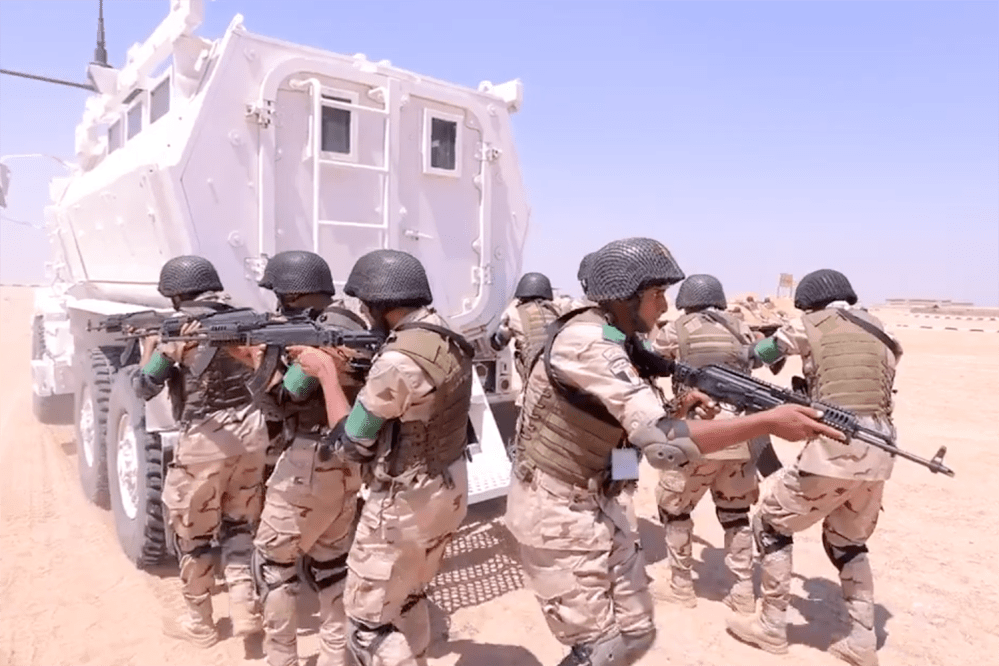
Egypt also deployed around 1,100 soldiers to Somalia earlier this month as part of the African Union Support and Stabilization Mission (AUSSOM) to support counterterrorism efforts against al-Shabab, a jihadist group. They will form part of a 5,000 AUSSOM contingency that Cairo proposed in 2024.
Meanwhile, Egypt is concerned about a potential Israel-Ethiopia alignment, especially as some analysts expect Israel to push Ethiopia to recognize Somaliland (a possibility that Addis Ababa has flirted with before). According to security experts, Cairo views Somalia as an important “pressure point” against Ethiopia.
Egypt and Ethiopia are long-standing rivals; their current dispute centers on the construction of the latter’s Grand Ethiopian Renaissance Dam, which Cairo has argued will negatively impact its access to the Nile’s water supply.
In late 2025, Egypt reached agreements to upgrade Djibouti’s port of Doraleh and Eritrea’s port of Assab. The moves were widely seen by analysts as encircling Ethiopia.
As these regional actors compete for influence, they risk transforming the Horn of Africa into a volatile proxy conflict zone that further draws in other states including Turkey, Saudi Arabia, and Iran. Saudi Arabia is reportedly finalizing an agreement on a new military coalition with Somalia and Egypt, in a bid to counter the United Arab Emirates’ regional influence.
Egyptians have generally supported their government being a strong actor in supporting regional stability, particularly on the conflict in Gaza, but many fear that lavish spending on ports, arms, and troop deployments abroad is misplaced.
On the streets of Cairo, ordinary Egyptians have told me this week that they see Sisi’s focus on military might as a way to distract from public anger over the worsening economy.
They largely blame this on Sisi’s mega-projects, from the $59 billion new administrative capital, which is slated to have the world’s largest defense headquarters when completed, to a $35 billion megacity on the Mediterranean. Rampant building is hard to ignore around Cairo, where Sisi’s image adorns giant billboards advertising his infrastructure accomplishments and heralding a “new Egypt.”
The newly opened $1 billion Grand Egyptian Museum, while impressive, only had a few Egyptian visitors when I went recently, among crowds of Western and East Asian tourists.
Poverty rates have steadily risen in Egypt over the past decade. Although the Egyptian pound stabilized last year—largely due to capital injections from the International Monetary Fund and foreign investment pledges—Egyptians continue to face a cost-of-living crisis, which has only been exacerbated by new policies that clamp down on rent controls and food subsidies.
Many Egyptians are especially unhappy with the military’s outsized role in the economy. The military controls up to 90 percent of public projects, and firms linked to it are shielded from financial audits and parliamentary scrutiny.
The new administrative capital “does nothing to grow our economy—it’s a smokescreen for corruption,” said one trader, who asked to remain anonymous. “We are all struggling.”
Wednesday, Feb. 25: The United Nations Security Council holds a briefing on its peacekeeping mission in the Central African Republic.
Wednesday, Feb. 25, to Thursday, Feb. 26: The African Energy Chamber leads a delegation to Venezuela aimed at strengthening oil and gas cooperation. The visit began on Monday.
Wednesday, Feb. 25, to Friday, Feb. 27: Africa’s Green Economy Summit, which began on Tuesday, continues in Cape Town, South Africa.
Russia’s foreign fighters. More than 1,000 Kenyans are fighting for Russia in Ukraine after being misled with false promises of civilian jobs in Russia, according to an intelligence report commissioned by Kenya’s parliament.
Kenya’s foreign ministry had previously said late last year that Moscow had recruited around 200 Kenyans, after it had been contacted by Kenyans in distress at Russian military camps. In a statement on social media, the Russian Embassy in Nairobi refuted the claims, calling them “dangerous and misleading propaganda.”
In recent months, multiple media outlets have reported on Moscow’s use of mass employment agencies to lure foreign job seekers to the front line in Ukraine.
Meanwhile, South Africa recently said it secured the release of 17 of its citizens duped into fighting for Russia, four of whom returned to the country last week. The men said they believed that they were going to Russia for training and jobs as bodyguards but were instead sent to Ukraine.
Border shutdown. Chad closed its eastern border with Sudan on Monday after fighting between the RSF and militia fighters allied with Sudan’s government spilled over into Chad’s territory, killing Chadian soldiers and civilians.
Authorities said the measures are necessary to protect Chadian citizens and refugees who have fled Sudan’s civil war. According to Chadian Communications Minister Mahamat Gassim Cherif, the decision followed “repeated incursions and violations committed by the forces” involved in the conflict.
Tunisian critics. On Monday, a Tunisian court ordered the release of prominent lawyer Ahmed Souab, who was sentenced last October to five years in prison and three years of administrative supervision for allegedly forming a terrorist group and spreading fake news.
Souab is a fierce critic of Tunisian President Kais Saied. His arrest last April came two days after he spoke at a press conference criticizing Saied’s use of terrorism laws to convict critics. The appeals court did not cite a reason for reducing his sentence.
Also on Monday, another Tunisian court sentenced lawmaker Ahmed Saidani to eight months in prison over Facebook posts mocking Saied. Saidani had criticized Saied’s decision to visit victims of floods as nothing more than a photo opportunity, calling him the “supreme commander of sanitation and rainwater drainage.”
Benghazi’s sportswashing. In recent months, European soccer clubs, including Inter Milan and Atlético Madrid, have played friendly matches in eastern Libya as part of a state-backed campaign to signal political stability, Abdalla Najjar reports in New Lines Magazine.
These matches are financed by the Libya Development and Reconstruction Fund, a body overseen by Belgacem Haftar, a son of Khalifa Haftar, the warlord who controls eastern Libya.
“Despite Western support for Tripoli’s government and the gradual effort to integrate the eastern part of the country, Haftar seems to be gaining more influence,” Najjar writes. “His approach seems to be more creative.”
African AI. Earlier this month, Google launched an open access data set for 21 African languages, including Luganda, Malagasy, Swahili, and Yoruba, for use in artificial intelligence voice recognition software. The release will make building AI products that understand African languages easier, Damilare Dosunmu reports in Rest of World.
The project was developed in partnership with universities across the continent and “represents a rare move toward digital sovereignty,” Dosunmu writes. “The data, controlled by African institutions and made open-source for everybody, is a great foundation to build on,” one expert told Rest of World.