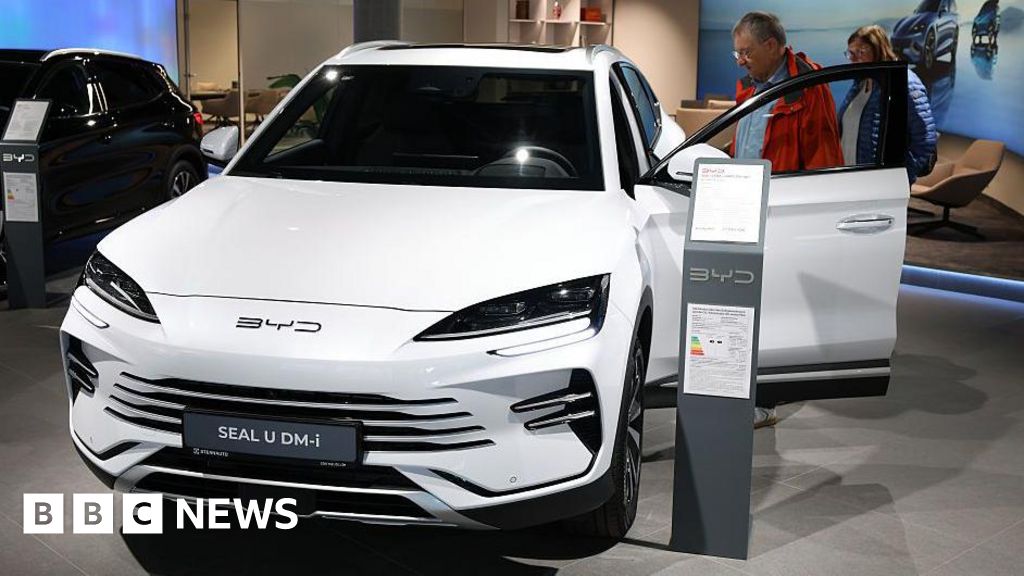
China’s BYD is set to overtake Elon Musk’s Tesla as the world’s biggest seller of electric vehicles (EVs), marking the first time it has outpaced its American rival for annual sales.
On Thursday, BYD said that sales of its battery-powered cars rose last year by almost 28% to more than 2.25 million.
Tesla, which is due to reveal its total sales for 2025 later on Friday, last week published analyst’s estimates suggesting that it had sold around 1.65 million vehicles for the year as a whole.
In October, Tesla introduced lower-priced versions of its two best-selling models in the US in a bid to boost sales. It had faced criticism that it had been slow to release new and more affordable options to stay competitive.
Musk, who is already the world’s richest man, is tasked with significantly boosting Tesla’s sales and stock market value over the next decade to secure a record-breaking pay package. The deal, which was approved by shareholders in November, could see him getting a payout of as much as $1tn (£740bn).
As part of the agreement, Musk also has to sell a million humanoid robots over the next ten years. Tesla has invested heavily in its “Optimus” product and self-driving “Robotaxis”.
Tesla sales slumped in the first three months of 2025 after a backlash against Musk’s role in US President Donald Trump’s administration.
Besides Tesla, the multi-billionaire’s business interests also include the social media platform X, the rocket firm SpaceX and the Boring Company, which digs tunnels.
Those commitments, along with running Trump’s Department of Government Efficiency (Doge), led some investors to suggest that Musk was not focusing enough on Tesla.
Since then Musk has pledged to “significantly” cut back his role in the US government.
Despite BYD’s rapid expansion in recent years, its sales growth slowed in 2025 to the weakest rate in five years.
The Shenzhen-based firm faces mounting competition in China, its key market, from a surge of EV makers like XPeng and Nio.
Still, BYD remains a global EV powerhouse as its prices often undercut rival carmakers.
The company’srapid expansion – especially in Latin America, South East Asia and parts of Europe – comes despite many countries imposing steep tariffs on Chinese EVs.
In October, BYD said the UK had become its biggest market outside China. The firm said that its sales in Britain surged by 880% in the year to the end of September, driven by strong demand for the plug-in hybrid version of its Seal U sports utility vehicle (SUV).
Tens of thousands of app-based delivery workers in India went on strike over New Year’s Eve, protesting a system they say is defined by relentless pressure, including requirements to deliver items in under 10 minutes.
The workers are calling for “fair pay, dignity and safety,” as well as an immediate ban on a marketing hook that commits them to delivering groceries to any address within a roughly three kilometer (1.8 miles) radius within 10 minutes – no easy feat in India’s notoriously traffic-clogged cities.
They are also protesting against the automated systems used by the platforms to penalize delivery workers and reduce their ratings when delays occur, and are asking for comprehensive social security including health insurance and pensions. More than 200,000 workers joined the strike, according to the Indian Federation of App Based Transport Workers who organized the strike.
While quick commerce is a global phenomenon, in India, a nation of 1.4 billion people and where a roughly a million new jobseekers enter the market each month, it has become a brutal battleground.
Fueled by a burgeoning middle class with money to spend, speed has become an essential weapon in the corporate battle for market share.
The market is huge – major firm Swiggy has a market capitalization of around $11 billion; its rival Zomato around $28 billion.
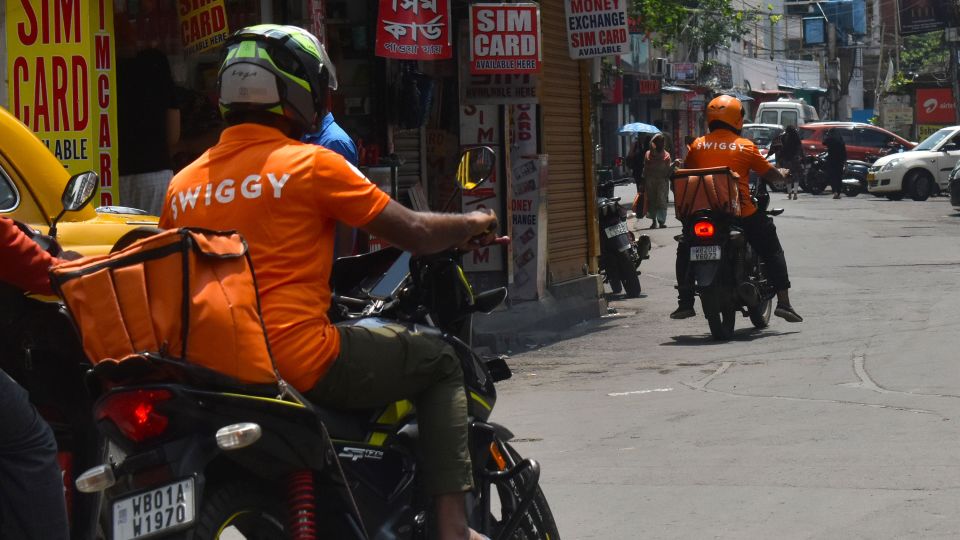
Some companies like Swiggy’s Instamart, as well as Blinkit and Zepto, have made the 10-minute delivery promise a signature marketing hook – a strategy that workers say can come at the cost of their safety and well-being.
And on top of this, many platforms do not classify their riders as employees, legally absolving the companies from providing the many benefits that the workers are demanding.
Gig workers rest in New Delhi during a nationwide strike on Wednesday – Hindustan Times/Shutterstock
One 41-year-old Swiggy delivery driver in the city of Hyderabad told CNN he makes a base rate of 5 rupees (less that 10 cents) per order and has the potential to earn more based on the number of orders and distance he travels. He works from 7pm to 5am everyday, he said.
“We have to pay for our own fuel and bike maintenance,” he said, asking for anonymity for fear of retribution.
And then at least 50 rupees (56 cents) a day goes in paying for something to eat,” he said. “I didn’t think this is what I would be doing in my 40s but what other choice do I have?”
He became a delivery driver after his bookshop went out of business during the Covid-19 pandemic, and said he makes about 20,000 rupees per month ($222). More than half of that money goes toward his rent and the school fees for all five of his children, forcing his family to live paycheck to paycheck.
CNN has contacted Swiggy, Zomato, Blinkit, Zepto and India’s labor ministry for a response.
Deepender Goyal, the co-founder of Zomato, said both Zomato and Blinkit delivered “at a record pace” on Wednesday, “unaffected by calls for strikes,” in a post on X.
“Support from local law enforcement helped keep the small number of miscreants in check,” he wrote, adding: “if a system were fundamentally unfair, it would not consistently attract and retain so many people who choose to work within it.”
In response, the Telangana Gig and Platform Workers Union said some 7.5 million orders “were delivered because workers cannot afford to log out, not because the system treats them justly,” in a post on X.
Jumping red lights
Wednesday’s strike placed a spotlight on the deep chasm between the convenience offered to urban consumers and the livelihoods of those providing it.
On one hand, in a country with a massive working-age population, platforms like Swiggy and Zomato provide crucial employment for millions and have been praised for their efficiency. India’s gig workforce is expected to expand to 23.5 million by 2030, according to a 2023 report by government research agency Niti Ayog.
Commuters walk on a bridge connecting platforms at a railway station in Mumbai, India, on July 11. – Divyakant Solanki/EPA/Shutterstock
But critics argue this model creates a new form of exploitation.
“When it first started, the idea of being your own boss and making your own money was something that attracted people,” said Ria Kasliwal, an independent policy consultant whose research focuses on South Asia’s gig economy.
“But what it has essentially done, mostly, is that it has just formalized the informalization of workers.”
In other words, the system takes the instability of informal work – no job security, no fixed salary, no benefits – and embeds it within a controlled corporate structure.
For Mohammad Numan, 30, a Swiggy rider in India’s financial capital Mumbai, the financial precarity is so acute that he felt he couldn’t afford to lose a day’s pay to join the strike.
“The work is difficult, but there is no option. I have to do it to earn money,” he said.
He described a grueling routine, often working up to 16 hours a day to complete the 35 to 40 orders required to meet Swiggy’s targets. After paying for fuel and other expenses, he said he is left with about 700 rupees ($7.70) for the day.
There is also pressure to deliver fast. “For 1 kilometer, we are expected to deliver in 3-4 minutes, and for 4 kilometers, in about 10 minutes,” Numan said.
Commuters ride along a street in Varanasi, India, on December 10. – Niharika Kulkarni/AFP/Getty Images
“To meet these timelines, we have to ride fast. If we don’t drive fast, we won’t be able to meet targets. When I get an order, I just think about delivering it fast so I can take on more orders.”
Another rider also based in Mumbai, said he has to “jump red lights most of the time” to make a delivery on time.
“We get penalized if we don’t and if we get caught, we need to pay that fine as well out of pocket, so we’re stuck either way,” the Zepto worker, who did not give his name out of fear of retribution, said.
Goyal defended the 10 minute promise in a post on X, saying it is “enabled by the density of stores” around homes.
“After you place your order on Blinkit, it is picked and packed within 2.5 minutes. And then the rider drives an average of under 2kms in about 8 minutes. That’s an average of 15kmph,” he wrote.
‘Working in fear’
In 2020 India’s central government introduced labor reform that promised social security schemes for all gig workers, but the nationwide implementation of these protections has been slow.
In 2023, Rajasthan became the first state to pass a law regulating the gig economy, creating a dedicated welfare board to establish a social security fund and addressing grievances.
Karnataka – home to the country’s tech hub Bengaluru – and the state of Jharkhand passed its own legislation last year, with Telangana exploring similar measures.
The gig economy has also been credited for inviting more women into the workforce, and faced with public pressure, some platforms have also introduced a range of benefits such as accident insurance and a basic health insurance plan.
A Zomato delivery person rides a bike through a flooded street in Mumbai on August 19. – Ashish Vaishnav/SOPA Images/Shutterstock
But some gig workers say these are often difficult to access and multiple protests in recent years highlight the need for more transparency and greater benefits.
Manoj Kharade, who works for an app that offers at-home salon services, said he went on strike to demand fixed wages and social security.
His account gets blocked if he doesn’t meet the company’s targets, affecting his ability to earn, he said. Kharde said he works up to 15 hours a day, earning about 25,000 rupees a month ($277).
“We are working in fear because if I don’t meet my target… then it will affect my family. And if we don’t have an income, then we are ruined.”
For more CNN news and newsletters create an account at CNN.com
Tommy Lee Jones’ daughter Victoria Jones was found dead on Thursday, Jan. 1, according to a report
Victoria made some onscreen appearances in film and television in the early 2000s
Victoria Jones, the daughter of actor Tommy Lee Jones, was found dead on Thursday, Jan. 1 in San Francisco, according to reports. She was 34.
TMZ was first to report the news of Victoria’s death, citing law enforcement sources.
The San Francisco Fire Department confirmed to PEOPLE that it responded to a medical emergency at the San Francisco Fairmont just before 3 a.m. local time on Thursday. The fire department said that an unnamed individual was found dead at the scene.
The San Francisco Police Department additionally confirmed to PEOPLE that officers responded to the hotel on Thursday, where they met with paramedics and declared an unnamed adult female dead.
NBC Bay Area also reported that a police source told the outlet that the woman found dead at the hotel is believed to be Victoria.
A cause of death is unknown, though NBC Bay Area said that foul play is not suspected.
William Conran/PA Images via Getty
Victoria and Tommy Lee Jones in 2002
The San Francisco Fairmont, San Francisco Office of the Chief Medical Examiner and a rep for Tommy did not immediately respond to PEOPLE’s requests for comment.
Victoria was the daughter of Tommy, now 79, and his ex-wife, Kimberlea Cloughley. The couple also shares a son, Austin Jones, 43.
She did some acting at a young age, first appearing in her father’s film, Men in Black II, back in 2002. She was also in 2005’s The Three Burials of Melquiades Estrada, a film directed by her father and which featured her stepmom, Dawn Laurel-Jones, as the stills photographer.
Masatoshi Okauchi/Shutterstock
Victoria and Tommy Lee Jones in 2017
In addition to her film roles, Victoria made an appearance in the popular teen drama TV series One Tree Hill in one episode in 2003.
Tommy is, of course, an Oscar-winning actor, nabbing the Best Supporting Actor honor for 1993’s The Fugitive. He has also appeared in JFK, the Men in Black series, No Country for Old Men and Lincoln, among other acclaimed projects.