Category: Uncategorized

  • Great white sharks face extinction in Mediterranean, say researchers

    Great white sharks face extinction in Mediterranean, say researchers


    Victoria Gill, Kate Stephens and Gwyndaf Hughes,BBC News science teamand

    Ahmed Nour,BBC News Arabic

    Getty Images A great white shark moves towards the camera through clear, blue water. A shoal of small fish surround the large predator and its rows of pointed teeth are clearly visible Getty Images

    Great white sharks in the Mediterranean Sea are in danger of disappearing, with illegal fishing contributing to their decline.

    This is according to research by US scientists, working in partnership with UK charity Blue Marine Foundation. They say some of the most threatened species – including great white sharks – are being sold in North African fish markets.

    Great whites are one of more than 20 Mediterranean shark species protected under international law, meaning it is illegal to fish for them or to sell them.

    By monitoring fishing ports on the Mediterranean coast of North Africa, however, researchers discovered that at least 40 great white sharks have been killed there in 2025 alone.

    James Glancy/Blue Marine A white shark's head sits on a table in a fish market. It is surrounded by other fish and appears to be for sale.  James Glancy/Blue Marine

    Conservationists and scientists say they have seen protected species for sale in fish markets in North Africa

    The BBC has also found, and independently verified, footage from social media of protected sharks being brought dead into North African ports.

    One video showed a large great white being hauled ashore from a fishing boat in Algeria. Another, filmed in Tunisia, shows heads and fins of what appears to be a short-finned mako shark, which is also a threatened and protected species, being prepared for sale.

    Last shark stronghold

    James Glancy/Martin Stalker The image is captured by a drone and is looking directly down upon a research vessel - with crew and equipment visible on deck - and two smaller dinghies close by. The picture is taken at dusk and the sea surrounding the vessel looks dark, inky blueJames Glancy/Martin Stalker

    The researchers worked from a vessel in the Strait of Sicily

    Lead researcher, Dr Francesco Ferretti from the US university Virginia Tech, explained that many shark populations – white sharks in particular – had declined dramatically in the Mediterranean in recent decades.

    “No other stretch of water is fished like the Mediterranean Sea,” he said, speaking to the BBC News science team while working on a research vessel off the coast of Sicily in late 2025.

    “The impact of industrial fishing has been intensifying… and it’s plausible that they will go extinct in the near future.”

    The Mediterranean white shark population is now classified as Critically Endangered by the International Union for the Conservation of Nature.

    In their latest attempt to find and study the predators, Dr Ferretti and his team worked in the Strait of Sicily – an area between Sicily and North Africa that has been identified as a “last stronghold” in the Mediterranean for several threatened shark species.

    One key aim of their mission was to fit a satellite tracking tag onto a white shark – something that has never been done in the Mediterranean Sea.

    To attempt this, the researchers brought more than three tonnes of fish bait – a shipping container packed with frozen mackerel and tuna scraps, as well as 500 litres of tuna oil to create a “fat slick” that many sharks would be able to smell from hundreds of metres away.

    Despite working for two weeks – baiting the ocean, taking samples of seawater to search for shark DNA and using underwater cameras – the researchers did not manage to find any animals to tag.

    They captured only a brief glimpse of one blue shark on their submarine cameras.

    “It’s disheartening,” Dr Ferretti told us. “It just shows how degraded this ecosystem is.”

    While the team was searching for surviving sharks, they also received reports that a juvenile great white had been caught and killed in a North African fishery – just 20 nautical miles from where they were working.

    It is not clear whether that animal was accidentally caught in fishing gear, or if it was targeted.

    Dr Ferretti and his team, though, estimate that more than 40 great white sharks have been caught around that coast. “This is a lot for a critically endangered population,” he said.

    Sharks for sale
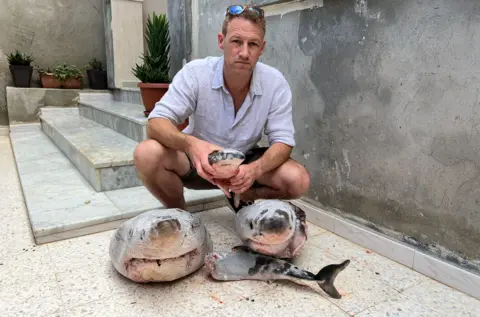
    James Glancy/Blue Marine A conservationist, James Glancy, is pictured with two dead white sharks in the foreground. The image is posed by steps leading up to the doorway of a building. The sharks have been cut into several pieces and appear to be partially frozen James Glancy/Blue Marine

    James Glancy from Blue Marine visited fish markets in Tunisia in 2023 and discovered protected sharks being sold

    The researchers, with their colleagues in North Africa are monitoring several fishing ports in the region. Our work, with the BBC Forensics team, also shows that protected sharks are caught, landed and offered for sale in countries including Tunisia and Algeria.

    We found footage – posted on social media – of a great white being landed in a fishing port in Algeria and another large shark that appears to be a protected short-finned mako, being prepared for sale on a trolly in a fish market in Tunisia.

    The rules that protect sharks are complicated. Currently, 24 threatened species have international legal protection – including mako, angel, threshers and hammerheads.

    The EU and 23 nations around the Mediterranean have signed an agreement, which states that those species cannot be “retained on board, transhipped, landed, transferred, stored, sold or displayed or offered for sale”.

    The international agreement states “they must be released unharmed and alive [where] possible”. Those rules do not tackle accidental bycatch and enforcement is variable from country to country.

    Virginia Tech/Blue Marine The underwater image shows a mako shark swimming towards the camera in clear blue water. A bright yellow cylinder in the foreground is a container of fish bait to attract sharks Virginia Tech/Blue Marine

    The researchers used baited underwater cameras to search the area for sharks

    James Glancy from Blue Marine told BBC News that his own investigation found multiple white sharks on sale in Tunisian fishing markets. But, he said, there was a paradoxical element of hope in the fact that white sharks were turning up for sale.

    “It shows that there is wildlife left,” he told BBC News. “And if we can preserve this, there is a chance of recovery.”

    What can be done?

    In poorer communities in North Africa, fishers who catch sharks might face the choice of whether to feed their family, or return a threatened species to the ocean.

    Sara Almabruk from the Libyan Marine Biology Society says that most of the catches happening in North African waters are accidental, but adds: “Why would they throw sharks back into the sea when they need food for their children?

    “If you support them and train them in more sustainable fishing, they will not catch white sharks – or any sharks.”

    James Glancy from Blue Marine added that if countries around the Mediterranean worked together, “there is hope.

    “But, he added, “we’ve got to act very quickly”.


    Source link

  • Protests spread across Iran for third day after currency hits record low

    Protests spread across Iran for third day after currency hits record low


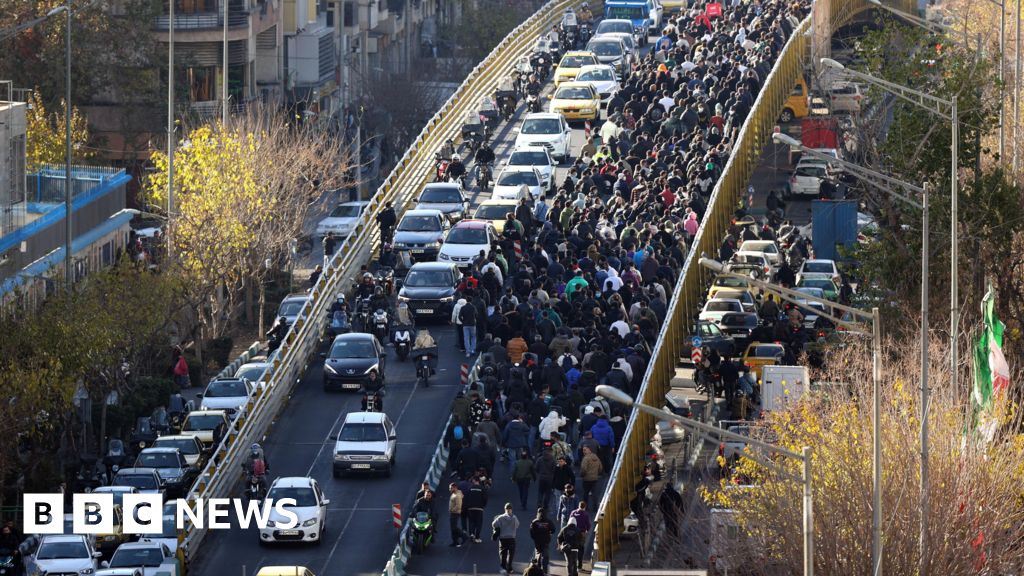
    Protests and strikes in Iran over inflation and currency devaluation have spread from the capital, Tehran, to several other cities on a third day of unrest.

    The protests began on Sunday after shopkeepers in Tehran’s Grand Bazaar staged a strike when the Iranian rial hit a record low against the US dollar on the open market.

    Since then, videos verified by BBC Persian have shown demonstrations in the cities of Karaj, Hamedan, Qeshm, Malard, Isfahan, Kermanshah, Shiraz and Yazd. Police were also seen using tear gas in an attempt to disperse demonstrators.

    The Iranian government said it “recognises the protests” and would listen “with patience, even if it is confronted with harsh voices”.

    President Masoud Pezeshkian wrote on X late on Monday that he had instructed the interior minister to hold talks with what he described as “representatives” of the protesters so that measures could be taken “to resolve the problems and act responsibly”.

    He also accepted the resignation of Iran’s central bank governor, Mohammadreza Farzin, and named former economy and finance minister Abdolnasser Hemmati to replace him.

    University students have also joined the protests, chanting anti-government slogans including “Death to the dictator” – a reference to the Supreme Leader, Ayatollah Ali Khamenei, who holds ultimate power in Iran.

    Some protesters were also heard chanting slogans in support of the son of the late Shah Mohammad Reza Pahlavi, who was overthrown in the 1979 Islamic Revolution, including “Long live the Shah”.

    In response, Reza Pahlavi, who lives in exile in the United States, wrote on X: “I am with you. Victory is ours because our cause is just and because we are united.”

    “As long as this regime remains in power, the country’s economic situation will continue to deteriorate,” he added.

    The US state department’s Persian-language account on X also expressed support for the protests.

    It said the US “praises their courage” and stands with those seeking “dignity and a better future” after years of failed policies and economic mismanagement.

    Iran was reportedly high on the agenda of a meeting between US President Donald Trump and Israeli Prime Minister Benjamin Netanyahu in Florida on Monday,

    At a joint news conference afterwards, Trump declined to say whether he supported regime change in Iran, but said: “They’ve got a lot of problems: tremendous inflation, their economy is bust, their economy is no good, and I know people aren’t so happy.”

    The president also said he might back another round of Israeli air strikes on Iran if the country rebuilt its ballistic missile or nuclear programmes.

    During a 12-day war between Israel and Iran in June, the US carried out air strikes on key Iranian uranium enrichment sites. Iran insists its nuclear programme is entirely peaceful.

    President Pezeshkian vowed on Tuesday that Iran’s response to “any oppressive act of aggression” would be “severe and regret-inducing”.

    Iran’s supreme leader has repeatedly said that Israel’s government hoped mass protests would erupt in Iran during the war and topple the regime.

    “They wanted to create sedition on the streets… But people were absolutely not influenced by what the enemy wanted,” Khamenei said in September.


    Source link

  • The ‘thorny’ issues that threaten to derail a Russia-Ukraine peace deal

    The ‘thorny’ issues that threaten to derail a Russia-Ukraine peace deal


    Paul KirbyEurope digital editor

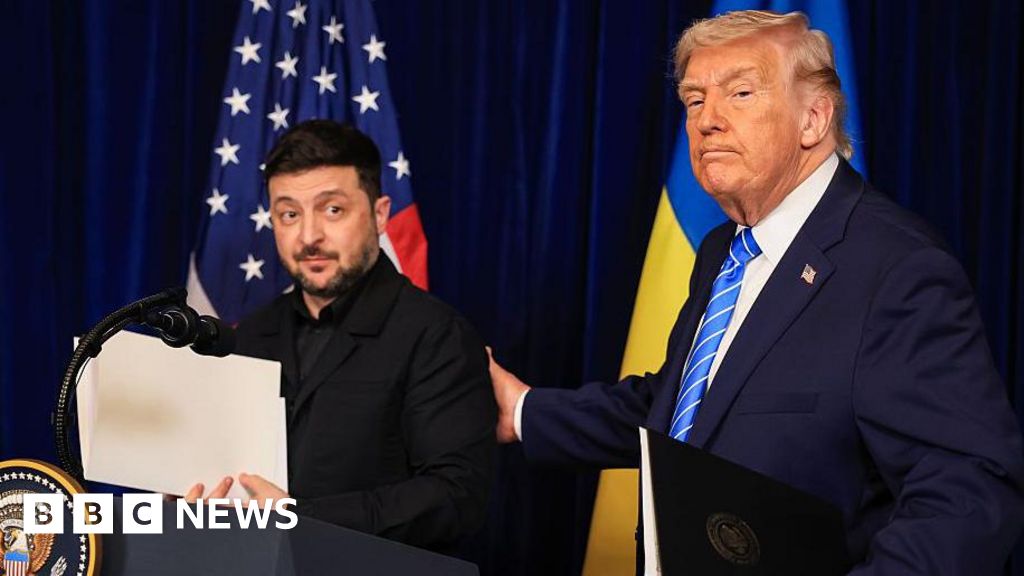
    Joe Raedle/Getty Images U.S. President Donald Trump and Ukrainian President Volodymyr Zelensky leave a press conference following their meeting at Trump’s Mar-a-Lago club Joe Raedle/Getty Images

    Unlike Trump, Zelensky says he does not trust Russia’s Putin on peace talks

    Russia, the US and Ukraine agree that a deal on ending almost four years of full-scale war is edging closer but, in the words of President Donald Trump, “one or two very thorny, very tough issues” remain.

    Two of the trickiest issues in Washington’s 20-point plan involve territory and the fate of Europe’s biggest nuclear plant, which is currently occupied by Russia.

    The Kremlin agrees with Trump that negotiations are “at a final stage”, and Zelensky’s next step is to meet European leaders in France on 6 January, but any one of the sticking points could jeopardise a deal.

    Fate of Ukraine’s industrial heartland coveted by Putin

    Vladimir Putin has not budged from his maximalist demand for the whole of Ukraine’s industrial Donbas, although Ukraine’s Volodymyr Zelensky has offered a compromise.

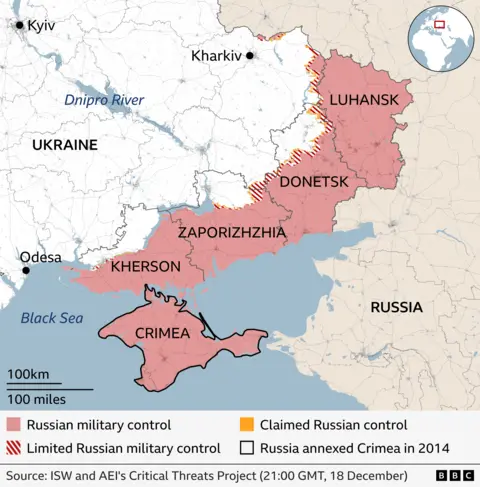
    Russian forces occupy most of the Luhansk region in the east but little more than 75% of Donetsk, and Putin wants it all, including the remaining “fortress belt” cities of Sloviansk and Kramatorsk.

    “We can’t just withdraw, it’s out of our law,” says Zelensky. “It’s not only the law. People live there, 300,000 people… We can’t lose those people.”

    He has proposed Ukrainian forces pull back from the area to create a demilitarised or free economic zone policed by Ukraine, if the Russians pull back the same distance too. The current line of contact would then be policed by international forces.

    It is difficult to imagine Putin agreeing to any of that, and Russia’s generals have told him they are capturing Ukrainian territory fast.

    Anadolu via Getty Images Workers from the organisation East SOS evacuate 92-year-old Valentina due to continuous Russian attacks on the city of SlovianskAnadolu via Getty Images

    The two eastern cities of Sloviansk and Kramatorsk are coming under regular Russian attack

    “If the authorities in Kyiv don’t want to settle this business peacefully, we’ll resolve all the problems before us by military means,” Putin has claimed.

    Both sides are widely seen as suffering from exhaustion, and analysts from the Institute for the Study of War have estimated it would take Russian forces until August 2027 to conquer the rest of Donetsk if they are able to maintain their current rate of advance – which is not a given.

    Zelensky’s compromise would also require Russian troops to leave other areas of Ukrainian territory where they maintain a limited presence, including Kharkiv and Sumy region in the north, Dnipropetrovsk in the east and Myokolaiv in the south.

    Without movement on Donetsk, the chance of a peace deal looks unrealistic, but a Russian compromise may not be out of the question.

    Kremlin envoy Yuri Ushakov said recently “it’s entirely possible that there won’t be any troops [in Donbas], either Russian or Ukrainian”, although he was adamant the territory would be part of the Russian Federation.

    Map showing Russian occupation of eastern Ukraine

    Ukraine’s huge nuclear power plant in Russian hands

    Ever since March 2022, Russia has occupied Europe’s biggest nuclear plant at Enerhodar, on the banks of the Dnipro river. But the six nuclear reactors of the Zaporizhzhia plant are not producing electricity – they have all been in cold shutdown mode for more than three years – and external power supplied by Ukraine is keeping the plant going to prevent a meltdown.

    To get it going again it needs substantial investment, partly to rebuild the destroyed Kakhovka hydro-electric dam that was used to provide cooling water for the plant.

    Ukraine believes the area should also become demilitarised and turned into a free economic zone.

    The US proposal, according to Zelensky, is for the US to manage the plant as a joint enterprise with Russia and Ukraine. Kyiv has said that is unrealistic and instead the US and Ukraine could jointly manage it 50-50, with the US deciding where half of the power goes – by implication to Russia.

    Ukraine’s problem is that Russia will not let it go and the head of Russia’s Rosatom nuclear agency Alexei Likachev has stressed that only one entity – Russia – can run it and ensure its safety.

    He has held out the possibility that Ukraine could use electricity generated by the plant in the context of international co-operation.

    Compromise on this issue may not be insurmountable, but it would require a level of trust between two neighbouring states when none exists.

    Washington Post via Getty Images A man wheels a barrow towards a dumpster on a road that is overlooked by the Zaporizhzhia Nuclear Power Plant on the Russian controlled southern bank side of the Dnipro riverWashington Post via Getty Images

    The Zaporizhzhia nuclear plant dominates the skyline near the Dnipro river

    Lack of mutual trust despite positive rhetoric

    It is hard to imagine significant progress on the biggest sticking points when there is so little trust.

    When Trump suggested this week that Putin “wants to see Ukraine succeed… including supplying energy… at very low prices”, Zelensky clearly did not believe a word of it – he does not consider Putin as serious about peace.

    “I don’t trust Russians and… I don’t trust Putin, and he doesn’t want success for Ukraine,” the Ukrainian leader said.

    Russia has also shown little faith in Kyiv – accusing Ukrainian forces of targeting drones at a Putin residence in the Novgorod region, although it gave no evidence of the attack.

    Ukraine denies it even happened and believes it is a Russian pretext for further Russian strikes on government buildings in Kyiv.

    Other sticking points that could derail deal

    Kyiv has asked the US and European leaders for security guarantees to ensure a Nato-style response in the event of a further Russian attack. Ukraine is also seeking to maintain an 800,000-strong military.

    Although the US and Europe might sign up to a deal on security, Russia will not accept European troops on the ground in Ukraine.

    Financial losses for Ukraine have been estimated at $800bn (£600bn), so another key issue is how much will Russia contribute to that. The US talks of a joint investment fund with Europe, and Russia has €210bn (£183bn) worth of assets in Europe that could also be used, even though Moscow has so far refused to allow it.

    Russia also rejects Ukraine’s bid to join Nato. That may not be too much of a sticking point as there is no likelihood yet of that happening, but it is part of Ukraine’s constitution, so finding agreement will be difficult.

    Membership of the European Union is also a potential sticking point, perhaps less so for Russia than for countries that are ahead of Ukraine in the queue to join the EU. Few believe it will happen very soon.

    Could Ukrainians hold a vote on a deal?

    The Ukrainian leader has cited opinion polls that suggest 87% of Ukrainians want peace, while at the same time 85% reject withdrawing from Donbas.

    So he believes no decision on either the fate of Donetsk or the broader 20-point plan can be made without a popular vote and a 60-day ceasefire to prepare it: “A referendum is the way to accept it or not accept it.”

    This too is a potential sticking point as the Kremlin argues a temporary ceasefire would only prolong the conflict and lead to renewed hostilities – and Trump has said he understands Putin’s position.

    But without such a vote Zelensky believes a deal would have no validity which just adds to the list of thorny issues to be resolved.


    Source link