LUSAKA, Zambia (AP) — She says she was let down at every step. By a partner who abandoned her when she was pregnant. By a health service that denied her a legal abortion. And by a justice system that sent her to a maximum-security prison for illegally terminating her pregnancy on her own.
Violet Zulu, a house cleaner in Zambia earning $40 a month, was sentenced to seven years in prison in 2024 after representing herself in court with little understanding of the consequences of her actions. She didn’t see her two children or other family members for nearly two years.
After word of her case reached international rights groups that helped her file an appeal, Zulu was freed last month. Activists say she represents many women in Africa who take desperate decisions when facing barriers to legal abortion services.
Her story has drawn little sympathy in her southern African nation, where parts of society view abortion harshly. Her own mother said she agreed with her daughter’s prison sentence, but said it should have been shorter.
Zulu spoke with The Associated Press as she pieces her life together again at the age of 26.
Turned away from care
She said she first attempted to access legal abortion services at a public clinic, which should have given her advice or services but turned her away. She then tried a private pharmacy, which requested 800 Zambian kwacha ($43) for abortion drugs, a month’s salary for her.
She was already struggling to feed her two young sons, and she sometimes had to beg food from relatives.
She said her decision to drink an herbal concoction she prepared herself, one known for terminating pregnancies, was taken out of despair. She couldn’t bear for her boys to have even less food if she had another child.
“I never wanted to abort my pregnancy, but it is the circumstances at home that forced me to do it,” Zulu said in the interview at the two-room rented home with no running water that she shares with her children and parents.
“I was scared (when I took the concoction), but I didn’t really care what would happen to me,” she added.
In her court testimony, she explained what happened next: She delivered the fetus in a toilet, placed it in a sack and dropped it in a nearby stream. She said she confided in a friend, but word got out and neighbors reported her to police.
Zulu, who left school in the eighth grade, was never offered free legal counsel despite the right to request it. She represented herself in court and pleaded guilty to the offense of procuring her own abortion. She said she didn’t understand the legality of abortion and thought she would receive a warning.
A system that failed
“This is a system that failed Violet,” said Rosemary Kirui, a legal adviser for Africa for the abortion rights group Center for Reproductive Rights, which campaigned for Zulu’s release and helped with her appeal. “It is not that she did not try. It is that she could not afford the services, yet she should be able to access them as a citizen of Zambia.”
Zulu should have been eligible for a free abortion under a provision that allows doctors in Zambia to consider risks to the well-being of her existing children, said Sharon Williams, country director for the Women and Law in Southern Africa advocacy group.
But Zulu was not aware of that, largely because of the secrecy, stigma and shame around abortion, which is not advertised by Zambia’s public health system.
Zambia’s health ministry did not respond to questions about her case.
Part of the problem, Williams said, is that Zambia has legalized abortion while also defining itself in its constitution as a strongly Christian country.
Abortions are still largely restricted in Africa, with few countries allowing them for reasons other than threats to the health of the mother or the fetus. Even in countries like Zambia, religious beliefs, conservative values rooted in local cultures or a lack of information make access to legal procedures difficult, according to health and rights groups.
Williams said Zulu’s case ought to lead to a national conversation over whether Zambian authorities should better educate communities over the legal right to abortion.
“I think now that we have this judgment, we’re ready for the conversation,” she said.
Desperate women, unsafe abortions
Activists say desperate women turn to unsafe abortions. Africa and Latin America have the highest proportions of them, with approximately 75% of all abortions in Africa deemed unsafe, according to the World Health Organization.
The Guttmacher Institute health rights organization estimated in a 2019 report that over 6 million unsafe abortions a year occurred in sub-Saharan Africa. It noted that Zambia’s abortion law “tended to be a ‘paper law’ rather than one that ensures widespread access.”
In South Africa, which claims to have the most progressive laws on the continent, abortion has been legal for nearly 30 years. It is allowed on request before 13 weeks of pregnancy and for several reasons before 21 weeks.
But studies estimate only 7% of public health facilities there offer abortion services.
In 2023, the case of a 14-year-old who was denied an abortion by South African health workers three times for reasons that were not valid prompted a national reality check. After an urgent court case, a judge ordered that the girl be allowed to have an abortion, which was performed on the last day eligible by law.
At the time, a representative of the social justice group that represented the girl said South Africa’s abortion laws were being undermined by “the abuse of medical knowledge by health care professionals” in trying to prevent abortions.
In Zambia, Zulu said she still felt bad about what she did but must now provide for her sons. She was looking for work again, she said.
The Associated Press receives financial support for global health and development coverage in Africa from the Gates Foundation. The AP is solely responsible for all content. Find AP’s standards for working with philanthropies, a list of supporters and funded coverage areas at AP.org.
They managed to sneak through the design and testing stages without all their vulnerabilities being discovered and it’s left to the crew, and in some cases passengers, to deal with the often tragic fallout.
The aircraft listed here were, with one exception, more dangerous than they should have been, but in most cases, this was also a sign of the period in which they were operating.
For example, entries 2-10 could have been filled with jet fighters from the 1950s and 60s which probably would have been more statistically accurate, but would also have got a bit predictable. Regardless, here are ten aircraft you probably should avoid flying:
10: Tupolev Tu-104
Entering service during the British Comet’s awkward pause in operations the Soviet Tu-104 was the world’s only jet airliner for a brief period. What it wasn’t was particularly safe. The controls were heavy, it was unstable, and the highly swept wings had adverse handling characteristics approaching the stalling speed. These quirks might be acceptable in a strategic bomber but were not ideal in an airliner.
The tendency to pitch up violently, or enter an uncontrollable dive at the stall led to pilots flying the approach into airports 30mph faster than the intended speed often creating problems that the brake chute couldn’t solve. 1958 saw three aircraft lost in accidents with subsequent years seeing a steady drum beat of losses.
10: Tupolev Tu-104
32 aircraft were lost in accidents before the type was withdrawn from commercial use, while another aircraft was hit by a missile after a training exercise went awry. Aeroflot withdrew the Tu-104 in 1979 after a false fire alarm led to an aircraft crashing while returning to Moscow airport, killing 58 of 119 onboard. The Russian military continued using the type until 1981 when a Soviet Navy example crashed due to improper loading of cargo, killing 16 Admirals in the process.
With 201 aircraft built the Tu-104 suffered a loss rate of 16%, better than the next entry but substantially worse than just about any other operational jet airliner.
9: de Havilland Comet
After years of wartime austerity, the de Havilland Comet showed the world that Britain was still at the cutting edge of civil aviation. The world’s first jet-powered airliner entered service with BOAC in 1952 heralding a golden future. Unfortunately, that never arrived.
On 26 October 1952, a BOAC aircraft ran off the runway at Rome’s Ciampino airport refusing to leave the ground despite the nose being held in the air. Four months later a Canadian Pacific Airlines Comet taking off from Karachi did the same, killing all 11 onboard. Ultimately a modification to the wing leading edge would solve the problem but much worse was to come.
9: de Havilland Comet
In January 1954, Comet G-ALYP disintegrated over the Mediterranean killing all onboard. After a brief investigation, the Comet was returned to flight in March. Two weeks later G-ALYY would disappear near Naples. The Comet’s Certificate of Airworthiness was revoked, and a thorough investigation began.
It was discovered that the crack that caused the first accident began at a rivet hole that had been damaged during build. The thin-gauge metal used to save weight made the early Comets vulnerable to this type of damage and a redesign was required. However the damage was done, the battle lost to the Boeing 707. 114 Comets were built, with 25 being lost.
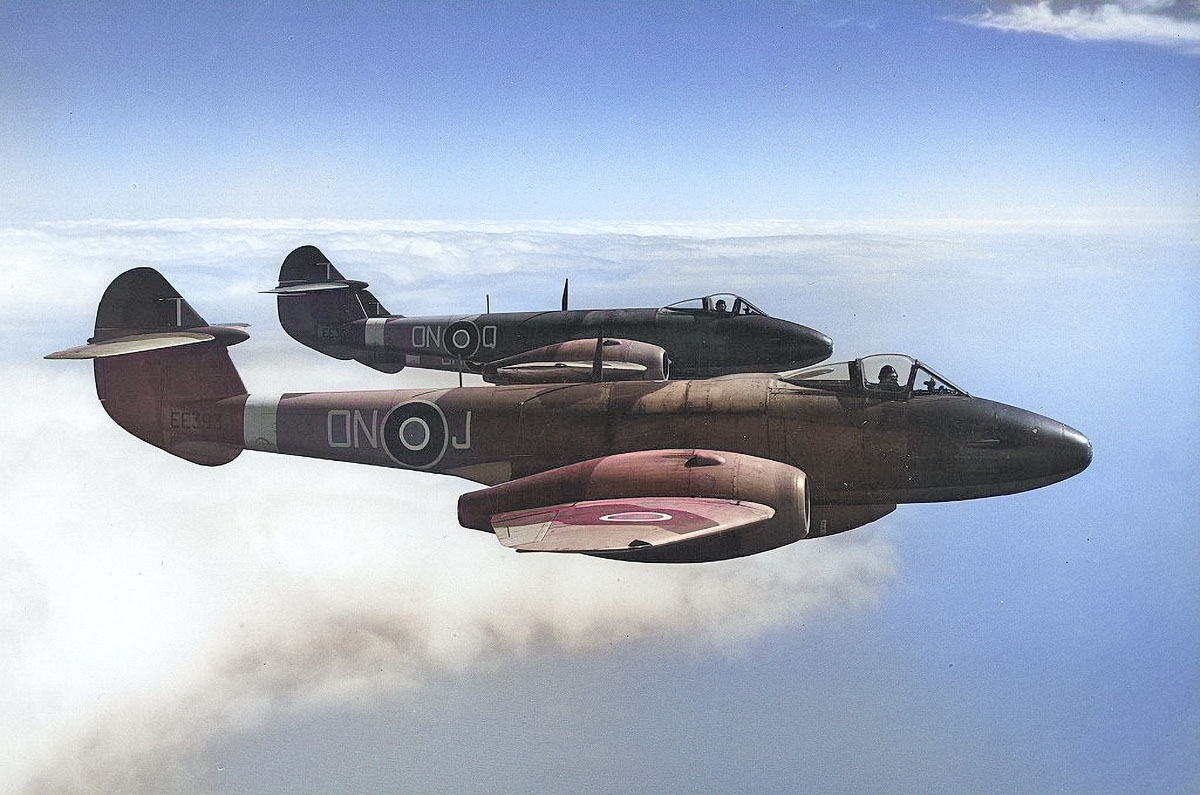
8: Gloster Meteor
The endurance of the Gloster Meteor, the first jet-powered fighter of the Allies, could be measured with an egg timer. Another serious issue was that an engine failure of one of the two engines on take-off could be fatal. The two engines were widely spaced out from each other causing alarmingly asymmetric thrust with one engine out. In some cases, pilots would have their own critical speed recommendation for asymmetric flight based on their leg strength. Other issues included selecting the air brakes with the undercarriage and flaps already down, the resultant blanking of airflow to the tail leading to a dive.
The limited navigation aids available at the time also caused issues, on one occasion in 1951 a flight of three aircraft from 203 Advanced Flying School at RAF Driffield found themselves having to descend over the sea to gain visual flight conditions.
8: Gloster Meteor
The full list of Meteor crashes is astonishing and not only was the aircraft ridden with dangerous design features, it was a new type of aeroplane requiring new skills to many pilots more familiar with piston-engined aircraft. 1952 alone saw 150 Meteors lost in RAF service, 30% of losses for that year, the next highest figure being for Vampires with a ‘mere’ 82 being lost.
The following year saw a slight easing off with only 143 Meteors lost. In total the RAF alone lost 890 Meteors, accounting for 22% of the production run.
7: Vought F7U Cutlass
The Vought Cutlass still looks like it came from the future today. Unfortunately, it’s a future with a very relaxed approach to safety. A lack of thrust was one flaw; a complicated high-pressure hydraulic system was another. In the F7U-1 failure of this could leave the pilot with no control for 11 seconds while pressure decreased enough for manual control to be taken. A third weak point was the fragile nose gear.
As if having the cockpit 14 feet off the ground at a 9 degrees attitude wasn’t enough for landing and taxiing it was raised to 14 degrees, and in a foreshadowing of the Phantom a full 20 degrees for take-off. Unfortunately, this made the whole spindly assembly liable to collapse on landing, or worse punching up through the cockpit floor into the bottom of the ejection seat causing it to fire.
7: Vought F7U Cutlass
As a carrier aircraft, its greatest weakness, of many, was the 23-degree nose-high attitude on approach which essentially guaranteed that if you could see the ship you were doing it wrong. A design flaw meant that while in afterburner the transfer tank that fed fuel to the engines could be drained faster than it was being replenished from the rest of the system.
Unsurprisingly the Cutlass was withdrawn from fleet operations by October 1957, only three and a half years after entering service, although some would remain in second-line use until March 1959 primarily for trial work. 78 of 320 Cutlasses were lost in accidents in only 55,000 flying hours making it one of the most dangerous US Navy jets of all time. Still, that’s amateur hour compared to the next entry.
6: C-87 Liberator Express
The B-24 Liberator was one of the best heavy bombers of the Second World War, and in its Anti Submarine Warfare variants was responsible for sinking more submarines than any other aircraft in history. The C-87 transport version would enjoy none of its siblings’ success. To make a C-87 the bomb bay was converted into a cargo area along with the fuselage forward of the cockpit. Able to carry up to 25 passengers or 12,000lbs (5455kg) of cargo the Liberator Express was an improvement on the existing C-47.
Unfortunately, due to the priority given to its bomber cousin shortcuts were taken in the C-87’s production.
6: C-87 Liberator Express
The use of a lower boost supercharger adversely affected its high-altitude performance. The nose gear was prone to breaking, having not been intended for landings with a full internal load. Cargo was also liable to shift throwing the centre of gravity out of limits, causing the aircraft to climb or dive uncontrollably. In the book, ‘Fate is the Hunter’ author and pilot Ernest K Gann details the C-87’s faults, including the time he nearly destroyed the Taj Mahal after taking off in a C-87 with three tonnes more fuel than expected.
The C-87’s loss rate was over 50% with 152 of 287 lost. In comparison, despite regularly being engaged in air-to-air combat, only around 33% of Liberators were lost.
5: Latécoère 631
The Latécoère 631 was the ultimate in late ‘30s flying boats with six engines, twin tails, and a bar in the nose, unfortunately, the second world war would delay its service entry to 1946. Before this, the first example had been commandeered by the Luftwaffe, and then sunk at its moorings by the RAF. In October 1945 the second aircraft was flying between Rio de Janeiro and Montevideo when the number 3 propeller broke off.
One blade hit the number 2 engine’s propeller and another ripped through the fuselage killing two passengers. Air France continued its operations and it wasn’t until February 1948 when a brand new 631 crashed into the English Channel in bad weather.
5: Latécoère 631
August 1948 saw aircraft F-BDRC disappear over the Atlantic. Air France took the opportunity to cancel its orders while the French government created a company to use the remaining examples for cargo. Meanwhile, F-WANU was used to discover what had led to F-BDRC’s loss, leading to it too crashing. Another company was now formed to use two of the remaining 631s for cargo operations. When one of these broke up in a thunderstorm over Cameroon in 1955 operations finally stopped.
Four of seven Latécoère 631s were lost in accidents with all onboard dying, making it one of the more dangerous airliners ever to fly; a further four 631 planes were never even used.
4: Vought F-8 Crusader
The Crusader was a handful, which was painfully apparent when it came to landing, a terrible quality in a carrier aircraft. A terrifying total of 493 Crusader pilots had to exit the aircraft by ejection seat. Overall, 517 of the 1261 Crusaders had been built had been lost. This loss rate of 41% is dismal, and that there is 737 entries in the Aviation Safety Network database is clearly atrocious.
4: Vought F-8 Crusader
The high approach speed of 147 knots was a big issue on smaller carriers such as the Essex-class. Consistent speed was also important. To help, an autothrottle (Approach Power Compensator) was added in 1964, but even this caused problems as over-reliance on the APC was equally dangerous. Another peculiarity of the F-8 was its odd relationship between nose attitude and sink rate caused by its oddest design feature, on landing the wing stayed at the same angle of attack as the fuselage tilted (the wing was mounted on a mechanism).
Things were particularly counter-intuitive for the pilot in the final approach stages, which again required attention. The Crusader, fine in many ways, was an extremely dangerous aeroplane.
3: Supermarine Scimitar
The Supermarine Scimitar was a twin-jet naval fighter from the manufacturers of the Spitfire. Despite having two engines each producing 11,000lbs of thrust, the overly thick wing, prevented it being supersonic in anything other than a dive. It also suffered a horrendous loss rate. For a naval aircraft surprisingly few of its accidents directly involved an aircraft carrier. Two suffered cable breaks after landing and fell off the front of the ship.
A third suffered brake failure while taxiing to the catapult, while a fourth ditched after an aborted landing. A fifth aircraft suffered an engine failure on approach.
3: Supermarine Scimitar
Scimitars also suffered nine losses due to hydraulic failures, 5 due to engine failures, a couple each due to bird strikes, fuel leaks, or Controlled Flight into Terrain. There were also 7 losses for unknown reason. In an unusual twist, two of the three surviving Scimitars were involved in a mid-air collision over Malta in April 1964 when 807 squadron was on its way back from the Far East.
Overall of 76 Scimitars built, 39 were lost in accidents – a staggering 51% – all essentially in peacetime: the closest they came to a war was deterring an Iraqi invasion of Kuwait in 1961.
2: Republic F-105 Thunderchief
The Republic F-105 Thunderchief had an auspicious start to life with the first two prototypes breaking their backs in landing accidents. Given the airframe needed a complete redesign to reach the contracted top speed this was probably less of a problem than it at first seemed. However, it wasn’t an encouraging sign when after all the modifications to achieve that were done the third prototype very nearly did the same thing. In this case the main gear refused to extend as the engine auxiliary intakes, located in the gear bay, had opened and the suction from the Pratt and Whitney J-75s was holding the doors firmly shut.
In a cruel twist with the engine shut down the test pilot was walking away from the aircraft only for it to slowly hoist itself up onto its wheels, the hydraulics being able to overcome gravity if not vacuums.
2: Republic F-105 Thunderchief
Aside from the excessive heat and humidity requiring modification to the Thunderchief the single hydraulic system controlling the horizontal stabiliser soon emerged as a weak point. Damage to the system would force the aircraft into an irrecoverable dive – F-105s were also falling to North Vietnamese air defences, primarily guns, at a shocking rate. At least 60 were lost in 1965, 111 in 1966, and a further 97 in 1967. In all 334 Thunderchiefs were lost in combat over Vietnam nearly 20% of USAF losses and 40% of all F-105s produced.
Even in the context of war, this was bad when compared to loss rates for aircraft in WW2. A further 63 were lost in accidents in South East Asia while when other losses are included well over 50% of all Thunderchiefs produced were lost.
1: Yokosuka MXY-7 Ohka
Built by the Imperial Japanese Navy’s Yokosuka arsenal, the MXY-7 Ohka suicide bomb was a 20 foot tube with stub wings. The doomed pilot was sandwiched between a 1200kg warhead and a 4500 pound thrust rocket motor. Surprisingly, there was armour plating at the rear of the cockpit to protect the pilot. Despite a top speed of over 500mph, the Ohka was not the highly effective weapon that had been hoped for.
Kamikaze attacks in converted fighters had shown limited success but the MXY-7 had an Achilles heel. Its limited range required it to be carried to the target by a converted G4M ‘Betty’ bomber.
1: Yokosuka MXY-7
Carrying the Ohka compromised the G4M’s speed, and its ceiling was reduced to a dangerously low 16,400 feet. On their first mission on 21 March 1945, all the bombers were intercepted before they were within 50 miles of their target. Although some MXY-7s were released, with a range of only 20 miles it would be to no effect. The Ohka’s performance didn’t improve, only one ship, the destroyer USS Mannert L Abele was sunk by the MXY-7, with 84 sailors believed killed. Given there were 74 MXY-7 missions, and the Betty itself had a crew of seven, it’s entirely possible more Japanese lives were lost in Ohka missions than American. Quite how a suicide aircraft could be even more dangerous than it was intended to be is a grim and perplexing question…
Joe Coles is the author of The Hush-Kit Book of Warplanes Vol 1.
If you enjoyed this story, please click the Follow button above to see more like it from Autocar
Welcome back to Foreign Policy’s Situation Report, where we come to you from an uncharacteristically quiet Sunday at the Bayerischer Hof hotel on the final day of the Munich Security Conference. The dignitaries and officials are long gone, the speeches are done, and the security barricades have been dismantled, but your SitRep co-authors are still chugging along to bring you a final special pop-up edition.
Here’s what’s on tap for the day: a “what now?” moment for Europe, a “what’s next?” moment for Ukraine, and an important conversation about Gaza.
While the Munich Security Conference has become increasingly global and hosts high-profile officials and attendees from Japan to Chile, it remains, at its core, a trans-Atlantic and largely European conference. That was very much the flavor of the gathering’s final day, which opened with a panel titled “Europeans Assemble! Reclaiming Agency in a Rougher World” followed by another titled “The European Dream(s): Defending Core Values Under Pressure.”
The panel titles were set long before U.S. Secretary of State Marco Rubio’s mixed message speech at the conference on Saturday, but they take on a greater meaning the day after as Europe gets realistic about where Washington stands.
“I agree that there is an urgent need to reclaim European agency,” Kaja Kallas, the European Union’s top diplomat, said in her speech introducing the first panel, where she previewed an upcoming new European security strategy that will “address all dimensions of European security.”
But first, she opened with a thinly veiled barb at some of the Trump administration’s favorite attacks against Europe. “Contrary to what some may say, woke decadent Europe is not facing civilizational erasure,” she said. “In fact, people still want to join our club—and not just fellow Europeans. When I was in Canada last year, I was told that over 40 percent of Canadians have an interest in joining the European Union, so the waiting list is quite long.”
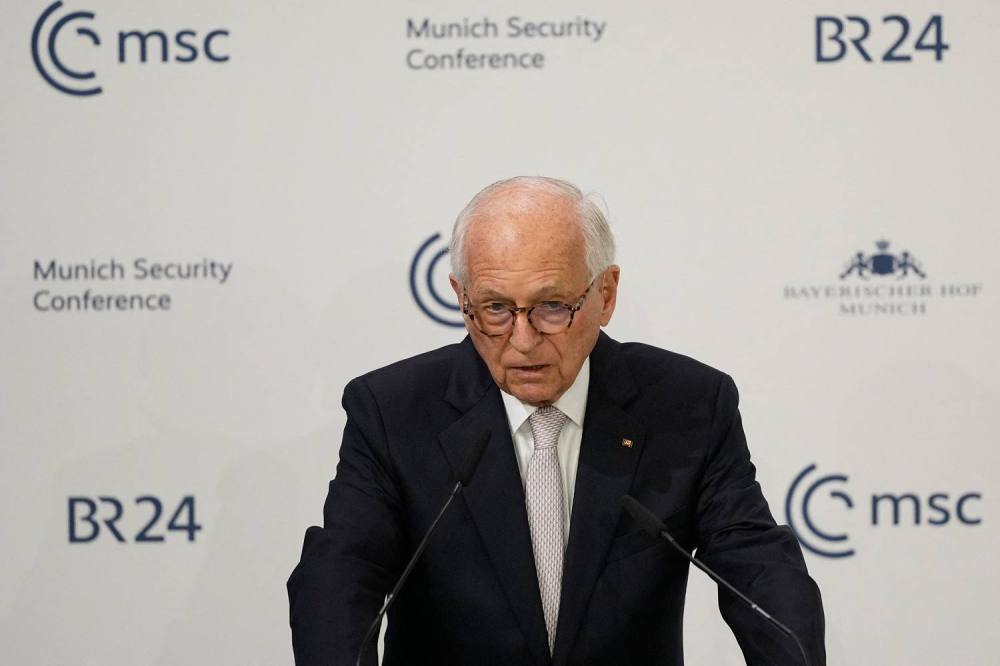
‘An existential question.’ The country at the top of that waiting list—Ukraine—was the biggest focus of the final day, with much of the discussion focusing on the path forward for ending its war with Russia and Europe’s role in an eventual peace. “The question of how this war is going to end is actually an existential question for Europe,” said Wolfgang Ischinger, the former German ambassador to Washington who chairs the conference. “It will determine—in more ways than one—the future of this continent,” he added.
But for all the panels and speeches, no new answers seemed to emerge on how to actually end the war. The consensus among nearly all the Europeans is that, as German Chancellor Friedrich Merz put it in his speech to the conference on Friday, “Russia is not yet willing to talk seriously. … This war will only end when Russia is at least economically, potentially militarily, exhausted.” And as John reported yesterday, even U.S. Sen. Lindsey Graham, one of U.S. President Donald Trump’s closest allies in Congress, is openly saying as much. Yet Trump himself continues to insist that Russian President Vladimir Putin wants a deal.
With another round of U.S.-brokered talks between Russia and Ukraine set to take place this week in Geneva, how to resolve that disconnect remains perhaps the biggest open question of all.
We discussed some of these issues with Estonian Foreign Minister Margus Tsahkna in a late Saturday evening interview at the Bayerischer Hof’s basement tiki bar, which has become something of a SitRep sanctuary over the past three days.
Tsahkna said that the reset of expectations between the United States and Europe that began at the Munich Security Conference a year ago and settled into an equilibrium this year has been like a “vaccine” for European leaders to realize that the trans-Atlantic relationship is “strong, but not unconditional.”
As a result, he added, “I see a more self-confident Europe. I see more European leaders who really understand that Putin is not stopping. It’s on Europe to put more pressure on Russia and give Ukraine more support,” Tsahkna said. “We are understanding more and more that we need Ukraine in Europe—as a security guarantee, as a military power, as an economic power, but also a power that is actually going to produce everything that we need for our defense … but of course, the war is not finished.”
When asked whether there is a disconnect between how Europe and the United States see Russia’s willingness to reach a deal, Tashina said: “I think that everybody is very pragmatic—everybody is hoping that good things may happen, but probably not, and I think mentally as well, Europe is ready to continue to support Ukraine for the long run.”
Gaza is no longer in the global spotlight in the way that it was even a few months ago, but the coastal enclave remains in crisis. The humanitarian situation is still dire, and key aspects of the peace process are stalled. To get a better picture of where things stand, SitRep sat down with Philippe Lazzarini, the commissioner-general of the United Nations Relief and Works Agency for Palestine Refugees (UNRWA), at the Munich Security Conference.
Lazzarini said there wasn’t enough focus on Gaza in Munich. He contributed this lack of attention to a broader shift that’s occurred since a U.S.-orchestrated cease-fire began in October, which he emphasized is a “cease-fire by name at this stage” given “nearly daily breaches” and the roughly 600 Palestinians killed from the time the truce started. (Four Israeli soldiers have been killed in Gaza during the same period.)
UNRWA has been banned by the Israeli government, and Lazzarini discussed the challenges that the agency continues to face and the pressure that it’s under. Israel has alleged that UNRWA is “infiltrated” by Hamas, which the agency categorically denies.
This interview has been edited for length and clarity.
SitRep: Can you paint a picture of where the humanitarian situation stands right now in Gaza?
PL: We [UNRWA] are not allowed to bring anything in. We’re totally constrained. Basically, the supplies we have outside of Gaza have been donated to other organizations to bring in. Since the cease-fire started, I would say the only real impact has been to prevent the deepening of hunger. We have reversed the famine. You still have about 100,000 people in acute food insecurity. But besides that, the bulk has been reversed.
Otherwise, life in Gaza is nothing else than just misery. It’s a daily struggle for survival. Winter has been extraordinarily harsh, and there haven’t been adequate shelters. People are queuing for hours to have access to clean water, for the basics. We are already four or five months into the cease-fire. Fundamentally, besides the famine and deep hunger dimension, there haven’t been significant changes.
SitRep: What are the challenges UNRWA faces because of the Israeli ban and other recent steps, such as the demolition of the agency’s East Jerusalem headquarters?
PL: Our agency is under a fierce, massive attack, whether operationally, politically, diplomatically, legislatively, legally, and financially—you name it. Today, we still have 12,000 staffers working in Gaza focusing on public health, primary health care, access to water, waste management, vaccination campaigns, and also in managing shelters and bringing back a learning environment for the children of Gaza.
Despite all the constraints, we are part of a community. We have the workforce, we have the expertise, and we have the community’s trust. So, these activities are not only ongoing, but they’re even expanding.
We also operate in the occupied West Bank, but we don’t operate anymore in East Jerusalem. What happened in East Jerusalem is extraordinarily outrageous, because it is based on a Knesset bill for the government to cut off electricity and water and to seize the land of all UNRWA’s premises in occupied East Jerusalem, despite two ICJ [International Court of Justice] rulings, one declaring the occupation illegal, the second one also declaring that decisions taken by Israel against agencies like UNRWA [are] illegal.
A large billboard on the side of what appears to be a residential building shows various UAVs and other weapons underneath the words “We Got This” in English.
A billboard shows an advertisement for German UAV and weapons producer Helsing that reads “We Got This” near the venue of the Munich Security Conference in Munich on Feb. 12.Sean Gallup/Getty Images
It wouldn’t be an MSC SitRep without a Mark Rutte moment. After the table-sharing awkwardness of last year, this time, we were not parties to but witnesses of another awkward moment involving the NATO secretary-general when a reporter at his Saturday roundtable mentioned that it was Rutte’s birthday. Rutte thanked the reporter but also became a little uncharacteristically bashful at the shout-out and quickly moved on to more substantive topics. “No, no. Forget it,” he said, jokingly, prompting laughter across the room.
“Frankly, I can’t imagine at this point that we are going to have a deal in 2026.”
—Latvian President Edgars Rinkevics on the prospect of a negotiated settlement between Russia and Ukraine.
72,522—we’ve decided to make this a SitRep pop-up tradition by counting our cumulative steps throughout the conference. In case you were wondering, Rishi did a few thousand steps more than John, but John says, “Work smarter, not harder.”