Category: Uncategorized

  • US-Nigeria strikes: Living in fear of Lakurawa

    US-Nigeria strikes: Living in fear of Lakurawa


    Makuochi OkaforBBC Africa

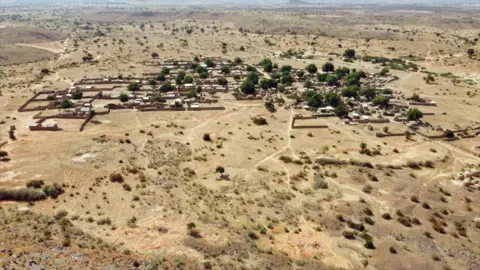
    Gift Ufuoma/BBC An aerial view showing the remote location of Nukuru village on a savannah plain.Gift Ufuoma/BBC

    Buildings in Nukuru village were damaged by the ferocity of the missiles that struck 10km away on Christmas Day

    Deep fear has long pervaded the arid savannah plains and highlands of north-western Nigeria – even before the US air strikes on the Islamist militants who have made this area their base on Christmas night.

    The heavily armed jihadists, who dress in camouflage and wear vibrant turbans, have lived in camps in Tangaza, a remote area of Sokoto state near the border with Niger, for several years.

    They belong to a group called Lakurawa and hail from areas north of Nigeria in the Sahel.

    Locals in Tangaza, a community made up of mainly moderate Muslims, believe they come from Niger and Mali – and are terrified of them.

    Recently, both US and Nigerian authorities have said the militants are affiliated to Islamic State (IS) groups in the Sahel – though IS has not linked itself to any of the group’s activities or announced ties to Lakurawa as it has done with other groups in the region that it backs.

    When the BBC visited Nukuru, one of several remote villages in Tangaza around 10km (six miles) from where the US missiles struck, most people were deeply suspicious and did not want to talk about Lakurawa – fearing reprisal if they spoke.

    It was only after assurances that their identities would be kept anonymous that some men agreed to be interviewed, speaking in hushed tones.

    We had travelled into the dangerous area, about 12km from the Niger border, on Saturday under police escort and with extra security personnel for protection.

    The police do not usually venture into this region as they say they do not have enough fire power to confront the militants should they come under attack.

    Our team was not able to reach the site of the strikes because of ongoing security risks – and was advised not to stay too long in the area so as not to allow the militants time to plant land mines along our exit route.

    A farmer, who lives not far from Nukuru, said shortly after the strikes on Thursday night, some fleeing militants converged on his community.
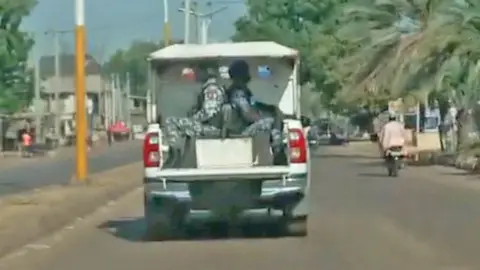
    Gift Ufuoma/BBC A police 4x4 truck with two officers on the back and acting as a security escort drives along a tarmac road lined with trees in north-western Nigeria.Gift Ufuoma/BBC

    The police provided a security escort from Sokoto city to the remote village of Nukuru – a journey of around 70km

    “They came on about 15 motorcycles,” he told the BBC, explaining that there were three fighters to each bike.

    He heard them phoning others, urging them to leave quickly, before escaping on motorbikes.

    “It seems they were devastated – we were afraid too,” he said. “They were not carrying any dead person, they just carried some luggage.”

    It is unclear if there were any casualties in the strikes on the two camps ordered by US President Donald Trump.

    But the residents of Nukuru – a tiny hamlet with around 40 mud-walled and thatched houses and clay granaries used to store the crops harvested a few months ago – can vouch for the ferocity of the missiles.

    “The doors and roof were shaking, old roofs were torn,” a 70-year-old man told us.

    “We couldn’t sleep because everywhere was shaking. We couldn’t figure out what it was, and we heard things falling from the sky, and then there was fire.”
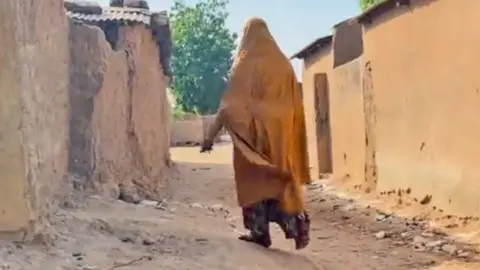
    Gift Ufuoma/BBC A woman wearing a mustard-coloured robe, seen from behind, walking through a  street in Nukuru with mud-walled buildings on either side.Gift Ufuoma/BBC

    The residents of Nukuru village have had to pay taxes to Lakurawa militants for several years

    Yet the villagers fear the militants will be able to regroup. They are agile and use motorbikes to move quickly across the region’s rough and rugged terrain.

    It is not hard to see how the group has been able to gain a foothold here as there is very little sign of a government presence.

    There are no visible schools, hospitals or paved roads. Much of the terrain can only be reached using vehicles capable of navigating rough desert paths.

    In Nukuru, the villagers’ main means of transport appeared to be donkeys.

    They said that by day the Lakurawa militants come into the community – having established themselves as the de facto governing authority.

    The farmers and villagers have no option but to agree to their terms and taxes as the Islamists are well-armed. If they do not comply, they are attacked and their livestock is stolen.

    The farmer who spoke to the BBC said the fighters passed through his hamlet most days on their way to other communities.

    “We knew they are Lakurawa because of their dressing,” he said, describing their camouflage uniforms and their turbans usually worn by men in desert areas of Mali and Niger.

    Amongst themselves the militants spoke Fulfude – the language of the Fulani ethnic group spoken in many West African countries – but communicated with the locals in Hausa, the lingua franca of the region, he said.

    At night, the fighters go back to their isolated camps, which are on higher ground and give them a good vantage point over the plains. No women or families are thought to be living in these makeshift bases.

    When Lakurawa initially arrived in the largely Muslim states of Sokoto and Kebbi, the group presented itself as a religious force that wanted to help a vulnerable community in an insecure region.

    Nigeria faces an array of complex security issues. For the past 15 years, it has been the north-east of the country that has suffered from a devastating Islamist insurgency at the hands of jihadist groups such as Boko Haram.

    But more recently swathes of the country’s north-west have been terrorised by criminal gangs, known locally as bandits, who make money by kidnapping and holding people for ransom.

    When Lakurawa moved into communities along the Niger-Nigeria border, it prompted the bandits to move elsewhere.

    At first, this is thought to have ingratiated the group with some locals – but this was short-lived. People in Tangaza area say the religious militants became heavy-handed, and began enforcing harsh rules and spreading fear.

    A resident of Nukuru spoke about the hard-line, strict Muslim ideology the militants have imposed – including banning things they deem to be against Islamic Sharia law.

    “We cannot live freely,” the young man told the BBC. “You cannot even play music on your phone – they will not only confiscate it, but also punish you.”

    Music is seen as distracting from religious duties or encouraging of immoral behaviour by some highly conservative Muslim sects – and offenders have been flogged.

    Some Lakurawa militants are thought to have married into border communities – keeping their families away from the camps – and recruited young people.

    Some of these recruits are used as informants, while others help the militants trade or gather supplies from residents.
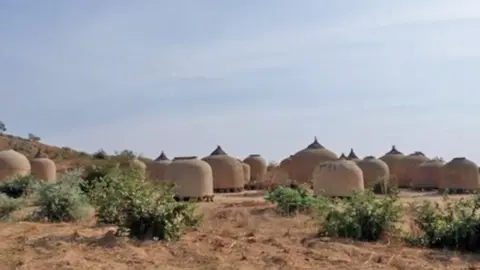
    Gift Ufuoma/BBC Around 15 clay granaries in Nukuru Gift Ufuoma/BBC

    These granaries are used to store crops harvested after the rainy season

    The strikes on Thursday were the second time the group has been targeted in operations on a Christmas Day.

    Last Christmas, Nigeria’s military launched an attack against them near Gidan Sama and Rumtuwa, several kilometres from Nukuru. Around 10 civilians were killed.

    A month later, several days after Trump’s inauguration, the Nigerian government designated the group a terrorist organisation.

    The militants were accused in court documents of cattle rustling, kidnapping for ransom, hostage-taking and attacks on senior government officials.

    The move gave the government sweeping powers to take strong action against the group.

    When Trump announced his Christmas Day strikes, he said it was because the group was “viciously killing, primarily, innocent Christians, at levels not seen for many years, and even centuries”.

    Nigeria’s Foreign Minister Yusuf Maitama Tuggar has been at pains to point out that the recent strikes were a “joint operation” and “nothing to do with a particular religion”.

    Most of the villagers and farmers who live in the shadow of the militants are Muslims, not Christians.

    But should the US-Nigerian operation be able to dismantle Lakuwara’s hold over their lives, it is clear they will be grateful to be free of the terror.

    Additional reporting by Abayomi Adisa and Gift Ufuoma
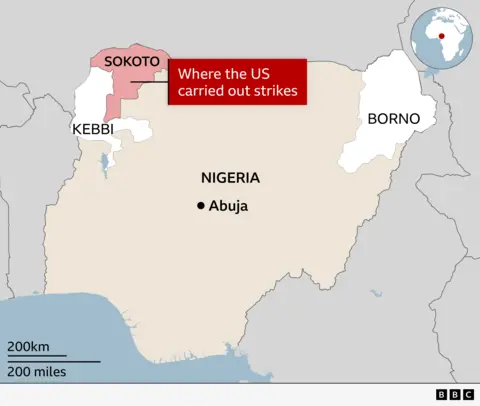
    Map of Nigeria

    More BBC stories on Nigeria’s security crisis:

    Getty Images/BBC A woman looking at her mobile phone and the graphic BBC News AfricaGetty Images/BBC


    Source link

  • Five-year-old boy dies after getting caught in ski travelator

    Five-year-old boy dies after getting caught in ski travelator


    A five-year-old boy in Japan has died while on a ski holiday with his family after his arm caught on a travelator.

    On Sunday morning Hinata Goto was about to step off the travelator at a Hokkaido resort’s ski slopes when he fell down and his right arm became trapped in the machinery, Japanese media reported citing police.

    The travelator was equipped with a safety mechanism, but it failed to activate. The machine only halted when the boy’s mother hit the emergency stop button.

    Rescue workers spent 40 minutes dismantling part of the travelator to free the boy, who by then had fallen unconscious. He was later pronounced dead at the hospital.

    Staff at the Asarigawa Onsen Ski Resort in Otaru said that the travelator’s safety mechanism, which was designed to immediately halt operations if it detected that an object was trapped in the machinery, had worked earlier in the day.

    Police are investigating the incident to assess whether there was any professional negligence, such as in the manufacturing and maintenance of the travelator.

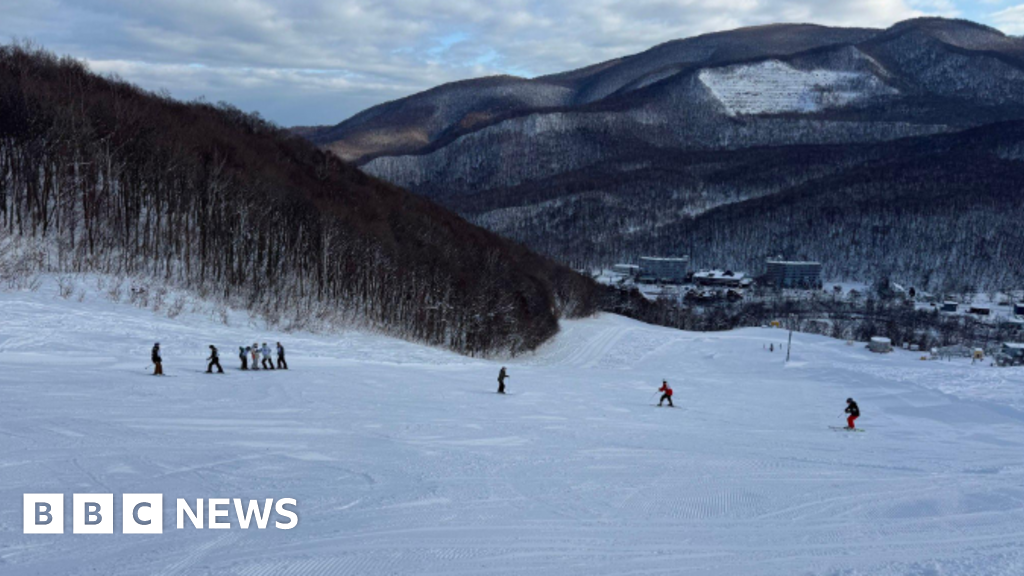
    Installed about six years ago, the travelator is about 30m (98 ft) long and 60cm (24 in) wide, with no hand rails. It connects the resort’s car park to the ski slopes.

    Japanese media quoted other visitors saying that they have stumbled while using the same travelator.

    “Even as an adult, there are times when I think, ‘It’s a little scary’,” a regular customer told Asahi Shimbun.

    A representative of Asarigawa Onsen Ski Resort apologised for the incident and said they will take action to prevent a recurrence.

    Hokkaido is known to be the ski capital of Japan and welcomes millions of visitors every year, with the bulk of them staying during the winter months for ski holidays.


    Source link

  • Home secretary urged to strip activist of British citizenship

    Home secretary urged to strip activist of British citizenship


    Alex Kleidermanand

    Harry Sekulich

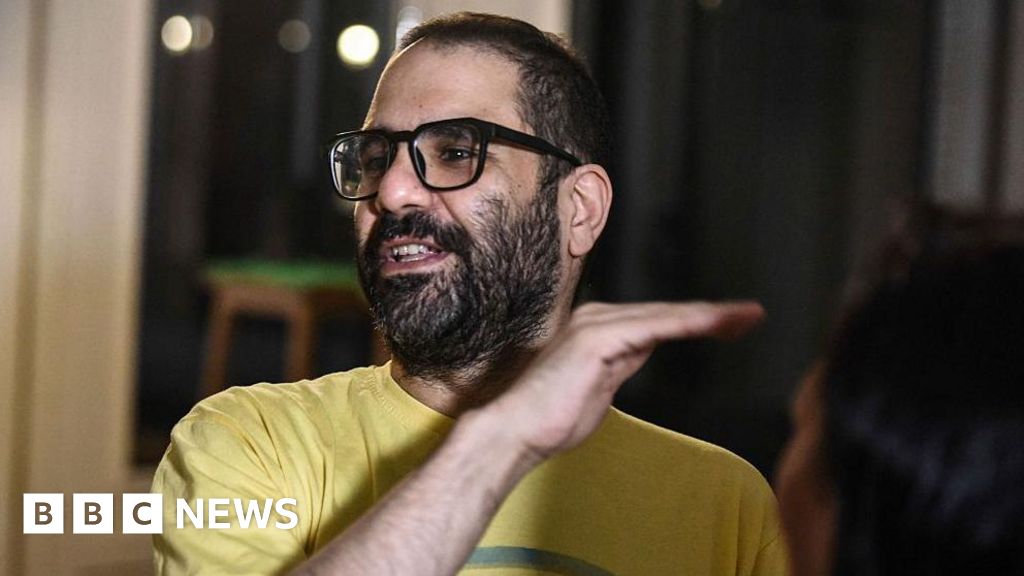
    MOHAMED EL-RAAI/AFP via Getty Images Alaa Abdel Fattah in Cairo on 23 September 2025MOHAMED EL-RAAI/AFP via Getty Images

    British-Egyptian democracy activist Alaa Abd El Fattah has apologised for several of his old tweets that have resurfaced, as calls grow for him to be deported from the UK days after he arrived following his release from an Egyptian jail.

    Tory and Reform UK leaders say the home secretary should consider whether Abd El Fattah, a dual national, can be removed after social media messages showed him calling for Zionists and police to be killed.

    The Times reports some senior Labour MPs are also calling for his citizenship to be removed.

    After reviewing the historic posts, Abd El Fattah said: “I do understand how shocking and hurtful they are, and for that I unequivocally apologise.”

    He added: “I am shaken that, just as I am being reunited with my family for the first time in 12 years, several historic tweets of mine have been republished and used to question and attack my integrity and values, escalating to calls for the revocation of my citizenship.”

    Abd El Fattah said he took allegations of antisemitism “very seriously” while arguing some of the posts had been “completely twisted out of their meaning”.

    Sir Keir Starmer has been criticised for saying he was “delighted” by Abd El Fattah’s arrival in the UK on Friday, three months after he was freed from prison in Egypt, but it is understood he was unaware of the historical messages.

    Conservative leader Kemi Badenoch and Reform UK leader Nigel Farage both said Home Secretary Shabana Mahmood should look at whether Abd El Fattah’s citizenship could be revoked to enable his swift removal from the UK.

    Farage said in a letter to Mahmood: “It should go without saying that anyone who possesses racist and anti-British views such as those of Mr el-Fattah should not be allowed into the UK.”

    The Foreign Office said it had been “a long-standing priority under successive governments” to work for Abd El Fattah’s release and see him reunited with his family in the UK, but condemned his posts as “abhorrent”.

    The 44-year-old was convicted in 2021 of “spreading fake news” in Egypt for sharing a Facebook post about torture in the country following a trial that human rights groups said was grossly unfair.

    He was granted citizenship in December 2021 through his London-born mother – when the Conservatives were in power and Dame Priti Patel was home secretary.

    Shadow home secretary Chris Philp – who was immigration minister under Patel – told the BBC he did not know of these details in 2021. He added he was now clear in his mind that “this man should have his citizenship revoked”.

    “There is no excuse for what he wrote,” Philp told BBC Radio 4’s Today programme.

    PA Media Shadow home secretary Chris Philp wears a blue suit and tie.PA Media

    In one resurfaced tweet, from 2012, Abd El Fattah appears to say: “I am a racist, I don’t like white people”. In another, he says he considers “killing any colonialists and specially Zionists heroic, we need to kill more of them”.

    He is also accused of saying police do not have rights and “we should kill them all”.

    “There is no excuse for that kind of language,” Philp said on Monday. “People who express that kind of hatred, that kind of anti-white racism, that kind of extremism who seek to incite violence, have no place in the United Kingdom.”

    Appearing on the same programme, Dame Emily Thornberry, who chairs the Commons foreign affairs committee, accused Philp of “throwing ideas around that were just not based in law”.

    “The bottom and top of it is that he [Abd El Fattah] is a British citizen,” she told Today.

    “He was entitled to British citizenship, he claimed it so he is a British citizen. The British government has been doing their utmost to get him back into the country and out of jail.”

    Labour MP Emily Thornberry wears a red jacket and dark top.

    The UK has responsibilities under international law to avoid leaving people stateless and British citizenship can only be stripped from someone eligible to apply for citizenship in another country.

    Badenoch said Abd El Fattah’s reported comments were “disgusting and abhorrent” and anti-British, adding that citizenship decisions “must take account of social media activity, public statements, and patterns of belief”.

    She said: “It is one thing to work for someone’s release from prison if they’ve been treated unfairly as previous governments did. It is quite another to elevate them, publicly and uncritically, into a moral hero.”

    She added that Abd El Fattah “should have received a free and fair trial in Egypt”, but “there ends my sympathy”.

    In his letter to the home secretary, Farage said it was “astonishing” that neither MPs from Labour, the Conservatives or other parties carried out “basic due diligence” on Abd El Fattah while they campaigned for his release.

    He said Starmer showed an “extraordinary error of judgement” when he posted on X welcoming Abd El Fattah’s return.

    The Board of Deputies of British Jews said the case was of “profound concern”.

    Adrian Cohen, the board’s senior vice-president, said: “His previous extremist and violent rhetoric aimed at ‘Zionists’ and white people in general is threatening to British Jews and the wider public.

    “The cross-party campaign for such a person, and the warm welcome issued by the government, demonstrate a broken system with an astonishing lack of due diligence by the authorities.”

    While conceding some of his comments were “shocking and hurtful”, Abd El Fattah contends some of the old messages were misinterpreted.

    “For example, a tweet being shared to allege homophobia on my part was actually ridiculing homophobia,” he said in a statement.

    “I have paid a steep price for my public support for LGBTQ+ rights in Egypt and the world.”

    A writer, intellectual and software developer, Abd El Fattah rose to prominence during an uprising in 2011 that forced the former Egyptian president, Hosni Mubarak, to resign.

    He has spent more than a decade of his life behind bars and his release in September after a presidential pardon followed a long campaign by his family and lobbying by the British government.

    In 2014, Abd El Fattah was nominated for a European human rights award, the Sakharov Prize, but this was withdrawn over tweets about Israel he posted in 2012.

    He said those comments had been part of a “private conversation” that took place during an Israeli offensive in Gaza and had been taken out of context.

    After being removed from a travel ban list imposed by Egyptian authorities that kept him in the country for three months after his release from jail, Abd El Fattah has now been reunited with his 14-year-old son, who lives in Brighton.


    Source link