Osaka’s mayor says he is ‘lost for words’ and that he has ‘nothing but appreciation’ for the gesture.
Source link
Category: Uncategorized
-

Mystery donor gives Japanese city $3.6m in gold bars to fix water system
-
Will the U.S. Go to War With Iran?
Welcome back to Foreign Policy’s SitRep, where your coauthors are fighting off jet lag after finally returning to the United States post-Munich Security Conference (with some stops in other cities along the way). John is also dealing with the shocking revelation that Rishi has never seen The Godfather, among other iconic films, which we hope he addresses by next week’s edition.
Alright, here’s what’s on tap for the day: The rising likelihood of U.S. strikes on Iran, the first Board of Peace meeting, and Trump’s mixed signals toward Taiwan.
There’s growing speculation that a new war could be on the horizon in the Middle East as the United States drastically boosts its military presence in the region amid rising tensions with Iran. It’s unclear if U.S. President Donald Trump has decided whether to attack—and his administration is still engaged in diplomatic talks with Iran—but the U.S. military could reportedly be prepared to strike as early as this weekend.
If diplomacy fails, Trump has not been clear on whether he would pursue regime change, as some of his allies in Congress have pushed for, or focus on further crippling Iran’s military and nuclear capabilities.
Trump has been threatening strikes for weeks—initially over Tehran’s deadly crackdown on mass anti-government protests but more recently in relation to his push for a nuclear deal. This makes it difficult to pinpoint what Trump’s endgame would be, particularly after the U.S. attack on key Iranian nuclear facilities last June. Trump claimed that those strikes “obliterated” Iran’s nuclear program, but the fact that the U.S. is still negotiating with Tehran over the matter is one of many pieces of evidence that that’s not the case.
The rising odds of a U.S. attack. To get a better picture of where this could all go, SitRep spoke with Jonathan Panikoff, who served as deputy national intelligence officer for the Near East at the U.S. National Intelligence Council from 2015 to 2020, including under the first Trump administration.
The development of the force posture in the region and the way it’s “increasing in size and scope, makes it less and less likely that you see the president walk away from strikes,” said Panikoff, who is now the director of the Scowcroft Middle East Security Initiative at the Atlantic Council.
The U.S. has roughly 12 warships deployed in the Middle East and will soon have two carrier strike groups in the region (the USS Gerald R. Ford carrier strike group, which until recently had been deployed in the Caribbean, is en route). The U.S. has also boosted its airpower in the region with an additional 50 fighter jets, as well as communications and refueling aircraft.
Panikoff said the fact that two carrier strike groups—both of which consist of thousands of personnel, dozens of aircraft, and accompanying warships—have been deployed stands out to him as a sign that the administration is planning to act and that it will be part of a “sustained campaign” rather than focused on an individual target. “If you’re planning for a campaign of weeks, not of hours or days, this is the type of footprint that you would need to put into the region,” he said.
Iranian retaliation should also be expected, and both U.S. forces and allies in the region such as Israel could be targets. “The longer it goes, the greater the set of targets the Iranians will seek,” Panikoff said.
Giving peace a chance (maybe). The Trump administration held a second round of indirect talks with Iran on its nuclear program in Geneva this week. Though both sides have expressed cautious optimism about the process and have left the door open for a third round of talks, Washington and Tehran remain at odds over key issues ranging from uranium enrichment to Iran’s ballistic program, and overcoming those disagreements will be difficult.
Trump on Thursday said that “good talks” are being had with Iran but that the years have shown that it’s difficult to reach a deal with the country. (Though it should be noted that the United States had a nuclear deal with Iran before Trump pulled the U.S. out of it during his first term.) Trump warned Tehran that it “must make a deal” or else “bad things will happen” and appeared to give Iran a deadline. “We may have to take it a step further, or we may not. Maybe we’re going to make a deal. You are going to be finding out over the next, probably, 10 days,” Trump said. Later, Trump told reporters that Iran had a “maximum” of 10 to 15 days to reach a deal.
For strikes to be avoided, Panikoff said, Iran would have to sign off on an “amazing” deal in which it agrees to stop enrichment of uranium (or to keep it close to zero), while also addressing Washington’s concerns on ballistic missiles and Tehran’s support for proxy groups in the region.
“I think there’s zero chance of that happening, and we’re edging closer to a conflict,” Panikoff said.
Unclear goals. If the U.S. does attack, an expansive list of targets is likely to be on the table, Panikoff said, including command-and-control centers, ballistic missile production facilities, and nuclear sites. The U.S. would likely begin its assault by moving to cripple additional air defenses and ballistic missile launchers, to protect both U.S. assets and allies in the region. From there, it’s possible that the U.S. could move to target the Iranian leadership—but Trump’s opaqueness on what the ultimate goal is makes it hard to predict.
Tricia McLaughlin, the spokesperson for the Department of Homeland Security who was one of the top defenders of Trump’s controversial immigration crackdown, is leaving the agency, she announced in a post on X this week. McLaughlin will be replaced by Katie Zacharia, a Fox News and Newsmax commentator.
That’s not the only recent spokesperson shake-up within the U.S. government. Col. Dave Butler, a spokesperson and strategic communications advisor at the Department of Defense, was reportedly forced out of the Pentagon at the behest of Secretary of Defense Pete Hegseth.
What should be high on your radar, if it isn’t already.
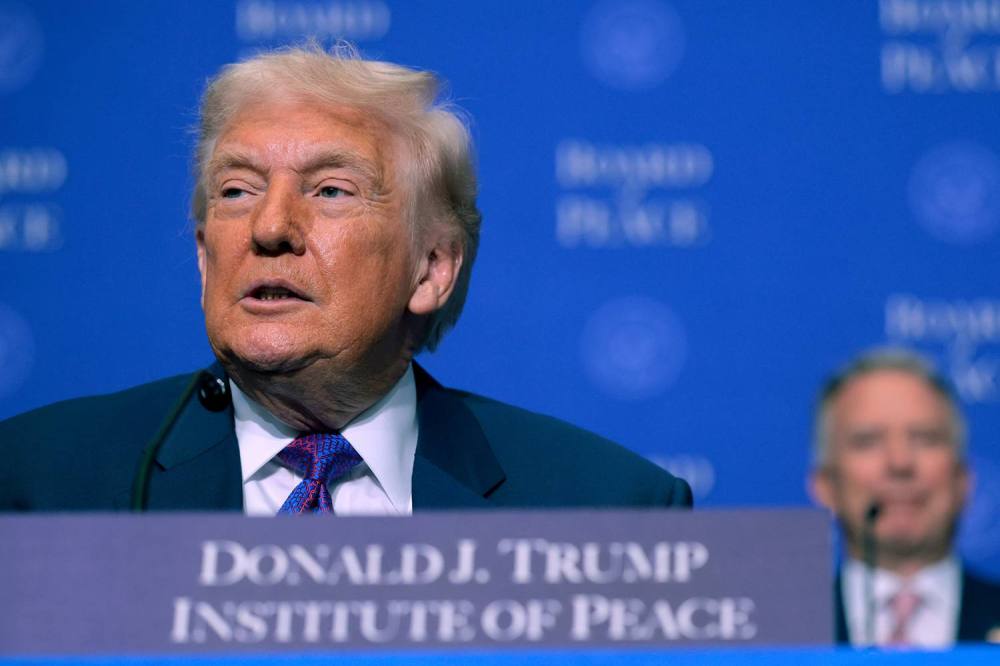
Board of Peace meets. Trump convened the first meeting of his Board of Peace in Washington on Thursday, with dozens of foreign officials and members of the Trump administration in attendance to discuss the future of Gaza.
At the event, Trump announced that nine members of the board have pledged to provide a total of $7 billion toward relief for the enclave and that the United States will contribute $10 billion, though he did not specify where that money will come from. In addition, five countries agreed to deploy troops to Gaza as part of an international stabilization force, with two others (Jordan and Egypt) committing to train police.
The Board of Peace, which was established on the sidelines of the World Economic Forum in January this year, aims to promote peacekeeping around the world and will oversee the Gaza peace plan that Trump brokered last year. But more than half of the 60 countries Trump invited to join have thus far declined, including several key U.S. allies.
Trump tiptoes around Taiwan. Weeks after greenlighting the biggest-ever U.S. weapons sales package to Taiwan, Trump is slow-walking further sales to the island under pressure from Chinese President Xi Jinping, the Wall Street Journal reported.
Trump told reporters on Monday that he was “talking” to Xi about further arms sales to Taiwan and would “make a determination pretty soon.” Trump is scheduled to travel to Beijing in April to meet with Xi, saying in a speech on Thursday that he hoped Xi would “put on the biggest display you’ve ever had in the history of China” for the visit.
While the Trump administration has continued to support Taiwan over the past year, a narrative of the island as a “strategic liability” has come to the surface among certain administration officials in Washington, Ryan Hass, a fellow and director of the China Center at the Brookings Institution and former China director on the National Security Council, wrote in a new report on Wednesday. “To protect its interests, the United States must also update its own story about why Taiwan matters and what Washington aims to achieve in cross-Strait relations,” he wrote, highlighting Taiwan’s centrality to the U.S. AI boom and pouring cold water on the notion that conflict between China and Taiwan is inevitable.
Yoon gets a life sentence. A court in Seoul sentenced Yoon Suk-yeol—the former South Korean president who attempted to impose martial law on the country in 2024—to life in prison on Thursday. The judge said that he found Yoon “guilty of rebellion for mobilizing military and police forces in an illegal attempt to seize the [National] Assembly, arrest political opponents and establish unchecked power for an indefinite period.”
Lawyers for Yoon, who was formally ousted last April and arrested in July, said they would evaluate whether to appeal the verdict. The court also convicted five other South Korean officials, including former Defense Minister Kim Yong-hyun, who was sentenced to 30 years in prison for his role in the insurrection.

Indian Prime Minister Narendra Modi is seen on a stage holding up his arms while holding hands with tech CEOs. Indian Prime Minister Narendra Modi (center) takes a group photo with AI company leaders at the AI Impact Summit in New Delhi on Feb. 19. Ludovic Marin/AFP via Getty Images
The United States, Russia, and Ukraine held another round of trilateral talks in Geneva this week, without any significant breakthroughs. Ahead of the talks, SitRep caught up with two of Moscow’s sharpest critics at the Munich Security Conference to get their views on the peace negotiations: Bill Browder, head of the Global Magnitsky Justice Campaign, and Sviatlana Tsikhanouskaya, the exiled Belarusian opposition leader. Though Trump has repeatedly said that he believes that Russian President Vladimir Putin is ready for a deal, both expressed skepticism.
Browder said it’s “absolutely accepted” among Europeans that Putin has “no intention” of ending the war in Ukraine. “There’s not a single European that I know who has any illusions about this negotiation,” Browder said, adding that it’s been “shameful” how Trump has “sided with Putin over Ukraine.” Browder called for Trump to impose sanctions on oil refineries in China, India, and Turkey purchasing Russian crude if he truly wants to end the war.
Tsikhanouskaya said that, as someone from the region, she knows “the nature of Putin” and that he doesn’t want the war to stop because it “fuels” his regime. She also emphasized the need for a “just and lasting peace” for Ukraine. “We can talk about a cease-fire, about stopping the war, but on what conditions?” she said. “If it is just a break for Russia to regroup” and for Putin to feel that he’s a “political winner in this war, he will take this advantage, regroup, and will attack again,” Tsikhanouskaya warned.
Saturday, Feb. 21: Indian Prime Minister Narendra Modi hosts Brazilian President Luiz Inácio Lula da Silva in New Delhi.
Sunday, Feb. 22: Laos conducts parliamentary elections.
Lula visits South Korea.
Tuesday, Feb. 24: Trump gives his State of the Union address.
Four-year anniversary of Russia’s invasion of Ukraine.
Wednesday, Feb. 25: Modi is expected to visit Israel.
67 percent—the increase in military aid that Europe allocated for Ukraine in 2025, compared to the 2022-24 average, according to new data from the German think tank Kiel Institute. That increase almost offset the 99 percent drop in U.S. aid last year, the report said.
“Don’t do any better than you did, please, because if you do, you’re outta here.”
—Trump joking about firing U.S. Secretary of State Marco Rubio for his well-received speech at the Munich Security Conference.
-

Austrian climber found guilty after girlfriend froze to death on mountain
The woman died of hypothermia during a climbing trip on the Grossglockner mountain in January 2025.
Source link