Category: Uncategorized

  • Indonesians raise white flags as anger grows over slow flood aid

    Indonesians raise white flags as anger grows over slow flood aid


    Kelly Ng,Singapore,

    Riana Ibrahim,BBC Indonesian, Jakartaand

    Raja Eben Lumbanrau,BBC Indonesian, Jakarta

    AFP via Getty Images Activists protest with white flags in front of a mosque in Banda Aceh to demand that the Indonesian government opens the door to foreign aidAFP via Getty Images

    People in Indonesia’s Aceh province are raising white flags as a call for international solidarity

    For weeks now, angry and distressed residents in Indonesia’s westernmost province have been raising white flags over the state’s slow response to a series of deadly floods.

    Triggered by a rare cyclone in November, the deluge killed more than 1,000 people and displaced hundreds of thousands across the island of Sumatra. In Aceh, the worst-hit province which accounted for nearly half of the deaths, many still do not have ready access to clean water, food, electricity and medical supplies.

    In a sign of just how frustrating managing the crisis has become, the governor of North Aceh broke down publicly earlier this month.

    “Does the central government not know [what we’re experiencing]? I don’t understand,” a tearful Ismail A Jalil said in front of cameras.

    But President Prabowo Subianto has refused foreign aid, insisting the situation is “under control”.

    “Indonesia is capable of overcoming this disaster,” he told his cabinet last week. Prabowo has also ignored calls to declare it a national disaster, which would unlock emergency funds and streamline relief efforts.

    Prabowo’s administration has increasingly been criticised as reactive, disorganised and out of touch – adjectives that some analysts say have come to define his presidency, which he won in February 2024 on the back of populist pledges.

    Already this year, his flagship billion-dollar free school meals programme has been mired in controversy over mass food poisonings. In August and September, thousands of Indonesians took to the streets over unemployment and rising costs of living, in what were some of the biggest protests the country has seen in decades.

    And now his government’s response to November’s floods has become yet another challenge for the leader, even as his approval ratings have held steady at about 78%.
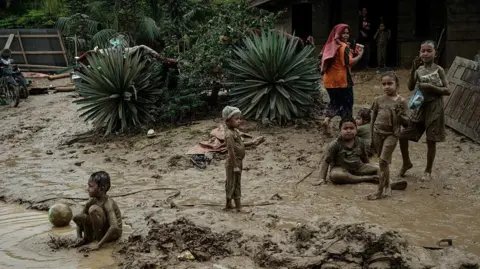
    AFP via Getty Images Children play in a muddy puddle in Aceh TamiangAFP via Getty Images

    Many in Aceh still do not have ready access to clean water, food and electricity

    Desperate calls for help

    Last Thursday, dozens of protesters rallied in Aceh’s capital, Banda Aceh, waving white flags and demanding that the central government opens the door to foreign aid.

    Standing among the crowd was a little girl holding a sheet of paper, which read: “I am just three years old, I want to grow up in a safe and sustainable world.”

    Though typically seen as a symbol for surrender, the white flags that have popped up across the province – on broken rooftops, along eroded riverbanks and outside mosques – are a call for international solidarity, protesters say.

    “The flags do not mean we are giving in. They are a distress signal to grab the attention of friends outside, to let them know the conditions in Aceh today are very bad,” Husnul Khawatinnissa, who was at the rally, told the BBC.

    Entire villages have been wiped out, while widespread damage to roads and infrastructure has also isolated many communities. Survivors have spoken of sickness and starvation.

    “How long more do we have to wash ourselves in mud and floodwaters,” shouted Nurmi Ali, another demonstrator.

    Provincial authorities have reached out to the United Nations for support, with the Aceh governor declaring that he welcomes help “from anyone, anywhere”.

    Prabowo’s administration has said relief efforts are under way on a “national scale”, noting that it has disbursed some 60 trillion rupiah ($3.6bn) for reconstruction efforts.

    Disaster strikes again

    For some in Aceh, the situation brings back painful memories of the 2004 Boxing Day tsunami, one of the worst natural disasters ever.

    A magnitude 9.1 undersea earthquake unleashed a tsunami that triggered waves up to 30m (100 feet) high which slammed into the Indian Ocean coastline that morning, killing an estimated 230,000 people in more than a dozen countries.

    Aceh, already ravaged by decades of civil war, was among the hardest-hit. Locals say they had only recently finished rebuilding their lives when disaster struck again in November.

    Relief arrived more quickly after the 2004 tsunami, even though it was far more devastating, they say.

    Various countries, multilateral agencies like the World Bank, and private organisations poured billions of dollars into the recovery effort. The Indonesian government then set up a dedicated agency to manage funds and aid projects.

    “Everyone took action and the community recovered quickly after the tsunami. What we’re suffering now is worse,” said Rindu Majalina, who was a high-school student when the tsunami struck.

    The mother of three has been struggling to feed her children since the recent floods swallowed their home. Residents “fight like zombies” for every bit of supply delivered to her village “because we are starving”, she added.

    Several countries have offered aid. The UAE, for instance, sent 30 tonnes of rice and 300 relief packages to Medan, another city hit by the floods – but it was all sent back by authorities following what they described as “guidance” from the central government.
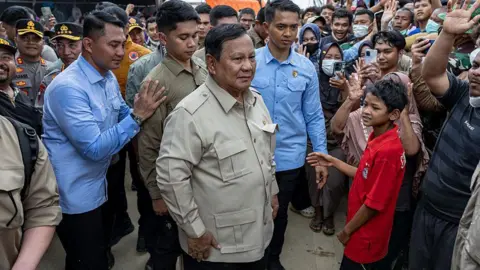
    Getty Images Indonesia President Prabowo Subianto (centre, wearing cream shirt) is surrounded by a crowd of residents during his visit to Aceh Tamiang following the deadly floodsGetty Images

    Prabowo Subianto (centre) and his administration have increasingly been criticised as out of touch

    The president’s refusal to accept international aid is his way of asserting authority, said Vidhyandika Djati Perkasa, a senior politics researcher at Indonesia’s Centre for Strategic and International Studies.

    “Opening the door to foreign assistance means inviting foreign scrutiny, which they do not want… [Prabowo] doesn’t want to be seen as a failure and is trying to maintain his image,” Mr Perkasa said, noting however that this could backfire politically.

    Prabowo has prioritised the “symbolic performance of sovereignty” over crisis management, said Vedi Hadiz, an Asian studies professor at the University of Melbourne.

    Critics say the government has little understanding of the situation on the ground. Some also accuse Prabowo of being insensitive toward flood victims by promoting the expansion of palm oil plantations – environmental groups say the deforestation caused by that has also worsened the floods.

    Rindu Majalina said she initially thought herself fortunate to have survived the floods, “but it turns out the post-disaster situation is even worse”.

    “It has been very painful and miserable,” she said. “Everything has come to a complete standstill, from markets to schools to offices. My children don’t know if they’ll ever be able to go back to school.”

    With reporting by Akramul Muslim, Rino Abonita and Nanda Fahriza Batubara in Aceh


    Source link

  • India’s renewable energy boom faces a hidden waste problem

    India’s renewable energy boom faces a hidden waste problem


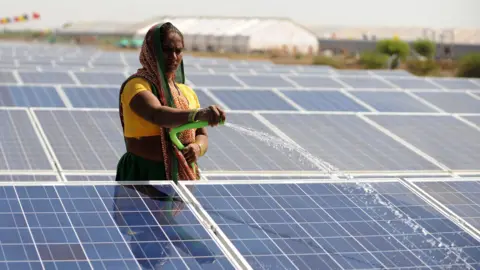
    AFP via Getty Images An Indian worker sprays water onto panels of India's first 1MW canal-top solar power plant at Chandrasan village of Mehsana district, some 45 kms from Ahmedabad on World Earth Day, April 22, 2012.AFP via Getty Images

    India gets plenty of sunlight throughout the year, which makes solar power highly efficient

    India’s rapid solar energy expansion is widely hailed as a success. But without a plan to manage the waste it will generate, how clean is the transition?

    In just over a decade, India has become the world’s third-largest solar producer, with renewables now central to its climate strategy. Solar panels are everywhere – from vast solar parks to blue rooftops across cities, towns and villages.

    Alongside large solar parks, millions of rooftop systems now feed power into the electricity grid. Government data show nearly 2.4 million households have adopted solar under a subsidy scheme.

    Solar growth has cut India’s reliance on coal. Though thermal and other non-renewables still supply over half of installed capacity, solar now contributes more than 20%. Yet the achievement carries a challenge: while clean in use, solar panels can pose environmental risks if not properly managed.

    Solar panels are mostly recyclable, made of glass, aluminium, silver, and polymers – but trace toxic metals like lead and cadmium can pollute soil and water if mishandled.

    Solar panels typically last about 25 years, after which they are removed and discarded. India currently has no dedicated budget for solar-waste recycling and only a few small facilities to process old panels.

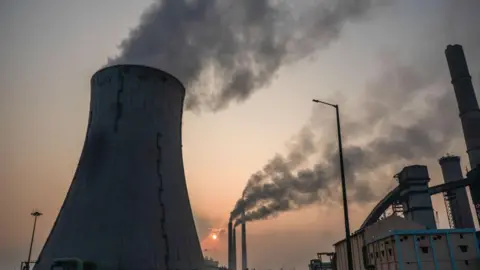
    Bloomberg via Getty Images A cooling tower and chimneys at the NLC Tamil Nadu Power Ltd. (NTPL) power plant in Tuticorin, India, on Monday, March 18, 2024. Bloomberg via Getty Images

    Thermal power plants continue to dominate India’s energy generation capacity

    India has no official data on solar waste, but a study estimated around 100,000 tonnes by 2023, rising to 600,000 tonnes by 2030. For now, the volume is small, but experts warn the bulk is yet to come – and without rapid recycling investment, India could face a growing waste crisis.

    A new study by the Council on Energy, Environment and Water (CEEW) estimates that India could generate more than 11 million tonnes of solar waste by 2047. Managing this would require almost 300 dedicated recycling facilities and an investment of $478 (£362m) over the next two decades.

    “Most of India’s large solar parks were built in the mid-2010s, so the real wave of waste is coming in 10 to 15 years,” says Rohit Pahwa of energy company Targray.

    India’s solar-waste projections mirror global patterns: the US may generate 170,000–1 million tonnes and China nearly one million tonnes by 2030, following rapid solar expansion in the 2010s.

    The policy landscape, however, differs significantly.

    In the US, solar-panel recycling is mostly market-driven under a patchwork of state rules. China’s system, like India’s, is still developing and lacks a dedicated regulatory framework.

    In 2022, India brought solar panels under e-waste rules, making manufacturers responsible for collecting, storing, dismantling and recycling them at end of life.

    Experts say enforcement is uneven, especially for home and small-scale panels, which make up 5–10% of installations. Though modest, these panels can still generate substantial waste, as they are harder to track, collect, and recycle.

    Damaged or discarded panels often end up in landfills or with unauthorised recyclers, where unsafe methods can release toxic materials. The BBC has contacted India’s renewable energy ministry for comment.

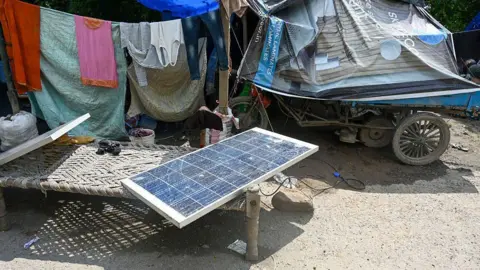
    Hindustan Times via Getty Images OIDA, INDIA - SEPTEMBER 4: Flood-affected residents on Noida's Pushta Road installed solar panels in their homes to cope with the darkness, on September 4, 2025 in Noida, India. Hindustan Times via Getty Images

    Damaged and ageing rooftop panels are rarely recycled

    “Solar power gives an illusion of clean energy for two decades, but without a serious plan for recycling panels it risks leaving behind a graveyard of modules and not much of a legacy,” says environment expert Sai Bhaskar Reddy Nakka.

    Despite the challenges, experts say the problem is not without opportunities.

    “As waste rises, so will the demand for companies that know how to process it,” Mr Pahwa says.

    Efficient recycling could reclaim 38% of materials for new panels by 2047 and prevent 37 million tonnes of carbon emissions from mining, says CEEW.

    India already has markets for glass and aluminium, and metals found in solar cells – silicon, silver, and copper – can be recovered for new panels or other industries, says Akansha Tyagi, co-author of the study.

    Currently, most solar waste is processed with basic methods that recover only low-value materials like glass and aluminium, while precious metals are lost, damaged or extracted in tiny amounts.

    Experts say the next decade will be decisive for India’s solar goals. The country must act fast – building a regulated, self-sustaining recycling system, raising household awareness, and integrating waste collection into solar business models.

    Companies that profit from solar power should also be responsible for what happens to panels once they stop working, says Mr Nakka.

    “Without proper recycling, clean energy today could mean more waste tomorrow,” he warned.

    Follow BBC News India on Instagram, YouTube, X and Facebook.


    Source link

  • US judge blocks detention of British social media campaigner

    US judge blocks detention of British social media campaigner


    A US judge has temporarily blocked the detention of British social media campaigner Imran Ahmed, who took legal action against the US government over having his visa removed.

    The Center for Countering Digital Hate founder was among five people denied US visas after the Trump administration accused them of seeking to “coerce” tech platforms into censoring free speech.

    The move brought a backlash from European leaders defending the work of organisations monitoring online content.

    Mr Ahmed, a US permanent resident, had warned that being detained and possibly deported would tear him away from his American wife and child. Praising the judge’s decision, he told BBC News he would not be “bullied”.

    Secretary of State Marco Rubio had said online that the individuals were blocked over concerns that they had organised efforts to pressure US platforms to censor and “punish American viewpoints they oppose“.

    Mr Ahmed filed a legal complaint on Wednesday against officials including Rubio and US Attorney General Pamela Bondi over the decision to have him sanctioned.

    In court documents seen by the BBC, US District Judge Vernon S Broderick said on Thursday he had granted Mr Ahmed’s request for a temporary restraining order.

    The judge also temporarily blocked the officials from detaining Mr Ahmed without the chance for his case to be heard.

    The BBC has contacted the state department and White House for comment.

    When approached by AFP news agency, a state department spokesperson was quoted as saying: “The Supreme Court and Congress have repeatedly made clear: the United States is under no obligation to allow foreign aliens to come to our country or reside here.”

    Mr Ahmed said: “I will not be bullied away from my life’s work of fighting to keep children safe from social media’s harm and stopping antisemitism online.”

    His lawyer, Roberta Kaplan, said the speed of the judge’s decision was telling.

    “The federal government can’t deport a green card holder like Imran Ahmed, with a wife and young child who are American, simply because it doesn’t like what he has to say,” she said.

    In 2023, Mr Ahmed’s centre was sued by Elon Musk’s social media company after it reported on a rise in hate speech on the platform since the billionaire’s takeover of the firm, now called X.

    The case was dismissed but an appeal is pending.


    Source link