A US judge has temporarily blocked the detention of British social media campaigner Imran Ahmed, who took legal action against the US government over having his visa removed.
The Center for Countering Digital Hate founder was among five people denied US visas after the Trump administration accused them of seeking to “coerce” tech platforms into censoring free speech.
The move brought a backlash from European leaders defending the work of organisations monitoring online content.
Mr Ahmed, a US permanent resident, had warned that being detained and possibly deported would tear him away from his American wife and child. Praising the judge’s decision, he told BBC News he would not be “bullied”.
Secretary of State Marco Rubio had said online that the individuals were blocked over concerns that they had organised efforts to pressure US platforms to censor and “punish American viewpoints they oppose“.
Mr Ahmed filed a legal complaint on Wednesday against officials including Rubio and US Attorney General Pamela Bondi over the decision to have him sanctioned.
In court documents seen by the BBC, US District Judge Vernon S Broderick said on Thursday he had granted Mr Ahmed’s request for a temporary restraining order.
The judge also temporarily blocked the officials from detaining Mr Ahmed without the chance for his case to be heard.
The BBC has contacted the state department and White House for comment.
When approached by AFP news agency, a state department spokesperson was quoted as saying: “The Supreme Court and Congress have repeatedly made clear: the United States is under no obligation to allow foreign aliens to come to our country or reside here.”
Mr Ahmed said: “I will not be bullied away from my life’s work of fighting to keep children safe from social media’s harm and stopping antisemitism online.”
His lawyer, Roberta Kaplan, said the speed of the judge’s decision was telling.
“The federal government can’t deport a green card holder like Imran Ahmed, with a wife and young child who are American, simply because it doesn’t like what he has to say,” she said.
In 2023, Mr Ahmed’s centre was sued by Elon Musk’s social media company after it reported on a rise in hate speech on the platform since the billionaire’s takeover of the firm, now called X.
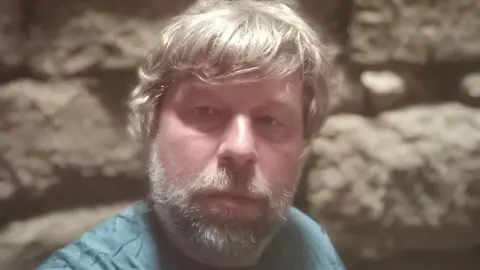
A selfie taken by Alexander Butyagin earlier this year at an ancient site in Crimea
A Russian archaeologist detained in Poland is at the centre of an intense debate over the role of museums and experts and the role they play in Kremlin war propaganda.
Alexander Butyagin is under arrest in Warsaw, awaiting a Polish court decision on a request to extradite him to Ukraine.
Until now, courts across Europe have been reluctant to extradite Russians to Ukraine, citing the European Convention on Human Rights.
Butyagin’s case has divided opinion.
A senior scholar at the Hermitage, Russia’s largest art museum in St Petersburg, he has led the museum’s expedition at the site of Myrmekion in Crimea since 1999, well before Russia’s illegal landgrab of Ukraine’s southern peninsula in 2014.
Supporters argue his work has helped preserve Crimea’s ancient heritage, but critics say he is no better than a looter of Ukrainian history making the most of Russia’s occupation.
Getty Images
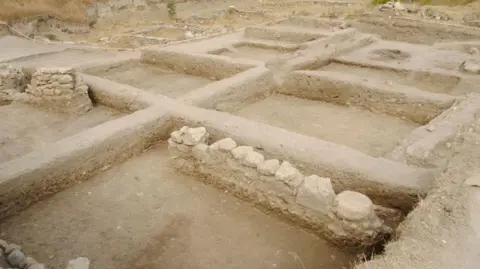
Site of Myrmekion in Crimea
Myrmekion dates back to the 6th Century BC, when the Ancient Greeks settled in Crimea as democracy was being born in Athens.
Butyagin’s expedition has uncovered hundreds of ancient coins at the site, some from Alexander the Great’s period in the 4th Century BC.
His expedition continued after Russia seized Crimea from Ukraine, and a criminal case was opened against him by Ukrainian authorities for working there without authorisation.
In November 2024, he was placed on a wanted list, and in April 2025 a Kyiv court ordered his arrest in absentia. Butyagin is accused of illegal excavations and “illegal partial destruction” of an archaeological complex.
Under the 2nd Protocol to the Hague Convention for the protection of cultural property in the event of armed conflict, occupying authorities “shall prohibit and prevent” any archaeological excavations with only a few, narrow exceptions.
Both Poland and Ukraine are parties to the protocol, while Russia is not.
AFP via Getty Images
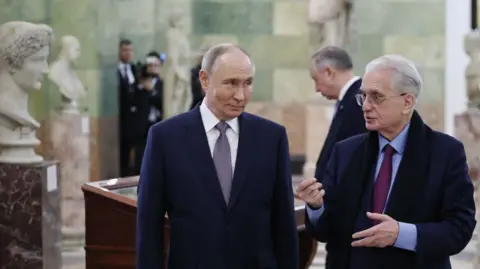
Hermitage director Mikhail Piotrovsky has endorsed Vladimir Putin and the invasion of Ukraine
Excavations, however ethical, amount to destruction if they take place without permission and under conditions of armed conflict, says Evelina Kravchenko, a senior researcher at the Institute of Archaeology of the National Academy of Sciences of Ukraine.
Butyagin “violated the Hague Convention, and all his problems stem from that”, says Krachenko, whose committee issued permits for Russian archaeologists to work in Crimea before its annexation.
Butyagin told Russian media last year he was “simply doing the work we’ve devoted our lives to”, and that his main goal was preserving monuments.
Getty Images
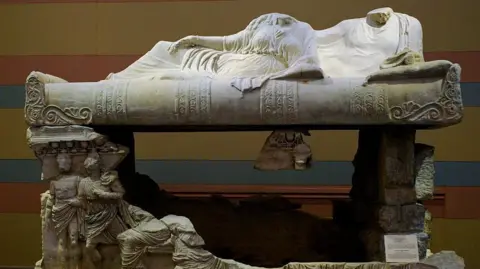
This ancient Roman sarcophagus from Myrmekion has been in the Hermitage collection since 1851
The Hermitage press office insisted Butyagin’s work complied with all international legal and ethical norms “regardless of geopolitical circumstances.”
A senior archaeologist from the museum told the BBC that Butyagin had followed the only path available for Russian archaeologists working in Crimea.
“A Russian archaeologist, if he wants to continue his research, has no opportunity to obtain permits from the Ukrainian side, but must obtain them from the Ministry of Culture of the Russian Federation,” said the scholar who spoke on condition of anonymity as he was not authorised to comment on the case.
Several Ukrainian sources have also accused Butyagin of “looting” objects by taking them to Russia, although these charges are not part of Ukraine’s case.
Both the archaeologist and the Hermitage insist all their finds remain in Crimea as they are transferred to the Eastern Crimean Museum in Kerch. They argue that objects can only be relocated to Russia temporarily for restoration or as exhibition loans.
However, this violates Ukrainian law too, as all discoveries must go into Ukraine’s museum fund. Under the terms of Russia’s illegal annexation, the Eastern Crimean Museum collection has instead been made part of Russia’s museum fund.
Since the start of the war, several European courts have refused Ukraine’s requests to extradite Russians, citing potential risks under the European Convention, which prohibits politically motivated persecution, violations of the right to a fair trial, and torture and inhuman treatment of detainees.
Even if the Polish court deciding Butyagin’s case does find sufficient grounds to extradite him, it might not go ahead, says Gleb Bogush, a researcher at the Institute for International Peace and Security Law at the University of Cologne.
Last June, Denmark’s Supreme Court ruled against extraditing to Ukraine a Russian national suspected of espionage for Moscow.
Gleb Bogush says it is primarily the Russian state and its officials that are responsible for Crimean excavations, rather than Butyagin, because it was not up to archaeologists to decide whether the Hermitage expedition should continue.
A senior Hermitage employee told the BBC that “a field archaeologist cannot be a citizen of the world; he deals with officials, obtaining permits and has to look for funding and volunteers”.
Butyagin has attracted support not just from the Kremlin but from Russians who oppose Putin and the war.
“The claims being made against him are absurd,” said Arseny Vesnin, an exiled journalist and historian. He said Butyagin had ensured conservation and preservation of the site he was excavating.
Others maintain that artefacts would have been looted by criminals and sold on the black market if Russian archaeologists had refused to work in Crimea.
That does not justify their actions, says Samuel Andrew Hardy, a leading British criminologist specialising in the protection of cultural property in conflict zones.
Official excavations do not always stop criminal digs from taking place, he argues. Some looters target sites that have already been excavated.
Hardy says all that Butyagin’s supporters are doing is arguing that ultimately Russia should just be allowed to carry on doing what it wants regardless of the war.
President Donald Trump has said the US launched a “powerful and deadly strike” against the Islamic State (IS) group in north-western Nigeria.
The US leader described IS as ” terrorist scum”, accusing the group of “targeting and viciously killing, primarily, innocent Christians”.
Trump said the US military “executed numerous perfect strikes”, while the US Africa Command (Africom) later reported that Thursday’s attack was carried out in co-ordination with Nigeria in the Sokoto state.
Nigerian Foreign Minister Yusuf Maitama Tuggar told the BBC it was a “joint operation” targeting “terrorists”, and it “has nothing to do with a particular religion”.
Tuggar did not rule out further strikes, saying this depended on “decisions to be taken by the leadership of the two countries”.
In his post on Truth Social late on Thursday, Trump said that “under my leadership, our Country will not allow Radical Islamic Terrorism to prosper”.
He did not say at the time which killings he was referring to – but claims of a genocide against Nigeria’s Christians have been circulating in recent months in some right-wing US circles.
Meanwhile, US Defence Secretary Pete Hegseth said on Thursday he was “grateful for Nigerian government support & cooperation”.
“Merry Christmas!” he added, writing on X.
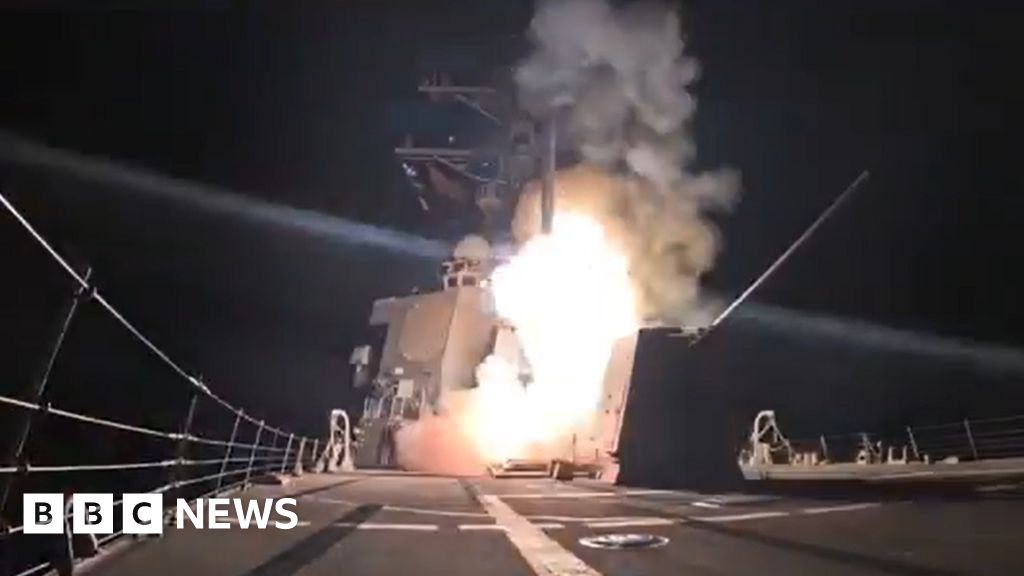
The US Department of Defense later posted an unclassified short video that appeared to show a missile being launched from a military vessel.
On Friday morning, the Nigerian foreign ministry said in a statement that the country’s authorities “remain engaged in structured security co-operation with international partners, including the United States of America, in addressing the persistent threat of terrorist and violent extremism.
“This has led to precision hits on terrorist targets in Nigeria by air strikes in the North West,” the statement said.
Groups monitoring violence say there is no evidence to suggest that Christians are being killed more than Muslims in Nigeria, which is roughly evenly divided between followers of the two religions.
An adviser to Nigerian President Bola Tinubu told the BBC at the time that any military action against the jihadist groups should be carried out together.
Daniel Bwala said Nigeria would welcome US help in tackling the Islamist insurgents but noted that it was a “sovereign” country.
He also said the jihadists were not targeting members of a particular religion and that they had killed people from all faiths, or none.
President Tinubu has insisted there is religious tolerance in the country and said the security challenges were affecting people “across faiths and regions”.
Trump earlier announced that he had declared Nigeria a “Country of Particular Concern” because of the “existential threat” posed to its Christian population. He said “thousands” had been killed, without providing any evidence.
This is a designation used by the US state department that provides for sanctions against countries “engaged in severe violations of religious freedom”.
Following this announcement, Tinubu said his government was committed to working with the US and the international community to protect communities of all faiths.
Jihadist groups such as Boko Haram and Islamic State West Africa Province have wrought havoc in north-eastern Nigeria for more than a decade, killing thousands of people – however most of these have been Muslims, according to Acled, a group which analyses political violence around the world.
In central Nigeria, there are also frequent clashes between mostly Muslim herders and farming groups, who are often Christian, over access to water and pasture.
Deadly cycles of tit-for-tat attacks have also seen thousands killed – but atrocities have been committed on both sides.
Human rights groups say there is no evidence that Christians have been disproportionately targeted.
The US Central Command (Centcom) said fighter jets, attack helicopters and artillery “struck more than 70 targets at multiple locations across central Syria”. Aircraft from Jordan were also involved.