Despite the U.K. government taking every possible precaution to ensure that the state got its convictions in this show trial, the jury refused to find that trying to stop genocide is a crime.
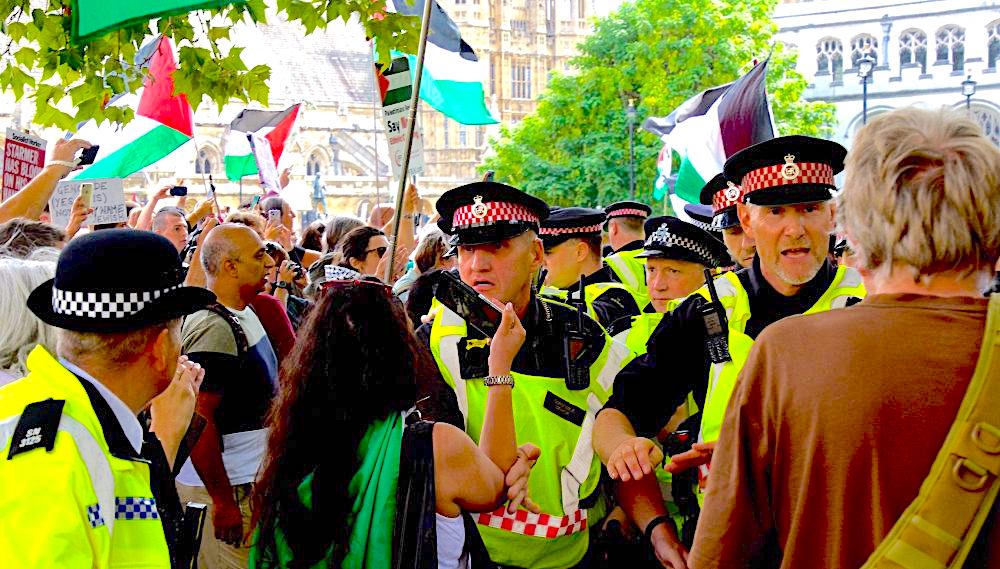
The Defend Our Juries protest against the proscription of Palestine Action in London on Sept. 6, 2025. (indigonolan /Flickr/ Wikimedia Commons/CC BY 4.0)
By Craig Murray
CraigMurray.org.uk

As the trial finished at Woolwich Crown Court of the six Palestine Action activists who entered the Filton factory to destroy Israeli killer drones, British Prime Minister Keir Starmer, Foreign Secretary Yvette Cooper, Justice Minister David Lammy and Home Secretary Shabana Mahmood are left bereft of a single guilty verdict in the case on which they relied heavily to label Palestine Action as a terrorist organisation.
I could not, on pain of imprisonment, tell you this during the trial. One item produced by the prosecution as evidence was the notebook of the arrested protestor Charlotte Head, on which she had written details from her training session with Palestine Action and of the proposed direct action against Elbit’s drone factory.
The first ten pages of her notes were about the Israeli weapons company Elbit, their footprint in the U.K., their corporate structure and the weapons they manufacture, and the evidence of the use of their weaponry in the genocide in Gaza.
The jury were shown the notebook but were specifically not allowed to see the first ten pages. Throughout the trial anything that referred to the crimes of Elbit, their role in the mass killing and mutilation of women and children, and their cozy relationship with the British government, was excluded from the jury. The judge continually stopped the defence lawyers from asking or saying anything about who Elbit are or why their property was being attacked.
The defendants were not permitted therefore to explain to the jury why they did what they did, which you might have believed was a pretty fundamental right. The jury were additionally in effect instructed by Judge Jeremy Johnson to convict on the least serious charge, that of criminal damage.
But despite the state taking every possible precaution to ensure that the state got its convictions in this show trial, the jury refused to find that trying to stop Genocide is a crime.
This trial was fundamental to the government’s argument that Palestine Action is a terrorist organisation. And the key to that was the accusation that Palestine Action intended from the start harm to people, not just to property. That is why these defendants were all charged with “aggravated burglary”.
Aggravated burglary is an extremely serious charge, carrying a potential life sentence. It is the offence of breaking into a property with the intent to use a weapon. On aggravated burglary, all six defendants were found resoundingly Not Guilty.
So the attempt to portray Palestine Action as an organisation involved in violence against persons has fallen flat on its face. Because the jury could see it was stupid and obviously untrue.
When it comes to events after the activists were attacked by security guards, three of the six were found not guilty of the charge of “violent disorder”. On three others the jury could not reach a verdict.
Most interesting of all perhaps was the charge of criminal damage to Elbit’s machinery and instruments of genocide. Here Judge Johnson to all intents and purposes had instructed the jury to convict. Yet enough of the jury could not accept that stopping Genocide is a crime.
The final question was the charge against Samuel Corner of Grievous Bodily Harm with Intent. This was the famous incident where the security guards attacked the defendants with weapons and there was a melee as they defended themselves.
It is worth stating that the tabloid stories and right wing meme of “a policewoman’s spine was fractured” was always utter nonsense. As the defence closing speech stated:
“The prosecution have said it was a fracture to the spine, a deliberate choice of words which although technically accurate, conjure up a break, a snapping of the spinal vertebrae. Maybe that’s what the jury had in mind until they saw the CT scan – it was actually an injury that wasn’t obvious. The doctors looking at the first X-rays didn’t identify any bone damage, nor in an MRI later.
The injury didn’t require surgery and Sergeant Evans was advised to take painkillers and do physiotherapy. The agreed facts state from medical evidence that you’d expect such a fracture to heal in six to twelve weeks, with full healing in three to six months, and no long-term consequences.”
The unfortunate policewoman suffered no damage at all to her spinal cord. She had a possible hairline fracture to the wing of one vertebrae. That there was any fracture at all was never definitive from the X rays and MRIs. Whether it reached the bar of grievous bodily harm was disputed, how it was caused was disputed and whether there was any intent to harm was disputed. The refusal of the jury to convict was completely consistent with the evidence heard in court.
“Throughout the trial anything that referred to the crimes of Elbit, their role in the mass killing and mutilation of women and children … was excluded from the jury.”
This has driven right wingers into a frenzy with completely false claims about the extent of the injury, and continued reference to a highly edited brief video clip.
That video clip is extremely important because it represents the height of the state’s attempt to use this incident to demonise Palestine Action.
The police were permitted, during the course of the trial, to release a single and highly edited clip of video said to represent the injury of Sergeant Evans by a sledgehammer. A great deal of other video evidence was not released. This resulted in a massive media frenzy.
Even before this, Yvette Cooper (then home secretary) and Commissioner of the Metropolitan Police Mark Rowley had caused massive prejudice by stating that a policewoman had been attacked with a sledgehammer.
None of these deliberate attempts to affect the trial was censured by the judge nor resulted in any proceedings for contempt of court. Yet we were strictly told we absolutely could not mention that the judge was withholding the evidence about Elbit from the jury, as that would prejudice the trial, and we would face contempt of court proceedings.
On Sergeant Evans, she has become a cause celebré for the right, but I should say there is no evidence she is herself whipping this up. Her behaviour on the night was admirable. She was not herself involved in the excessive use of force, and despite her own painful back tended to others after the event quietened.
Government Over-Exaggeration Falls Flat
In my view this prosecution was doomed by the overcharging and exaggeration used by the government to demonise Palestine Action. The “aggravated burglary” charge was ludicrous. To attempt to claim that the activists entered the factory with the intent of using weapons against people, went so far against the evidence it was bound to fail.
The massive over-exaggeration of the extent of Sergeant Evans’ injury has successfully whipped up right wing hysteria, but did not really meet the threshold of grievous bodily harm, and the decision to add intent to that charge was again not backed by evidence.
On criminal damage, the jury plainly refused to accept the destruction of weapons of genocide was a crime. For that, I salute them. For the rest, they simply applied robust commonsense to the evidence before them.
The “policewoman attacked with a sledgehammer” nonsense of course featured heavily in the English judicial review of the proscription of Palestine Action. In the Scottish judicial review, they cannot really use this – not without a caveat that a jury did not agree with them.
The Filton result is great news for the Scottish judicial review. We have to submit all the paperwork for that, in just seven working days. I hate to say this, but we are now desperately short of funds to continue this action. I cannot keep asking the same supporters to give more, but if you know people who can afford it and will contribute please activate them.
You can donate through the link via Crowd Justice, which goes straight to the lawyers, or through this blog.
https://www.crowdjustice.com/case/scottish-challenge-to-proscription/
Craig Murray is an author, broadcaster and human rights activist. He was British ambassador to Uzbekistan from August 2002 to October 2004 and rector of the University of Dundee from 2007 to 2010. His coverage is entirely dependent on reader support. Subscriptions to keep this blog going are gratefully received.
Subscriptions to keep Craig Murray’s blog going are gratefully received. Because some people wish an alternative to PayPal, Murray has set up new methods of payment including a GoFundMe appeal and a Patreon account.
This article is from CraigMurray.org.uk.
The views expressed are solely those of the author and may or may not reflect those of Consortium News.