
Category: Uncategorized

  • Wiz Khalifa sentenced to nine months jail in Romania

    Wiz Khalifa sentenced to nine months jail in Romania


    Mircea Barbu,Bucharestand

    André Rhoden-Paul

    Getty Images Wiz Khalifa wears a vest and jacket with a big chain on stage at Loud Park  in Mumbai Getty Images

    A Romanian court has sentenced Wiz Khalifa to nine months in prison for smoking cannabis on stage.

    The American rapper, real name Thomaz Cameron Jibril, admitted to smoking a joint during his performance at the Beach, Please! festival last year in Costinesti.

    A Romanian appeals court overturned an earlier fine of 3,600 Romanian leu (£619; $829) for drug possession and ruled the rapper must serve the sentence in custody.

    However he was sentenced in abstentia, and it is unclear if Jibril is even in Romania – he was last seen on Tuesday, performing with Gunna in California.

    The BBC has approached the ten-time Grammy-nominated artist for comment.

    Police briefly held and questioned Jibril after the concert on 13 July 2024, and prosecutors later charged him with possession of “risk drugs” for personal use.

    Romanian investigators said he was in possession of more than 18 grams of cannabis and consumed an additional amount on stage.

    In a written decision, the Constanța Court of Appeal judges said they overturned the original fine because the artist had sent “a message of normalisation of illegal conduct” and thereby encouraged “drug use among young people”.

    Calling it an “ostentatious act”, the judges said the rapper was “a music performer, on the stage of a music festival well known among young people” who “possessed and consumed, in front of a large audience predominantly made up of very young people, an artisanal cigarette”.

    Jabril said in a post on X a day after the incident that he did not mean to offend the country.

    “They [the authorities] were very respectful and let me go. I’ll be back soon. But without a big ass joint next time.”

    Romanian criminologist Vlad Zaha told BBC News that there was little-to-no chance of the US extraditing Jibril, and described the sentence as “unusually harsh”.

    “Given the defendant’s wealth and connections, Romania’s lack of real negotiating power on extradition, and the legal and political status of cannabis in the US, it is highly unlikely that Wiz Khalifa will be sent to serve a prison sentence in Constanța, even though a formal judicial request will be submitted to the United States,” Mr Zaha said.

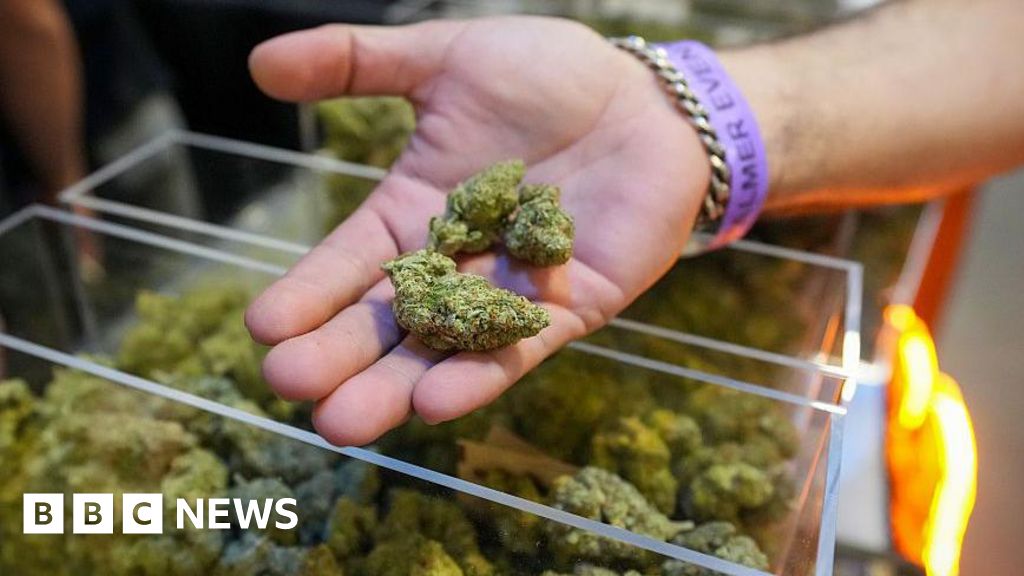
    The artist, known for songs like Black and Yellow, See You Again and Young, Wild & Free, is often pictured smoking on his social media and founded his own marijuana brand in 2016.

    Cannabis is legal recreational and medical use in some US states, but remains illegal under federal law.

    Source link

  • Trump expands access to cannabis in a major shift in drug policy

    Trump expands access to cannabis in a major shift in drug policy


    President Donald Trump has signed an executive order that will expand access to cannabis, a long anticipated move that would mark the most significant shift in US drug policy in decades.

    The order directs the US attorney general to reclassify cannabis from a Schedule I narcotic, to a Schedule III drug – placing it under the same category as Tylenol with codeine.

    Cannabis will remain illegal at the federal level. But classifying it as a Schedule III narcotic would allow expanded research to be conducted into its potential benefits.

    Several Republican lawmakers cautioned against the move, with some arguing it could normalise cannabis use.

    The US Drug Enforcement Agency notes that Schedule III narcotics – which also include ketamine and anabolic steroids – have only a “moderate to low potential for physical and psychological dependence”.

    The new classification also has tax implications for state-authorised cannabis dispensaries, as current regulations bar them from some tax deductions if they sell Schedule I products.

    In addition to the rescheduling of cannabis, Trump has ordered White House officials to work with Congress to allow some Americans access to to cannabidiol, commonly known as CBD.

    As part of a new programme announced as part of the order, some Medicaid recipients will be able to access CBD, at a doctor’s recommendation, at no cost.

    Health officials have also been tasked with developing “methods and models” to examine the real-world health benefits and risks of CBD.

    A senior administration official said that the order was a “commonsense action that will let us better understand and study” cannabis and CBD.

    In recent years, a majority of US states have approved cannabis for some medical use, and nearly half – 24 – have legalised recreational use. But since 1971, cannabis has been a Schedule I narcotic, which means it has no accepted medical use and a high potential to be abused.

    The Biden administration proposed a similar reclassification, and in April 2024 the DEA proposed a rule change, but got bogged down under administrative and legal issues.

    Trump has long expressed a desire to change US drug policy regarding cannabis.

    “I believe it is time to end endless arrests and incarcerations of adults for small amounts of marijuana for personal use,” he wrote on Truth Social last year while running for president.

    “We must also implement smart regulations, while providing access for adults, to safe, tested products,” he said.

    The reclassification order has met some resistance from Republican lawmakers.

    On Wednesday, a group of 22 Republican Senators sent an open letter to the president, arguing that marijuana use would mean that “we cannot re-industrialise America”.

    The Senators pointed to lingering concerns over the health impact of cannabis, as well as research suggesting that cannabis can be linked to “impaired judgement” and “lack of concentration”.

    “In light of the documented dangers of marijuana, facilitating the growth of the marijuana industry is at odds with growing our economy and encouraging healthy lifestyles for Americans.”

    In a separate letter sent to Attorney General Pam Bondi in August, nine Republican representatives argued that “no adequate science or data” exists to support the change.

    “Marijuana, while different than heroin, still has the potential for abuse and has no scientifically proven medical value,” the letter said. “Therefore, rescheduling marijuana would not only be objectively wrong, but it would also imply to our children that marijuana is safe. That couldn’t be further from the truth.”

    More broadly, polls show that a majority of Americans support efforts to legalise marijuana.

    One Gallup poll released in November found that 64% of Americans believe that it should be legalised, although support had drifted slightly from previous years because of a 13-point drop among Republicans.


    Source link

  • China-Aligned Threat Group Uses Windows Group Policy to Deploy Espionage Malware

    China-Aligned Threat Group Uses Windows Group Policy to Deploy Espionage Malware


    Dec 18, 2025Ravie LakshmananMalware / Cloud Security

    A previously undocumented China-aligned threat cluster dubbed LongNosedGoblin has been attributed to a series of cyber attacks targeting governmental entities in Southeast Asia and Japan.

    The end goal of these attacks is cyber espionage, Slovak cybersecurity company ESET said in a report published today. The threat activity cluster has been assessed to be active since at least September 2023.

    “LongNosedGoblin uses Group Policy to deploy malware across the compromised network, and cloud services (e.g., Microsoft OneDrive and Google Drive) as command and control (C&C) servers,” security researchers Anton Cherepanov and Peter Strýček said.

    Group Policy is a mechanism for managing settings and permissions on Windows machines. According to Microsoft, Group Policy can be used to define configurations for groups of users and client computers, as well as manage server computers.

    Cybersecurity

    The attacks are characterized by the use of a varied custom toolset that mainly consists of C#/.NET applications –

    • NosyHistorian, to collect browser history from Google Chrome, Microsoft Edge, and Mozilla Firefox
    • NosyDoor, a backdoor that uses Microsoft OneDrive as C&C and executes commands that allow it to exfiltrate files, delete files, and execute shell commands
    • NosyStealer, to exfiltrate browser data from Google Chrome and Microsoft Edge to Google Drive in the form of an encrypted TAR archive
    • NosyDownloader, to download and run a payload in memory, such as NosyLogger
    • NosyLogger, a modified version of DuckSharp that’s used to log keystrokes
    NosyDoor execution chain

    ESET said it first detected activity associated with the hacking group in February 2024 on a system of a governmental entity in Southeast Asia, eventually finding that Group Policy was used to deliver the malware to multiple systems from the same organization. The exact initial access methods used in the attacks are presently unknown.

    Further analysis has determined that while many victims were affected by NosyHistorian between January and March 2024, only a subset of these victims were infected with NosyDoor, indicating a more targeted approach. In some cases, the dropper used to deploy the backdoor using AppDomainManager injection has been found to contain “execution guardrails” that are designed to limit operation to specific victims’ machines.

    Also employed by LongNosedGoblin are other tools like a reverse SOCKS5 proxy, a utility that’s used to run a video recorder to capture audio and video, and a Cobalt Strike loader.

    Cybersecurity

    The cybersecurity company noted that the threat actor’s tradecraft shares tenuous overlaps with clusters tracked as ToddyCat and Erudite Mogwai, but emphasized the lack of definitive evidence linking them together. That said, the similarities between NosyDoor and LuckyStrike Agent and the presence of the phrase “Paid Version” in the PDB path of LuckyStrike Agent have raised the possibility that the malware may be sold or licensed to other threat actors.

    “We later identified another instance of a NosyDoor variant targeting an organization in an E.U country, once again employing different TTPs, and using the Yandex Disk cloud service as a C&C server,” the researchers noted. “The use of this NosyDoor variant suggests that the malware may be shared among multiple China-aligned threat groups.”


    Source link