Verified videos emerging from Iran show bodies piled up in a hospital, snipers stationed on buildings and CCTV cameras being destroyed, following the unprecedented crackdown on protests earlier this month.
BBC Verify has been tracking the spread of protests across Iran since they first erupted in late December, but the near total internet blackout imposed by the authorities has made it extremely difficult to document the scale of the state’s deadly crackdown on protesters.
The US-based Human Rights Activists News Agency (HRANA) says it has confirmed the killing of nearly 6,000 people, including 5,633 protesters, since the unrest began at the end of December. It says it is also currently investigating another 17,000 reported deaths received despite an internet shutdown after nearly three weeks.
Another group, the Norway-based Iran Human Rights (IHR), has warned that the final toll could exceed 25,000.
Iranian authorities said last week that more than 3,100 people were killed, but that the majority were security personnel or bystanders attacked by “rioters”.
The latest videos to emerge from the country are understood to have been filmed on 8 and 9 January, when thousands of people took to the streets following a call for nationwide protests from Reza Pahlavi, the exiled son of the late Shah.
They are thought to be the deadliest nights for protesters so far and these newly verified videos show how Iran’s security forces have been violently cracking down on protesters.
Multiple clips analysed by BBC Verify and BBC Persian show bodies piled up inside a mortuary at Tehranpars hospital in east Tehran. We verified the location of the hospital by matching its interior to other publicly available images and videos of the building, and counted at least 31 bodies in just one video. Another clip shows seven body bags laid on the ground outside the hospital’s entrance.
Hundreds of people are seen protesting on a highway in west Tehran in another video before multiple rounds of gunfire can be heard and people begin to scream.
Protesters have also been seen trying to evade Iran’s heavy surveillance infrastructure by disabling CCTV cameras. Footage we verified shows one person in the capital climbing up a post and hitting a surveillance camera several times in an attempt to disable it. A huge crowd of protesters can be seen on the ground and heard cheering as the camera is damaged.
We have tracked the spread of the anti-government protests across 71 towns and cities in Iran, though the true number of areas where demonstrations have taken place is likely far higher.
In the south-eastern city of Kerman a video taken from high up in a building shows several armed men in military uniform walking down a road firing their weapons continuously, though it is not clear who they are shooting at. A small fire burns in the middle of the road while the sound of protesters chanting can be heard in the background.
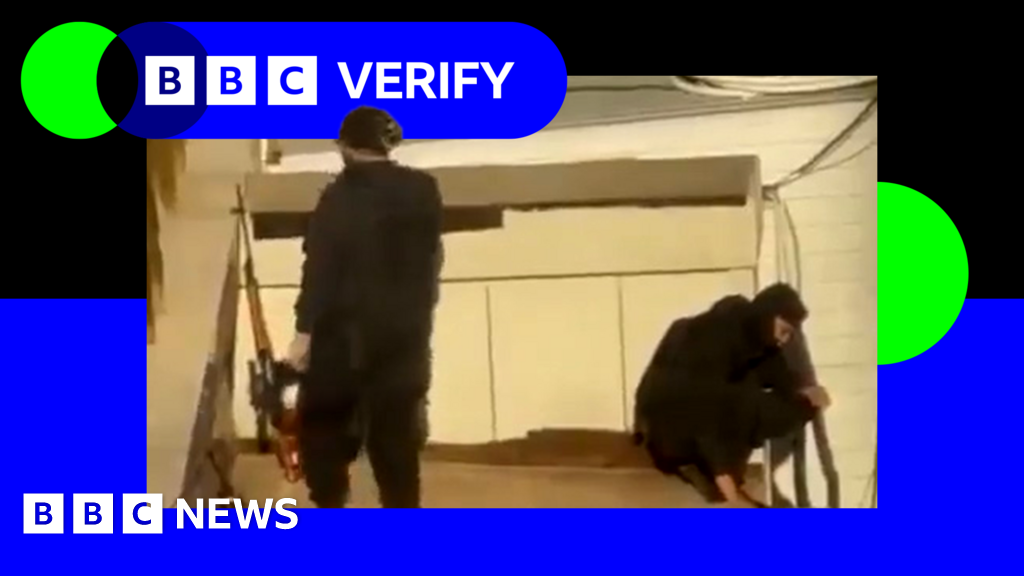
Snipers have also been recorded on the roofs of buildings. In the north-eastern city of Mashhad verified video shows two men dressed in black on a rooftop of a building in daylight. One man is standing next to a large rifle that is lent against a wall and speaking on the phone. The other man crouches on the floor while smoking.
For most people there has been an almost-total internet blackout since 8 January, but some have managed to briefly access the internet using methods such as SpaceX’s Starlink satellite internet and virtual private networks (VPNs).
More videos are likely to emerge in the coming days as the country’s economy has struggled during the blackout.
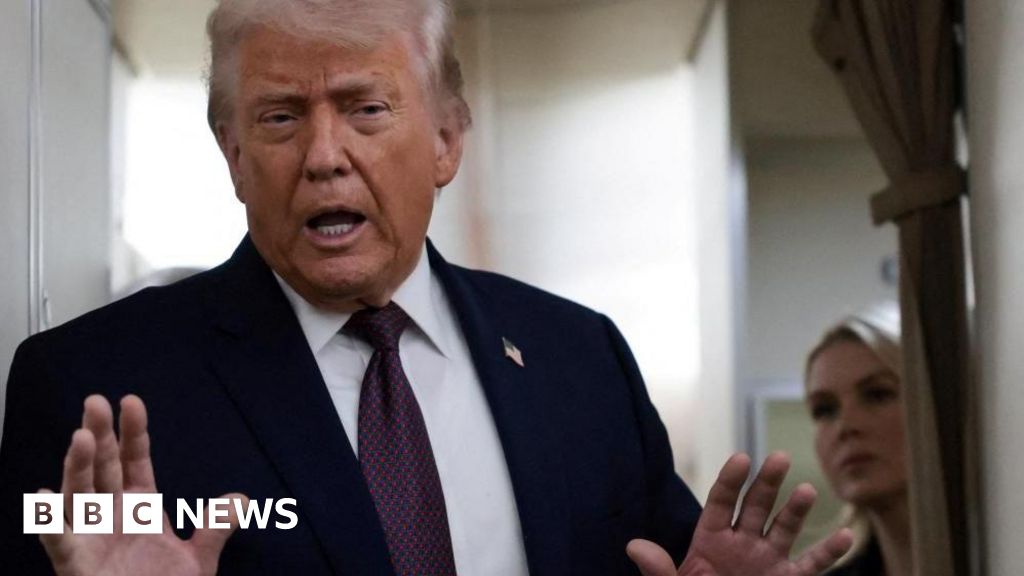
President Trump talks to reporters on Air Force One on Saturday
The Trump administration has quickly abandoned its familiar “deny and attack” playbook after initially using it when federal agents shot dead Alex Pretti in Minneapolis on Saturday morning.
Within 24 hours, as various videos of the shooting circulated online, it became clear that the White House was out of step with public opinion.
Since then, the administration – and the president himself – have changed tack, blaming Democrats for what happened and focusing less on the actions of the American nurse who was killed.
Democrats, meanwhile, have increased their criticism of the president’s mass deportation policy and the aggresive tactics of Immigration and Customs Enforcement (ICE), leaning into a political fight that could result in a new government shutdown on Friday.
On Monday morning, Deputy Attorney General Todd Blanche described the situation as a “powder keg”. While he blamed the Democrats, many on both sides of America’s political divide will agree that the current situation is fraught with peril.
The initial administration response to Pretti’s death was straightforward. The 37-year-old was portrayed as a domestic terrorist bent on bloodshed.
Homeland Security Secretary Kristi Noem said that Pretti wished to “inflict harm” and was “brandishing” a weapon. US Border Patrol Commander Gregory Bovino said that it “looks like a situation where an individual wanted to do maximum damage and massacre law enforcement”.
Senior presidential adviser Stephen Miller called Pretti a “would-be assassin”.
This White House has typically been quick to push back when criticised. “Deny and attack” has long been a bedrock Trump strategy for handling adversity.
But, perhaps tellingly, White House Press Secretary Karoline Leavitt refused to echo Miller’s comments herself on Monday when pressed on whether the president agreed with his senior adviser. Instead, she said a full investigation would be carried out.
It was a notably more muted tone than that struck immediately after the shooting.
Unpicking the second Minneapolis shooting frame by frame
That initial response had echoed the path the administration took three weeks ago, when federal law enforcement shot and killed another Minneapolis resident, Renee Good. They said Good was a terrorist who had “weaponised” her vehicle in an attempt to injure ICE agents.
As with Good’s case, the federal government’s version of events has been challenged by local officials, eyewitnesses and the victim’s family.
In a statement on Sunday, Pretti’s parents asked for the truth to come out, adding: “The sickening lies told about our son by the administration are reprehensible and disgusting.”
Multiple videos of Saturday’s deadly encounter contradict many of the administration’s initial claims. The footage shows Pretti filming ICE agents with his mobile phone and helping a woman who is pushed over before both are pepper-sprayed. Pretti is visibly not holding a gun when he is wrestled to the ground.
DHS says Pretti had a 9mm semi-automatic handgun and two magazines of ammunition. Local police have said Pretti was a legal gun owner. Under Minnesota law, citizens can legally carry a concealed handgun in public, if they have a permit.
Watch: Federal and state officials gave conflicting accounts on Saturday of Alex Pretti’s death
This time around, the administration’s initial response quickly had become difficult for the administration to maintain.
“People have had enough,” Minneapolis Police Brian O’Hara said, noting that his officers made hundreds of arrests of violent offenders last year without resorting to shooting. “This is not sustainable.”
Republicans in Washington DC and elsewhere have expressed growing unease with how the administration was handling the situation. Vermont Governor Phil Scott called the federal efforts in Minnesota “a complete failure of coordination of acceptable public safety and law enforcement practices, training and leadership” – at best.
At worst, he said, it was “deliberate federal intimidation and incitement of American citizens”.
In Congress, some Republicans expressed unease with the White House actions and called for new oversight.
Since Sunday night, there has been a marked change in tone from the White House. Veteran’s Affairs Secretary Doug Collins offered condolences to the Pretti family. The president posted a message on his Truth Social website calling the death “tragic” and blaming it on “Democrat ensued chaos” – a message echoed by Vice-President JD Vance.
On Monday morning, Trump posted that he was dispatching “border czar” Tom Homan to Minnesota to direct law-enforcement efforts there. Homan, who handled deportations during Democrat Barack Obama’s administration, is considered a more measured, politically attuned operator less prone to the kind of bombastic declarations recently made by Noem and Bovino.
“Tom is tough but fair, and will report directly to me,” Trump wrote.
While Homan’s assignment to Minneapolis may not necessarily reflect a change in policy – this administration has yet to show signs of backing away from its aggressive immigration enforcement – it could be a change in presentation, as the president tries to come to grips with a public mood that opinion surveys suggest is souring on how his immigration crackdown is being carried out.
In a CBS survey taken before the weekend’s shooting, 61% of respondents said that ICE is being “too tough when stopping and detaining people”, while 58% disapproved of his handling of immigration as a whole.
EPA
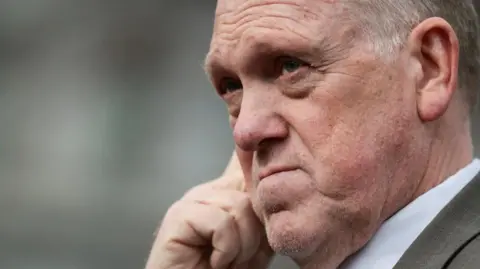
Trump is sending Tom Homan to oversee the immigration operation in Minnesota
Minnesota Attorney General Keith Ellison, when asked by BBC News about Homan’s involvement, said that he may provide a new avenue to work with the administration.
“I don’t want to foreclose the possibility that reasonable minds can prevail,” he added, “but we are here exactly because the federal government had unreasonable positions.”
Another potential thaw came when Trump announced on Monday that he had spoken with Minnesota’s Democratic governor, Tim Walz.
“It was a very good call,” Trump wrote. “We, actually, seemed to be on a similar wavelength.”
That represents a marked cooling of what had been a series of heated exchanges between the two men in recent weeks – and could portend the kind of de-escalation in Minnesota that many politicians have been calling for.
That may not be enough for Washington Democrats, however, who have come under increasing pressure to draw a bright line against the Trump administration’s rhetoric and policy.
Congressman Tom Suozzi on Monday said he regretted voting for a recent Department of Homeland Security (DHS) funding bill that contained money for immigration enforcement.
“I failed to view the DHS funding vote as a referendum on the illegal and immoral conduct of ICE in Minneapolis,” he posted on X. “I hear the anger from my constituents, and I take responsibility for that.”
Senate Democrats have announced they will now block that funding measure in their chamber, which would trigger a partial government shutdown on Friday night.
“I am voting against any funding for DHS until and unless more controls are put in place to hold ICE accountable,” said Senator Brian Schatz of Hawaii. “These repeated incidents of violence across the country are unlawful, needlessly escalatory and making all of us less safe.”
Such a move is not without its own political risks, however. Democrats triggered a record-setting shutdown last autumn over health care subsidies but ultimately relented with little to show for it.
A new government shutdown – one that wouldn’t affect ICE funding but could hamper national emergency preparedness and other government functions – could produce a similarly limited results. Democrats will also be wary of pushing too far on immigration and law and order, two issues where they poll poorly.
At the moment, both Republicans and Democrats are grappling with how to handle what has become an explosive situation. At stake is the public perception of Trump’s immigration policy, a core political issue for the president and one that helped him win back the White House.
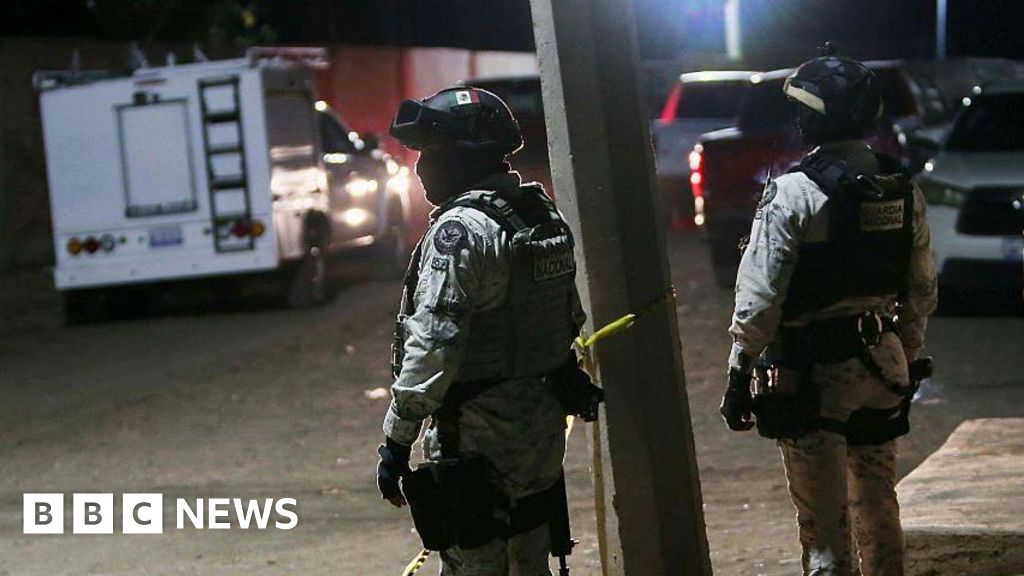
At least 11 people were killed and another dozen injured when gunmen opened fire on locals who had gathered at a football pitch in the city of Salamanca in central Mexico on Sunday.
Witnesses said armed men arrived at the grounds in several vehicles and shot at those gathered there seemingly indiscriminately.
Many families had stayed behind to socialise after a match between local clubs. At least one woman and one child were among those killed.
The motive behind the shooting is not yet clear. Guanajuato, the state in which Salamanca is located, registered the highest number of murders in the whole of Mexico last year.
Neighbours reported hearing at least 100 shots ring out as the gunmen opened fire at the Cabañas pitch in the Loma de Flores neighbourhood.
Local and federal security forces are now investigating the deadly shooting.
It came just a day after several violent incidents in the city, in which a total of five men were killed and another was abducted.
Guanajuato has seen a spike in violence committed by a number of gangs that engage in the theft of oil and fuel, as well as other criminal activities such as drug trafficking and extortion.
Gang members frequently hold up tanker trucks carrying oil and tap oil pipelines belonging to state-run oil company Pemex.
Salamanca, which is home to a major Pemex refinery, has been particularly subjected to violent gang-related attacks.
Analysts say that the rivalry between the Jalisco New Generation Cartel (CJNG) and the Cartel de Santa Rosa de Lima (CSRL) is behind many of the most brutal incidents.
Their criminal activities are not confined to Mexico, with both the smuggling of stolen fuel and illicit drugs spreading violence into the United States.
Last year, the US State Department designated the CJNG as a Foreign Terrorist Organisation and, more recently, placed sanctions on the CSRL.
US President Donald Trump has made the fight against criminal gangs sending illicit drugs such as heroin, fentanyl, methamphetamines and cocaine one of his priorities.
He has in the past alleged that “cartels are running Mexico” and has threatened to hit “narco-terrorists” with land strikes.
The US has already carried out at least 36 strikes against vessels allegedly transporting drugs by sea, both in the Caribbean and the Pacific, killing at least 125 people.
Legal experts and Trump’s critics have questioned the legality of these strikes.
Mexican President Claudia Sheinbaum last week handed over 37 “high-impact” suspects to the US in what local media described as an attempt by her government to co-operate with US counternarcotic efforts and thereby ward off the possibility of Trump ordering unilateral strikes against the cartels in Mexican territory.