Category: Uncategorized

  • EU investigates Elon Musk’s X over Grok AI sexual deepfakes

    EU investigates Elon Musk’s X over Grok AI sexual deepfakes


    The European Commission has launched an investigation into Elon Musk’s X over concerns its AI tool Grok was used to create sexualised images of real people.

    It follows a similar announcement in January from the UK watchdog Ofcom.

    If the site is found to have breached the rules of EU’s under the Digital Services Act, the Commission could fine the company up to 6% of its global annual turnover.

    A previous statement from X’s Safety account said the social media platform had stopped Grok from digitally altering pictures of people to remove their clothing in “jurisdictions where such content is illegal”.

    Regina Doherty, a member of the European parliament representing Ireland, said the Commission would assess whether “manipulated sexually explicit images” have been shown to users in the EU.

    Campaigners and victims said the ability to generate sexually explicit pictures using the tool should have “never happened”, and Ofcom said its investigation would remain ongoing.

    The EU regulator said it may “impose interim measures” if X refuses to implement meaningful adjustments.

    It said it had also extended its ongoing investigation launched in December 2023 over risks associated with X’s recommender systems – the algorithm that recommends specific posts to users.

    Before the Commission’s announcement, Elon Musk posted a picture on X on Monday appearing to make light of the new restrictions in place around Grok.

    The X owner has previously criticised those scrutinising the app’s image-editing function – particularly the UK government – calling it “any excuse for censorship”.

    On Sunday, the Grok account on X claimed more than 5.5 billion images were generated by the tool in just 30 days.

    Other investigations into the platform’s chatbot are underway in Australia, France and Germany.

    Grok was temporarily banned in Indonesia and Malaysia, although the latter has now lifted the ban.

    Henna Virkkunen, Executive Vice-President for Tech Sovereignty, Security and Democracy at the Commission called the sexual deepfakes a “violent, unacceptable form of degradation”.

    “With this investigation, we will determine whether X has met its legal obligations under the DSA, or whether it treated rights of European citizens – including those of women and children – as collateral damage of its service,” she said.

    In a statement to Reuters, Doherty said there were “serious questions” over if platforms such as X were meeting legal obligations “to assess risks properly and to prevent illegal and harmful content from spreading”.

    “The European Union has clear rules to protect people online,” she said.

    “Those rules must mean something in practice, especially when powerful technologies are deployed at scale.

    “No company operating in the EU is above the law.”

    The move comes a month after the EU fined X €120m (£105m) over its blue tick badges, saying they “deceive users” because the firm is not “meaningfully verifying” who is behind the account.

    In response, the US Secretary of State Marco Rubio and the Federal Communications Commission (FCC) accused the EU regulator of attacking and censoring US firms.

    “The European Commission’s fine isn’t just an attack on X, it’s an attack on all American tech platforms and the American people by foreign governments,” he said.

    His remarks were reposted by Musk, who added “absolutely”.


    Source link

  • Fire at Violanta food factory leaves at least four dead

    Fire at Violanta food factory leaves at least four dead


    At least four people have been killed after a fire broke out at a food factory near the central Greek city of Trikala, the country’s fire service says.

    The blaze began early on Monday at a Violanta biscuit factory, where 13 workers were on site, local media reported. Eight managed to escape.

    One person remains missing, but the city’s deputy mayor for civil protection, Giorgos Katavoutas, told the BBC that “there is no hope of finding any of the missing workers alive, given the force of the explosion and the fire that followed”.

    An investigation into the cause of the blaze is ongoing but unconfirmed reports have suggested a possible gas leak.

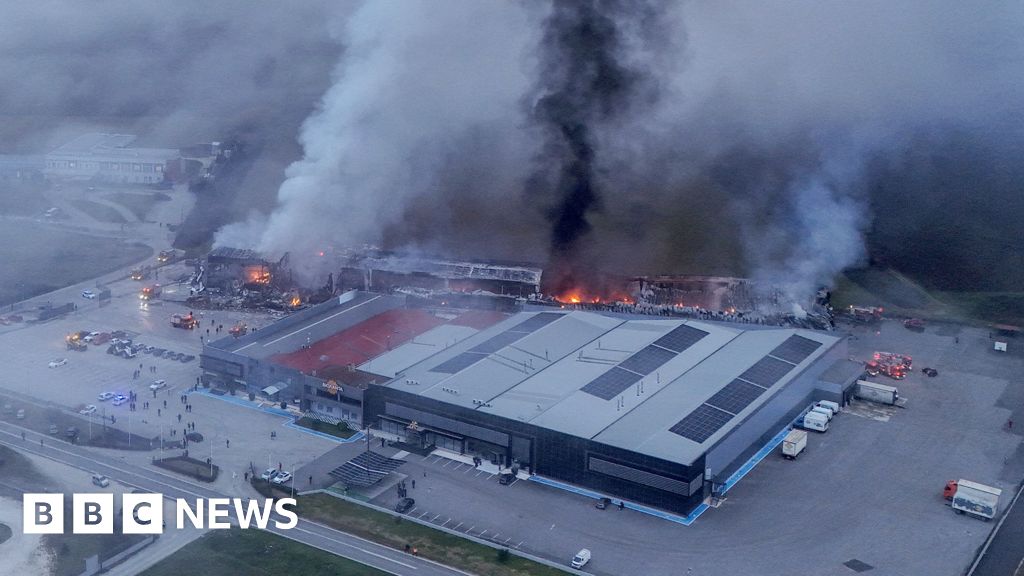
    Television footage showed extensive damage to the factory, with part of the building destroyed, effectively splitting the structure in two. Thick smoke could also be seen billowing from the fire.

    Violanta said it was “deeply saddened” by the fire.

    “Today a serious incident occurred at our factory premises, during the night shift, for a currently unknown reason,” Violanta said in a statement.

    “We are fully cooperating with the relevant authorities and providing all available assistance.”

    Health minister Adonis Georgiadis earlier told the Skai news agency that six workers and a firefighter had been taken to hospital, adding that they were “in good health, mainly suffering from respiratory problems”.

    The fire service said more than 50 firefighters and 16 fire trucks had been sent to tackle the blaze.

    Prime Minister Kyriakos Mitsotakis referred to the fire during opening remarks at a cabinet meeting on Monday.

    “Our thoughts are with the families of the victims,” he said, adding that the fire service was already investigating the circumstances of the incident” so that “responsibilities can be established”.


    Source link

  • Israel to reopen Gaza crossing after search for hostage’s body ends

    Israel to reopen Gaza crossing after search for hostage’s body ends


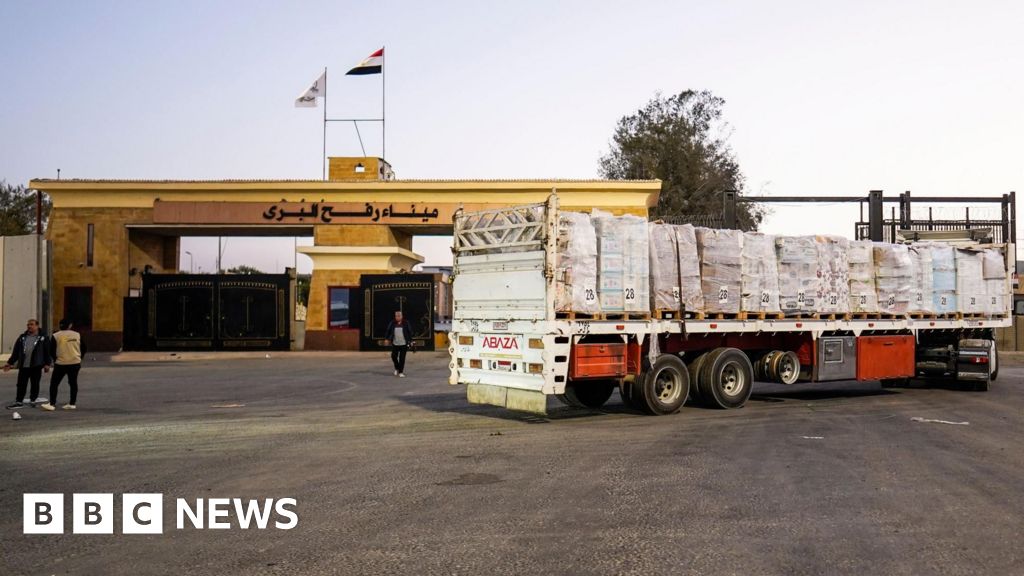
    EPA File photo showing a humanitarian aid lorry moves past the Egyptian side of the Rafah border crossing between Egypt and Gaza, in Rafah, North Sinai, Egypt (20 October 2025)EPA

    The Rafah crossing between Gaza and Egypt has been mostly closed since May 2024 (file photo)

    Israel says it has agreed to reopen the Gaza Strip’s key border crossing with Egypt only after an operation to retrieve the body of the last remaining Israeli hostage in the territory is complete.

    The Rafah crossing has been mostly closed since May 2024, when the Palestinian side was seized by Israeli forces. It was meant to have reopened during the first stage of the ceasefire between Israel and Hamas, which began in October.

    However, the Israeli government has made that conditional on Hamas making every effort to return the body of the last hostage, police officer Master Sgt Ran Gvili.

    On Sunday, Israel’s military said it had begun a new search for his remains in northern Gaza.

    Although in its latest announcement Israel appears to offer a timeframe for the reopening of the crossing, it is not known how long the search for Gvili will take.

    Israeli media quoted military officials as saying the operation was taking place at a cemetery in Gaza City and that it could last several days.

    On Thursday, the head of the new technocratic Palestinian government in Gaza said the Rafah crossing would open “in both directions” this week.

    It comes as US and other mediators continue to press both sides to take the next steps to advance President Donald Trump’s peace plan.

    On Sunday night, Israeli Prime Minister Benjamin Netanyahu’s office announced that Israel had “agreed to a limited reopening of the Rafah crossing for pedestrian passage only, subject to a full Israeli inspection mechanism”.

    The Israeli military was “currently conducting a focused operation to exhaust all of the intelligence that has been gathered in the effort to locate and return” the remains of Ran Gvili, a statement said.

    “Upon completion of this operation, and in accordance with what has been agreed upon with the US, Israel will open the Rafah crossing,” it added.

    Israel’s Haaretz newspaper cited a source as saying there would be a “full Israeli monitoring mechanism” at the crossing, which would include oversight of entry and exit lists.

    Israel also planned to establish an additional screening point for all people entering Gaza located in an area around the Yellow Line, which demarcates the territory still controlled by Israeli forces under the ceasefire deal, the source added.

    Earlier on Sunday, the Israeli military said troops had “begun a targeted operation in the area of the Yellow Line in the northern Gaza Strip” to retrieve Gvili’s body.

    Israeli military officials told local media that the operation was acting on intelligence collected over a long period of time, which indicated that Gvili’s remains might have been buried in the Shejaiya and Daraj Tuffah areas of Gaza City, east of the Yellow Line.

    Specialised units were on the ground, including rabbis, search teams and dental experts equipped with mobile X-ray machines, they added.

    Hamas’s military wing, the Izzedine al-Qassam Brigades, said on Sunday that it had “provided mediators with all the details and information in our possession regarding the location” of Gvili’s body.

    Israeli forces were “searching one of the sites,” it added.

    Gvili’s family meanwhile reiterated their strong opposition to the reopening of the Rafah crossing before his body had been returned to Israel for burial. “First and foremost, Ran must be brought home,” they said.

    The 24-year-old was killed in Kibbutz Alumim during the Hamas-led attack on southern Israel on 7 October 2023 and his body was taken back to Gaza as a hostage.

    At the start of December, the Israeli government said the Rafah crossing would open “in the coming days” to allow Palestinians to leave Gaza.

    However, a dispute emerged with Egypt, which said the crossing would only be opened if movement was allowed in both directions, enabling the return of tens of thousands of Palestinians who fled Gaza during the war.

    On Saturday, US special envoy Steve Witkoff and Trump’s son-in-law Jared Kushner led a delegation which met Israel’s prime minister for discussions focused on the implementation of phase two of the Gaza peace plan. Witkoff said the meeting was “constructive and positive”.

    Under phase one, Hamas and Israel agreed to the ceasefire, an exchange of all living and dead Israeli hostages in Gaza for Palestinians detained in Israeli jails, a partial Israeli withdrawal, and a surge in deliveries of humanitarian aid.

    Phase two should see a new technocratic Palestinian government in Gaza take over running public services, as well as the reconstruction and full demilitarisation of the territory, including disarmament of Hamas and other groups.

    The war was triggered by the 7 October 2023 attack, when about 1,200 people were killed and 251 others taken to Gaza as hostages.

    Israel responded by launching a military campaign in Gaza, during which more than 71,650 people have been killed, according to the territory’s Hamas-run health ministry.


    Source link