Category: Uncategorized

  • This Rock-Solid 5.5%-Yielding Dividend Stock Just Gave its Investors Another Raise

    This Rock-Solid 5.5%-Yielding Dividend Stock Just Gave its Investors Another Raise


    • Oneok is raising its dividend by 4%.

    • The pipeline giant backs its high-yielding dividend with stable cash flows and a strong financial profile.

    • The company has lots of visible growth on the horizon.

    • 10 stocks we like better than Oneok ›

    Oneok (NYSE: OKE) offers investors an attractive dividend yield today. At 5.5%, it’s several times above the S&P 500‘s dividend yield, which is approaching its record low at around 1.2%.

    While higher-yielding dividend stocks can have higher risk profiles, that’s not the case with Oneok’s payout. It’s on rock-solid ground. That’s enabling the pipeline company to give its investors another raise.

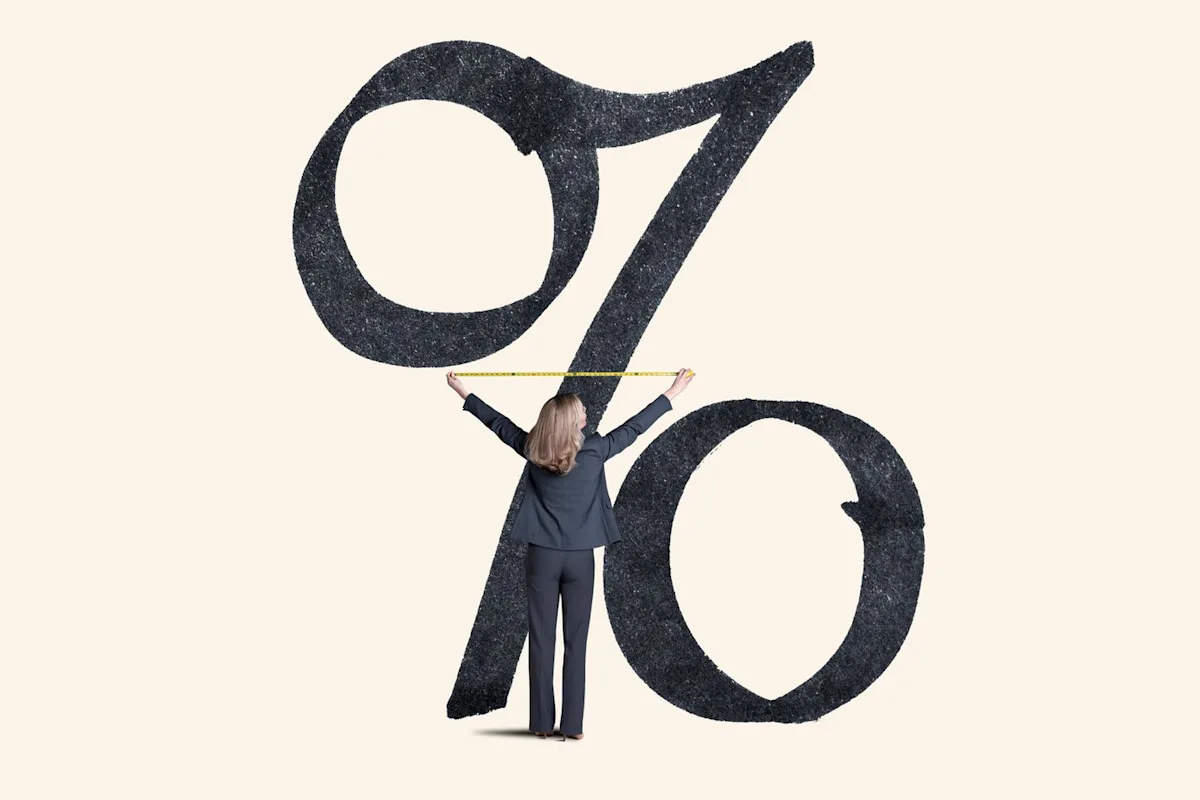
    A person measuring a yield sign.
    Image source: Getty Images.

    Oneok recently declared its latest quarterly dividend payment. The diversified energy midstream company will pay $1.07 per share ($4.28 annualized) on Feb. 13 to investors who hold shares by Feb 2. That’s a 4% increase from its prior level.

    That continues the pipeline company’s quarter-century track record of delivering stable to growing dividends for its investors. While Oneok hasn’t increased its dividend every year during that period, it has nearly doubled its dividend payment over the past decade. It has a much better track record than its closest peers in the pipeline industry, most of which have reduced their dividend payments at some point over the past 10 years.

    Oneok’s current target is to grow its dividend by 3% to 4% each year. That’s a very achievable goal, given its financial strength and the visible growth it has coming down the pipeline.

    The pipeline company’s diversified midstream operations generate very stable cash flow as long-term contracts and government-regulated rate structures underpin the bulk of its assets. Additionally, the company has an investment-grade credit rating backed by a conservative 3.5 times leverage ratio.

    Oneok has grown significantly in recent years by completing a series of large-scale acquisitions. It sees the potential of capturing several hundred million dollars in additional cost savings and commercial synergies from these deals, including $250 million targeted for 2026.

    Meanwhile, the company has several organic expansion projects under construction to expand its midstream operations. It currently has projects underway that should enter commercial service through the middle of 2028, including joint ventures (JVs) to build a new LPG export terminal and a large-scale natural gas pipeline. These projects will provide Oneok with incremental sources of stable cash flow as they enter commercial service over the next few years.



    Source link

  • CISA Adds Actively Exploited VMware vCenter Flaw CVE-2024-37079 to KEV Catalog

    CISA Adds Actively Exploited VMware vCenter Flaw CVE-2024-37079 to KEV Catalog


    Ravie LakshmananJan 24, 2026Vulnerability / Enterprise Security

    The U.S. Cybersecurity and Infrastructure Security Agency (CISA) on Friday added a critical security flaw affecting Broadcom VMware vCenter Server that was patched in June 2024 to its Known Exploited Vulnerabilities (KEV) catalog, citing evidence of active exploitation in the wild.

    The vulnerability in question is CVE-2024-37079 (CVSS score: 9.8), which refers to a heap overflow in the implementation of the DCE/RPC protocol that could allow a bad actor with network access to vCenter Server to achieve remote code execution by sending a specially crafted network packet.

    It was resolved by Broadcom in June 2024, along with CVE-2024-37080, another heap overflow in the implementation of the DCE/RPC protocol that could lead to remote code execution. Chinese cybersecurity company QiAnXin LegendSec researchers Hao Zheng and Zibo Li were credited with discovering and reporting the issues.

    Cybersecurity

    In a presentation at the Black Hat Asia security conference in April 2025, the researchers said the two flaws are part of a set of four vulnerabilities – three heap overflows and one privilege escalation – that were discovered in the DCE/RPC service. The two other flaws, CVE-2024-38812 and CVE-2024-38813, were patched by Broadcom in September 2024.

    In particular, they found that one of the heap overflow vulnerabilities could be chained with the privilege escalation vulnerability (CVE-2024-38813) to achieve unauthorized remote root access and ultimately gain control over ESXi.

    It’s currently not known how CVE-2024-37079 is being exploited, if it’s the work of any known threat actor or group, or the scale of such attacks. However, Broadcom has since updated its advisory to officially confirm in-the-wild abuse of the vulnerability.

    “Broadcom has information to suggest that exploitation of CVE-2024-37079 has occurred in the wild,” the company said in its update.

    In light of active exploitation, Federal Civilian Executive Branch (FCEB) agencies are required to update to the latest version by February 13, 2026, for optimal protection.


    Source link

  • Captain of suspected Russian shadow tanker into French custody

    Captain of suspected Russian shadow tanker into French custody


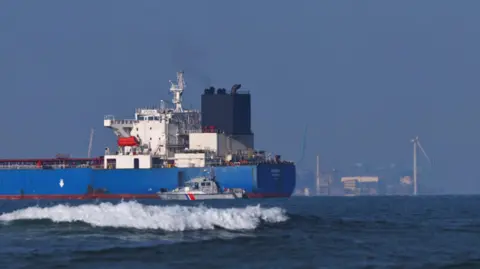
    Reuters A French navy boat surrounds the GRINCH oil tanker, intercepted by France in the Alboran Sea on suspicion of operating under a false flag and belonging to Russia's shadow fleetReuters

    The Grinch was intercepted by the French navy on Thursday

    French officials have taken the Indian captain of a suspected Russian shadow fleet tanker into custody days after the oil tanker was seized.

    On Thursday, the French navy intercepted the tanker – named the Grinch – which President Emmanuel Macron said was “subject to international sanctions and suspected of flying a false flag”.

    The Grinch had been travelling through the Mediterranean Sea from the Russian Arctic port of Murmansk. It is now moored, under guard, at a southern French port near Marseille.

    Although Moscow is yet to comment, Macron said on Thursday that the shadow fleet helped to “finance Russia’s war of aggression against Ukraine”.

    The office of the Marseille prosecutor office said the rest of the ship’s crew members – all also Indians – were being “kept on board” while the 58-year-old captain was taken into custody.

    “The investigation aims to verify the validity of the flag used by the tanker,” prosecutors said. French media report say it was sailing under a Comoros Islands flag.

    Nautical and air exclusion zones have been established around the anchorage site, officials say.

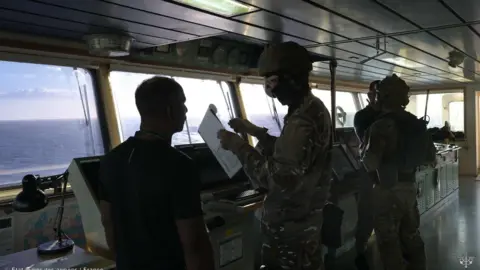
    French Joint Staff of the Armed Forces Soldiers talk to people on the oil tankerFrench Joint Staff of the Armed Forces

    Soldiers searched the vessel after it was seized in the Mediterranean

    Announcing the seizure on Thursday, Macron said: “We are determined to uphold international law and to ensure the effective enforcement of sanctions.”

    Many Western countries imposed sanctions on Russian energy following Russia’s full-scale invasion of Ukraine in 2022.

    Earlier in January, British armed forces supported a US operation to seize a Russian-flagged tanker in the Atlantic that US officials said had broken sanctions by carrying oil for Venezuela and Russia.

    Last October, France seized another sanctioned tanker, the Boracay, off its west coast before releasing it a few days later.

    Shadow fleets are becoming increasingly common, with Venezuela, Iran and Russia all accused of using them to avoid sanctions on oil.

    Financial intelligence firm S&P Global estimates that one in five oil tankers worldwide are used to smuggle oil from sanctioned countries.


    Source link