Archie Mitchelland
Danielle Kaye,Business reporters

 Getty Images
Donald Trump has made clear he covets Greenland.
Now he claims to have secured the “framework” of a future deal, to address defence on the island – a deal that he says includes rights to rare earth minerals.
So what natural resources does Greenland have?
Greenland is believed to sit on top of large reserves of oil and natural gas.
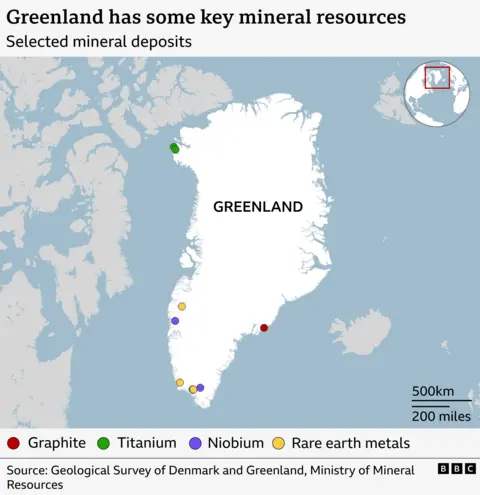
It is also said to be home to the vast majority of raw materials considered crucial for electronics, green energy and other strategic and military technologies – to which Trump has been pushing to secure America’s access.
Overall, 25 of 34 minerals deemed “critical raw materials” by the European Commission are found in Greenland, including graphite, niobium and titanium, according to the 2023 Geological Survey of Denmark and Greenland.
Greenland’s strategic importance is “not just about defence”, Senator Ted Cruz, a Republican from Texas, said at a Senate hearing last year about the potential acquisition of Greenland, pointing to the island’s “vast reserves of rare earth elements”.
Trump has sometimes downplayed the importance of those resources, pointing to what he claims is rising Russian and Chinese influence in the region to justify his claims that the US has to “have” the island.
“I want Greenland for security – I don’t want it for anything else,” he told reporters at the World Economic Forum in Davos on Wednesday, pointing in part to the difficulty of exploring in the Arctic region. “You have to go 25ft down through ice to get it. It’s not, it’s not something that a lot of people are going to do or want to do.”
But access to the island’s natural resources have loomed large in the background for the administration, which has put the US economy at the centre of its geopolitical vision and has made combatting China’s dominance of the rare earths industry a priority.
Trump’s interest in controlling Greenland is “primarily about access to those resources, and blocking China’s access”, according to Steven Lamy, professor of international relations at the University of Southern California.
Even before Trump’s second term, the US had been tightening its ties with Greenland, including by reopening its consulate in the island’s capital, Nuuk, in 2020, responding to Russia and China’s expanding military presence in the Arctic.
Since Trump returned to office, his allies have talked up the island’s commercial potential, as rising temperatures expand sea routes and opportunities to explore the region’s fisheries and other natural resources, especially those related to defence, such as energy and critical minerals, that the administration sees as a priority.
“This is about shipping lanes. This is about energy. This is about fisheries. And, of course, it’s about your mission, which is keeping us safe and monitoring space, monitoring our adversaries, and making sure the American people can sleep safely in their homes, day in and day out,” Mike Waltz, the current US ambassador to the United Nations and then Trump’s national security adviser, told US troops stationed in Greenland last year.
And Louisiana Governor Jeff Landry told CNBC this month that Trump was a “business president” who believed the island represented “a more robust trading opportunity”.
Over the summer, the Trump administration signed off on the possibility of backing an American company’s mining project in Greenland, via $120m (£90m) in financing from the Export-Import Bank of the United States.
The plan built on other deals the Trump administration has agreed with Australia and Japan, as well as private firms, to secure US access to supply and production of rare earths, an industry now dominated by China.
Dr Patrick Schröder, a senior research fellow at Chatham House, said the scale of Greenland’s critical minerals holdings had the potential to “shift the dial” for the US, allowing it to reduce its reliance on China – a key priority for the administration.
But critics of Trump’s designs on the island, say it is not clear why US control would be necessary to access the island’s resources.
Analysts also warn that tapping them is easier said than done.
Among other challenges, mining in Greenland currently is expensive and hampered by severe weather conditions, a lack of infrastructure and a small labour force, Lamy said.
While exploration permits have been given for 100 blocs of the island, there are just two productive mines in Greenland.
“Greenland has been trying to attract outside investments into its extractive industries for a long time, and has not had a lot of luck because the business case just hasn’t really been there,” said Mikkel Runge Olesen, a senior researcher at the Danish Institute for International Studies.
“It’s true that there are huge quantities of minerals of various kinds in Greenland. However, it also costs a lot of money to extract those minerals.”
But Prof Andrew Shepherd, director of the Centre for Polar Observation and Modelling, said rapidly melting layers of ice are increasingly easing the process, exposing rock for potential mining and creating river runoff.
“Getting all the fieldwork done traditionally has been very hard to do because you have to get energy to remote regions,” he told the BBC.
“With the melting ice, you get the potential for hydro power in the area where the land is being exposed… so this presents itself as an interesting prospect.”
Jennifer Spence, director of the Arctic Initiative at the Harvard Kennedy School, said when it came to mining in Greenland, “it’s all still about potential”.
Still, she thinks the island’s strategic shipping location and rare earths deposits were key factors drawing Trump’s attention.
“His logic is that there’s a national security imperative,” Spence said. “My belief is that this is much more economically driven.”
Additional reporting by Natalie Sherman