Category: Uncategorized

  • ICE detains 5-year-old Liam Ramos during Minnesota operation

    ICE detains 5-year-old Liam Ramos during Minnesota operation


    US Immigration and Customs Enforcement (ICE) officers detained a 5-year-old boy on Tuesday during an enforcement operation, Minnesota school officials have said, as part of an immigration crackdown in the state.

    Pre-schooler Liam Ramos was with his father – named by the Department of Homeland Security (DHS) as Adrian Alexander Conejo Arias – when Conejo Arias was approached by agents on his driveway.

    In a statement posted on X, the DHS said “ICE did NOT target a child”, but was conducting an operation against his father, an “illegal alien” who “abandoned” his son when approached.

    Zena Stenvik, the Columbia Heights Public Schools superintendent, asked: “Why detain a 5-year-old?

    “You can’t tell me that this child is going to be classified as a violent criminal.”

    Photos provided to the BBC by the school district show a boy, identified as Liam Ramos, wearing a bunny-shaped winter hat, standing outside as an officer holds onto his backpack.

    The Columbia Heights Public Schools authority described these as bystander photos. The district did not identify the individuals who took the pictures, referring to them as “known and confirmed community members”.

    Marc Prokosch, a lawyer representing the family, told journalists that Liam and his father were likely being held at a detention centre in Texas. School officials said that the father had an active asylum case with no deportation order.

    The son had just arrived home from pre-school at the time of the apprehension, Stenvik said during a press conference on Wednesday.

    Around the time of the incident, school officials were present at the Ramos house to provide support, according to the schools superintendent.

    Stenvik said that ICE had recently detained a total of four students in her school district, including a 10-year-old, and two 17-year-olds.

    The DHS did not immediately respond to the BBC’s request for comment on the incident.

    In its post on X, the DHS described the arrest as a “targeted operation”. It added: “For the child’s safety, one of our ICE officers remained with the child while the other officers apprehended Conejo Arias.

    “Parents are asked if they want to be removed with their children, or ICE will place the children with a safe person the parent designates. This is consistent with past administration’s immigration enforcement.”

    According to Stenvik, another adult living in the home did ask to take the young boy inside but was refused. It was not clear why.

    Instead, the school officials allege, an agent asked the child to knock on the door of the home to see if anyone else was there.

    Columbia Heights Public Schools Board of Education Chair Mary Granlund said in a statement: “Our children should not be afraid to come to school or wait at the bus stop.

    “Their families should not be afraid to drop off or pick up their children from school.”

    The DHS has previously said it is arresting the “worst of the worst criminal illegal aliens” in an effort to restore public safety in Minnesota.

    At a DHS press conference on Tuesday, Gregory Bovino of the US Border Patrol discussed the wider operation and said: “Our operations are lawful, are targeted, and are focused on individuals who pose a serious threat to this community.”

    The mission, dubbed Operation Metro Surge, has sparked outcry from residents in Minneapolis, St Paul, and other cities in the state.

    On 7 January, a federal officer fatally shot a woman named Renee Good in Minneapolis, sparking nationwide protest and condemnation from local and state officials.


    Source link

  • Two dead and several missing after deadly landslides

    Two dead and several missing after deadly landslides


    Watch: Footage captures moment landslide starts in Mount Maunganui in New Zealand

    Two people have died and several are feared buried after landslides in New Zealand’s North Island.

    The deaths were reported at Welcome Bay, while rescue workers are still searching through rubble at a different site in a popular campground on Mount Maunganui.

    There are no “signs of life”, authorities said, adding that they have a “rough idea” of how many people are missing but are waiting for an exact figure. They provided no other details except that the group includes “at least one young girl”.

    The landslides were triggered by heavy rains over the last few days, which led to flooding and power outages across the North Island. One minister said the east coast resembled “a war zone”.

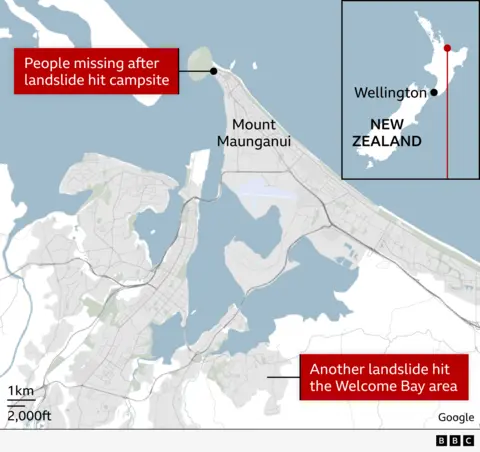
    Map showing the Mount Maunganui area in New Zealand’s Bay of Plenty. A marker indicates a campsite where people are missing after a landslide. Another labelled area shows a second landslide in the Welcome Bay area to the south. Roads, waterways and coastal features are visible, with a scale bar showing distances. An inset map shows New Zealand with Wellington marked for location context.

    New Zealand is “heavy with grief” after the “profound tragedy” caused by recent weather, Prime Minister Christopher Luxon said on X.

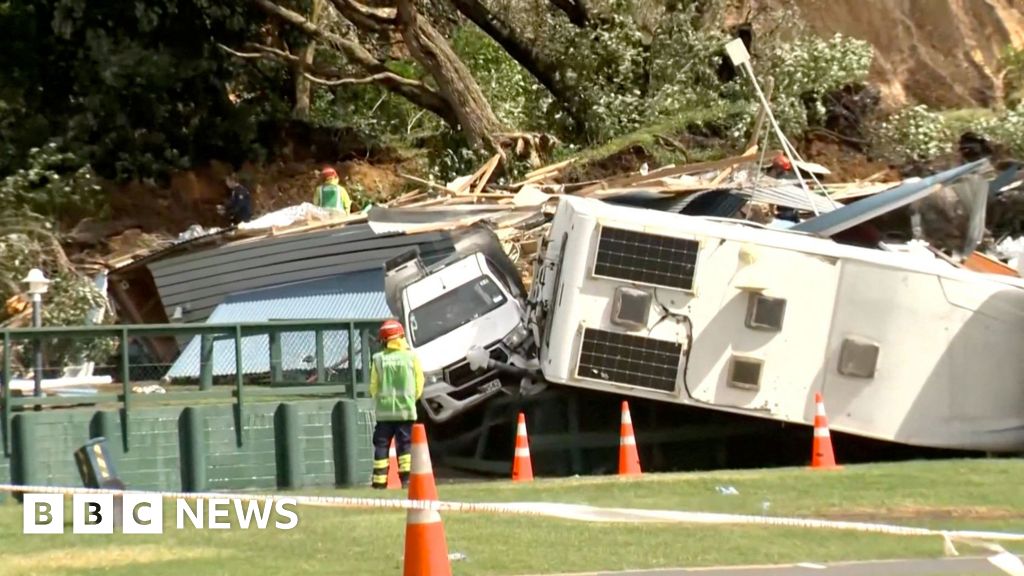
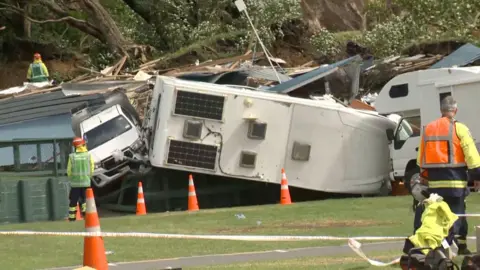
    Footage from the campsite on Mount Maunganui, an extinct volcano, shows a huge slip near the base of the volcanic dome, as rescuers and sniffer dogs comb through crushed caravans and flattened tents.

    Authorities said that the search would continue through the night. “This is a complex and high-risk environment, and our teams are working to achieve the best possible outcome while keeping everyone safe,” said Megan Stiffler, the deputy national commander for the Urban Search and Rescue team,

    The extinct volcano is a sacred Māori site and one of the most popular campgrounds in New Zealand, with a local holiday website describing it as a “slice of paradise”. But it has been repeatedly hit by landslides in recent years.

    “I heard this huge tree crack and all this dirt come off, and then I looked behind me and there’s this huge landslide coming down,” Australian tourist Sonny Worrall told local broadcaster TVNZ.

    “I’m still shaking from it now… I turned around and had to jump out of my seat and just run,”he added. He saw it happen while swimming in a hot pool.

    Hiker Mark Tangney told the New Zealand Herald he heard people screaming from under the rubble. “So I just parked up and ran to help… We could hear people screaming: ‘Help us, help us, get us out of here’,” he said.

    Those calls persisted for about half an hour and then went silent, Tangney said.

    TVNZ Rescuers comb through crushed caravans and flattened tents at the campsite, with orange cones lining itTVNZ

    Rescue work will continue through the night, officials say

    A surf club in another part of Mount Maunganui has been evacuated following fears of more landslides.

    A state of emergency has been declared in the Bay of Plenty where Mount Maunganui sits, and various parts of the North Island, including Northland, Coromandel, Tairāwhiti and Hauraki.

    Several areas reported their wettest days on record on Thursday. Tauranga in the Bay of Plenty, for example, received three months worth of rain within a day, according to local media.

    Some 8,000 people were without power as of Thursday morning, Radio New Zealand (RNZ) reported.

    The wife of a man who was swept away in the Mahurangi River is holding out hope that he will survive.

    “I know his personality is strong, wise,” she told RNZ, adding that he was a fisherman back home in Kiribati and knew how to swim and dive.

    The man, 47, was driving to work with their nephew when the car they were in fell into the river.

    He had pushed the nephew towards a branch so the nephew could hoist himself onto land; but the older man did not manage get back up himself, according to the report.

    “It’s been a very big event for us as a country, really hitting almost our entire eastern seaboard of the North Island,” said Minister for Emergency Management Mark Mitchell.

    “The good news is that everyone responded really quickly, and there was time to get prepared. That helps to mitigate and create a very strong response,” he told RNZ.

    December to February are typically the sunnier months in New Zealand but in recent years heavy rains and storms have become more frequent.

    In February 2023, parts of the island were devastated by Cyclone Gabrielle, which is to date the costliest cyclone to hit the Southern Hemisphere, with damage amounting to NZ$13.5bn ($7.9bn; £5.9bn).

    This week’s flooding has added to the toll for the local communities that are still rebuilding.

    Additional reporting by Vandhna Bhan and Koh Ewe


    Source link

  • Pixel Zero-Click, Redis RCE, China C2s, RAT Ads, Crypto Scams & 15+ Stories

    Pixel Zero-Click, Redis RCE, China C2s, RAT Ads, Crypto Scams & 15+ Stories


    Ravie LakshmananJan 22, 2026Cybersecurity / Hacking News

    Most of this week’s threats didn’t rely on new tricks. They relied on familiar systems behaving exactly as designed, just in the wrong hands. Ordinary files, routine services, and trusted workflows were enough to open doors without forcing them.

    What stands out is how little friction attackers now need. Some activity focused on quiet reach and coverage, others on timing and reuse. The emphasis wasn’t speed or spectacle, but control gained through scale, patience, and misplaced trust.

    The stories below trace where that trust bent, not how it broke. Each item is a small signal of a larger shift, best seen when viewed together.

    Taken together, these incidents show how quickly the “background layer” of technology has become the front line. The weakest points weren’t exotic exploits, but the spaces people stop watching once systems feel stable.

    The takeaway isn’t a single threat or fix. It’s the pattern: exposure accumulates quietly, then surfaces all at once. The full list makes that pattern hard to ignore.


    Source link