Category: Uncategorized

  • Rapid rollback of Kurdish-led forces reshapes Sharaa’s Syria

    Rapid rollback of Kurdish-led forces reshapes Sharaa’s Syria


    Hugo BachegaMiddle East correspondent, Beirut

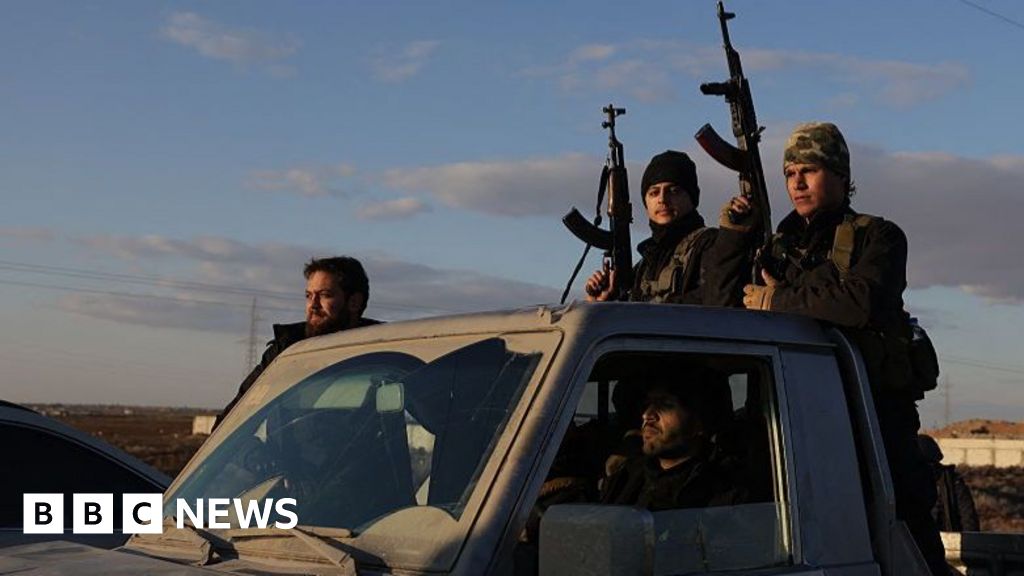
    AFP Syrian government forces hold rifles while riding on a pick-up truck on the road to Raqqa, Syria (19 January 2026)AFP

    Syrian government forces advanced rapidly into north-eastern Syria in recent days

    President Ahmed al-Sharaa has made significant advances in his efforts to unify a deeply fractured Syria, reclaiming large swathes of territory in the north-east that had been under the control of a Kurdish-led militia alliance for more than a decade. What happens next will be a test for a government that has tried to assert its authority over the whole country.

    The gains by government forces in a lightning offensive against the Syrian Democratic Forces (SDF) marked the biggest change of control in Syria since Islamist-led rebels toppled Bashar al-Assad in December 2024, ending the 13-year civil war. Before this month’s push, nearly a third of Syria’s territory was controlled by the Kurds, who enjoyed American support after helping a US-led coalition defeat the jihadist group Islamic State (IS) in the last decade. There, they ran an enclave with its own government and institutions, with the SDF being its military arm.
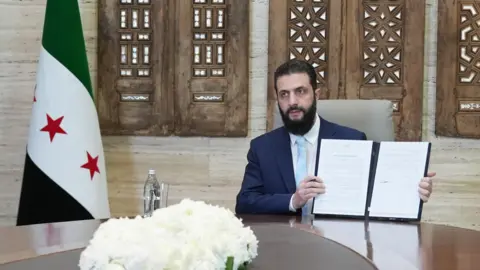
    EPA Syrian President Ahmed al-Sharaa holds up a 14-point agreement with the Syrian Democratic Forces (SDF), giving the government control over Kurdish-run north-eastern Syria, in Damascus, Syria (18 January 2026)EPA

    President Ahmed al-Sharaa signed a 14-point agreement with the SDF on Sunday

    The offensive came amid stalled talks between Sharaa’s government and the SDF about the key issue of integrating its forces into the country’s institutions. A deal was signed last March, but a year-end deadline expired with little progress as the SDF remained reluctant to give up its autonomy. The militia alliance, analysts say, miscalculated in its negotiations with the government, seeming to believe it would have the backing of its longtime ally.

    But the US under President Donald Trump has strongly supported Sharaa, who has defended his vision of a united Syria under the control of Damascus. Trump hosted Sharaa, who was once branded a terrorist by the US for his former links to al-Qaeda, at the White House last year, and lifted devastating sanctions imposed on Syria in the Assad years. When Sharaa’s forces started their push, there was no apparent US objection.
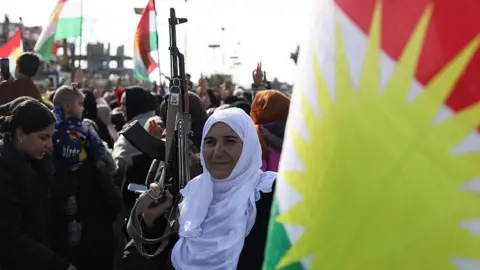
    AFP A woman holds a rifle at a protest by Kurds against a government offensive in north-eastern Syria, in Qamishli, Syria (20 January 2026 AFP

    Syrian Kurds stand to lose the autonomy they enjoyed for more than a decade

    On Sunday, after suffering stunning territorial losses, the SDF agreed on a 14-point deal that reversed almost all concessions it had gained from the government in earlier negotiations. Crucially, its members are expected to join the Syrian army and interior ministry as individuals – and not as separate units, as it had demanded – while the control of oil and gas fields, important for Syria’s economic recovery, will be transferred to the government. SDF-run prisons and camps holding thousands of IS detainees and family members are also being brought under Damascus’ control.

    The announcement came days after Sharaa issued a decree that was seen as an attempt to reach out to the Kurds, whose rights had been denied in the five-decade rule by the Assads: it designated Kurdish as a national language, granted Syrian nationality to stateless Kurds, and declared the Nowruz – the Persian new year – a national holiday.

    Fighting, however, erupted again. So far, the areas reclaimed by government forces have been mainly Arab, where locals had resentments against the SDF. But the troops continued to move towards Kurdish-majority areas, raising the prospect of deadly clashes, and reportedly angering Washington. On Tuesday, Sharaa’s government suddenly announced a ceasefire, giving the SDF four days to present a detailed plan for the integration of areas under its control into the state. This halted the move of his army and prevented the escalation of the violence, for now.
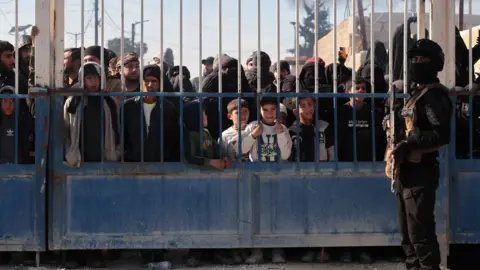
    EPA Syrian security forces stand in front of the gate of the al-Hol camp, behind which stand family members of suspected IS members, in Hassakeh province, Syria (21 January 2026)EPA

    Government forces took control of al-Hol camp for IS families after SDF fighters withdrew

    Since coming to power after the fall of the Assad regime, Sharaa has repeatedly vowed to protect Syria’s minorities. But the country has seen deadly bouts of sectarian violence. Last year, government forces were accused of atrocities after being sent to the Mediterranean coast, which is the heartland of Assad’s Alawite sect, and the mainly Druze southern province of Suweida. Kurds fear the same could happen to them, despite renewed guarantees offered by Sharaa.

    For the Kurds, the losses are a fatal blow to the aspirations of preserving their autonomy, with the US position being seen as a betrayal. Tom Barrack, the US special envoy, said the “original purpose” of the partnership with the SDF, as the main anti-IS force in Syria, had “largely expired”, and that the “greatest opportunity for the Kurds in Syria” lay in the transition under Sharaa, whose government is seen by Western countries as the best chance to guarantee Syria’s stability.

    The dramatic changes empower Sharaa but are likely to renew calls for him to decentralise authority, with critics saying key posts have been limited to his allies. It could also indicate what he may be planning to do in other areas of the country, including those held by the Druze, who demand autonomy.
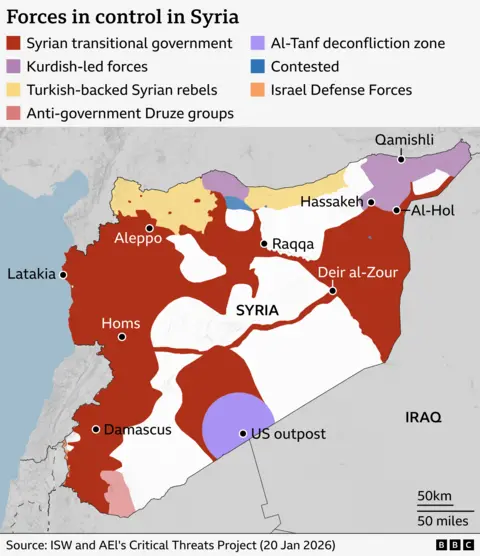
    Map showing forces in control of Syria, as of 20 January 2026


    Source link

  • Ugandan MP and Bobi Wine ally arrested over election violence

    Ugandan MP and Bobi Wine ally arrested over election violence


    Ugandan police have detained a lawmaker, and close ally of opposition leader Bobi Wine, for his alleged role in election-related violence last week.

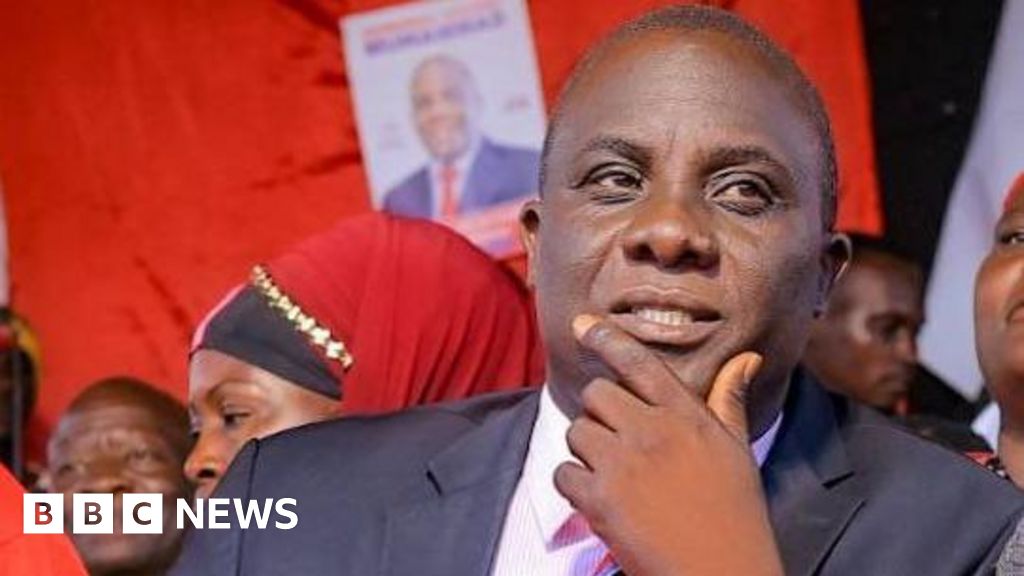
    Muwanga Kivumbi, a deputy leader of Wine’s National Unity Platform (NUP), is accused of organising attacks on a police station and a vote-tallying centre after their electoral loss, which the party denies.

    The police have said that seven people were killed in the incident, but the politician has given a different account, saying that 10 people were killed at his home as they waited for parliamentary election results.

    The Uganda Police Force said in a post on X on Thursday that Kivumbi would be “arraigned before court in due course”.

    “His arrest is in connection with recent incidents of political violence,” it added.

    Kivumbi’s arrest follows tensions after last week’s elections in which President Yoweri Museveni was re-elected for a seventh term.

    During his victory speech over the weekend, Museveni warned opposition figures including Kivumbi of coordinated plans to attack polling stations.

    He said seven people were shot dead by police after groups of alleged opposition supporters, armed with machetes, attempted to carry out violent attacks in Butambala district outside the capital, Kampala.

    Wine, Museveni’s closest challenger and who is in hiding after fleeing a raid on his house after the elections, has denounced the results as “fake”, citing electoral fraud.

    He has also alleged that there was “silent massacre” under way and a crackdown targeting political activists.

    On Tuesday, he posted on social media that more than 100 people had been killed in election violence, without stating evidence.

    This came after Uganda’s army chief Gen Muhoozi Kainerugaba, who is also Museveni’s son and his potential successor, said the security forces had killed 22 opposition supporters during poll-related violence.

    Since the election, Ugandan authorities have reportedly arrested dozens of youths on various charges linked to election-related incidents in Kampala.

    Museveni first came to power as a rebel leader in 1986. He will have served for 45 years when the next term ends in 2031.

    Uganda has not witnessed a peaceful transfer of presidential power since independence.


    Source link

  • Son-in-law of Venezuelan opposition candidate freed from jail, wife says

    Son-in-law of Venezuelan opposition candidate freed from jail, wife says


    Rafael Tudares, the son-in-law of Venezuelan opposition candidate Edmundo González, has been released from prison, his wife has said, more than a year after he was detained as part of a crackdown on Maduro government critics and their relatives.

    Mariana González said her husband had returned home after “380 days of unjust and arbitrary detention”.

    Tudares is one of more than 150 detainees who have been released since the US military seized Venezuelan leader, Nicolás Maduro, in a nighttime raid and took him to New York to stand trial on drug-trafficking charges.

    An NGO lobbying for the release of Venezuelan political prisoners warns that 777 still remain behind bars.

    Tension within the country remains high with Maduro’s former vice-president, Delcy Rodríguez, now in power having been sworn in as the acting president.

    Her interim government has received the backing of US President Donald Trump, who has praised Rodríguez for agreeing to “turn over” up to 50 million barrels of Venezuelan oil to the US.

    The release of political prisoners had been among the first things the Trump administration had pushed Venezuela’s interim government to do.

    Just five days after the US raid, the head of Venezuela’s National Assembly announced that “an important number of people” would be freed as “a gesture of peace”.

    However, rights groups have denounced the slow pace of the releases and the fact that the number given by officials – 400 – falls far short of what they have been able to confirm.

    The NGO Foro Penal says it has so far only been able to verify the release of 151 political prisoners since 8 January, when the head of Venezuela’s National Assembly announced that “an important number of people” would be freed as “a gesture of peace” following the US operation.

    Foro Penal has also said that many those released have not had the charges against them dropped, leaving them in legal limbo, and have been barred from speaking in public.

    Tudares’s imprisonment was one of the emblematic cases of the repression which followed in the wake of Venezuela’s 2024 presidential election.

    His father-in-law, González, became the main challenger of the incumbent Maduro after the well-known opposition leader María Corina Machado was barred from running.

    Fearing the Maduro government would resort to fraud to rig the result, González and Machado mobilised hundreds of people to act as observers at the polling stations and collect the tallies from the electronic voting machines.

    The electoral council, dominated by government loyalists, declared Maduro the winner but never provided the detailed voting tallies to back up its claim.

    The voting tallies collected by the observers deployed by the opposition and independently verified by the Carter Center, however, suggested that González had won by a landslide.

    Nevertheless, Maduro – who was firmly in control of the state institutions, including the armed forces and the police – was sworn in for another term in January 2025.

    In the run-up to his inauguration, many opposition leaders and activists were seized by the security forces in an attempt to stifle any dissent.

    Fearing arrest, González had sought refuge in the Dutch embassy as early as September 2024 and gone in to exile in Spain shortly afterwards.

    Three days before Maduro’s inauguration, González’s 46-year-old son-in-law – a lawyer who was not involved in politics – was seized by hooded men as he was taking his young children to see their ailing grandmother.

    For months, his family did not know where he was being held or on what grounds he had been seized.

    Last month, his wife said she had learned that he had been sentenced to 30 years in prison for “terrorism and conspiracy”. She said her access was not allowed to choose a lawyer and had only been allowed to read the charges levelled against him on the day of his “only hearing”.

    Mariana González told El Pais newspaper that she had been approached on at least three occasions by middlemen who told her that her husband would only be allowed to return to his family if her father renounced his cause.

    “This has nothing to do with justice,” she said at the time. “Being the son-in-law of Edmundo González is not a crime,” she added.

    Mariana González took to X to thank all of the people who had supported her in her fight for her husband’s release.

    But she also reminded readers that there were still many families waiting for the release of their loved ones who, she said, had been “forcibly disappeared, arbitrarily detained and unjustly locked up.

    Many of them have been holding vigils outside the main prisons in Venezuela in the hope that their relatives will be among those released in the wake of the US military raid.


    Source link