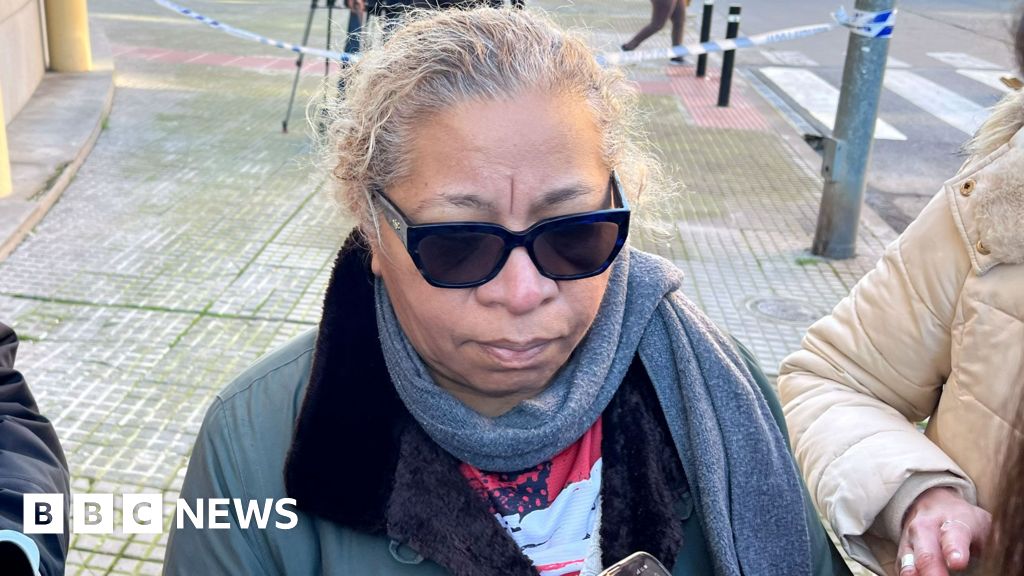
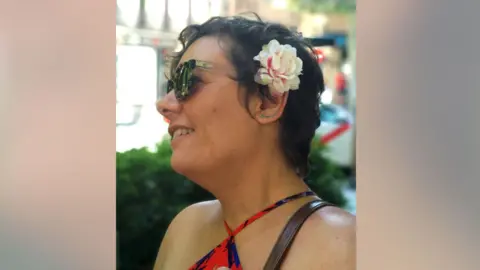
Yamilei’s brother-in-law Victor was among the victims of Sunday night’s crash
Eduardo Morán, a doctor at Córdoba’s Reina Sofía Hospital, suspected it was serious.
He and his wife, also a medic, had been asked to head to work after reports that two high speed trains had collided nearby.
“We were preparing different parts of the hospital,” he recalls. “Not just the emergency room, but the intensive care unit, all the surgery theatres and the regular floor. Everybody was there.”
As the patients arrived, their injuries ranged from scratches to missing limbs. Staff prioritised who to treat. Some were operated on, others monitored.
Eduardo had never seen such an influx of casualties in his 20-year career, and yet the hospital was not overwhelmed.
“We were expecting more,” he says. “Unfortunately, there were a lot of people who didn’t make it and died on the railway.”
Social Media
Among the victims was María del Carmen Abril, returning from a surprise birthday party
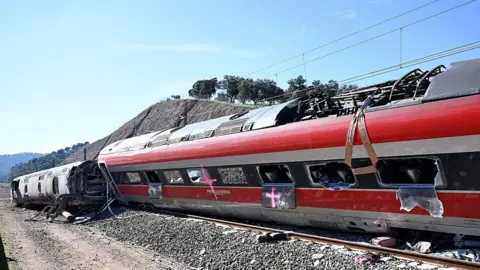
In dense woodland 36 miles from Córdoba lies the tangled wreckage of the two trains that collided on Sunday evening.
A gap in the straight section of track is thought to be what investigators are focusing on.
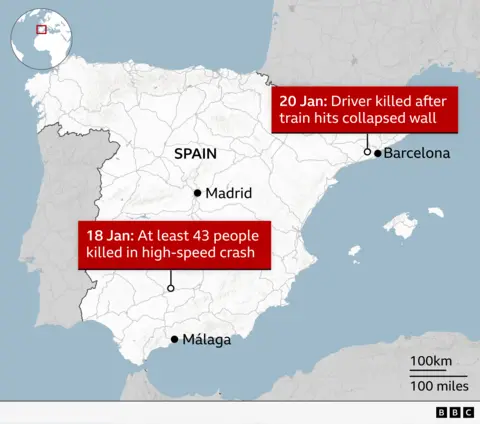
At least 43 people lost their lives here, and as sniffer dogs weave between the empty seats and shattered windows, there is still a hunger to unearth answers as to what caused Spain’s worst rail crash in more than a decade.
As officials called for patience, news broke of a second derailment in almost as many days.
Unlike Sunday night’s disaster, the train that crashed near Barcelona was not a high-speed model, and the accident involved a wall that collapsed onto the track in heavy rain.
Nevertheless, it has led to the Spanish train drivers’ union calling a strike over the “unacceptable constant deterioration of the railway”.
For the families and friends of those missing and killed in southern Spain, these events have only added to their unanswered questions.
BBC/Moose Campbell
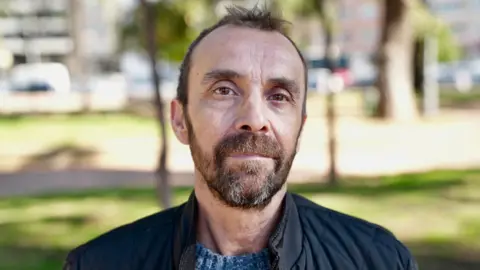
Jose Manuel Muñoz lost his friend Abril in Sunday’s high-speed rail crash
Throughout Saturday afternoon and into the night in Córdoba, Jose Manuel Muñoz and his friends were holding a surprise 50th birthday party for María del Carmen Abril, a teacher.
The party was barely over when Abril, as she is known, made her way back north to Madrid. She thanked her hosts on their WhatsApp group, and they later frantically replied to see if she was OK.
Abril was sitting on one of the carriages that came off the tracks into an oncoming train. Her death was confirmed the next day.
Carlos Alvarez/Getty Images
An Iryo train was the first to derail at Adamuz, crashing into an oncoming train
“It’s very difficult to explain the contrast of emotions,” says Muñoz, sitting in the tranquil surroundings of Córdoba’s Jardines de la Victoria, a park next to his workshop where he makes picture frames.
“We spent one day celebrating life with our friend, then there were two days of uncertainty, without knowing anything about what happened to her, then we get the confirmation that she’s dead.”
He describes Abril as a “lovely, generous, affectionate person who loved flowers and was always trying to solve other people’s problems”.
And yet Muñoz does not blame anyone for her death; instead, he puts it down to bad luck.
Under the low winter sun and next to the city’s bull ring is Córdoba’s Civic Centre. Outside are two makeshift tents where the families of the missing give DNA samples in the hope their relatives can at least be identified.
BBC/Marianne Baisnée
Yamilei shows a picture of her brother-in-law, Victor Luis Terán
Because of a last-minute change in travel plans, Jamilet’s brother-in law, Victor Luis Terán, took an earlier train and became caught up in the crash as he travelled south from Madrid to Huelva.
It was not until Tuesday night that confirmation came that Victor, a Bolivian national, was among the 43 victims.
Yamilei is looking for answers: “That’s all we want. Because we can’t do it any more.”
The truth she seeks is likely to take weeks to arrive, and official calls for patience have only been hampered by a devastating three days on Spain’s rail network.
Additional reporting by Marianne Baisnée and Marta Jimenez
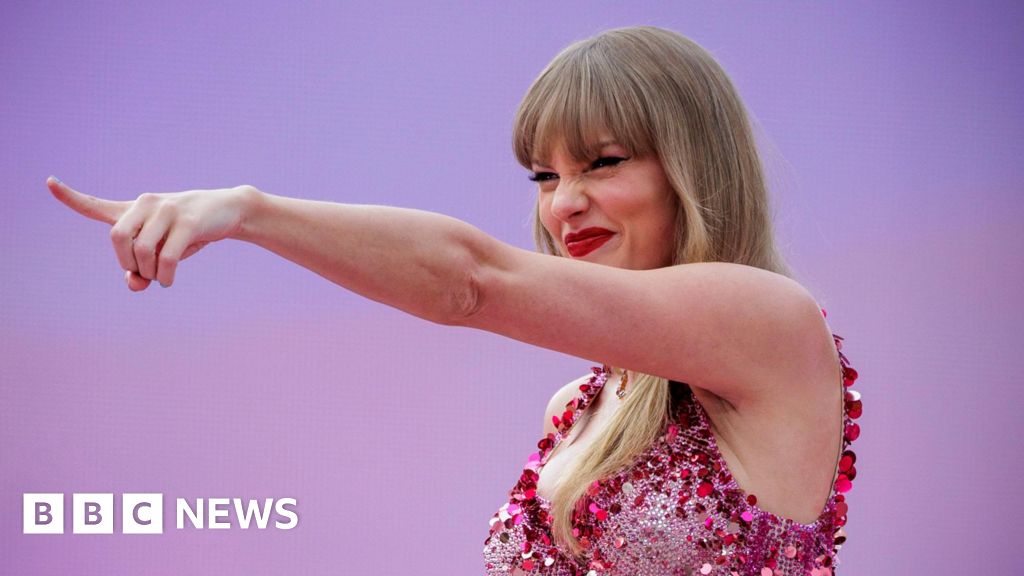
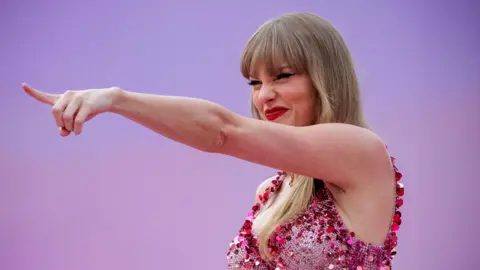
Taylor Swift’s latest accolade follows a record-breaking year for the pop sensation
Taylor Swift has become the youngest female artist inducted into the Songwriters Hall of Fame.
It follows a glittering few years for the 36-year-old pop superstar, who broke her own sales record with her latest album, The Life of a Showgirl, in October.
She is among nine songwriters within the 2026 class, which also includes Canadian-American singer-songwriter Alanis Morissette and Walter Afanasieff, known for his work with Mariah Carey.
The singer will be welcomed into the prestigious club during a private ceremony in New York later this year.
‘Everything originates from the song and its creator’
Founded in 1969, the Songwriters Hall of Fame honours those “whose work represents a spectrum of the most beloved songs from the world’s popular music songbook”.
It selects a small group of artists on an annual basis, and less than 500 people have been invited in over the last fifty years.
Announcing this year’s inductees, chairman and Chic frontman Nile Rodgers said this year’s line-up “not only showcases iconic songs but also celebrates unity across various genres”.
“These songwriters have profoundly impacted the lives of billions of listeners worldwide, and it is our privilege to honor their contributions,” he added.
Also among the 2026 class is Christopher “Tricky” Stewart, who was behind Beyonce’s Single Ladies and Break My Soul, and Paul Stanley and Gene Simmons of rock band Kiss.
Footloose singer-songwriter Kenny Loggins and Terry Britten and Graham Lyle, who wrote Tina Turner’s What’s Love Got To Do With It, have also been inducted.
Getty Images
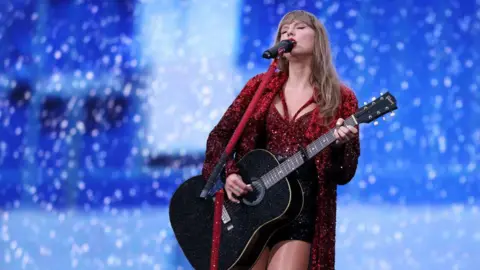
The pop superstar previously became the first performer to win the album of the year Grammy four times
Taylor is one of the best-selling music artists of all time, reaching stardom with her 12 studio albums and four re-recorded “Taylor’s Versions” albums.