Category: Uncategorized

  • Supreme Court sceptical of Trump firing of Lisa Cook

    Supreme Court sceptical of Trump firing of Lisa Cook


    Natalie ShermanBusiness reporter

    Getty Images Federal Reserve Governor Lisa Cook delivers remarks during an event organized by the Psaros Center for Financial Markets and Policy at the Georgetown University's McDonough School of Business at the university on November 20, 2025 in Washington, DCGetty Images

    US President Donald Trump appeared on course for a setback at America’s top court on Wednesday over his unprecedented move to fire a central bank governor.

    Supreme Court justices from the left and right asked why they should speed through such an impactful decision, citing concerns about process and implications for central bank independence and the wider economy.

    Trump in August said he was removing Federal Reserve governor Lisa Cook, accusing her of engaging in mortgage fraud, which she has denied.

    Cook has argued she did not receive due process to dispute those claims, which Fed defenders say were a pretext to allow Trump to assert more control over the bank.

    Justice Brett Kavanaugh, a conservative who was appointed by Trump, was among the justices to express sympathy with Cook’s arguments, asking: “What’s the fear of more process here?”

    He later warned the administration’s interpretation of the law would “weaken, if not shatter, the independence of the Federal Reserve”.

    ‘Quite a big mistake’

    By law, a president can only remove governors of the Federal Reserve “for cause”.

    That requirement was intended to shield the central bank from political pressure and allow it to make policy independently.

    The White House contends it has met that bar, accusing Cook of filing mortgage forms claiming two different principal residences at the same time. Banks typically offer lower interest rates for primary homes.

    The Trump administration has asked the court to allow the president to remove Cook, a move lower courts had blocked while the case played out.

    “Even if it’s inadvertent or a mistake, it’s quite a big mistake,” said solicitor general D John Sauer, who was arguing the case for the administration.

    He said such conduct could undermine confidence in the bank and that courts were bound to defer to the president’s judgement when it comes to finding a cause.

    He dismissed questions about process, noting that Trump had alerted Cook to the issue on social media before formally firing her.

    “There was a social media post,” he said. “And the response was defiance.”

    ‘Nothing criminal whatsoever’

    Cook has denied committing fraud.

    In a November letter to the Justice Department, her lawyers said the claims were based on “cherry-picked, incomplete snippets of the full documents”.

    They said there was “one stray reference to primary residence” in a mortgage application for an apartment in Alabama, but noted that the file also contained “truthful and more specific disclosures about the property’s use”.

    “There is no fraud, no intent to deceive, nothing whatsoever criminal or remotely a basis to allege mortgage fraud,” her lawyers wrote.

    Arguing on behalf of Cook, Paul Clement said people in her position should have the chance to present their evidence and be shielded from having a decision made in advance.

    He said the administration’s interpretation of the law would make the protection that Congress intended by inserting the “for cause” requirement “toothless”.

    Some justices indicated that they shared those concerns.

    The “position that there’s no judicial review, no process required, no remedy available, very low bar for cause that the president alone determines – that would weaken if not shatter the independence of the Federal Reserve,” Kavanaugh said.

    The lawsuit is seen as high stakes, given swirling debate about Trump’s efforts to influence the Fed, which he wants to lower interest rates more aggressively to boost economic growth.

    Federal Reserve chairman Jerome Powell was among the officials expected to attend. He is facing his own criminal probe related to cost overruns during renovations of Fed properties – concerns he has called “pretexts”.

    In other recent cases, the Supreme Court, which has a 6-3 conservative majority, has allowed the White House to proceed with firings.

    But it has signalled that it views the Federal Reserve, which was designed to set policy independently from the White House, as different.

    Several justices, including conservatives, indicated they were hesitant to greenlight Cook’s removal without courts having resolved issues like whether the mortgage filings, which were made before Cook was appointed, would meet the bar for a “for cause” firing.

    “We know that the independence of the agency is very important and that that independence is harmed if we decide these issues too quickly and without due consideration,” said Justice Sonia Sotomayor, a liberal. “So to me, waiting to have at least the lower courts look at these issues first makes the most sense.”

    “Is there any reason why this whole matter had to be handled by everybody… in such a hurried manner?” asked Justice Samuel Alito, a conservative.

    Justice Amy Coney Barrett, another Trump appointee, pressed Sauer to explain what harm the president would suffer by waiting, noting that the court had been warned of potentially dire economic consequences of a decision that could weaken belief in the central bank’s independence.

    “There’s a risk,” she said. “Doesn’t that counsel… caution on our part?”


    Source link

  • Israeli strike in Gaza kills three journalists, first responders say

    Israeli strike in Gaza kills three journalists, first responders say


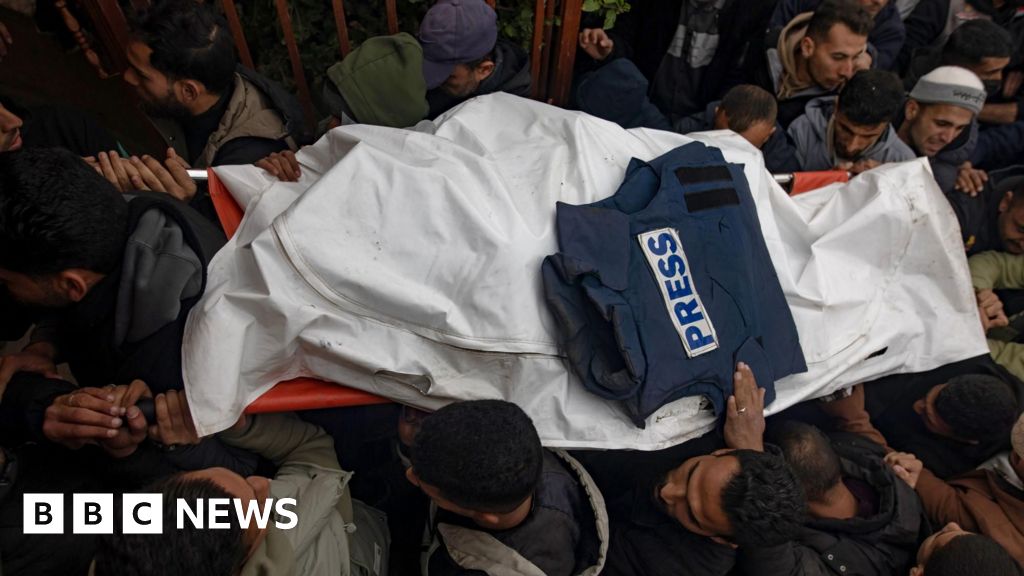
    Three Palestinian journalists have been killed in an Israeli strike in central Gaza, first responders say.

    Gaza’s Hamas-run Civil Defence agency said their car was hit in the al-Zahra area and named them as Mohammed Salah Qeshta, Anas Ghunaim and Abdul Raouf Shaath. They are understood to have been working for an Egyptian relief organisation.

    The Israeli military said it struck “several suspects who operated a drone affiliated with Hamas… in a manner that posed a threat” to its troops. It added that the incident was under examination.

    Another eight people, two of them children, were killed by Israeli artillery and gunfire across Gaza on Wednesday, the Hamas-run health ministry said.

    Medics said three people, including a 10-year-old boy, were killed by Israeli tank fire elsewhere in central Gaza, and that a 13-year-old boy and a woman were killed by Israeli gunfire in the southern Khan Younis area, according to Reuters news agency.

    The Israeli military said on Wednesday morning that its troops had killed a “terrorist who crossed the Yellow Line and approached” them, without mentioning a location. The Yellow Line demarcates territory in Gaza still under Israeli control under the ceasefire deal.

    At least 466 Palestinians have been killed in Gaza since a ceasefire between Israel and Hamas began on 10 October, according to the health ministry.

    The Israeli military has said three of its soldiers have been killed in attacks by Palestinian armed groups over the same period.

    The three photojournalists killed on Wednesday – one of whom contributed regularly to French news agency AFP – were reportedly working for the Egyptian Relief Committee in the Gaza Strip to film its camps for displaced people.

    A spokesperson for the humanitarian organisation said the car that was struck was marked with its logo and that it was “targeted during a humanitarian mission, resulting in the martyrdom of three individuals”.

    Hamas called the strike a “dangerous escalation of the flagrant violations of the ceasefire agreement”.

    The Palestinian Journalists Syndicate said it constituted a war crime and evidence of what it called “a systematic Israeli policy aimed at silencing the Palestinian voice, obstructing the transmission of facts, and concealing crimes committed against civilians in the Gaza Strip”, according to Palestinian news agency Wafa.

    The Committee to Protect Journalists (CPJ) has documented the killing of at least 206 journalists and media workers by Israeli fire in Gaza since the start of the war – the deadliest conflict for journalists ever documented.

    Before Wednesday, two journalists had been killed in Israeli strikes during the ceasefire, and a third had been killed by members of a Palestinian armed group, according to the US-based organisation’s data.

    International news outlets rely on local journalists in Gaza, as Israel does not allow foreign media, including BBC News, to send their journalists into the territory independently. Some journalists are taken into Gaza by the Israeli military under controlled access.

    The war was triggered by the Hamas-led attack on southern Israel on 7 October 2023, in which about 1,200 people were killed and 251 others were taken hostage.

    Israel responded to the attack by launching a military campaign in Gaza, during which more than 71,550 people have been killed, according to the territory’s health ministry.


    Source link

  • Oldest cave painting could rewrite origins of human creativity

    Oldest cave painting could rewrite origins of human creativity


    Pallab Ghosh profile image

    Pallab GhoshScience Correspondent

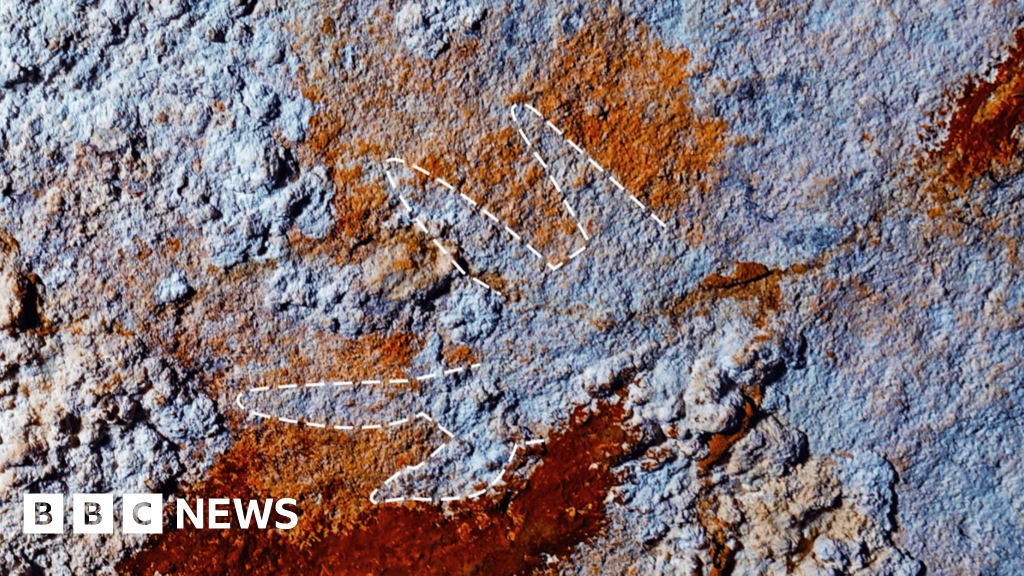
    A stencilled outline of a hand found on the Indonesian island of Sulawesi is the world’s oldest known cave painting, researchers say.

    It shows a red outline of a hand whose fingers were reworked, researchers say, to create a claw-like motif which indicates an early leap in symbolic imagination.

    The painting has been dated to at least 67,800 years ago – around 1,100 years before the previous record, a controversial hand stencil in Spain.

    The find also strengthens the argument that our species, Homo sapiens, had reached the wider Australia–New Guinea landmass, known as Sahul, by around 15,000 years earlier than some researchers argue.

    Over the past decade, a series of discoveries on Sulawesi has overturned the old idea that art and abstract thinking in our species burst suddenly into life in Ice Age Europe and spread from there.

    Cave art is seen as a key marker of when humans began to think in truly abstract, symbolic ways – the kind of imagination that underpins language, religion and science.

    Early paintings and engravings show people not just reacting to the world, but representing it, sharing stories and identities in a way no other species is known to have done.

    Professor Adam Brumm of Griffiths University in Australia, who co-led the project, told BBC News, that the latest discovery, published in the journal Nature, adds to the emerging view that there was no awakening for humanity in Europe. Instead, creativity was innate to our species, the evidence for which stretches back to Africa, where we evolved.

    “When I went to university in the mid to late 90s, that’s what we were taught – the creative explosion in humans occurred in a small part of Europe. But now we’re seeing traits of modern human behaviour, including narrative art in Indonesia, which makes that Eurocentric argument very hard to sustain”.

    The oldest Spanish cave art is a red hand stencil in Maltravieso cave in Western Spain, dated to be at least 66,700 years old – though this is controversial and some experts don’t think it to be that old.

    In 2014, hand stencils and animal figures dating back at least 40,000 years were found in Sulawesi, followed by a hunting scene that is at least 44,000 year old, and then a narrative pig and human painting dated to at least 51,200 years ago. Each step pushed sophisticated image making further back in time, according to Professor Maxime Aubert of Griffiths University.

    “We started with minimum ages of at least 40,000 years, the same time as in Europe, but by getting closer to the pigment we’ve pushed the rock art in Sulawesi back by at least another 28,000 years”.

    The latest discovery is from a limestone cave called Liang Metanduno on Muna, a small island off south eastern Sulawesi. It has been spray-painted: an ancient graffiti artist pressed their hand flat against the cave wall, then blew or spat a mouthful of pigment around it so that, when they pulled the hand away, a negative outline was left behind on the rock.

    One fragmentary hand stencil there is overlain by thin mineral crusts that, when analysed, was found to have a minimum age of 67,800 years, making it the oldest reliably dated cave art anywhere in the world.

    Crucially, the artist did more than simply spray pigment around a hand pressed to the wall, the researchers say.

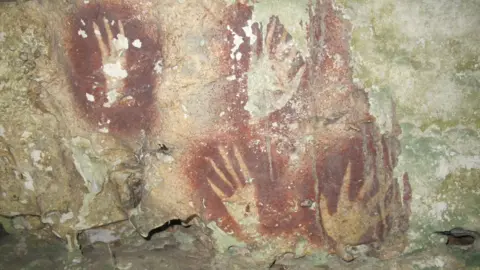
    Ahdi Agus Oktaviana A close view of a cave wall shows four reddish handprints in a rough rectangle, like a tiny gallery of ghostly signatures. Each is a negative hand stencil: the artist pressed a hand to the rock and sprayed red pigment around it, leaving the hand itself as bare stone outlined in colour. The rock surface is uneven and mottled green, cream and brown, with cracks and small cavities. Three stencils are clear, with long, unnaturally narrow fingers that taper to points, while the fourth, at the top right, is partly flaked away so only fragments of the palm and fingers remain. The overall effect is of glowing red halos of paint framing pale hands that seem to reach out from the ancient rockAhdi Agus Oktaviana

    More recent elongated hand stencils found elsewhere in Suluwesi shows how prevalent the red claw image was among these ancient artists.

    After the original stencil was made, the outlines of the fingers were carefully altered – narrowed and elongated to make it look more claw-like; a creative transformation that Brumm argues is “a very us thing to do”.

    He notes that there was no evidence of that experimentation in any of the art produced by our sister species, Neanderthals, in their cave paintings in Spain around 64,000 years ago. Even that is hotly contested because some researchers question the dating method.

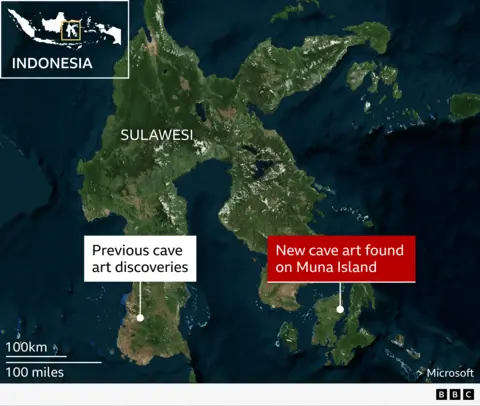
    Until this latest discovery on Muna, all the paintings in Sulawesi had come from the Maros Pangkep karst in the island’s south west. The fact that this much older stencil turns up on the opposite side of Sulawesi, on a separate satellite island, suggests that making images on cave walls was not a local experiment but deeply embedded in the cultures that spread across the region.

    Brumm says years of fieldwork by Indonesian colleagues have revealed “hundreds of new rock art sites” across remote areas, with some caves used repeatedly over tens of thousands of years. At Liang Metanduno, other, much younger paintings on the same panel – some produced as late as about 20,000 years ago – show that this single cave was a focus for artistic activity stretching over at least 35,000 years.

    Oldest cave art discoveries in Sulawesi, Indonesia

A satellite-style map shows the Indonesian island of Sulawesi and surrounding sea, viewed from above with green land and dark blue ocean. Inset at the top left is a small map of Indonesia with a yellow box highlighting Sulawesi’s location. Large white text labels the main island “Sulawesi.” Near the south‑west of Sulawesi, a white dot and white label read “Previous cave art discoveries.” To the south‑east, on a smaller adjoining landmass, a second white dot is connected to a bold red label that reads “New cave art found on Muna Island.” At the bottom left, a scale bar shows “100 km” above “100 miles.”

    Because Sulawesi lies on the northern sea route between mainland Asia and ancient Sahul, the dates have direct implications for assessing when the ancestors of Aboriginal Australians first arrived.

    For years, the mainstream view – based largely on DNA studies and most archaeological sites – was that Homo sapiens first reached the ancient Australia–New Guinea landmass, Sahul, about 50,000 years ago.

    But with firm evidence that Homo sapiens were settled on Sulawesi and making complex symbolic art at least 67,800 years ago, it makes it much more likely that controversial archaeological evidence for humans in northern Australia by about 65,000 years is correct, according to Adhi Agus Oktaviana, of the Indonesia’s national research and innovation Agency (BRIN).

    “It is very likely that the people who made these paintings in Sulawesi were part of the broader population that would later spread through the region and ultimately reach Australia.”

    Many archaeologists once argued for a European “big bang” of the mind because cave paintings, carvings, ornaments and new stone tools all seem to appear together in France and Spain about 40,000 years ago, soon after Homo sapiens arrived there.

    Spectacular Ice Age cave art in places like Altamira and El Castillo encouraged the idea that symbolism and art switched on almost overnight in Ice Age Europe. Since then, engraved ochre, beads and abstract marks from South African sites such as Blombos Cave, some 70,000–100,000 years old, have shown that symbolic behaviour was already established in Africa long before.

    Along with very old figurative and narrative paintings from Sulawesi, a new consensus is being shaped; that there was a much deeper and more widespread story of creativity, Aubert told BBC News.

    “What it suggests is that humans would have had that capacity for a very long time, at least when they left Africa – but probably before that”.


    Source link