

Category: Uncategorized

  • Oldest cave painting could rewrite origins of human creativity

    Oldest cave painting could rewrite origins of human creativity


    Pallab Ghosh profile image

    Pallab GhoshScience Correspondent

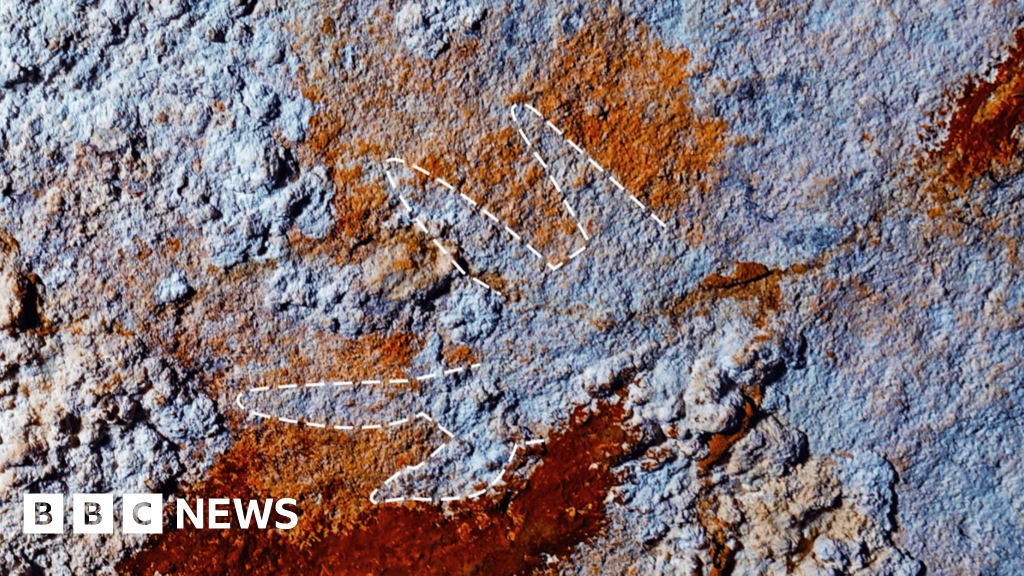
    A stencilled outline of a hand found on the Indonesian island of Sulawesi is the world’s oldest known cave painting, researchers say.

    It shows a red outline of a hand whose fingers were reworked, researchers say, to create a claw-like motif which indicates an early leap in symbolic imagination.

    The painting has been dated to at least 67,800 years ago – around 1,100 years before the previous record, a controversial hand stencil in Spain.

    The find also strengthens the argument that our species, Homo sapiens, had reached the wider Australia–New Guinea landmass, known as Sahul, by around 15,000 years earlier than some researchers argue.

    Over the past decade, a series of discoveries on Sulawesi has overturned the old idea that art and abstract thinking in our species burst suddenly into life in Ice Age Europe and spread from there.

    Cave art is seen as a key marker of when humans began to think in truly abstract, symbolic ways – the kind of imagination that underpins language, religion and science.

    Early paintings and engravings show people not just reacting to the world, but representing it, sharing stories and identities in a way no other species is known to have done.

    Professor Adam Brumm of Griffiths University in Australia, who co-led the project, told BBC News, that the latest discovery, published in the journal Nature, adds to the emerging view that there was no awakening for humanity in Europe. Instead, creativity was innate to our species, the evidence for which stretches back to Africa, where we evolved.

    “When I went to university in the mid to late 90s, that’s what we were taught – the creative explosion in humans occurred in a small part of Europe. But now we’re seeing traits of modern human behaviour, including narrative art in Indonesia, which makes that Eurocentric argument very hard to sustain”.

    The oldest Spanish cave art is a red hand stencil in Maltravieso cave in Western Spain, dated to be at least 66,700 years old – though this is controversial and some experts don’t think it to be that old.

    In 2014, hand stencils and animal figures dating back at least 40,000 years were found in Sulawesi, followed by a hunting scene that is at least 44,000 year old, and then a narrative pig and human painting dated to at least 51,200 years ago. Each step pushed sophisticated image making further back in time, according to Professor Maxime Aubert of Griffiths University.

    “We started with minimum ages of at least 40,000 years, the same time as in Europe, but by getting closer to the pigment we’ve pushed the rock art in Sulawesi back by at least another 28,000 years”.

    The latest discovery is from a limestone cave called Liang Metanduno on Muna, a small island off south eastern Sulawesi. It has been spray-painted: an ancient graffiti artist pressed their hand flat against the cave wall, then blew or spat a mouthful of pigment around it so that, when they pulled the hand away, a negative outline was left behind on the rock.

    One fragmentary hand stencil there is overlain by thin mineral crusts that, when analysed, was found to have a minimum age of 67,800 years, making it the oldest reliably dated cave art anywhere in the world.

    Crucially, the artist did more than simply spray pigment around a hand pressed to the wall, the researchers say.
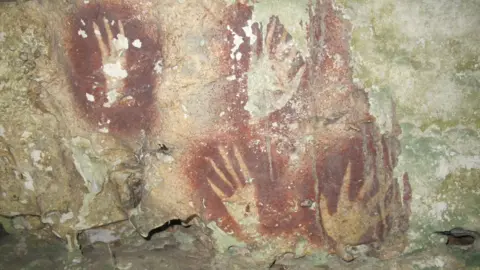
    Ahdi Agus Oktaviana A close view of a cave wall shows four reddish handprints in a rough rectangle, like a tiny gallery of ghostly signatures. Each is a negative hand stencil: the artist pressed a hand to the rock and sprayed red pigment around it, leaving the hand itself as bare stone outlined in colour. The rock surface is uneven and mottled green, cream and brown, with cracks and small cavities. Three stencils are clear, with long, unnaturally narrow fingers that taper to points, while the fourth, at the top right, is partly flaked away so only fragments of the palm and fingers remain. The overall effect is of glowing red halos of paint framing pale hands that seem to reach out from the ancient rockAhdi Agus Oktaviana

    More recent elongated hand stencils found elsewhere in Suluwesi shows how prevalent the red claw image was among these ancient artists.

    After the original stencil was made, the outlines of the fingers were carefully altered – narrowed and elongated to make it look more claw-like; a creative transformation that Brumm argues is “a very us thing to do”.

    He notes that there was no evidence of that experimentation in any of the art produced by our sister species, Neanderthals, in their cave paintings in Spain around 64,000 years ago. Even that is hotly contested because some researchers question the dating method.

    Until this latest discovery on Muna, all the paintings in Sulawesi had come from the Maros Pangkep karst in the island’s south west. The fact that this much older stencil turns up on the opposite side of Sulawesi, on a separate satellite island, suggests that making images on cave walls was not a local experiment but deeply embedded in the cultures that spread across the region.

    Brumm says years of fieldwork by Indonesian colleagues have revealed “hundreds of new rock art sites” across remote areas, with some caves used repeatedly over tens of thousands of years. At Liang Metanduno, other, much younger paintings on the same panel – some produced as late as about 20,000 years ago – show that this single cave was a focus for artistic activity stretching over at least 35,000 years.

    Oldest cave art discoveries in Sulawesi, Indonesia

A satellite-style map shows the Indonesian island of Sulawesi and surrounding sea, viewed from above with green land and dark blue ocean. Inset at the top left is a small map of Indonesia with a yellow box highlighting Sulawesi’s location. Large white text labels the main island “Sulawesi.” Near the south‑west of Sulawesi, a white dot and white label read “Previous cave art discoveries.” To the south‑east, on a smaller adjoining landmass, a second white dot is connected to a bold red label that reads “New cave art found on Muna Island.” At the bottom left, a scale bar shows “100 km” above “100 miles.”

    Because Sulawesi lies on the northern sea route between mainland Asia and ancient Sahul, the dates have direct implications for assessing when the ancestors of Aboriginal Australians first arrived.

    For years, the mainstream view – based largely on DNA studies and most archaeological sites – was that Homo sapiens first reached the ancient Australia–New Guinea landmass, Sahul, about 50,000 years ago.

    But with firm evidence that Homo sapiens were settled on Sulawesi and making complex symbolic art at least 67,800 years ago, it makes it much more likely that controversial archaeological evidence for humans in northern Australia by about 65,000 years is correct, according to Adhi Agus Oktaviana, of the Indonesia’s national research and innovation Agency (BRIN).

    “It is very likely that the people who made these paintings in Sulawesi were part of the broader population that would later spread through the region and ultimately reach Australia.”

    Many archaeologists once argued for a European “big bang” of the mind because cave paintings, carvings, ornaments and new stone tools all seem to appear together in France and Spain about 40,000 years ago, soon after Homo sapiens arrived there.

    Spectacular Ice Age cave art in places like Altamira and El Castillo encouraged the idea that symbolism and art switched on almost overnight in Ice Age Europe. Since then, engraved ochre, beads and abstract marks from South African sites such as Blombos Cave, some 70,000–100,000 years old, have shown that symbolic behaviour was already established in Africa long before.

    Along with very old figurative and narrative paintings from Sulawesi, a new consensus is being shaped; that there was a much deeper and more widespread story of creativity, Aubert told BBC News.

    “What it suggests is that humans would have had that capacity for a very long time, at least when they left Africa – but probably before that”.




    Source link

  • Add Punycode to your Threat Hunting Routine

    Add Punycode to your Threat Hunting Routine


    IDNs or “International Domain Names” have been with us for a while now (see RFC3490[1]). They are (ab)used in many attack scenarios because.. it works! Who can immediately spot the difference between:

    
    https://youtube.com/

    And:

    
    https://youtube.com/

    The magic is to replace classic characters by others that look almost the same. In the example above, the letter “o” has been replaced by Greek character “o”.

    If they are very efficient for attackers, they remain below the radar in many organizations. To avoid issues when printing unusual characters, Punycode[2] helps to encode them in plain characters. The example above will be encoded as:

    
    xn--yutube-wqf.com

    This format is based on:

    • “xn--“ : the common prefix for all IDNs requests.
    • “yutube.com”: The normal ASCII characters
    • “wqf” : The Punycode encoded version of the Unicode character

    Python can decode them easily:

    
    $ python3
    Python 3.12.3 (main, Jan  8 2026, 11:30:50) [GCC 13.3.0] on linux
    Type "help", "copyright", "credits" or "license" for more information.
    >>> domain = "xn--yutube-wqf.com"
    >>> decoded = domain.encode("ascii").decode("idna")
    >>> print(decoded)
    y?utube.com
    >>> for c in decoded:
    ...     print(f"{c} -> {ord(c)}")
    ...
    y -> 121
    ? -> 1086
    u -> 117
    t -> 116
    u -> 117
    b -> 98
    e -> 101
    . -> 46
    c -> 99
    o -> 111
    m -> 109
    >>>

    You can see the value of “o” is not “usual” (not in the ASCII range). They are plenty of online tools that can (de|en)code Punycode[3].

    If not all IDNs are suspicious, they are not very common and deserve some searches in your logs. If you already collect your DNS resolver logs (I hope you do!), it’s easy to search for such domains:

    
    $ grep "xn--" queries.log*
    queries.log:19-Jan-2026 19:54:38.399 queries: info: client @0x999999999999 192.168.255.13#47099 (in.xn--b1akcbzf.xn--90amc.xn--p1acf): query: in.xn--b1akcbzf.xn--90amc.xn--p1acf IN A +E(0) (192.168.254.8)
    queries.log:20-Jan-2026 04:38:25.877 queries: info: client @0x999999999999 192.168.255.13#49850 (in.xn--b1akcbzf.xn--90amc.xn--p1acf): query: in.xn--b1akcbzf.xn--90amc.xn--p1acf IN A +E(0) (192.168.254.8)
    queries.log.0:18-Jan-2026 15:22:11.741 queries: info: client @0x9999999999 192.168.255.13#60763 (in.xn--b1akcbzf.xn--90amc.xn--p1acf): query: in.xn--b1akcbzf.xn--90amc.xn--p1acf IN A +E(0) (192.168.254.8)
    queries.log.0:18-Jan-2026 17:27:23.127 queries: info: client @0x99999999999 192.168.255.13#44141 (in.xn--b1akcbzf.xn--90amc.xn--p1acf): query: in.xn--b1akcbzf.xn--90amc.xn--p1acf IN A +E(0) (192.168.254.8)
    queries.log.0:18-Jan-2026 22:54:36.841 queries: info: client @0x99999999999 192.168.255.13#35963 (in.xn--b1akcbzf.xn--90amc.xn--p1acf): query: in.xn--b1akcbzf.xn--90amc.xn--p1acf IN A +E(0) (192.168.254.8)

    The detected Punycode domain is decoded to: 

    Another good proof that DNS is a goldmine for threat hunting!

    [1] https://datatracker.ietf.org/doc/html/rfc3490

    [2] https://en.wikipedia.org/wiki/Punycode

    [3] https://regery.com/en/domains/tools/punycode-decoder

    Xavier Mertens (@xme)

    Xameco

    Senior ISC Handler – Freelance Cyber Security Consultant

    PGP Key


    Source link

  • Israel postpones demolition of Palestinian children’s football pitch in Bethlehem

    Israel postpones demolition of Palestinian children’s football pitch in Bethlehem


    BBC News Three Palestinian boys around 10 years old, wearing red football kit, wait in line to take a penalty. They are standing on a green astro turf football pitch with a metal fence behind them. Behind that stands a tall concrete wallBBC News

    The Aida Youth Centre’s pitch sits next to the barrier separating the occupied West Bank from Israel

    Israel has postponed the demolition of a Palestinian children’s football club in the city of Bethlehem, in the occupied West Bank.

    It said the Aida Youth Centre’s pitch was constructed without the necessary permits.

    It said the demolition was necessary for security reasons.

    An international campaign to save it, including a petition with more than half a million signatures, appears to have forced the authorities to reconsider. The club, however, said it had not yet received any official notification.

    It is barely a 10th of the size of a full-scale football field, there are patches of rust on the goalposts and, towering over the length of one of the touchlines, the architecture of conflict looms large in Israel’s concrete security barrier.

    But while it may not rank high up among the world’s iconic sporting venues, this children’s football club has found itself at the centre of a hard-fought international campaign for its survival.

    And despite the asymmetrical odds as it took on the Israeli state, that campaign appears – for now at least – to have worked.

    The club has won a reprieve against the threat of demolition by the Israeli military, which claimed that the pitch was far too close to the barrier.

    On the very northern edge of Bethlehem, construction of the pitch began in 2020 with the aim of providing a place to practise football for more than 200 young players from the nearby Aida refugee camp.

    The cramped and crowded streets contain the homes of the descendants of Palestinian families who were forced or who fled from their homes during the 1948 Arab-Israeli war.

    On 3 November last year, as the children made their short walk from the camp for that day’s training, they found a notice pinned to the gate of the football field declaring it to be illegal.

    The notice was followed by a demolition order, issued at the end of December.

    “We don’t have anywhere else to play, 10-year-old Naya told me, wearing a Brazil shirt with the name of the footballing legend Neymar emblazoned on the back.

    “We are building our dreams here,” she said. “If they demolish our field, they will demolish our dreams.”

    I asked another young player, Mohammed, what his reaction was when he heard the news that the club was earmarked for destruction.

    “I was upset,” he told me. “This is a field I really care for.”

    The community fought back, posting videos on social media, launching a petition attracting hundreds of thousands of signatures as well as the reported interventions of senior officials from some of football’s global and regional governing bodies.

    In its latest statement, the Israeli military repeated its claim that the football pitch, built so close to the wall, posed a security issue.

    But the BBC understands that a political decision has been made to postpone the demolition order “for the time being”.

    A map showing the Israel barrier wall and the football pitch

    Israel began building its concrete barrier in the early 2000s in the face of a wave of deadly suicide bombings and other attacks carried out by Palestinians which killed hundreds of Israelis.

    It says it is vital for Israel’s protection and that it has dramatically cut the number of attacks.

    Palestinians, however, say that it has become a tool of collective punishment, separating them from their workplaces, dividing their communities and effectively annexing parts of their land.

    For them, the fight over the football pitch highlights a wider injustice.

    While they are being denied the right to keep a small sporting facility on the boundary of one of their cities, Israel is approving vast new settlements across the occupied West Bank and which are considered illegal under international law.

    The immediate threat may now have been averted for the football pitch.

    But the club is taking nothing for granted.

    Mohammad Abu Srour, one of the board members of the Aida Youth Centre, told me that they feared that the threat might come back when the club is out of the spotlight.

    “We’re going to continue to campaign,” he told me.


    Source link