Visual Studio Code is a popular open-source code editor[1]. But it’s much more than a simple editor, it’s a complete development platform that supports many languages and it is available on multiple platforms. Used by developers worldwide, it’s a juicy target for threat actors because it can be extended with extensions.
Of course, it became a new playground for bad guys and malicious extensions were already discovered multiple times, like the ‘Dracula Official’ theme[2]. Their modus-operandi is always the same: they take the legitimate extension and include scripts that perform malicious actions.
VSCode has also many features that help developers in their day to day job. One of them is the execution of automatic tasks on specific events. Think about the automatic macro execution in Microsoft Office.
With VSCode, it’s easy to implement and it’s based on a simple JSON file. Create in your project directory a sub-directory “.vscode” and, inside this one, create a “tasks.json”. Here is an example:
The key element in this JSON file is the “runOn” method: The script will be triggered when the folder will be opened by VSCode.
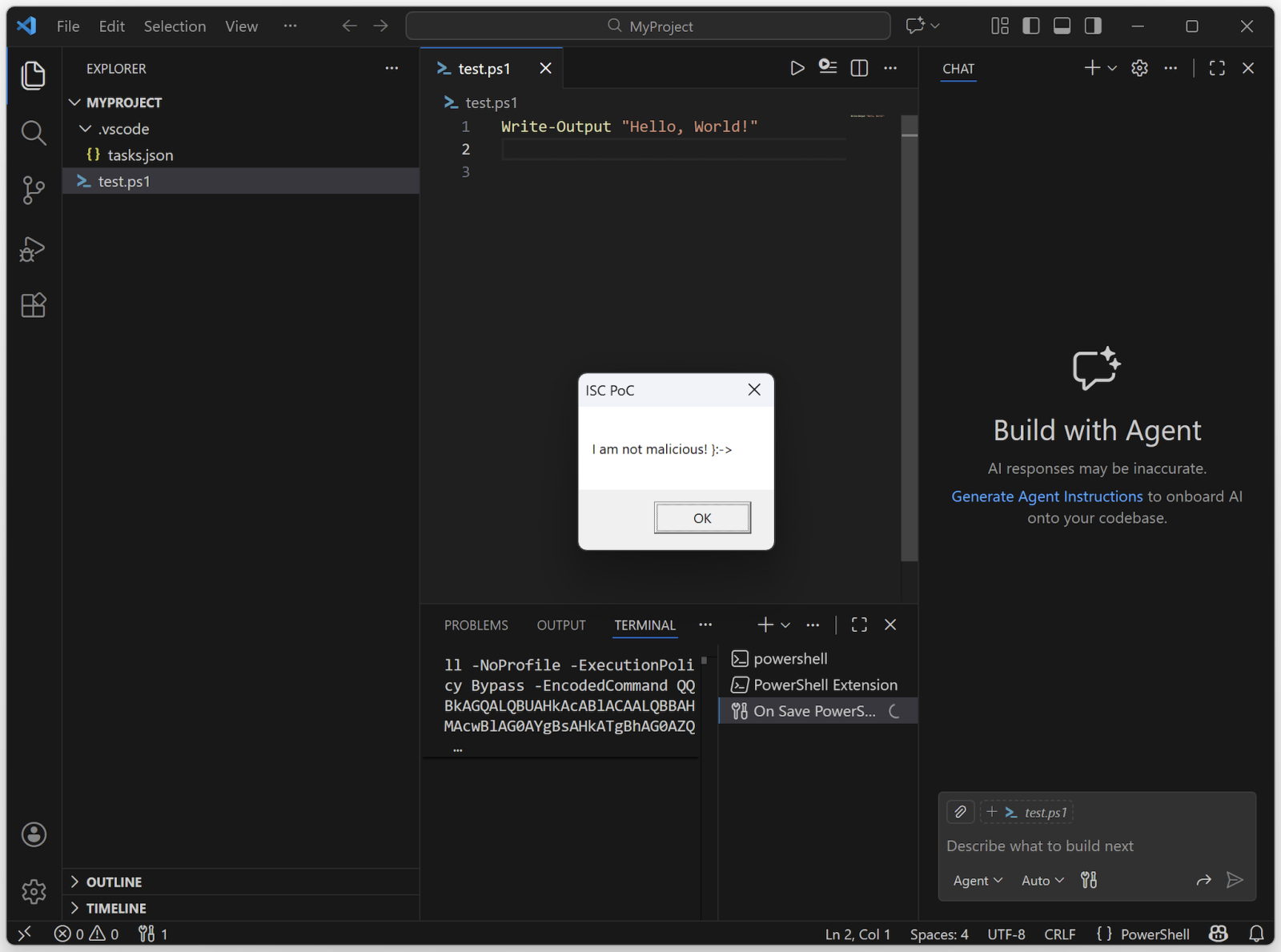
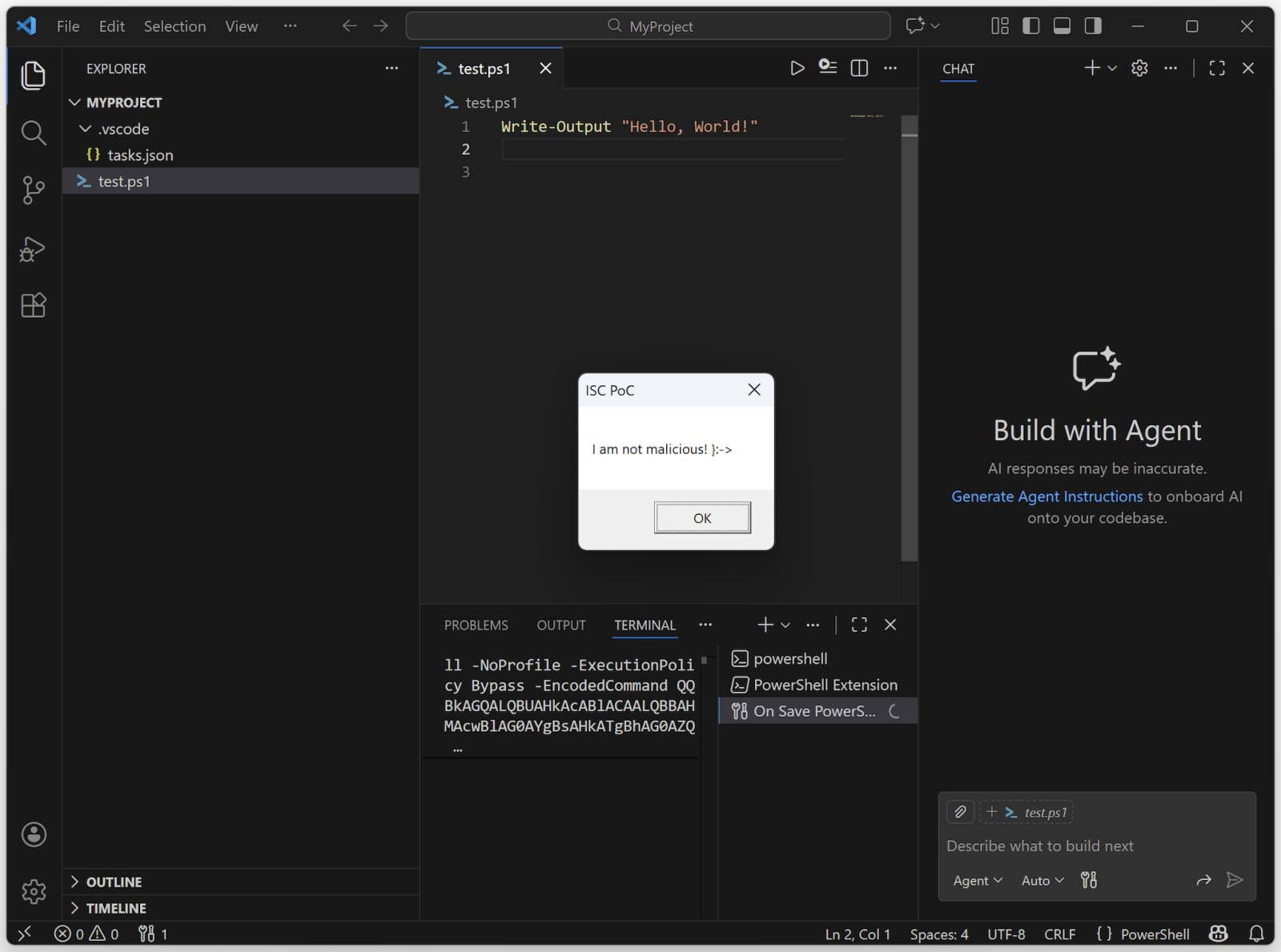
If you see some Base64 encode stuff, you can imagine that some obfuscation is in place. Now, launch VSCode from the project directory and you should see this:
The Base64 data is just this code:
Add-Type -AssemblyName PresentationFramework; [System.Windows.MessageBox]::Show('I am not malicious! }:->', 'ISC PoC') | Out-Null
This technique has already been implemented by some threat actors![3]!
Be careful if you see some unexpected “.vscode” directories!
It is the latest in a wave of kidnappings blamed on armed gangs (stock image)
Nigeria’s police have now confirmed that a group of worshippers was kidnapped from three churches in a remote part of the northern Kaduna state, after previously denying it.
More than two days after the raid on the Kurmin Wali area, police on Tuesday night said that an earlier statement denying the attack had been “widely misinterpreted”.
Local residents told the BBC that 177 worshippers had been abducted but that 11 later escaped.
Police spokesperson Benjamin Hundeyin did not give any numbers but said subsequent checks by operational units and intelligence sources had confirmed the abduction.
He said security forces had been fully deployed to the area, and that search-and-rescue operations and patrols were under way.
He said the earlier statement was “not a denial of the incident but a measured response pending confirmation of details from the field, including the identities and number of those affected”.
One eyewitness said the attack happened at about 10:00 local time on Sunday.
“Some people tried to run, but they couldn’t because the armed men had surrounded the village,” he said. “They gathered people together and later forced them to march into the bush.”
Residents said the attack affected three churches, Pentecostal Fellowship Assembly (PFA) Church 1, Pentecostal Fellowship Assembly (PFA) Church 2, and the Evangelical Church Winning All (ECWA) Church.
On Monday, Kaduna state police commissioner Alhaji Muhammad Rabiu told journalists: “We got a report that 300 people were kidnapped in Kurmin Wali and we sent our officers, soldiers and vigilante and at this time there is no evidence to suggest that a kidnap happened.”
He challenged “anyone to list the names of the kidnapped victims and other particulars.”
The chairman of Kajuru local government area, which includes Kurmin Wali, Dauda Madaki, said security forces were sent to the area but found no evidence of a kidnapping.
”We visited the church where the so-called kidnap took place. There was no evidence of the attack. I asked the village head, Mai Dan Zaria, and he said that there was no such attack.”
Amnesty International has criticised Nigeria’s authorities over what it described as “the desperate denial” of the kidnapping.
The rights group said: “Authorities must also take immediate and concrete measures to prevent rampant abductions that are gradually becoming the norm in Nigeria.”
A list of those kidnapped seen by the BBC on Tuesday contains more than 160 names, though this has not been independently verified.
In November, more than 300 students and teachers were seized from a Catholic school in neighbouring Niger state. They were later released in two successive groups. This was among a spate of kidnappings that made international headlines.
Nigeria is facing numerous security challenges – including kidnappings for ransom by criminal gangs, an Islamist insurgency in the north-east, separatist violence in the south-east, and a battle between herders and farmers in the centre over access to land and water.
Experts say corruption, poor intelligence sharing and underfunded local policing have hampered efforts to tackle the various crises.
Nigeria’s defence minister resigned last month at the height of the kidnapping crisis, officially for health reasons, according to the president’s office.
The US has recently become militarily involved in Nigeria – launching airstrikes on Christmas Day on two camps run by an Islamist militant group in north-western Nigeria.
Earlier this month, US President Donald Trump warned of more strikes if Christians continued to be killed in the West African nation.
There are more than 250 ethnic groups in Nigeria, which is roughly divided into a mainly Muslim north, a largely Christian south, with intermingling in the middle – and the government says people of all faiths have been victims of attacks.
A Nigerian foreign ministry spokesman responded to Trump’s warning by saying that Nigeria would continue to engage constructively with partners such as the US.
”Nigeria remains committed to protecting all citizens, Christians and Muslims alike, without discrimination,” Alkasim Abdulkadir said.
Motaz Malhees stars in the film which places the late Hind Rajab front and centre
“They’re shooting at me. Please come get me. I’m scared.”
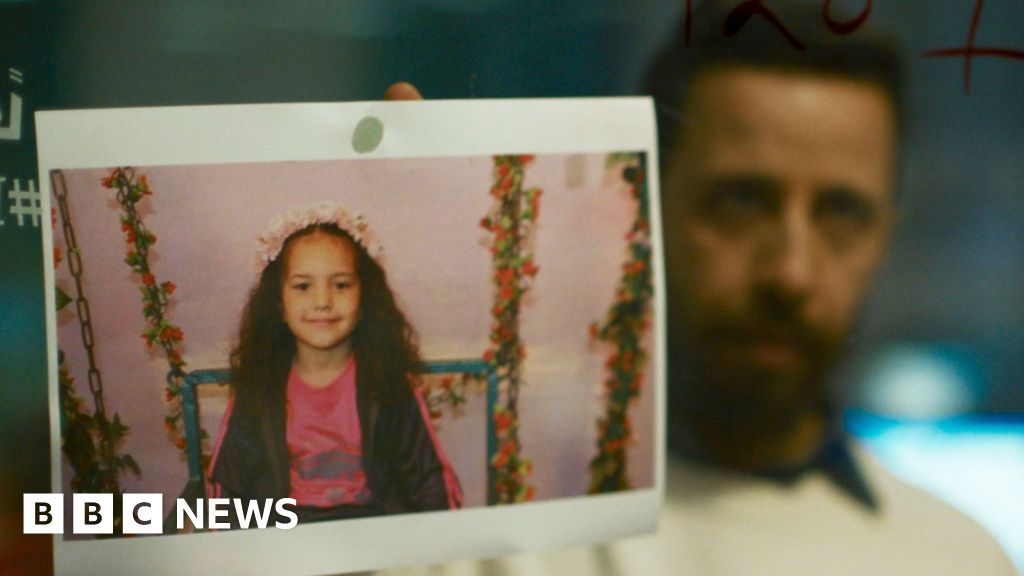
When filmmaker Kaouther Ben Hania first heard the emergency phone call recording of Hind Rajab, a frightened six-year-old Palestinian girl begging for help while under siege in Gaza City in 2024, on social media, she says she immediately knew what she had to do.
Hitting pause on the movie she was about to make, the Tunisian two-time Oscar-nominee called her producer and they agreed to shift focus to telling the story of the girl, who was killed – likely by Israeli fire, according to a number of media investigations – along with her aunt, uncle and cousins, and two paramedics sent to save her.
“It haunted me,” Ben Hania tells BBC News about the voice recording, which is the centrepiece of her Oscar-shortlisted docudrama, released in UK cinemas last Friday.
“I was really angry, I was sad, I felt helpless, and I hate it when I feel helpless.
“I asked myself this basic question, what can I do? I’m a filmmaker, so I can do movies.”
She adds: “We started working on The Voice of Hind Rajab that way to not feel helpless, to not accept, to bear witness.
“Because not doing it, for me, was being complicit in a way.”
Hind Rajab’s car was hit by suspected Israeli fire as she and her family tried to flee bombing during the two-year war in Gaza.
Several family members were killed, but Hind managed to answer a callback from the helpers at the Palestinian Red Crescent Society.
The ambulance trying to reach her was also shelled, and Hind, her family, and the ambulance crew all died.
The Israel Defence Force initially stated none of its troops had been in the area where Hind and the others were killed.
But that suggestion was questioned following independent investigations by research agency Forensic Architecture, in colloboration with NGO (Non-Governmental Organisation) Earshot and journalists from Al Jazeera, which concluded that damage to both the car and the ambulance was consistent with Israeli tank fire.
The IDF later said it had “conducted raids on terror targets” with forces operating in neighbourhoods in Gaza City, including Tel al Hawa, from where Hind had made her emergency call.
The UN cited her case in a commission of inquiry accusing Israel of war crimes, which it denies.
An IDF spokesperson told the BBC it is still being reviewed by Israel’s Fact-Finding Assessment Mechanism (FFAM).
‘Provoking empathy’
Ben Hania’s film sets out to tell the story – in Arabic and English – of what happened to Hind and her family, from the perspective of the Red Crescent volunteers at the Ramallah call centre in the occupied West Bank.
It is “based on true events” and “anchored in truth”, Ben Hania says.
“At some point, with all this proof, I thought that we are done explaining”, she adds.
“Cinema can do something better, which is provoking empathy.”
The feature mixes audio of the girl’s heart-rending real final phonecalls with the Red Crescent, with a visual dramatisation using actors to represent the volunteers.
They try to keep her calm and conscious as it becomes clear she is surrounded by the dead bodies of her relatives.
Critics have praised the emotional impact of the performances, while noting the problems inherent with mixing documentary with drama.
Variety’s Guy Lodge said it was “impossible not to be moved” by the recording at the heart of the hybrid film, heard at an “agonising distance”.
But he felt “the ethics and execution of the concept are questionable”.
“I dreaded watching this film,” he wrote. “Yet having now seen it, I find my mind changed, thanks largely to the philosophical diligence of Ben Hania’s approach.”
Willa
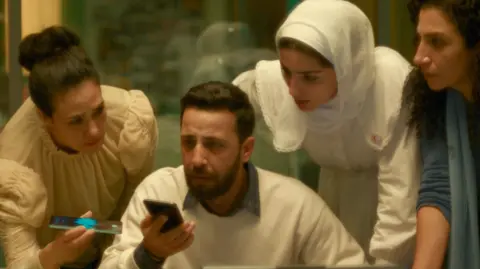
Nominated in the best foreign language film category at the recent Golden Globe Awards, it stars an ensemble cast of actors of Palestinian origin
The director – who received the blessing of Hind’s mother, Wesam, before making the movie – says she did her best to “respect the testimony” of the volunteers and what they told her about that day.
She did not reach out to the other side, because, she says: “My movie is not an investigation.
“The investigation was already done,” she adds, with reference to aforementioned findings, as well as those made by other major news providers including the Washington Post and Sky News.
Increasingly stressed scenes play out in the film between call centre worker Omar, played by Motaz Malhees, and his boss Mahdi, played by Amer Hlehel.
Mahdi is seeking a safe route approved by the Israeli army – via intermediaries – for his paramedics to make the eight-minute journey to carry out the rescue attempt.
Omar becomes exasperated at his boss’s insistence on trying to negotiate with Israel.
Actresses Saja Kilani and Clara Khoury, as fellow call centre workers Rana and Nisreen, respectively, complete the ensemble cast of actors of Palestinian origin.
We watch them hear the sound of gunfire or an explosion in the background before the phone connection is lost entirely.
“Even the actors, at some point, stop acting,” says their director. “They weren’t performing.”
Malhees confirms this. He tells us he suffered panic attacks during filming and thought his heart was “going to explode” during one scene, which for him was “like a real conversation with a child”.
“It was a hard experience, but it’s worth everything to give.”
Willa
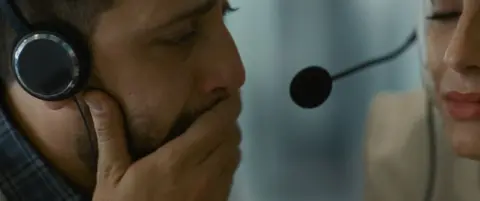
Motaz Malhees and Saja Kilani portraying call centre workers on the phone to young Hind Rajab while she is under attack
His director stresses she wanted to share with the audience what she had felt the first time she had heard the girl’s call for help. “I thought that she was almost talking to me, to save her”.
She told herself: “I need to go back to this moment when it was possible to save her.” Before “the war, mainly, failed her”.
In another four-star review, the Guardian’s Peter Bradshaw said there is “a reckless, ruthless kind of provocative brilliance in what Ben Hania is doing”.
He wrote: “Is it in bad taste? Problematic? Well, in a world where directors busy themselves and us with made-up stories about made-up people, Ben Hania is at least grabbing one of the most relevant issues of our time with both hands and finding a way to thrust it under our noses.”
Willa
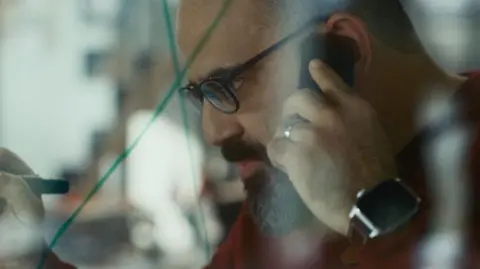
Amer Hlehel’s character Mahdi attempts to secure a safe route for his paramedics
The main question for Ben Hania when making the film was always: “How to make the voice of this little girl echo?”, she explains.
“Because the world don’t want to hear it. It’s not a comfortable thing to face.
“And for me, it was important to honour her voice and to make it resonate beyond borders.”
Worried that it would be perceived as “niche”, the filmmakers reached out to some famous Hollywood faces – including Brad Pitt, Joaquin Phoenix and Rooney Mara – who signed up as executive producers.
“I was like, when will they will stop?” recalls Ben Hania of the “incredible reaction”.
“And actually they stopped because the theatre asked us to leave, because there was another movie!”
“There was a moment of solidarity for real,” adds Mahlees. “You could feel that the people are there with you. You are not alone in this world.”
Ammar Abd Rabbo
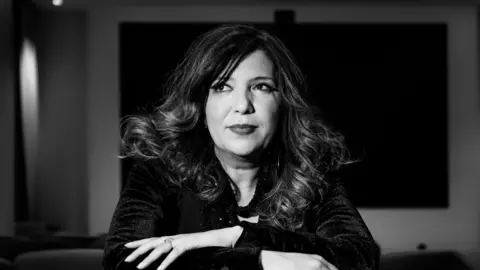
Kaouther Ben Hania has two previous Oscar nominations, and her latest film has been shortlisted for best international feature ahead of Thursday’s nominations
Allow Google YouTube content?
This article contains content provided by Google YouTube. We ask for your permission before anything is loaded, as they may be using cookies and other technologies. You may want to read and before accepting. To view this content choose ‘accept and continue’.