
Category: Uncategorized

  • New truce in Syria as Kurdish-led forces leave camp for IS families

    New truce in Syria as Kurdish-led forces leave camp for IS families


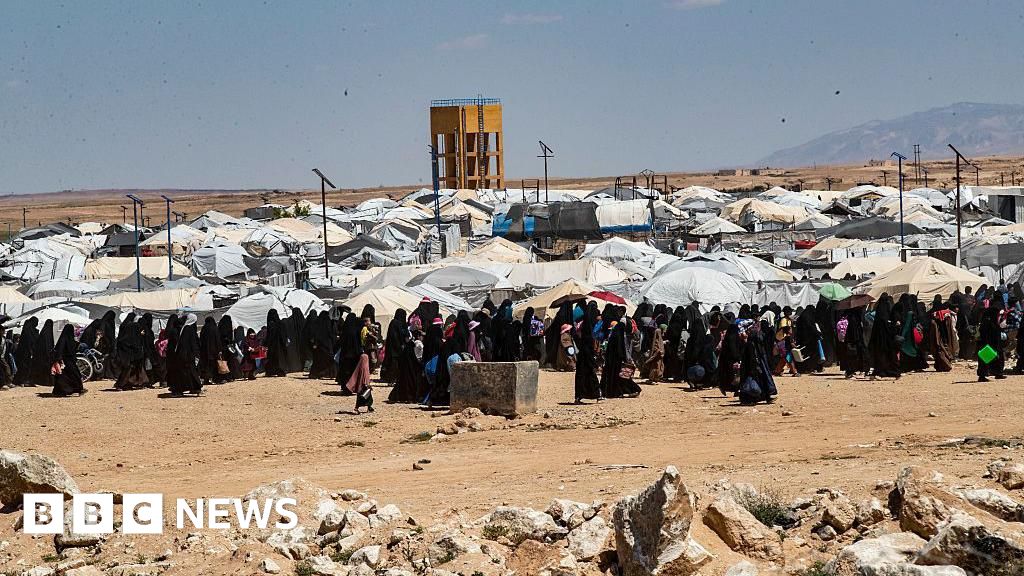
    AFP File photo showing people walking around al-Hol camp, in Hassakeh province, north-eastern Syria (18 April 2025)AFP

    About 20,000 people with alleged links to IS are held in al-Hol camp

    Syria’s government has announced a new ceasefire with the Kurdish-led Syrian Democratic Forces (SDF), after the militia alliance withdrew from a camp holding thousands of people with alleged links to the jihadist group Islamic State (IS).

    The SDF said its forces were “compelled” to leave al-Hol camp and redeploy to other cities in north-east Syria “due to the international indifference toward the issue of [IS]”.

    Syria’s interior ministry complained that it took place without co-ordination with the government or US-led coalition against IS.

    Later, the presidency said it had reached an “understanding” with the SDF on the future of Hassakeh province, which has a large Kurdish population.

    A statement said the SDF would be given four days to carry out consultations on a detailed plan for the peaceful integration of areas under its control into the state.

    The presidency also promised that government forces would not enter the cities of Hassakeh and Qamishli, or any Kurdish villages.

    At the same time, the SDF declared its “full commitment to the ceasefire” and said its forces would not initiate any military action unless they were attacked.

    The SDF also said it was ready to “move forward with implementing” the deal reached with the government on Sunday that was supposed to end almost two weeks of fighting.

    The agreement should see the Kurdish-run autonomous region in the country’s north-east and its key infrastructure brought under government control, as well as the integration of the tens of thousands of SDF fighters into the defence and interior ministries’ forces.

    It represents a major blow for the SDF, which had been reluctant to give up the autonomy that it won for Syria’s Kurdish minority when helping US-led coalition forces defeat IS militarily during the country’s 13-year civil war.

    Interim President Ahmed al-Sharaa has vowed to reunify Syria since he led the rebel offensive that overthrew Bashar al-Assad in December 2024, but the country remains deeply divided and has been rocked by waves of deadly sectarian violence.

    The SDF announced its withdrawal from al-Hol camp as Syrian army and interior ministry forces advanced deep into Hassakeh province after taking control of Deir al-Zour and Raqqa.

    “Due to the international indifference toward the issue of the IS terrorist organisation and the failure of the international community to assume its responsibilities in addressing this serious matter, our forces were compelled to withdraw from al-Hol camp and redeploy in the vicinity of cities in northern Syria that are facing increasing risks and threats,” it said.

    In a statement sent to Kurdish news agency Hawar, SDF commander Mazloum Abdi urged the US-led coalition – once his main ally – to “bear its responsibilities in protecting facilities”.

    “We withdrew to predominantly Kurdish areas and protecting them is a red line,” he added.

    The Syrian interior ministry said the SDF units had pulled out of al-Hol without any co-ordination in an “attempt to pressure the government over the fight against terrorism”.

    The ministry added that it was “taking all necessary measures in co-ordination and co-operation with the international coalition to maintain security and stability”.

    The defence ministry also said it was ready to assume control of the camp as well as all prisons holding suspected IS fighters in the region.
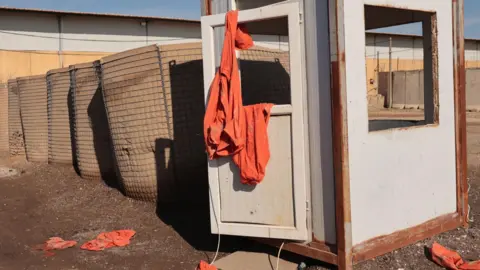
    EPA Abandoned orange prisoners' uniforms at Shaddadi prison in Hassakeh province, north-eastern Syria (20 January 2026)EPA

    Prisoners’ uniforms were scattered on the ground at Shaddadi prison after government forces took control

    Before the fighting with the government erupted earlier this month, the SDF was holding about 8,000 suspected IS fighters at prisons in north-eastern Syria.

    Around 34,000 people linked to IS were also being detained at al-Hol and another camp, Roj, the UN reported last August. The population of the camps, of which 60% were children, comprised 6,700 Iraqis, 15,500 Syrians and 8,500 citizens of other countries, including the UK.

    The SDF, US and UN have long called for the repatriation of the foreign IS suspects and their families from north-eastern Syria, citing the political instability and dire conditions in the prisons and camps, but many countries have refused to take them.

    Earlier, the government and SDF traded accusations over the escape of suspected IS fighters from an SDF-run prison in Shaddadi, in southern Hassakeh province.

    The interior ministry said on Monday night that its special forces and army soldiers had entered the town following “the escape of around 120 [IS] terrorists” from the prison. Search operations by the security forces resulted in the arrest of 81 of the fugitives, it added.

    The SDF said it had lost control of Shaddadi prison in the afternoon after “Damascus-affiliated factions” mounted a series of attacks and killed of dozens of its fighters, who it said had been attempting to “prevent a serious security catastrophe”.

    SDF spokesman Farhad Shami said around 1,500 IS members had escaped during the clashes, according to Reuters news agency.
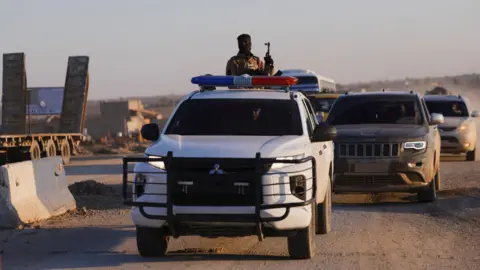
    Reuters Syrian government forces advance along a road in Hassakeh province, north-eastern Syria (20 January 2026)Reuters

    The government says it has given the SDF four days to formulate a plan on the future of Hassakeh province

    The SDF also accused government forces of attacking al-Aqtan prison, north of the city of Raqqa, which is holding IS members and leaders.

    On Tuesday, a statement said the prison’s buildings and facilities had been shelled and its water supply cut off. “These practices constitute a blatant violation of humanitarian standards and pose a serious threat to the lives of the detainees,” it warned.

    However, the defence ministry denied that there had been clashes in the vicinity of the prison.

    It said the facility was “fully secured”, with military police and internal security forces deployed around the facility and in contact with the administration to ensure supplies were provided.

    The US, which was once the SDF’s main ally in Syria, was monitoring developments in Syria with “grave concern”, a White House official said.

    “We urge all parties to exercise maximum restraint, avoid actions that could further escalate tensions, and prioritize the protection of civilians across all minority groups,” they added.

    Special envoy Tom Barrack meanwhile explained that the rationale for the US-SDF partnership had “largely expired”, and that his country was currently focused on ensuring the security of facilities holding IS prisoners and facilitating talks between the SDF and President Sharaa’s government on implementation of the ceasefire deal.

    “This moment offers a pathway to full integration into a unified Syrian state with citizenship rights, cultural protections, and political participation – long denied under Bashar al-Assad’s regime,” he wrote on X.

    After signing the deal with the SDF on Sunday, Sharaa said he hoped it would allow Syria to “end its state of division and move to a state of unity and progress”. However, Abdi said the fighting had been “imposed on us” and that he had accepted the deal “to stop the bloodshed”.
    Source link

  • EU to suspend approval of US tariffs deal

    EU to suspend approval of US tariffs deal


    Jonathan Josephs,Business reporterand

    Nick Edser,Business reporter

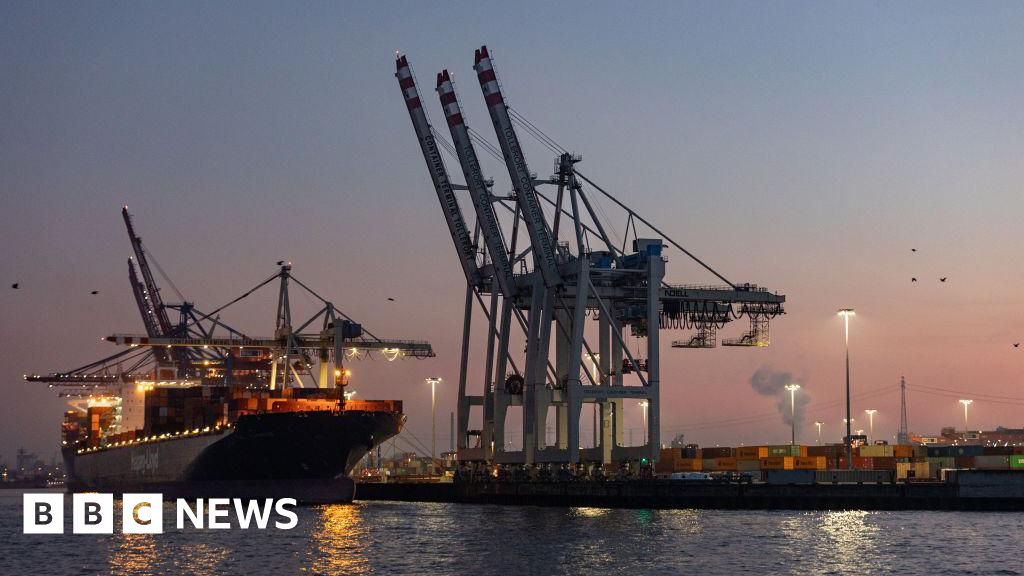
    Bloomberg via Getty Images Cranes hover over a container ship with lights at dusk at the HHLA Container Terminal Tollerort (CTT) at the Port of Hamburg in Hamburg, Germany, on Monday, Feb. 3, 2025. Bloomberg via Getty Images

    The European Parliament is planning to suspend approval of the US tariffs deal agreed in July, according to sources close to its international trade committee.

    The suspension is set to be announced in Strasbourg, France on Wednesday.

    The move would mark another escalation in tensions between the US and Europe, as Donald Trump ratchets up his efforts to acquire Greenland, threatening new tariffs over the issue on the weekend.

    The stand-off has rattled financial markets, reviving talk of a trade war and the possibility of retaliation against the US for its trade measures.

    Shares on both sides of the Atlantic were lower on Tuesday, with European stock markets seeing a second day of losses. In the US, the Dow Jones was down 1.3% in midday trading, while the S&P 500 dropped 1.5% and the Nasdaq was 1.7% lower.

    On the currency markets, the US dollar also fell sharply. The euro climbed 0.7% against the dollar to $1.1731 while the pound rose by 0.2% to $1.346.

    Borrowing costs also rippled higher around the world, as the biggest sell-off of long-term government debt in months drove up yields on 30-year bonds in markets including the US, UK and Germany.

    Trade tensions between the US and Europe had eased since the two sides struck a deal at Trump’s Turnberry golf course in Scotland in July.

    That agreement set US levies on European goods at 15%, down from the 30% Trump had initially threatened as part of his “Liberation Day” wave of tariffs in April. In exchange, Europe had agreed to invest in the US and make changes at on the continent expected to boost US exports.

    The deal still needs approval from the European Parliament to become official.

    But on Saturday, within hours of Trump’s threat of US tariffs over Greenland, Manfred Weber, an influential German member of European Parliament, said “approval is not possible at this stage”.

    The EU had put on hold plans to retaliate against the US tariffs with its own package targeting €93bn ($109bn, £81bn) worth of American goods while the two sides finalised the details.

    But that reprieve ends on 6 February, meaning EU levies will come into force on 7 February unless the bloc moves for an extension or approves the new deal.

    French Prime Minister Emmanuel Macron was among those urging the EU to consider its retaliatory options, including the anti-coercion instrument, nicknamed a “trade bazooka”.

    Washington’s “endless accumulation” of new tariffs is “fundamentally unacceptable, even more so when they are used as leverage against territorial sovereignty,” he said in a speech at the World Economic Forum in Davos.

    American response

    Also speaking in Davos, US Treasury Secretary Scott Bessent reiterated his warning to European leaders against retaliation, urging them to “have an open mind”.

    “I tell everyone, sit back. Take a deep breath. Do not retaliate. The president will be here tomorrow, and he will get his message across,” he said.

    Commerce Secretary Howard Lutnick and US Trade Representative Jamieson Greer warned that the US would not let retaliation go without response.

    “What I’ve found is that when countries follow my advice, they tend to do okay. When they don’t, crazy things happen,” Greer said, in remarks reported by the Agence France-Presse.

    The US has previously expressed impatience with European progress toward approval of the deal amid ongoing disagreements over tech and metals tariffs.

    The US and the 27-nation European Union are each others’ single biggest trade partners, with more than €1.6tn ($1.9tn, £1.4tn) in goods and services exchanged in 2024, according to European figures. That represents nearly a third of all global trade.

    When Trump started announcing tariffs last year, it prompted threats of retaliation from many political leaders, including in Europe.

    In the end, however, many, opted to negotiate instead.

    Only China and Canada stuck by their threats to hit American goods with tariffs, with Canada quietly withdrawing those measures in September, concerned they were damaging its own economy.

    In a speech in Davos on Tuesday, Canadian Prime Minister Mark Carney urged “middle powers” to unite to push back against the might-makes-right world of great power rivalry that he warned was emerging.

    “When we only negotiate bilaterally with a hegemon, we negotiate from weakness. We accept what is offered. We compete with each other to be the most accommodating,” he warned. “This is not sovereignty. It is the performance of sovereignty while accepting subordination.”

    Looming in the background of the trade tensions is a pending Supreme Court decision over whether many of the tariffs Trump announced last year are legal.


    Source link

  • Ukraine’s parliament and half of Kyiv with no heating after Russian strikes

    Ukraine’s parliament and half of Kyiv with no heating after Russian strikes


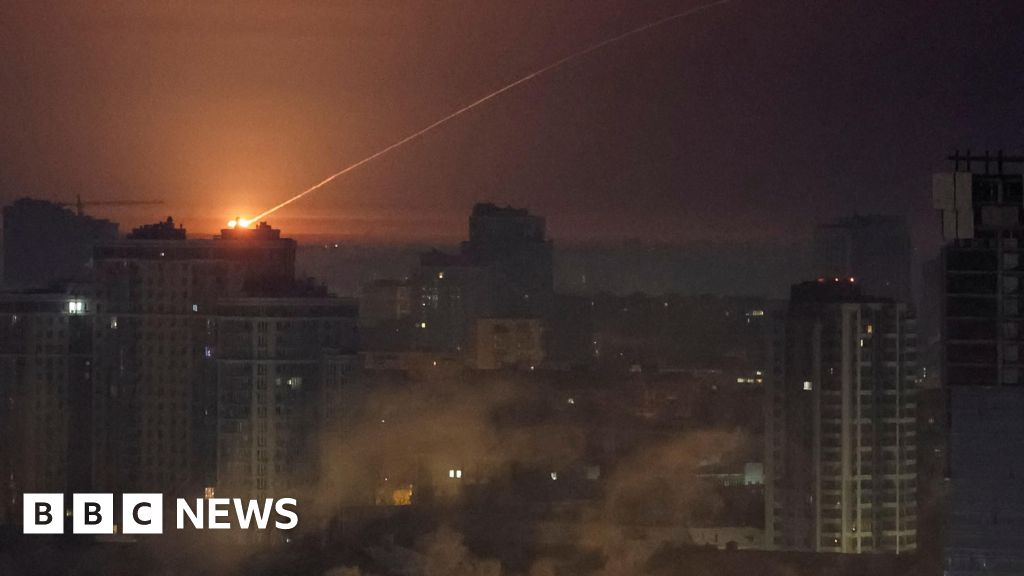
    Reuters A missile is shot down over residential buildings in KyivReuters

    Zelensky said repelling Monday night’s attack had cost Ukraine about €80m (£69m) just in terms of air defence missiles

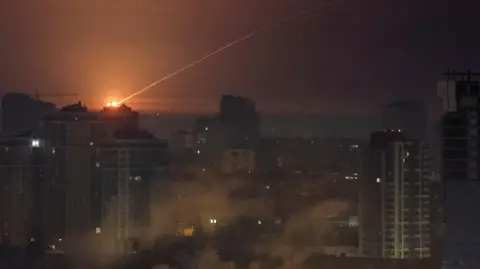
    A large Russian aerial strike on Ukraine has left the Ukrainian parliament and half of Kyiv’s residential buildings without heating or power as temperatures across the country continue to hover around -10C.

    Drones, ballistic and cruise missiles targeted several locations in Ukraine, including Kyiv, Dnipro in the centre and Odesa in the south.

    Air raid alerts in Kyiv lasted most of the night. Sirens rang out later as Russian drones and cruise missiles approached the capital.

    President Volodymyr Zelensky said a “significant number” of targets had been intercepted. But he also said that, in terms of air defence missile prices alone, repelling that attack had cost Ukraine about €80m (£69m).

    Between Monday and Tuesday, at least four people died and 33 others were injured in strikes across Ukraine.

    On Tuesday morning, more than 5,600 residential buildings – each with dozens of flats – in Kyiv woke up to no heating. A large part of the capital also has no water.

    Mayor Vitalii Klitschko said almost 80% of those buildings had just had their heating restored following the large-scale attack on 9 January, which knocked out power for much of the city. Since then, relentless efforts by technicians had managed to reinstate electricity and gas for thousands – only for that work to be undone overnight.

    “I have no electricity and no water,” Oleksandr Palii, a 29-year-old veteran, told the BBC. “I didn’t sleep until 3am because of the strikes either – there were explosions all night.”

    Parliament speaker Ruslan Stefanchuk said that, just like Ukrainian cities, the Verkhovna Rada was also without basic services of electricity, water and heating, and he called other parliaments not to remain silent.

    The Ukrainian president had been due to travel to the World Economic Forum in Davos, Switzerland, on Tuesday but, in the wake of the overnight strikes, he said he had decided to stay in Kyiv.

    He would travel to Davos only if documents on security guarantees with the United States and a prosperity plan were ready to be signed, he added.

    Temperatures have stayed well below freezing since the start of the year.

    Ukrainian media has reported instances of radiators bursting due to the water in them freezing, leading to flooding in entire buildings. There have also been reports of fires starting due to people using gas heaters indoor.

    As the power cuts continue, Kyiv residents are finding innovative solutions to carry on living. Many now use portable stoves to cook, and entire buildings chip in to buy generators. But much depends on individual financial capacities.

    “I think people who are less well-off are coping much worse,” says Olha Zasiadvovk, who has a young child. She and other parents have bought lamps and thermal containers for their children’s kindergarten “so that when the kitchen has no electricity they can cook all the meals at once and store them.”

    But if electricity is only available sporadically, she says, “the food doesn’t keep very well. There were cases when food was cooked in the morning and by dinner the porridge had become completely solid.”

    In recent days, videos have circulated on social media showing Ukrainians barbecuing in snowy yards and dancing to keep warm in the face of continued power cuts and freezing temperatures. But many say this is the worst winter since the start of the full-scale war in 2022, and with no end to hostilities in sight, nerves are frayed.

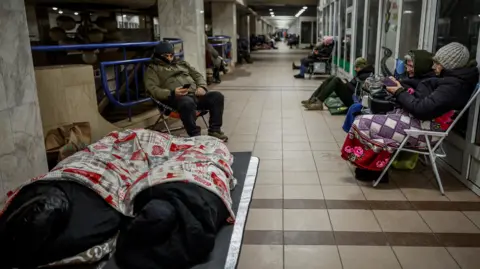
    Reuters People sleeping in a metro station in KyivReuters

    Around 10,000 people sought shelter in Kyiv’s metro stations overnight

    “The resilience of the Ukrainian people cannot be an excuse for this war to continue. It must end as soon as possible,” said Foreign Minister Andrii Sybiha‎ on Tuesday.

    The Kyiv city administration said more than 10,000 people, including nearly 800 children, took refuge in the city’s metro stations on Monday night.

    Many of the high-rise buildings that are often hit by drones do not have shelters, so the deep metro system is still the only place people can seek safety as the thudding sounds of air defence systems ring overhead.

    President Zelensky said Ukraine had received missiles to repel the overnight attack on Monday, and added they had helped significantly.

    But he also emphasised the need for air defence systems was still critical. In a call with reporters, he said Russia was using “far more” ballistic missiles in its attacks and that Moscow’s capacity to produce them had not been dented.

    “So far, this has not happened. That is why we need more missiles and more air defence systems,” he said.

    A flurry of diplomatic activity in late 2025 gave rise to hope that progress was being made towards a peace deal with Russia.

    But on Tuesday Zelensky hinted at concerns that growing tensions between the US and Europe could be detrimental to Ukraine’s ability to defend itself. As it stands, Kyiv’s European partners are buying missiles from the US on Ukraine’s behalf.

    “When it comes to [protection from] ballistic missiles, for now the key is in the hands of the United States of the America,” he said.

    “It is very important that deliveries are timely, that production works, and that partners help us purchase the necessary missiles,” Zelensky stressed. “In other words, a great deal in the security of Ukrainians depends on the unity of Europe and America.”

    Additional reporting by Liubov Sholudko.


    Source link