

Katya Adler Europe Editor
 BBC
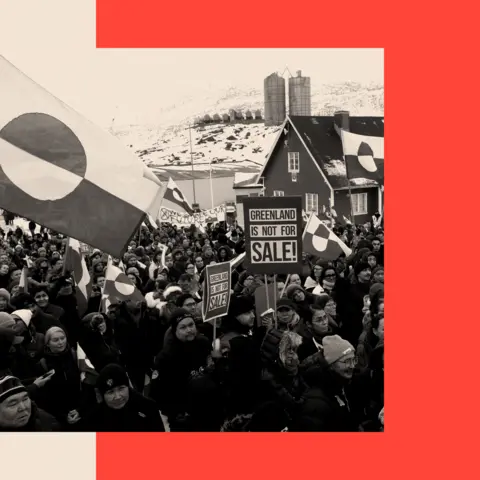
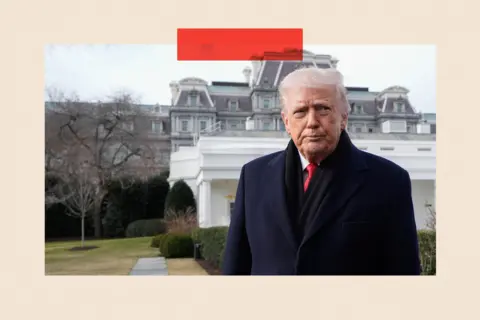
BBCSomething in Europe has snapped. Donald Trump doubled down again on Monday, in his insistence that the US needs Greenland for national security reasons.
Is he prepared to use force to seize it, journalists asked him? “No comment,” said the president, sending chills down the spine of Greenland’s anxious inhabitants. Again.
Greenland is a semi-autonomous territory of Denmark – a member of the EU and of Nato. President Trump is now leaning heavily on Denmark’s allies in both those organisations to abandon Copenhagen and let the US take control of Greenland, or face punitive taxes on all their exports to the United States.
It’s a horror scenario for European economies, which are already in the doldrums. Especially those reliant on exporting to the US, like Germany’s car industry and Italy’s luxury goods market.
 AFP via Getty Images
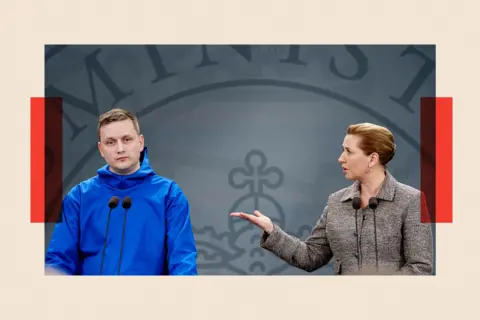
On Monday Germany’s finance minister said, “we will not allow ourselves to be blackmailed” after an emergency meeting with his French counterpart.
The Trump threats landed like a slap in the face of European governments, who (separately, in the case of the EU and the UK) had only just settled tariff deals with the US president last year.
“We’re living through uncharted territories. We’ve never seen this before. An ally, a friend of 250 years, is considering using tariffs… as a geopolitical weapon,” said France’s Finance Minister Roland Lescure.
His German counterpart Lars Klingbeil added: “A line has been crossed… You’ll understand that today I’m not saying exactly what will happen. But one thing must be clear: Europe must be prepared.”
All of a sudden, the softly-softly approach to Trump, that Europe’s leaders had clearly favoured since he returned for a second term to the White House, seems to have passed its sell-by date.
Europe’s good cop, bad cop approach
It’s too early to read the last rites on transatlantic relations altogether but the EU, at least, is hoping to approach the US president in Switzerland this Wednesday at the Global Economic Forum “speaking softly, while carrying a big stick” to paraphrase a former US president.
Theodore (Teddy) Roosevelt believed that, to achieve your goals, you need diplomacy backed by credible power. And Europe now seems to be adopting a good cop, bad cop approach.
European leaders are telling President Trump they’ll support him in prioritising Arctic security, so there’s no need for him to go it alone over Greenland.
At the same time, EU diplomats have let it be known they’re considering imposing €93 billion (£80 billion) worth of tariffs on US goods or even restricting the access of American businesses, possibly including banks and high tech companies – to the bloc’s massive single market, if Trump goes ahead with his “Greenland tariffs” as they’ve become known.
 Bloomberg via Getty Images
These retaliatory measures would most likely have a knock-on effect on US consumers too.
European Union investors have a massive presence in nearly all 50 US states and are said to be responsible for employing 3.4 million Americans.
The EU has a weak voice on the world stage of international diplomacy. The bloc is made up of 27 often bickering countries. But it has huge clout when it comes to the global economy and trade, where decisions are largely taken by the European Commission on behalf of EU single market members. The European Union is the world’s biggest trader of goods and services, accounting for nearly 16% of world trade in 2024.
So, Brussels is crossing its fingers that President Trump will climb down from from his maximalist position and negotiate a compromise solution, if he realises, that he may end up gaining an island (Greenland) but he’ll probably lose close allies (Europe), and be seen as responsible for US consumer costs going up (because of EU retaliatory tariffs).
“Our priority is to engage, not escalate,” EU Commission deputy spokesperson Olof Gill said on Monday.
 WPA Pool/Getty Images
“Trump is forcing the Europeans to grow a spine,” says Niclas Poitiers, an economist and expert in international trade at the Brussels-based Bruegel think-tank.
“[While] the damage of [Trump’s] tariffs is very manageable for Europe… the much bigger question here is not economic but security and foreign policy.
“The EU cannot afford not to react.”
Trust in US security guarantees
But on Monday, US Treasury Secretary Scott Bessent appeared less than impressed.
Speaking in Davos, he painted a picture of a US president with his mind set: “The president is looking at Greenland as a strategic asset for the United States. We are not going to outsource our hemispheric security to anyone else.”
European tariff retaliation would be “unwise”, he warned. And here Europe feels stuck. Damned if it takes action. Damned if it doesn’t.
Some in Europe worry that if they are now more confrontational with Trump, they risk alienating the US even further.
And the brutal truth is: Europe needs Washington to secure a sustainable peace deal for Ukraine and for its own continental security. Despite pledging more defence-spending, Europe is still heavily reliant on the US.
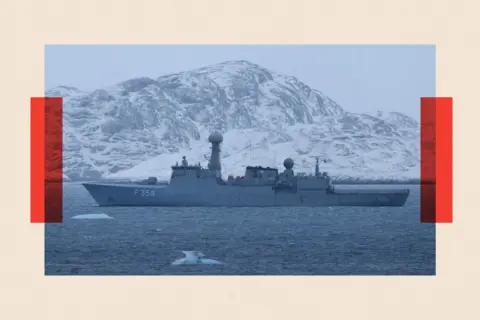 Getty Images
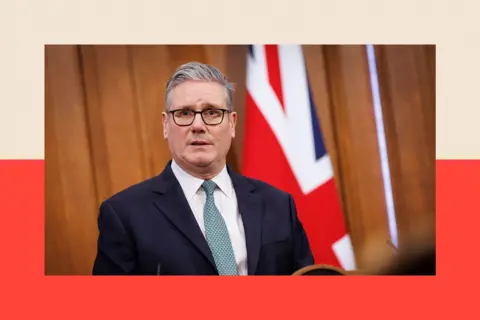
While also reiterating his support for Danish and Greenlandic sovereignty, Sir Keir Starmer, the UK prime minister, was at pains to make that point on Monday, saying it was in the UK’s “national interest that we continue to work with the Americans when it comes to defence, to security and to intelligence.
“Our nuclear deterrence is our foremost weapon. A deterrent when it comes to securing the safety of everybody in the United Kingdom is my primary duty and that requires us to have a good relationship with the United States.”
But, if Europe continues to try to “manage” president Trump, rather than stand up to him, when he is threatening the sovereignty of his fellow Nato ally (Denmark), and brandishing economic sanctions over other allies if they support Copenhagen, then the continent risks looking seriously weak.
 Shutterstock
On X on Monday the EU’s top diplomat Kaja Kallas wrote, “We have no interest to pick a fight, but we will hold our ground”.
As a former prime minister of Estonia, a country that fears the looming shadow of an expansionist Russia, she is keen to demonstrate to Moscow that Europe can – and will – bare its teeth, if pushed.
“Europeans can’t shy away anymore,” Tara Varma told me. She’s an expert in security and geopolitics at think tank, German Marshall Fund.
“They tried personal diplomacy alone [with Donald Trump] over the last year, in order to try and tie him into Europe’s collective defence and guaranteeing Ukraine’s security after a ceasefire with Russia,” she said.
But if he can suddenly turn around (as he just has), linking economic and security issues and threatening Nato, if he doesn’t get his way over a certain issue, then, she says, how much trust can Europe ultimately put in US security guarantees under this administration?”
Putin and the Board of Peace
Watching all this from the sidelines is not only Russia, but China. In their eyes the West – traditionally with the US and Europe tightly-knit at its core, dominant for decades in global politics – is now unravelling.
The world is increasingly dominated by a number of big powers, including Russia and China, but also India, Saudi Arabia and, to an extent, Brazil.
China hopes Donald Trump’s apparent fickleness with his allies may make Beijing appear a more stable, reliable partner and drive more international trade its way.
Canada, which President Trump had threatened to make the 51st state of the US, has just agreed to a limited trade deal with Beijing. It’s trying to reduce its exposure to Washington.
 AFP via Getty
The US president has also shown little regard for multilateral institutions like Nato and the United Nations set up by western powers after the second world war, to manage global order.
Some point to the Board of Peace that President Trump is now establishing, and that he reportedly wants to stage a signing ceremony for this Thursday in Davos. Many world leaders and leading business figures are attending the conference.
The Board is ostensibly designed to oversee the reconstruction of Gaza after Israel’s devastating two year offensive, aimed at destroying Hamas following its attack on Israel on 7 October 2023.
But the Board’s charter calls for “a more nimble and effective international peace-building body”, suggesting its remit would be far wider, possibly to rival the UN.
 AFP via Getty Images
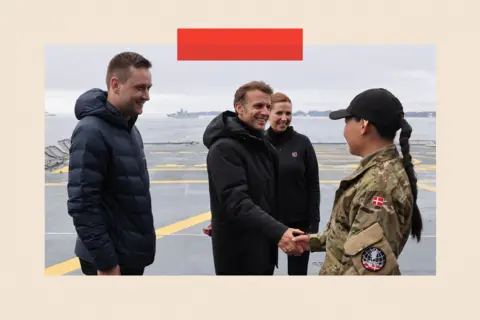
That’s how France’s President sees it. A source close to Emmanuel Macron issued a statement on Monday saying that France did not plan to accept an invitation that, “along with many countries”, it had received to join the Board of Peace.
“The [Board’s] Charter… raises major questions, particularly with regard to respect for the principles and structure of the United Nations, which cannot be called into question under any circumstances,” the statement reads.
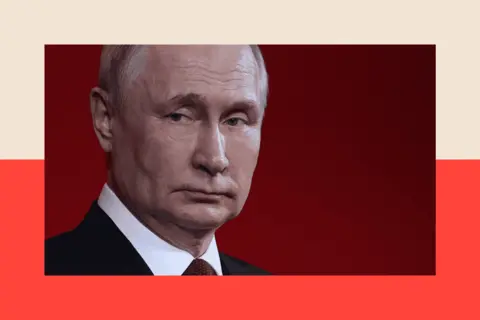
The Kremlin said on Monday that Vladimir Putin had also been asked to join the Board, suggesting that Trump is keen to maintain ties with the Russian president, despite Moscow’s four-year long assault on Ukraine and its failure so far to accept a US-backed peace plan.
Questions have been raised too about Trump’s overarching role on the Board, and his demand that world leaders pay $1 billion for permanent membership.
But Tara Varma insists that the Peace Board isn’t about peace. “How can it be, if you invite leaders like Putin to be part of it?
“Trump wants to be seen as a peacemaker. He wants the headlines, but without doing the hard graft to lay the groundwork needed for peace to be durable. His is more of a hit and run strategy.
“He can’t replace multilateral institutions like the UN that have been around for 80 years.”
Relations are strained but not broken
Perhaps, though, President Trump, with his flouting of decades-old international norms, is shaking some of these multilateral institutions up a bit, pushing or even forcing them to modernise and become more relevant.
The membership of the UN security council should arguably be less western-centric, and more representative of changes in global power structures.
Nato’s European members have admitted they ought to be paying more for their own defence. Trump is not the first US president to say that they should, though he’s far blunter.
It was after he threatened that the US would no longer defend nations that didn’t pay their way, that all Nato members except Spain agreed to dramatically increase security spending.
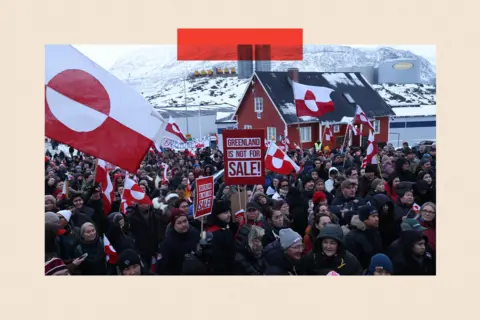
Back to Greenland, polls suggest 55% of Americans don’t want to buy the island and 86% oppose a military takeover by the US. Denmark and other European powers have been lobbying lawmakers on Capitol Hill to persuade them that Greenlandic and Danish sovereignty must be protected.
 Getty Images
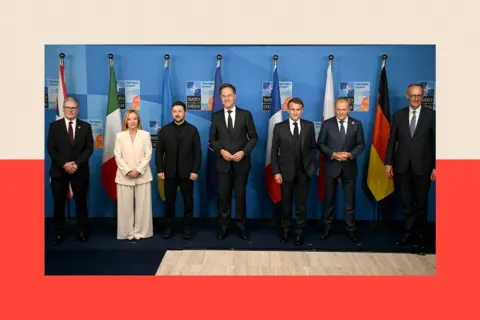
Transatlantic relations aren’t broken yet, though they are damaged. Donald Trump is still picking up the phone to his pal, the Italian premier, Giorgia Meloni, to Starmer, and to Nato’s Secretary General Mark Rutte. Lines of communication are still open.
Ultimately, though, if Europeans want to try to cut through with Donald Trump, they will have to stick together.
Not only the EU’s disparate member states, not just Nato: all countries together. And the UK, with its closer relationship with the US will be key here.
But Europe’s leaders are torn between wanting to do what they see as right internationally, and their own domestic concerns. If a full-blown transatlantic trade war were to break out, that would hurt their voters.
All singing from the same sheet over Greenland for any length of time, is going to be tough.
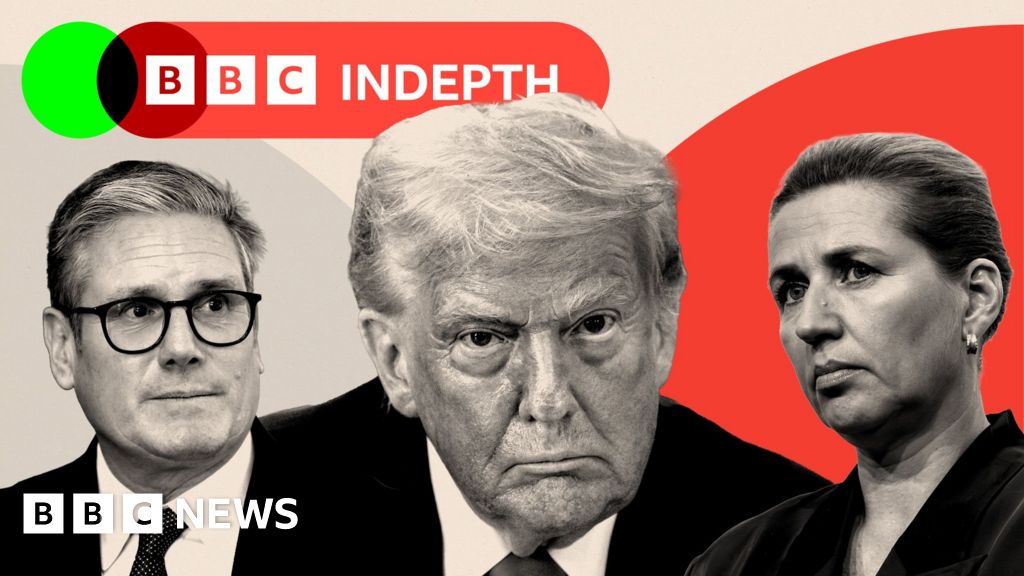
Top picture credits: Getty Images and Getty/Bloomberg/Lightrocket

BBC InDepth is the home on the website and app for the best analysis, with fresh perspectives that challenge assumptions and deep reporting on the biggest issues of the day. Emma Barnett and John Simpson bring their pick of the most thought-provoking deep reads and analysis, every Saturday. Sign up for the newsletter here