Category: Uncategorized

  • Japan PM Takaichi calls snap election three months after taking office

    Japan PM Takaichi calls snap election three months after taking office


    Japan’s Prime Minister Sanae Takaichi will dissolve parliament on Friday, paving the way for an early election on 8 February that she hopes will translate her strong public polling into a big majority in the lower house.

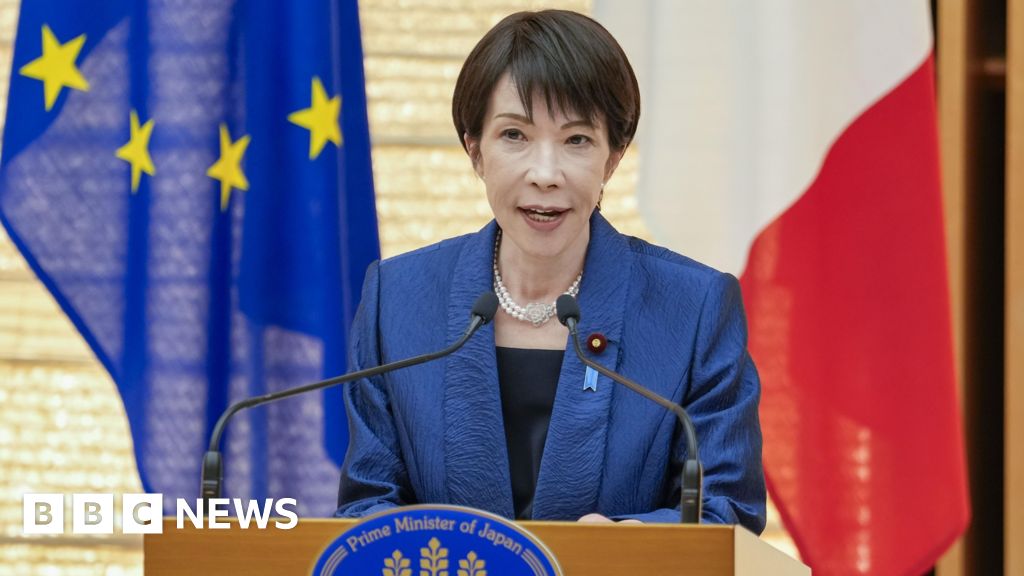
    It was an “extremely weighty decision” that would “determine Japan’s course together with the people”, Takaichi told a news conference in Tokyo.

    The country’s first female leader and her cabinet have enjoyed high public support since taking office last October.

    But her party lags behind in polls and the move is risky. It’s Japan’s second general election in as many years and will test appetite for her plans to boost public spending when cost-of-living is top of voters’ minds.

    Having been elected as prime minister by lawmakers on 21 October, Takaichi is now seeking a public mandate in the House of Representatives, the more powerful house in Japan.

    Since the day she took office, Takaichi said, she has been “constantly concerned that the Takaichi cabinet has not yet been tested in an election where the public chooses the government”.

    “Is Sanae Takaichi fit to be prime minister? I wanted to ask the sovereign people to decide,” she told the news conference.

    Campaigning for the vote to elect the 465 lower house MPs, who serve four-year terms, starts on 27 January.

    Her Liberal Democratic Party (LDP) has governed Japan almost continuously since 1955. It currently has 199 seats – including three held by its independent partners – in the House of Representatives, the most of any party. The LDP’s coalition with the Japan Innovation party gives it a fragile majority, with just enough seats to govern.

    A protege of former conservative PM Shinzo Abe and self-professed admirer of Margaret Thatcher, Takaichi is known as Japan’s “Iron Lady”.

    She came into office promising an economic upturn after years of stagnation.

    Takaichi is an advocate of heavy government-led spending to drive economic growth – a revival of the sort of stimulus measures that Japan saw under “Abenomics”. Her first few months in office have seen soaring personal poll ratings – no Japanese PM has been popular since Abe, in 2012.

    In December, her cabinet approved a record defence budget of nine trillion yen ($57bn; £43bn). This comes amid growing concern over China, with Tokyo describing its neighbour’s military activities in the region as its “greatest strategic challenge”.

    Takaichi has found herself the target of China’s ire since last November, when she made comments suggesting that Japan could respond with its own self-defence force if China attacked Taiwan. The diplomatic spat that ensued has sent bilateral ties plunging to their lowest point in more than a decade.

    Meanwhile, Takaichi has pursued closer ties with the US. During US President Donald Trump’s visit to Japan last October, the two leaders heaped praise on each other and signed a deal on rare earths. They also signed a document heralding a new “golden age” of US-Japan relations.

    Opinion polls show that while the LDP remains broadly unpopular among Japanese residents, Takaichi and her government have charted approval ratings of 60-80%.

    This popularity is what Takaichi hopes can help the LDP secure a “sole majority” in parliament and push through bolder policies more easily, Dr Seijiro Takeshita, a management professor at the University of Shizuoka, told the BBC World Service’s Asia Specific podcast.

    “She wants to solidify her position to make things smoother at a later stage,” Takeshita said.

    But the snap election gamble comes with its own set of risks.

    The LDP’s leadership has been on shaky ground, and Takaichi is the country’s fourth PM in five years. Her predecessors’ terms were cut short by falling public support and scandals.

    Her immediate predecessor, Shigeru Ishiba, also announced a snap election shortly after taking office – leading to one of the LDP’s worst ever results and costing the party its majority in the House of Representatives.

    Another challenge looms in the form of a new, consolidated opposition, the Centrist Reform Alliance, which was formed last week by Japan’s largest opposition party, the Constitutional Democratic Party of Japan, and the Komeito party, the LDP’s former coalition partner.

    Takaichi said the dissolution of parliament was being carried out only “after establishing a thorough system” which ensures there is no disruption to economic policies affecting livelihoods and rising prices.

    What Takaichi is hoping for is that “people will trust her to deliver on her promises”, Dr Jeffrey Kingston, an Asian studies professor at Temple University in the US, told the BBC.

    Her high approval ratings are “only going to decline so she wants to lock in the benefits of a long honeymoon”, he added.


    Source link

  • Afcon final: Senegal temporarily leave field after Morocco awarded controversial penalty

    Afcon final: Senegal temporarily leave field after Morocco awarded controversial penalty


    Thiaw, meanwhile, had his media briefing cancelled after a ruckus broke out in the press room.

    But in an interview with BeIN Sport, he accepted that he should not have ordered his team off the field.

    “We didn’t agree,” he said. “I don’t want to go over all the incidents. I apologise for the football.

    “After reflecting on it I made them come back [on the pitch] – you can react in the heat of the moment. We accept the errors of the referee.

    “We shouldn’t have done it but it’s done and now we present our apologies to football.”

    Thiaw, 44, was initially furious with referee Ndala for disallowing a goal by Crystal Palace forward Ismaila Sarr, who had bundled home from close range.

    His effort was chalked off for a foul by Abdoulaye Seck on Achraf Hakimi in the build-up.

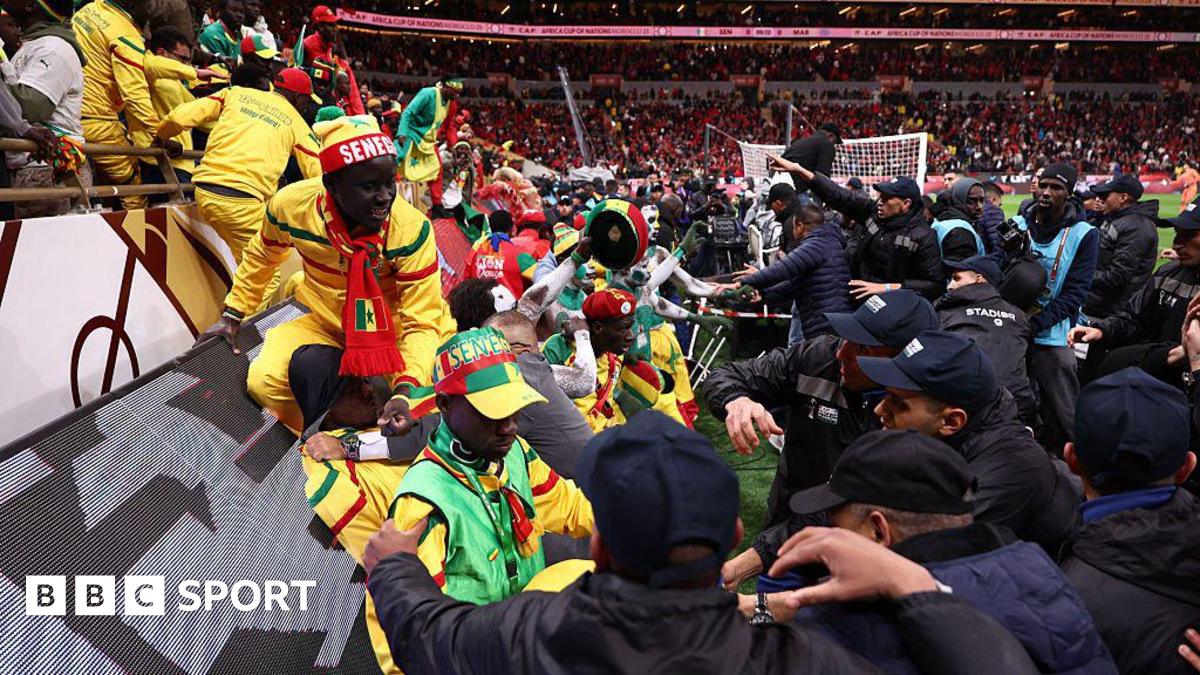
    And the penalty decision compounded those feelings. Several of the Senegal players followed Thiaw’s request to leave the field, while some of their supporters threw objects and attempted to get on the field.

    Diaz, who was substituted after Gueye’s goal, was left crestfallen as Morocco missed the chance to win a first Afcon title since 1976.

    After the game, Mane said: “Football is something special, the world was watching, so we have to give a good image for football.

    “I think it would be crazy to not play this game because what, the referee gave a penalty and we go out of the game? I think that would be the worst thing especially in African football. I’d rather lose than this kind of thing happen to our football.

    “I think it’s really bad. Football should not stop for 10 minutes but what can we do? We have to accept what we did but the good thing is that we came back and we played the game and what happened happened.”

    Former Chelsea keeper Mendy, who now plays for Al-Ahli in the Saudi Pro League, insisted he was “proud” of the way Senegal – instructed by Mane – returned to the field to win their second Afcon title this decade.

    “What did we say to each other? That’s between us,” said Mendy.

    “We did it together and we came back together, that’s all that matters. We can be proud.”

    Match-winner Gueye added: “We had a feeling of injustice. Just before the penalty we thought we should have had a goal and the referee didn’t go to VAR.

    “Sadio [Mane] told us to come back on and we remobilised. Edouard [Mendy] then made the save, we stayed focused, got the goal and won the game.”


    Source link

  • Trump tests boundaries of his power as Minnesota pushes back

    Trump tests boundaries of his power as Minnesota pushes back


    Tom BatemanBBC News, Minnesota

    BBC accompanies ICE observer on the lookout for agents in Minneapolis

    With 1,500 troops reportedly on standby to deploy to Minnesota, tensions are rising in the state as protests continue against Donald Trump’s immigration crackdown. US officials say they are targeting the “worst of the worst” but critics warn migrants with no criminal record and US citizens are being detained, too.

    “It could be anybody,” says Sunshine, as she drives around her neighbourhood, St Paul – one of the so-called Twin Cities, along with Minneapolis. Snow and ice swirl over the tarmac in the bitter wind.

    Sunshine is not her real name – she has asked to use a pseudonym because of fears she could be targeted for her actions.

    “I have decided for my own safety to give them more space,” she says, referring to the unmarked patrol cars ahead, driven by the US Immigration and Customs Enforcement (ICE) agents she is trying to track.

    Each day, residents in loosely organised groups drive around their neighbourhoods trying to spot ICE agents and film them, they say, to hold them to account.

    “I, we, have the legal right to drive on the streets of our own city and we have the legal rights to observe [the ICE agents], but they seem to have forgotten that,” Sunshine says.

    The streets of Minneapolis feel like a battle of wills between a Republican president pressing the boundaries of his power and a Democratic city and state pushing back.

    This week as the temperature plummeted, protests intensified against ICE agents outside the federal building hosting them.

    A woman's eyes can be seen in the rearview mirror of her car. Her identity is being obscured to protect her.

    “Sunshine” says she has a legal right to observe ICE’s actions

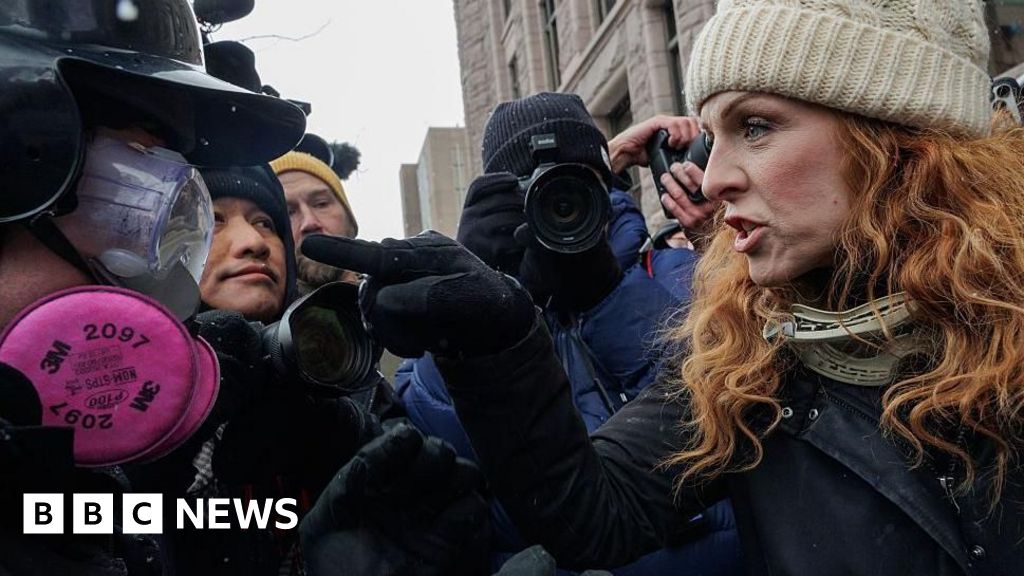
    Minnesota officials have urged protesters to stay orderly and peaceful, and local officials have said the majority have stayed trouble-free. But at times there have been clashes, with the authorities deploying tear gas and pepper balls to disperse crowds.

    On Friday, a US federal judge issued an order limiting the crowd control tactics that can be used by ICE agents toward peaceful protesters in Minneapolis.

    Judge Katherine Menendez said federal agents cannot arrest or pepper spray peaceful demonstrators, including those monitoring or observing ICE agents.

    Trump has vowed to press on with his mass deportation drive in Minnesota, with thousands of federal agents deployed to the state.

    Many of them were sent in the aftermath of the fatal shooting of Minneapolis woman, Renée Good, 37, by an ICE agent on 7 January.

    The circumstances surrounding her death remain contested, with the Trump administration saying the ICE agent who shot her acted in self-defence, while local officials argue the woman was attempting to leave and posed no danger. The FBI is investigating the shooting, but officials in Minnesota say they have been denied access to evidence.

    Good’s killing has focused the minds of many members of this community who are determined to reverse Trump’s campaign.

    In her car, Sunshine spots two unmarked vehicles with darkened windows containing ICE agents.

    We follow them to a nearby neighbourhood, where the two cars proceed to drive slowly and repeatedly around the block in circles, in what is seemingly a diversion tactic to take Sunshine away from a shopping centre immigrants often use.

    “This is the game. But if they’re doing this with me, they’re not putting their hands on someone,” she says.

    “So, yes, it’s gas money and it’s my time and I’m okay with that.”

    The week after Good’s death there was a second shooting involving a federal officer in Minneapolis.

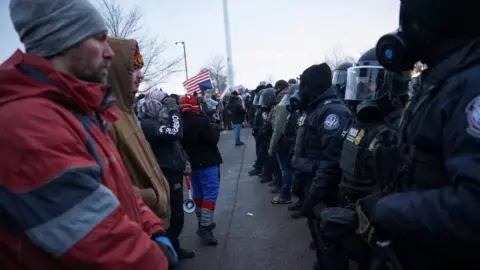
    Reuters Demonstrators stand in front of members of U.S. Customs and Border Protection (CBP) and other law enforcement officials, near the Bishop Henry Whipple Federal Building. One man is wearing a red jacket another is wearing a brown jacket opposite a line officials wearing all black and black helmets
Reuters

    The Department of Homeland Security (DHS) said an officer shot a man in the leg in Minneapolis after being attacked with a shovel as he tried to make an arrest of a Venezuelan migrant who entered the US illegally.

    After the incident, Homeland Security Secretary Kristi Noem said the agent was “beat up” and “bruised”, adding ICE officers were “following protocols that we have used for years” from before the Trump administration.

    The man’s family has disputed the DHS’ version of events in an interview with the Washington Post, saying he was shot in the doorway and not during a scuffle in the street.

    Minneapolis is the fifth major city to be targeted in Trump’s immigration crackdown after his election pledge for the biggest deportation operation of undocumented migrants in history.

    The campaign, which remains popular with most Republicans and especially Trump’s Make America Great Again (Maga) supporters, has sparked a fierce backlash in the Democrat-led cities where operations are taking place.

    On Saturday, hundreds of demonstrators confronted and chased away a small group attempting to hold a pro-ICE and anti-Islam rally.

    Counter-protesters converged on the event organised by far-right activist Jake Lang, who was pardoned by Trump after being charged with crimes related to the US Capitol riots on 6 January 2021. Lang had vowed to burn a Quran outside City Hall, however it is not clear if he carried out his plan.

    Minnesota is home to the largest community of Somali immigrants in the US, the majority of whom are US citizens. The president has said they should “go back to where they came from” and described the community as “garbage”. He launched the immigration crackdown in December after some Somali immigrants were convicted in a massive fraud of state welfare programmes.

    Minnesota Governor Tim Walz recently said he would end his bid for re-election amid the fraud scandal. But he has accused Trump and his allies of seeking to take advantage of the crisis to play politics.

    Against this backdrop, Trump has threatened to invoke the Insurrection Act, a 19th Century law that allows active-duty military personnel to be deployed for law enforcement within the US, to quell the city’s resistance to his immigration campaign.

    On Friday the Justice Department opened a criminal probe into the Democrats Walz and Minneapolis Mayor Jacob Frey, accusing them of attempting to impede federal immigration operations. Walz said the move was “weaponising the justice system against your opponents”.

    In a post on social media, Trump called protesters in the city “traitors, troublemakers and insurrectionists” and accused them of being “in many cases, highly paid professionals”.

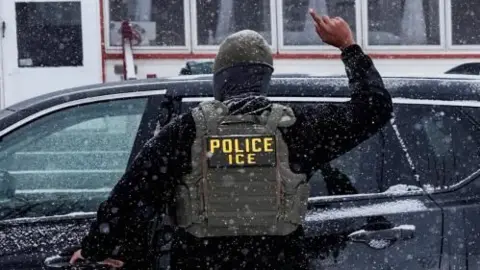
    Reuters An Immigration and Customs Enforcement agent raises a finger moments after detaining a man during an immigration raid, he is standing with his back to the camera and is wearing all black apart from a green vest with the words ICE on it in yellow writing Reuters

    In response to this characterisation, Sunshine says: “I’m definitely not being paid.

    “I think that I’m doing what I’m doing because I love my neighbours and watching them being racially profiled in the streets of our own our city.”

    She adds: “We have to protect one another.”

    Federal agents have been accused of racial profiling by observers, something the Trump administration denies.

    Near a Mexican restaurant, we stop the car and another observer who calls herself Misko gets out of her car, heading towards Sunshine, visibly distressed.

    The two women embrace. Misko is struggling for breath as she recounts what just happened.

    “Just around the corner. Two of them blocked me in, then they came out. [One agent] had an assault rifle. He was pounding on my window,” she says.

    DHS officials did not respond to questions from the BBC about the incident.

    Despite the encounter, Misko later tells me she won’t be deterred. With the president also renewing his threat to send in troops, Minneapolis feels in the grip of a deepening crisis, and no-one seems prepared to slow it down.

    A thin, grey banner promoting the US Politics Unspun newsletter. On the right, there is an image of North America correspondent Anthony Zurcher, wearing a blue suit and shirt and grey tie. Behind him is a visualisation of the Capitol Building on vertical red, grey and blue stripes. The banner reads: "The newsletter that cuts through the noise.”

    Follow the twists and turns of Trump’s second term with North America correspondent Anthony Zurcher’s weekly US Politics Unspun newsletter. Readers in the UK can sign up here. Those outside the UK can sign up here.


    Source link