Category: Uncategorized

  • US believes its power matters more than international law, UN chief António Guterres tells BBC

    US believes its power matters more than international law, UN chief António Guterres tells BBC


    Anna FosterPresenter, Today programme

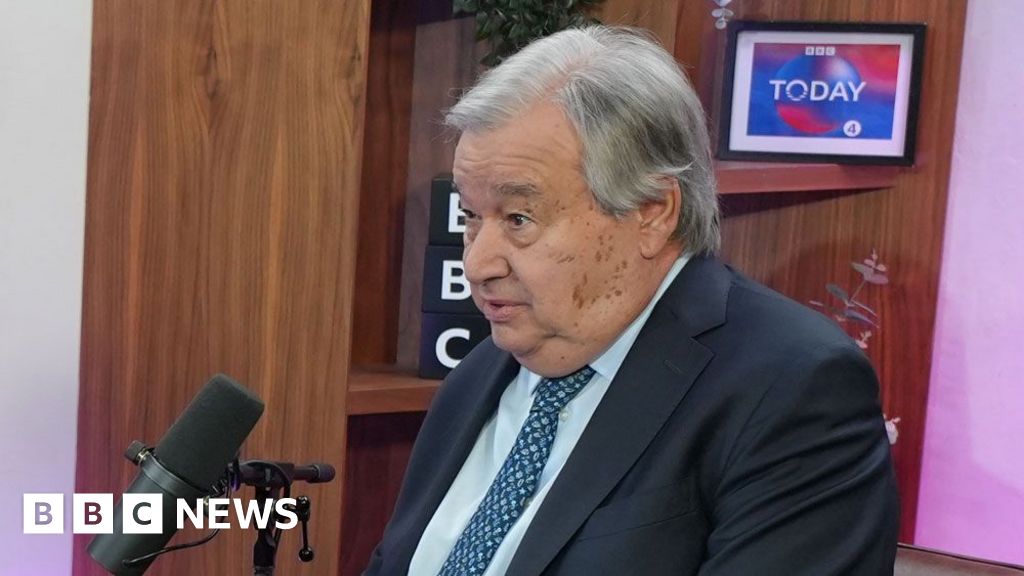
    UN Photo / Alba García Ruiz Antonio Guterres speaks to the BBC's Anna FosterUN Photo / Alba García Ruiz

    Antonio Guterres told the BBC some believe “the power of law should be replaced by the law of power”

    The US is acting with impunity and believes its power matters more than international law, the head of the UN has told the BBC.

    Speaking to BBC Radio 4’s Today programme, António Guterres said Washington’s “clear conviction” was that multilateral solutions were irrelevant.

    What mattered, he continued, was the “exercise of the power and influence of the United States and sometimes in this respect by the norms of international law”.

    His comments come weeks after the US struck Venezuela and seized its president – and in the context of Donald Trump’s repeated threats to annex Greenland.

    Guterres said he believed the founding principles of the UN – including the equality of member states – were now under threat.

    President Trump has previously been scathing in his criticism of the United Nations.

    He used his address at last September’s General Assembly to question its very purpose, claiming he had “ended seven unendable wars” on his own and the UN “did not even try to help in any of them”.

    “Later I realised that the UN wasn’t there for us,” he said.

    Presented with this damning assessment, Guterres admitted his organisation was struggling to make members abide by the international laws laid out in the UN Charter.

    The UN was “extremely engaged” in solving major global conflicts, he insisted. “But the UN has no leverage – the big powers have stronger leverage.

    He questioned whether that extra leverage was being used to produce real and enduring solutions to those conflicts, or just quick fixes. “There is a big difference between the two things,” he noted.

    Guterres also said his organisation needed reform to tackle “dramatic problems and challenges” facing its 193 members.

    “There are those that believe the power of law should be replaced by the law of power,” the UN chief said.

    “Indeed, when one sees the present policy of the United States, there is a clear conviction that multilateral solutions are not relevant and that what matters is the exercise of the power and the influence of the United States and sometimes in this respect by the norms of international law”.

    He suggested the UN Security Council – designed to maintain international peace and security – no longer represented the world and was “ineffective”.

    Any one of the council’s permanent members – France, China, Russia, the UK or US – can currently veto resolutions. Both Russia and the US have used this power to frustrate global efforts to end the wars in Ukraine and Gaza.

    Guterres claimed vetoes were being used to further individual members’ interests, and criticised the fact that “three European countries” were permanent members.

    He called for changes to the council’s composition – to “regain legitimacy” and “give voice to the whole world” – and to limit veto powers to avoid unacceptable “blockages”.
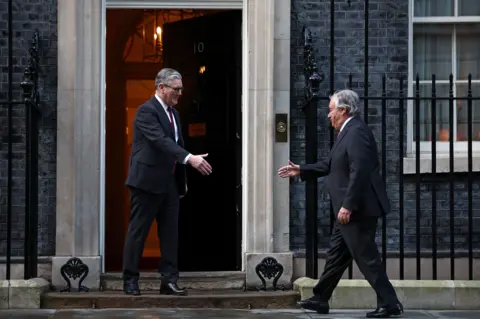
    Reuters António Guterres reaching out to shake Sir Keir Starmer's hand at Downing Street in a picture taken on 16 JanuaryReuters

    Guterres, whose term as secretary general is coming to an end, met Sir Keir Starmer in London last Friday

    Guterres – a former Portuguese prime minister – took on the job of heading the UN in 2017, and will leave the role at the end of this year.

    In his annual remarks to the General Assembly, traditionally used to identify the organisation’s priorities, he warned of a world in chaos, “brimming with conflict, impunity, inequality and unpredictability”, and identified “brazen violations of international law” as one of the biggest challenges facing the global order.

    One of the ongoing conflicts Guterres identified as key for the UN was Gaza.

    For large parts of the war it was prevented from distributing aid in the strip, as Israel blocked international humanitarian organisations from bringing it into the territory.

    At one point, Israel even backed an external contractor – the Gaza Humanitarian Organisation – to do the work the UN had traditionally carried out for decades. Hundreds of Palestinians were killed trying to access food at GHF sites.

    When asked if he saw the UN as powerless in Gaza where it should have made a difference, he said: “Of course, but let’s be clear.

    “For a long time, Israel was saying that humanitarian aid was not distributed because the UN was not able to do so. Of course, whenever Israel would not allow us to move into Gaza, we couldn’t move into Gaza. And then there was a ceasefire, and a massive flow of humanitarian aid.”

    He stressed: “We were ready, provided we had the conditions.”

    A few days ago, Guterres told the UN General Assembly that “1945 problem-solving” wouldn’t solve 2026 problems, referring to the organisation’s founding structure.

    The challenges keep coming, with the US-forced change of leadership in Venezuela, regime forces in Iran killing thousands of protestors and Donald Trump’s stated aim of annexing Greenland.

    Questions about the death of multilateralism – and the failure of some world leaders to speak out and defend the rule of international law – are growing ever-louder.

    But Antonio Guterres told me he was remaining positive.

    “I think that people are sometimes reluctant to confront the powerful. But the truth is that if we don’t confront the powerful, we will never be able to have a better world.”
    Source link

  • Why the US is buying icebreakers from Finland

    Why the US is buying icebreakers from Finland


    Adrienne MurrayBusiness reporter, Helsinki

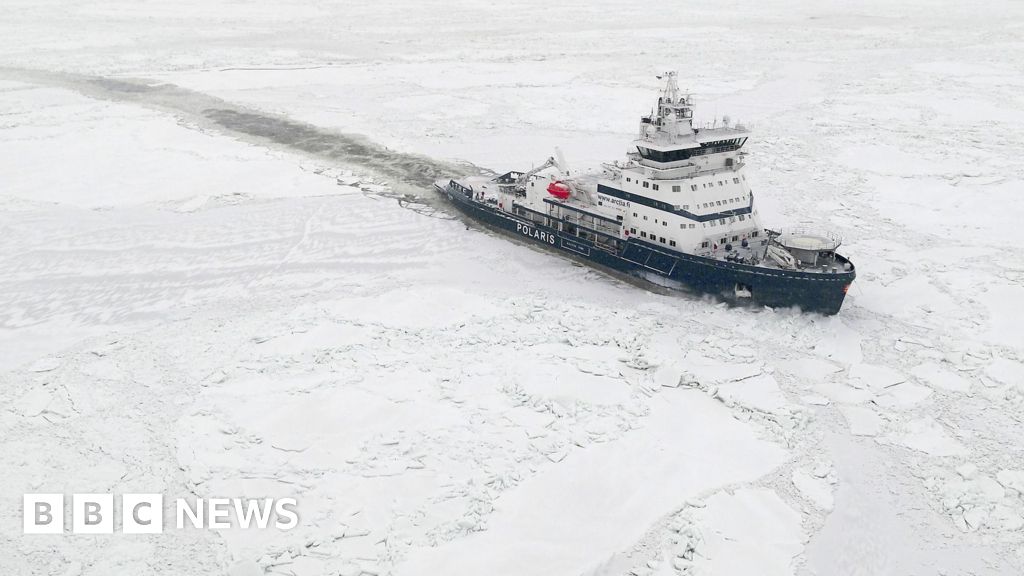
    Aker Arctic Technology A Polaris class icebreaker designed by Finnish firm Aker Arctic Technology cuts its way through ice covered waterAker Arctic Technology

    Finland leads the world when it comes to the design and construction of icebreakers

    As President Donald Trump continues to insist that the US needs to own Greenland, his wider focus on the Arctic region has seen Washington order new icebreakers.

    For these ships, which can sail through seas covered in solid ice, the US has gone to the world expert – Finland.

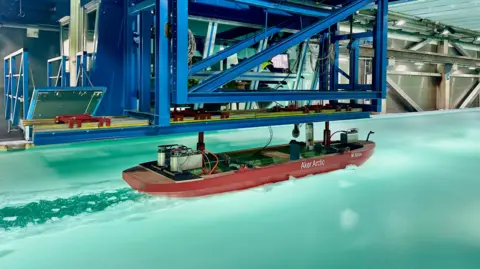
    Temperatures are sub-zero inside Aker Arctic Technology’s ice laboratory, as the scale model of an icebreaker cruises down a 70m-long simulation tank.

    It ploughs a neat channel through the frozen surface of the water.

    Undergoing testing at a facility in Helsinki, Finland’s capital, this is a design for the next generation of the country’s icebreakers.

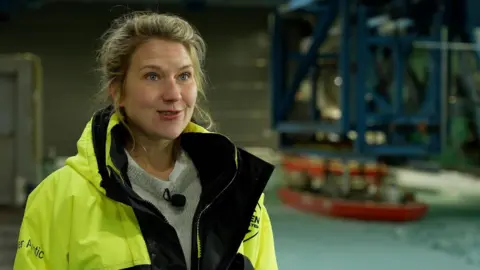
    “It’s crucial that it has sufficient structural strength and engine power,” says ice performance engineer, Riikka Matala.

    Mika Hovilainen, the firm’s chief executive, adds that the shape of the vessel is also crucial. “You have to have a hull form that breaks ice by bending it downwards,” he says. “It’s not cutting, it’s not slicing.”

    Finland is the undisputed world leader when it comes to icebreakers. Finnish companies have designed 80% of all those currently in operation, and 60% were built at shipyards in Finland.

    The country leads the way out of necessity, explains Maunu Visuri, president and chief executive of Finnish state-owned company Artica, which operates a fleet of eight icebreakers.

    “Finland is the only country in the world where all the harbours may freeze during wintertime,” he says, adding that 97% of all goods to the country are imported by sea.

    During the coldest months, icebreakers keep Finland’s ports open, and work as pathfinders for big cargo ships. “It’s really a necessity for Finland. We say that Finland is an island.”

    It was this expertise that saw Trump announce in October that the US planned to order four icebreakers from Finland for the US Coast Guard.

    A further seven of the vessels, which the US is calling “Arctic Security Cutters”, are to be built in the US, using Finnish designs and expertise.

    “We’re buying the finest icebreakers in the world, and Finland is known for making them,” said Trump.

    Adrienne Murray A model icebreaker being tested at Aker Arctic Technology's facility in HelsinkiAdrienne Murray

    Aker Arctic Technology is continuing to test designs for the next generation of icebreakers

    Under US law, the country’s naval and coastguard ships must be domestically-built, but in this case the president waived that requirement on national security grounds. He cited “aggressive military posturing, and economic encroachment by foreign adversaries”, by which he means Russia and China.

    This US concern comes as climate change continues to make the Arctic Ocean more navigable for cargo ships, at least if icebreakers lead the way by cutting a path. This opens up commercial trade routes from Asia to Europe, either above Russia, or north of Alaska and Canada’s mainland, and down past Greenland.

    Reduced ice levels also mean that oil and gas fields beneath the Arctic are more accessible.

    “There’s simply a lot more traffic in that part of the world now,” notes Peter Rybski, a retired US Navy officer and Helsinki-based, Arctic expert.

    “You have an active oil and gas exploration and extraction industry in Russia, as well as a newly-emerging trans-shipment route from Europe to Asia.”

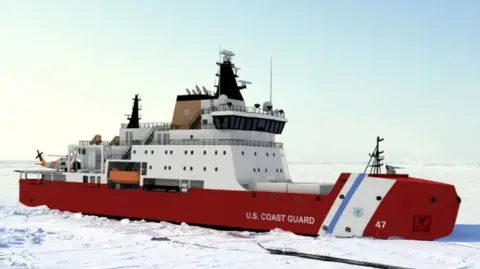
    Rauma Marine Constructions An artist's impression of the new Finnish icebreakers that the US has orderedRauma Marine Constructions

    The US intends to buy 11 icebreakers of Finnish design, pictured, four of which will be built in Finland

    Following Trump’s outline announcement last autumn, the first contracts were awarded on 29 December.

    Finland’s Rauma Marine Constructions is to build two icebreakers for the US Coast Guard at its shipyard in the Finnish port of Rauma. The first ship is due to be delivered in 2028.

    A further four will be constructed in Louisiana, with all six using an Aker Arctic Technology diesel-electric powered design.

    The US orders are part of an effort to catch up with the number of Russian icebreakers. Currently Russia has around 40, including eight that are nuclear powered.

    By contrast, the US presently only has three in operation.

    Meanwhile China operates around five polar-capable vessels. “None of them are technically icebreakers,” says Rybski, pointing to their design not meeting the strict criteria. “But they are increasing their fleet.”

    He adds that China has increasingly been sending these “research” ships into Arctic waters between Alaska and the far east of Russia, including areas that the US considers its “exclusive economic zone”.

    “With limited means to respond this becomes a problem [for the US].”

    Trump’s desire to enlarge its icebreaker fleet goes beyond the practicalities of operating in ice-clad Arctic seas, assesses Lin Mortensgaard, a researcher at the Danish Institute of International Studies. She says it is also about projecting power.

    “No matter how many aircraft carriers you have and how much you use them to threaten states with, you cannot sail your aircraft carrier into the central Arctic Ocean,” she says.

    “Icebreakers are really the only kind of naval vessel to signal that you are an Arctic state, with Arctic capabilities. And I think this is what much of the US discourse is about.”

    James Brooks Icebreaker engineer Riikka Matala wearing a fluorescent jacketJames Brooks

    Icebreaker engineer Riikka Matala says that icebreakers need both structural strength and powerful engines

    Back in Finland, Helsinki Shipyard occupies a dock on the capital’s waterfront. It is where half of the world’s icebreakers have been made. Today owned by Canadian firm Davie, it also hopes to win new contracts from the US Coast Guard.

    “The geopolitical situation has changed definitely,” says the shipyard’s managing director, Kim Salmi.

    “We have our eastern neighbour here [Russia]. They are building their own [new] fleet. And the Chinese are building their fleet.”

    He adds: “The US, Canada and the western allies in general, are looking for the power balance.”

    Inside a cavernous shipbuilding hangar, workers cut and weld steel for the yard’s latest icebreaker, a heavy-duty Arctic vessel, called Polarmax that’s destined for the Canadian coastguard.

    The Finns can build these complex vessels remarkably swiftly – it takes between two-and-a-half and three years – thanks to a streamlined production method, and decades of experience.

    “Over 100 years, we have practised this,” says Artica’s Visuri. “You’ve got this cycle of designers, operators, builders. That’s why Finland is the superpower of icebreakers.”

    Read more global business and technology stories


    Source link

  • Factory explosion in Inner Mongolia province kills two, injures 84

    Factory explosion in Inner Mongolia province kills two, injures 84


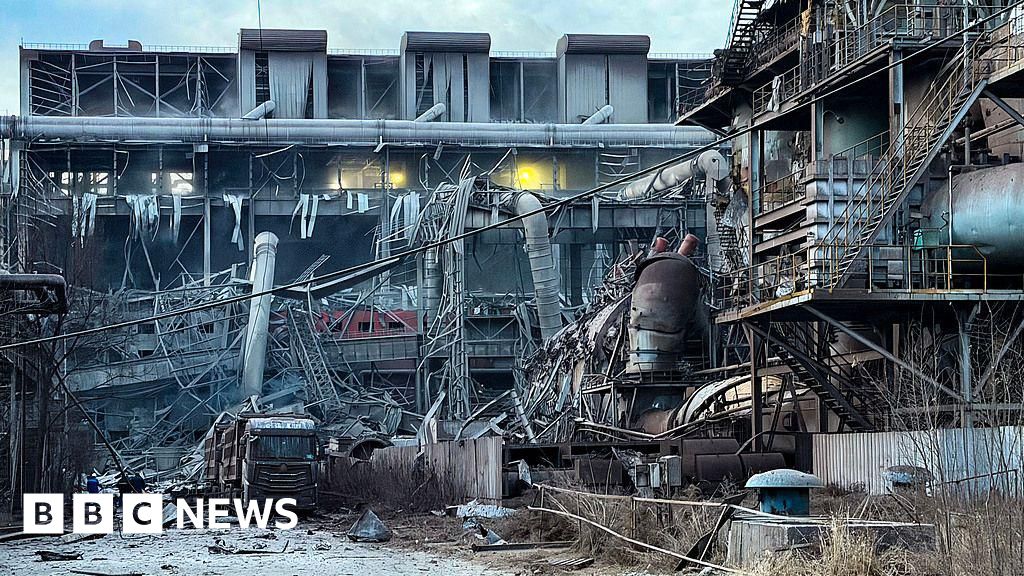
    A huge explosion at a factory in northern China has killed two people and injured 84 others, with eight people still missing, state media reported.

    The blast happened at around 15:00 local time (07:00 GMT) Sunday at Baogang United Steel plant in Inner Mongolia, causing noticeable tremors in the area.

    Footage online showed the explosion sending large plumes of smoke into the sky, while the ground was littered with debris, including collapsed ceilings and pipes.

    Five among the dozens hospitalised suffered serious injuries, state media reported. Authorities are investigating the cause of the blast.

    Baogang United Steel is a major state-owned iron and steel enterprise.

    China has a long history of industrial accidents, from factory explosions and mine collapses to mudslides.

    In 2015, two massive explosions in the port of Tianjin killed 173 people, leaving hundreds more injured and devastating large areas of the city.

    In May last year, an explosion in a chemical plant in the eastern province of Shandong killed five people and injured at least 19. The blast ripped the windows of building nearby from their hinges.


    Source link