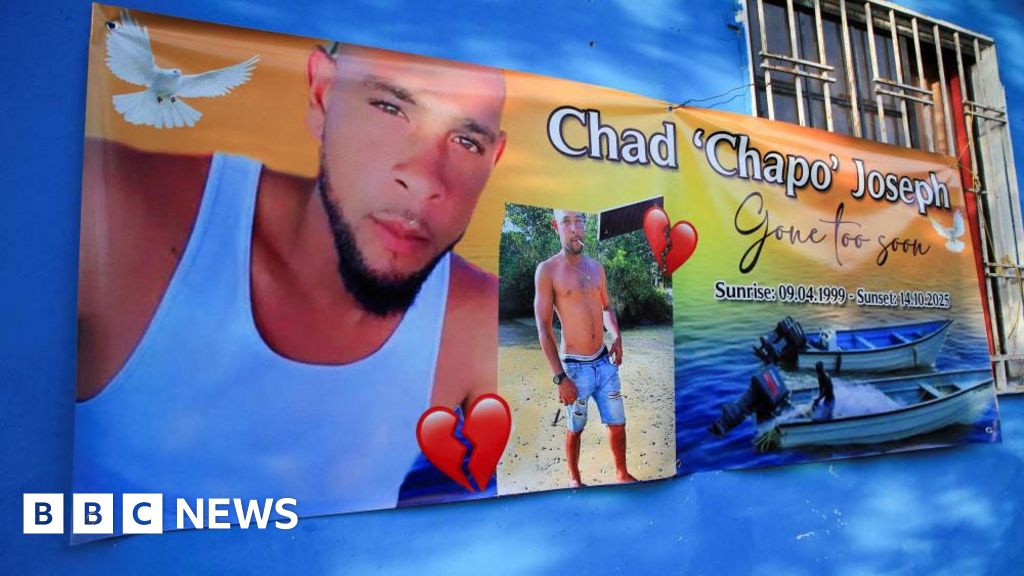
One of the lawyers said in a statement that the strike amounted to “lawless killings in cold blood; killings for sport and killings for theatre”.
The US has struck at least 36 vessels in the Caribbean and Eastern Pacific since September, killing more than 120 people. The Trump administration has said it is targeting “narco-terrorists” carrying drugs that kill Americans.
The US has positioned its operations as a non-international armed conflict with the alleged traffickers, but legal experts say they could be in violation of the laws governing such conflict.
This lawsuit was filed on Tuesday under the Death on the High Seas Act, which allows family members to sue for wrongful deaths on the high seas, and is a statute that allows foreign citizens to sue in US courts for violating international law.
The case was brought by Joseph’s mother and Samaroo’s sister, who say the two men did fishing and farm work in Venezuela, and were returning to Trinidad and Tobago when their boat was struck.
Joseph’s mother Sallycar Korasingh added that if the US government believed her son had done something wrong, “it should have arrested, charged and detained him, not murdered him”.
The lawsuit argues that the killings should be deemed a wrongful death because the men were not taking part in military hostilities against the US.
The Pentagon has not yet responded to requests for comment.
It comes after the family of a Colombian man, who was killed in a separate US strike, took their case to the Inter-American Commission on Human Rights.
The Spanish government has announced a plan to legalise the status of undocumented migrants, a measure expected to benefit at least half a million people.
Regularisation will be available to foreign nationals who do not have a criminal record and can prove they lived in Spain for at least five months prior to 31 December 2025.
“This is an historic day for our country,” said Elma Saiz, Spain’s minister of inclusion, social security and migration.
The measure will provide beneficiaries with an initial one-year residence permit, which can then be extended. Requests for legalisation are expected to begin in April and the process will remain open until the end of June.
“We are reinforcing a migratory model based on human rights, integration, co-existence and which is compatible with economic growth and social cohesion,” Saiz said.
Spain has seen a large influx of migrants in recent years, mainly from Latin America.
The conservative think-tank Funcas found that the number of undocumented migrants in Spain had risen from 107,409 in 2017 to 837,938 in 2025 – an eight-fold increase.
The highest number of undocumented arrivals currently living in Spain are believed to be from Colombia, Peru and Honduras.
Spain’s socialist-led coalition government has been an outlier on this issue among the larger European nations, underlining the importance of migrants for the economy.
The country has been outperforming the other main EU economies in recent years, posting expected growth of close to 3% in 2025.
Unemployment, a longstanding weakness of the Spanish economy, has dipped below 10% for the first time since 2008, according to figures released on Tuesday.
Prime Minister Pedro Sánchez has described immigrants as representing “wealth, development and prosperity” for Spain, pointing to their contribution to the social security system.
The government and parties on the left have also emphasised the need to treat migrants in a humane way.
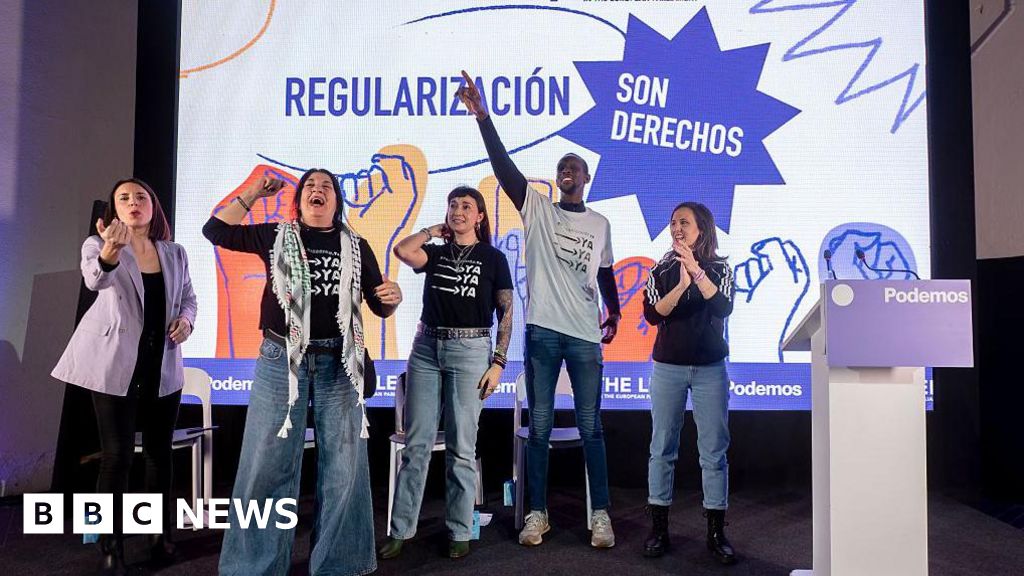
“Providing rights is the answer to racism,” said Irene Montero, of the far-left Podemos party and a former minister in a coalition government with the Socialists.
She has campaigned for this measure, which followed an agreement between the party and the government. A civic legislative proposal, calling for a mass migrant regularisation, received the support of around 700,000 people but had been languishing in parliament.
This measure will be approved by royal decree, meaning it does not require parliamentary approval.
It is the first large-scale migrant regularisation in Spain for two decades.
Several such initiatives, by governments of both the Socialists and the conservative People’s Party (PP), legalised the status of an estimated half a million migrants between 1986 and 2005.
However, Alberto Núñez Feijóo, leader of the PP, said the latest mass legalisation would “increase the pull effect and overwhelm our public services”.
Pepa Millán, spokeswoman for the far-right Vox, said the initiative “attacks our identity”, adding that the party would appeal before the Supreme Court in a bid to block it.
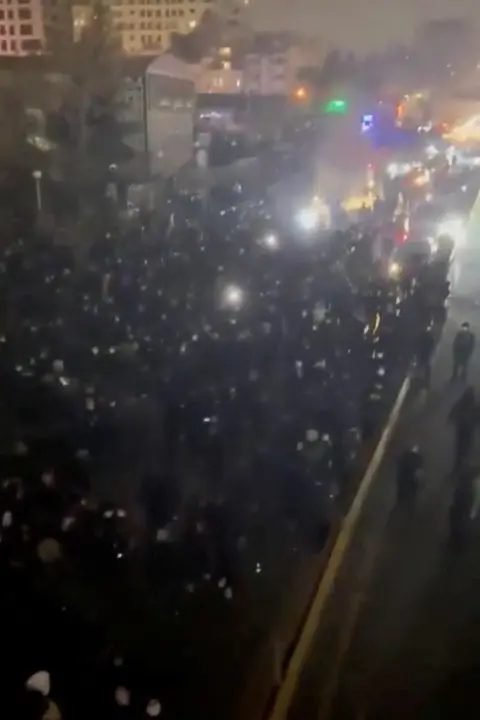
Iranian authorities responded with lethal force as the protests in Tehran escalated on 8 January
“My friends are all like me. We all know someone who was killed in the protests.”
For Parisa, a 29-year-old from Tehran, the crackdown by security forces in Iran earlier this month was unlike anything she had witnessed before.
“In the most widespread previous protests, I didn’t personally know a single person who had been killed,” she said.
Parisa said she knew at least 13 people who had been killed since protests over worsening economic conditions erupted in the capital on 28 December and then evolved into one of the deadliest periods of anti-government unrest in the history of the Islamic Republic.
With one human rights group reporting that the number of people confirmed killed has passed 6,000, several young Iranians able speak to the BBC in recent days, despite a near-total internet shutdown, have described the personal toll.
Parisa said one 26-year-old woman she knew was killed by “a hail of bullets in the street” when the protests escalated across the country on Thursday, 8 January, and Friday, 9 January, and authorities responded with lethal force to crush them.
She herself took part in protests in the north of Tehran that Thursday, which she insisted were peaceful.
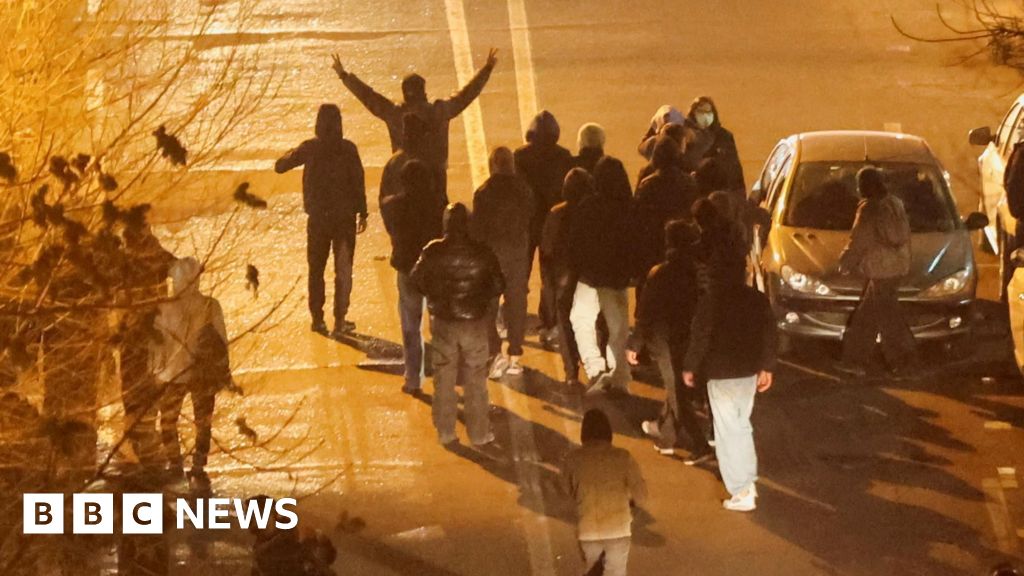
“No-one was violent and no-one clashed with the security forces. But on Friday night they still opened fire on the crowd,” she said.
“The smell of gunpowder and bullets filled the neighbourhoods where clashes were taking place.”
SOCIAL MEDIA via REUTERS
The protests were sparked by economic hardship but quickly widened into demands for political change
Mehdi, 24, who is also from Tehran, echoed her assessment of the scale of the protests and violence.
“I had never seen anything even close to this level of turnout and such killings and violence by the security forces,” he said.
“Despite the killings on Thursday [8 January] and threats of more killings on Friday, people came out, because many of them could no longer endure it and had nothing left to lose,” he added.
Mehdi described witnessing multiple killings of protesters at close range by security forces.
“I saw a young man killed right in front of my eyes with two live rounds,” he said.
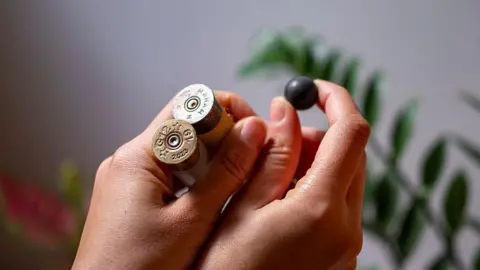
“Motorcyclists shot a young man in the face with a shotgun. He fell on the spot and never got back up.”
The US-based Human Rights Activists News Agency (Hrana) says it has so far confirmed the killing of at least 6,159 people since the unrest began, including 5,804 protesters, 92 children and 214 people affiliated with the government. It is also investigating 17,000 more reported deaths.
Another group, Norway-based Iran Human Rights (IHR), has warned that the final toll could exceed 25,000.
Iranian authorities said last week that more than 3,100 people had been killed, but that the majority were security personnel or bystanders attacked by “rioters”.
Most international news organisations, including the BBC, are barred from reporting inside Iran. But videos showing security forces firing live ammunition at crowds have been verified by the BBC.
AFP
Shotgun cartridges and rubber bullets recovered on Tehran streets on 8 January
Sahar, a 27-year-old from the capital, said she knew seven people who had been killed.
She described how the security forces’ response to the unrest escalated rapidly on 8 January.
During a protest that evening, Sahar and her friends sought refuge in a nearby house after tear gas was fired.
“My friend stuck his head out of a window to see what was going on and they shot him in the neck,” she said.
Another friend was wounded by pellets and later bled to death after avoiding going to hospital out of fear of being detained, according to Sahar.
Sahar said a third friend died while being detained by the Islamic Revolution Guard Corps (IRGC).
“They [officers] told his family to come to the IRGC intelligence office. After a few days they rang and said, ‘Come and collect the body.’”
On 9 January, Sahar said, live ammunition was fired openly and “without mercy” by uniformed security personnel.
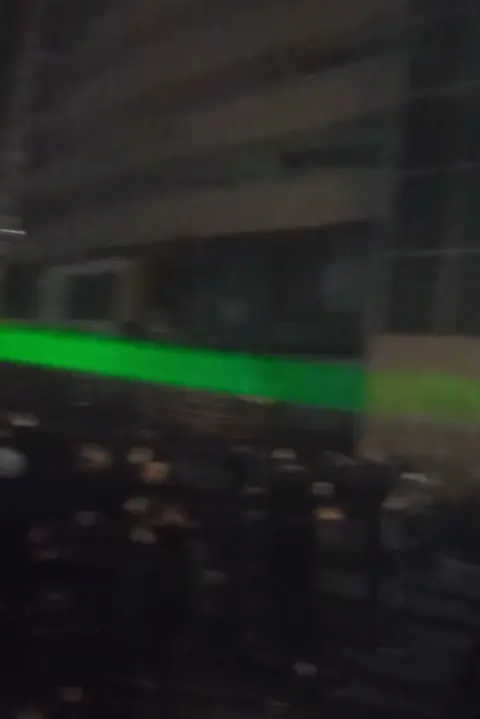
“They were pointing lasers at people, and locals were opening their car park doors for us to hide,” she said.
The communications blackout compounded the trauma.
“Right now there’s no news at all,” Sahar said. “Without internet or phone lines we had no idea what was happening to anyone. We could barely get calls through just to get bits of news.”
One video showed a green laser pointed towards a large crowd of protesters in Tehran
Parham, 27, described widespread use of pellet guns by security forces in Tehran, particularly targeting protesters’ faces and eyes.
One of his friends, Sina, 23, was shot in the forehead and eye on 9 January.
“We took him to a hospital, but the doctor could only give us a prescription and told us to leave as soon as possible,” Parham said.
At an eye hospital, he added, wounded protesters arrived constantly.
“Every 10 minutes, it felt like they were bringing in someone else who had been hit by a pellet.”
A worker at the hospital’s cafe said she had seen “70 people with eye injuries come in during a single shift”, according to Parham.
Sina – who still has pellets stuck behind one of his eyes and in his forehead – said they had been scared of being arrested at the first hospital because of the need to give their ID numbers, so they had gone to a private eye hospital.
He said he was “lucky” compared to the others who he saw at the eye hospital, who had “pellets all over their faces and in both of their eyes”.
The BBC has seen a medical document in Sina’s name that says “there is a 5mm metallic foreign body” behind his eye.
The medical records of a number of other protesters with pellet-gun wounds have also been received and verified by the BBC.
EPA
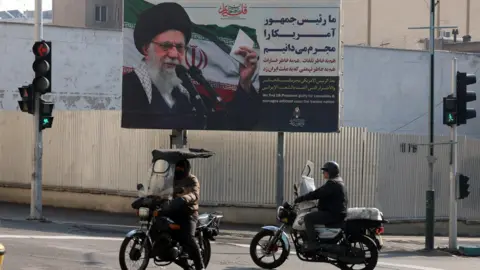
Iran’s leaders have portrayed the unrest as “riots” fomented by the US
Protesters and activists have also described a pattern of refusal by the authorities to hand over the bodies of those killed to their families.
Mehdi said his friend’s cousin was killed and that the family was told by officials to either pay a large sum of money to receive his body or agree to him being recorded as a member of the security forces.
“They said, ‘Either pay 1 billion tomans [more than $7,000; £5,000] for us to hand over the body to the family, or you have to say he was a member of the Basij and was martyred for public security and against the riots.’”
Navid, a 38-year-old from Isfahan, also said two close friends whose relatives were killed had received such an ultimatum.
“They say you have to pay the equivalent of several thousand dollars or let us issue them a Basij card so they are counted among the security forces’ dead,” he cited his friends as saying.
Human rights groups have warned that this practice has served both to punish protesters’ families and obscure the true death toll.