Category: Uncategorized

  • How Yoweri Museveni defeated Bobi Wine by a wide margin

    How Yoweri Museveni defeated Bobi Wine by a wide margin


    Sammy AwamiBBC Africa, Kampala

    Bloomberg via Getty Images Supporters of Yoweri Museveni, Uganda's president, dance during a campaign rally ahead of presidential elections in Kampala, Uganda, on Tuesday, Jan. 13, 2026Bloomberg via Getty Images

    For supporters of Uganda’s President Yoweri Museveni, his resounding victory in the just-concluded election is a vindication of his 40-year-long rule.

    He won with 72% of the vote, close to his highest-ever tally of 74% in Uganda’s first direct presidential election in 1996.

    It reinforces the 81-year-old’s claim that he still commands the support of the overwhelming majority of Ugandans, after seizing power as a rebel commander in 1986 ending the rule of the Milton Obote regime.

    But Museveni’s main election rival – the charismatic former pop star Bobi Wine – dismissed the result as “fake” and said he had gone into hiding following a raid on his home by the security forces.

    Museveni campaigned largely on his track-record, arguing that he has delivered political and economic stability in an era of global uncertainty.

    He pledged to steer Uganda towards achieving the status of a middle-income country by 2030, a milestone his supporters have framed as a fitting legacy for a man who will finish his seventh – and possibly final – term the following year.

    Museveni sees Uganda’s nascent oil industry as a central pillar towards achieving that goal.

    On the campaign trail, he repeatedly told voters that once exports commence, the economy would grow at double-digit rates.

    Museveni has set October as the target date for the first crude oil exports, via a 1,443 km pipeline to the Indian Ocean port of Tanga in Tanzania.

    Despite his age, the president has sought to project vitality and control. At one of his final campaign rallies, he told supporters that he had visited all of Uganda’s more than 140 electoral constituencies.

    Yet in early October, his team abruptly cancelled several campaign events, citing unspecified “state duties” – an explanation many found unconvincing, fuelling speculation about the octogenarian’s health.

    Subsequent pauses in his schedule only deepened speculation about fatigue and declining health.

    Reuters Robert Kyagulanyi, also known as Bobi Wine, of the National Unity Platform (NUP) party, stands with his wife Barbara Kyagulanyi, as he addresses a press conference as they prepare to leave their Magere home to vote in the general election, in Kasangati town near Kampala, Uganda January 15, 2026Reuters

    Bobi Wine has now twice failed to dislodge President Museveni from power

    For Wine, the result was a massive blow. His share of the vote slumped from 35% in 2021 to 25% this time round, despite Uganda’s overwhelmingly young population – a demographic long viewed as the 43-year-old natural base.

    From Wine’s perspective, the election was neither credible nor legitimate.

    He maintains that the campaign was far from free and fair, pointing to repeated disruptions of his rallies by security forces, including the use of tear gas and live ammunition to intimidate supporters, some of whom were killed.

    He also alleged ballot stuffing but has not provided any evidence to back his claims. The authorities have not commented on the claims.

    After two unsuccessful presidential bids, questions now hang over his political future.

    There is a growing risk that he could follow the path of many opposition figures across Africa – politicians whose popular appeal was steadily eroded by sustained repression, leaving them permanently excluded from power.

    During the campaign, Wine embodied the energy and impatience of Uganda’s youth, while Museveni cast himself as the seasoned patriarch, the guarantor of stability.

    Ultimately, according to the disputed official results, voters opted for the latter.

    Those seeking to understand Uganda’s next chapter have largely focused on the question of presidential succession – when and how Museveni will eventually exit the stage.

    Ugandan journalist and political analyst Allan Kasujja – a former BBC Newsday radio and podcast presenter – cautions against being fixated with the issue.

    “Change in Uganda, especially political change, does not, and almost certainly will not, happen suddenly,” Kasujja says.

    “It happens gradually, and that process has been under way for some time.”

    EPA / Shutterstock A member of Uganda security forces operates during the opening of ballot boxes during the presidential elections in Kampala, Uganda, 15 January 2026. Eight presidential candidates, including incumbent Yoweri Museveni and NUP candidate Bobi Wine, are vying for the presidency.
Uganda holds presidential elections, Kampala - 15 Jan 2026EPA / Shutterstock

    Uganda’s security forces have been accused of brutally cracking down on the opposition

    Viewed through that lens, the election appears less a moment of transformation than a ritual of the political calendar, one that legitimises deeper, slower shifts taking place within the ruling party, the National Resistance Movement (NRM), and the state machinery that it controls.

    These shifts were first noticed during a cabinet reshuffle by Museveni in March 2023, and became unmistakable in the August 2025 elections for the NRM’s top decision-making body, the Central Executive Committee.

    Far from being a routine internal contest, the process turned into a high-stakes struggle over positioning in a post-Museveni order.

    Marked by factional bargaining and allegations of widespread bribery, the elections revealed a regime increasingly driven by succession politics rather than competition with an opposition that had either been dealt with by the security forces or co-opted.
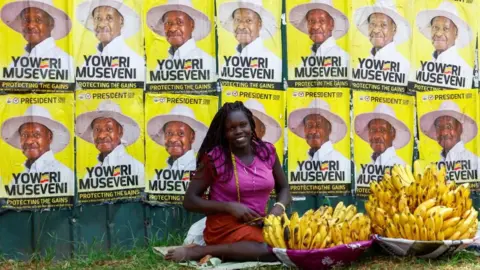
    Reuters A woman sells bananas near campaign posters of Uganda's President and the leader of ruling National Resistance Movement (NRM) party, Yoweri Museveni, following the general elections in Kampala, Uganda January 17, 2026Reuters

    The opposition says the election was marred by rigging and intimidation

    It provided the clearest indication yet of the growing influence within the ruling party of army chief Gen Muhoozi Kainerugaba – the son of the president and his potential successor.

    Veteran figures from the party’s old guard were pushed aside, replaced by newer faces, many without the credentials of having fought in the war that brought Museveni to power 40 years ago, but widely seen as loyal to his son.

    According to sources close to the presidency, authority at State House has become increasingly decentralised, with decisions once taken directly by Museveni now channelled through a tight inner circle of relatives and long-time associates.

    Museveni’s day-to-day schedule is said to be overseen by his eldest daughter, Natasha Karugire.

    Relations with foreign dignitaries and senior military figures are largely managed by his half-brother, Salim Saleh, while trade and economic policy are shaped by his son-in-law, Odrek Rwabwogo, married to Museveni’s second daughter, Patience.

    And for the first time in the country’s modern history, all security matters – both internal and external – are overseen by the chief of defence forces, the 51-year-old Gen Kainerugaba.

    Given the dominant role that the military has long played in Ugandan politics and the fact that Museveni himself came to power through armed struggle, this concentration of authority in his hands has profound political implications.

    It suggests that Uganda’s future is being shaped – and increasingly controlled – by Museveni’s son, even if he does not hold the title of head of state, yet.


    BBC election graphics
    Getty Images/BBC A woman looking at her mobile phone and the graphic BBC News AfricaGetty Images/BBC


    Source link

  • Black Basta Ransomware Leader Added to EU Most Wanted and INTERPOL Red Notice

    Black Basta Ransomware Leader Added to EU Most Wanted and INTERPOL Red Notice


    Ravie LakshmananJan 17, 2026Law Enforcement / Cybercrime

    Ukrainian and German law enforcement authorities have identified two Ukrainians suspected of working for the Russia-linked ransomware-as-a-service (RaaS) group Black Basta.

    In addition, the group’s alleged leader, a 35-year-old Russian national named Oleg Evgenievich Nefedov (Нефедов Олег Евгеньевич), has been added to the European Union’s Most Wanted and INTERPOL’s Red Notice lists, authorities noted.

    “According to the investigation, the suspects specialized in technical hacking of protected systems and were involved in preparing cyberattacks using ransomware,” the Cyber Police of Ukraine said in a statement.

    The agency said the accused individuals functioned as “hash crackers,” who specialize in extracting passwords from information systems using specialized software. Once the credential information was obtained, members of the ransomware group broke into corporate networks and ultimately deployed ransomware and extorted money to recover the encrypted information.

    Cybersecurity

    Authorities conducted searches at the defendants’ residences located in Ivano-Frankivsk and Lviv, allowing them to seize digital storage devices and cryptocurrency assets.

    Black Basta first emerged in the threat landscape in April 2022, and is said to have targeted more than 500 companies across North America, Europe, and Australia. The ransomware group is estimated to have earned hundreds of millions of dollars in cryptocurrency from illicit payments.

    Early last year, a year’s worth of internal chat logs from Black Basta leaked online, offering a glimpse into the group’s inner workings, its structure and key members, and the various security vulnerabilities exploited to gain initial access to organizations of interest.

    The leaked dossier also unmasked Nefedov as Black Basta’s ringleader, adding he goes by various aliases, such as Tramp, Trump, GG, and AA. Some documents alleged that Nefedov had ties to high-ranking Russian politicians and intelligence agencies, including the FSB and GRU.

    Nefedov is believed to have leveraged these connections to protect his operations and evade international justice. A subsequent analysis from Trellix revealed that Nefedov was able to secure his freedom despite getting arrested in Yerevan, Armenia, in June 2024. His other aliases include kurva, Washingt0n, and S.Jimmi. Although Nefedov is said to be in Russia, his exact whereabouts are unknown.

    Furthermore, there is evidence linking Nefedov to Conti, a now-defunct group that sprang forth in 2020 as a successor to Ryuk. In August 2022, the U.S. State Department announced a $10 million reward for information related to five individuals associated with the Conti ransomware group. They included Target, Tramp, Dandis, Professor, and Reshaev.

    It’s worth mentioning here that Black Basta surfaced as an autonomous group, alongside BlackByte and KaraKurt, following the retirement of the Conti brand in 2022. Other members joined groups like BlackCat, Hive, AvosLocker, and HelloKitty, all of which are now no longer active.

    Cybersecurity

    “He served as the head of the group. As such, he decided who or which organisations would be the targets of attacks, recruited members, assigned them tasks, took part in ransom negotiations, managed the ransom obtained by extortion, and used it to pay the members of the group,” Germany’s Federal Criminal Police Office (BKA or Bundeskriminalamt) said.

    The leaks have led to Black Basta’s apparent demise, with the group remaining silent after February and taking down its data leak later that month. But with ransomware gangs known to shut down, rebrand, and reemerge under a different identity, it won’t be surprising if members of the erstwhile criminal syndicate pivot to other ransomware groups or form new ones.

    Indeed, per reports from ReliaQuest and Trend Micro, it’s suspected that several of the former Black Basta affiliates might have migrated to the CACTUS ransomware operation – an assessment based on the fact that there was a massive spike in organizations named on the latter’s data leak site in February 2025, coinciding with Black Basta’s site going offline.


    Source link

  • Trump’s proposed credit card cap spotlights Americans’ debt. Would it help?

    Trump’s proposed credit card cap spotlights Americans’ debt. Would it help?


    Danielle KayeBusiness reporter

    Getty Images A woman is holding a credit card or debit card and doing online shopping on a smartphone. Getty Images

    Credit card debt is an increasingly heavy burden for millions of Americans.

    Selena Cooper, 26, is among those dealing with the strain. A former paralegal at the Social Security Administration, she was left without a stable income when the US government shut down a few months ago. She lost her job permanently after Christmas.

    Cooper first missed her credit card payments in October, when her paycheques ground to a halt. Since then, she said her debt across her three credit cards has accumulated to $6,000.

    Last month, her card issuers Capital One and American Express notified her that they were raising her interest rates due to late payments. The rate on her Capital One cards doubled to 16%, while the one on her Amex jumped from 10% to 18%, she said.

    Credit card rates have caught the attention of US President Donald Trump. Last week, he proposed capping them at 10% for one year from 20 January – an idea that Cooper said “would help a little bit, but it’s still not going to get me out of debt”.

    Cooper, who lives in Columbia, South Carolina, is now leaning on her photography business for income. “It’ll pay small bills – but not my credit card debt,” she said.

    Selena Cooper A woman wearing a denim shirt poses for a photo.Selena Cooper

    Selena Cooper said her debt across her three credit cards has accumulated to $6,000

    Credit card interest rates have been rising in recent years. They averaged about 22% as of November, up from 13% a decade ago, Federal Reserve data shows. 37% of adults carry a credit card balance, and overall credit card debt in the US totals more than $1tn.

    “It does show that consumers are feeling pinched, they’re going to continue to feel pinched,” Susan Schmidt, portfolio manager at Exchange Capital Resources in Chicago, told the BBC.

    “I think the Trump administration is trying to find a way out of it.”

    Trump’s proposal, which was among his campaign promises, was met with a swift backlash from bank executives, who say a cap would erode consumers’ access to credit. Banks could cut credit limits or close riskier accounts.

    Interest charges are a source of revenue for banks and other big lenders, amounting to $160bn in 2024, according to the Consumer Financial Protection Bureau – an agency that Trump largely dismantled last year.

    Banks are already pushing to protect that income, arguing that a rate cap would backfire to the detriment of consumers. JP Morgan hinted at the possibility of legal action.

    “People will lose access to credit on a very, very extensive and broad basis, especially the people who need it the most,” Jeremy Barnum, JP Morgan’s chief financial officer, warned on the company’s earnings call on Monday.

    Jane Fraser, Citigroup’s chief executive, also pushed back against the proposal on Wednesday and warned of a “severe impact on access to credit and on consumer spending across the country”.

    Some analysts and economists agree that a cap, on its own, might not benefit consumers as much as Trump and lawmakers across the political aisle claim.

    “A 10% cap may not be the right solution because the people that are already in trouble, that’s not necessarily going to help them,” said Schmidt of Exchange Capital Resources.

    Benedict Guttman-Kenney, an assistant professor of finance at Rice University, said banks might respond by limiting how much they lend to people with lower credit scores, who are considered higher-risk borrowers. Those are the people most at risk of losing access to credit cards, he said.

    Banks, he added, might also try to recoup their revenue elsewhere, like by raising annual fees or late fees.

    “It’s not clear that people are going to be better off,” Guttman-Kenney said. “They’re still paying similar amounts of money.”

    But he noted that some bank expenses are “bloated”, meaning they have room to cut costs to keep their margins intact. They could, for example, trim down how much they spend on marketing, he said.

    And a recent Vanderbilt University study found that Americans would save roughly $100bn a year in interest costs if a 10% rate cap were to be implemented.

    “This is something people would see, they would notice, they would feel it,” said Brian Shearer, a researcher at Vanderbilt’s Policy Accelerator and the author of the study.

    “This alone would impact their household budgets substantially.”

    Shearer questioned a key argument put forward by bank executives and their lobbyists: that any reduction in rates will necessarily lead to a reduction in lending. He pointed to banks’ robust margins in the credit card market.

    Interest payments, he added, do not account for the majority of the revenue that banks earn on credit cards.

    “No policy is without some pros and cons,” Shearer said. “To continue lending, banks would have to reduce rewards to some extent, especially to people with lower FICO scores (credit scores).

    “However, the savings from interest, even to those people who lose some rewards, would far exceed the lost rewards.”

    ‘I’m losing sleep’

    Morgan, 31, who asked to use only her first name, is also among those struggling to pay down thousands of dollars.

    Since last May, she has been using her Discover card to pay for her two-year-old daughter’s childcare, while unemployed. She said she decided to send her daughter to daycare because she needed the freedom, due to struggles with her mental and physical health.

    Those payments have left her with $6,700 in credit card debt.

    Morgan’s husband works in the military and pays for the family’s other expenses. Through a service member benefit programme, she secured an interest rate of roughly 3% on her credit card. Had she been forced to pay the typical 27% interest rate, sending her daughter to childcare would not have been an option, she said.

    “I’m losing sleep over the $6,700, but I have a little wiggle room to be able to do that because once I get a job, I can pay it off,” Morgan said.

    That’s why Trump’s proposal to cap credit card rates at 10% struck her as a “step in the right direction”.

    “I hope it actually comes to fruition,” she said. “It’s one of the few things he’s done that prioritises people over businesses.”

    Will the proposal go anywhere?

    The idea to cap credit card rates has been floating in legislative circles for years, and it has garnered bipartisan support.

    Senator Josh Hawley, a Republican, and Senator Bernie Sanders, a Democrat, last year introduced a bill to cap credit card interest rates at 10%.

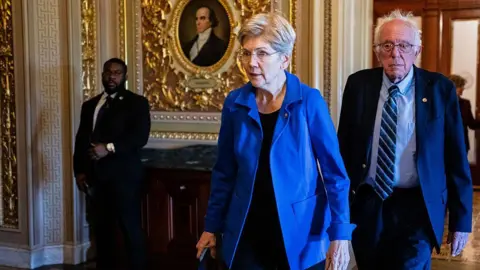
    Bloomberg via Getty Images A woman wearing a blue jacket and a man wearing a suit walk through the US Capitol.Bloomberg via Getty Images

    The proposal has received bipartisan support from the likes of Democrat Elizabeth Warren

    Democratic Senator Elizabeth Warren said in a statement that she spoke with Trump this week and “told him that Congress can pass legislation to cap credit card rates if he will actually fight for it”.

    “If he really wants to get something done, including capping credit card interest rates or lowering housing costs, he would use his leverage and pick up the phone,” Warren said.

    Still, there are hurdles ahead. Getting Congress on board could prove challenging, despite some support on both sides of the aisle.

    House Speaker Mike Johnson this week distanced himself from the rate cap proposal, citing “negative secondary effects” and a pullback in lending as a result. “It’s something that we’ve got to be very deliberate about,” Johnson said at a press conference.

    And banks are poised to keep pushing hard against it.

    “If the Trump administration backs down, I think it would be because of the bank lobbying,” said Shearer, of Vanderbilt.

    “This is their cash cow. They’re not going to let it go easily.”


    Source link