
Category: Uncategorized

  • US justice department investigating Minnesota Democrats over alleged ICE obstruction

    US justice department investigating Minnesota Democrats over alleged ICE obstruction


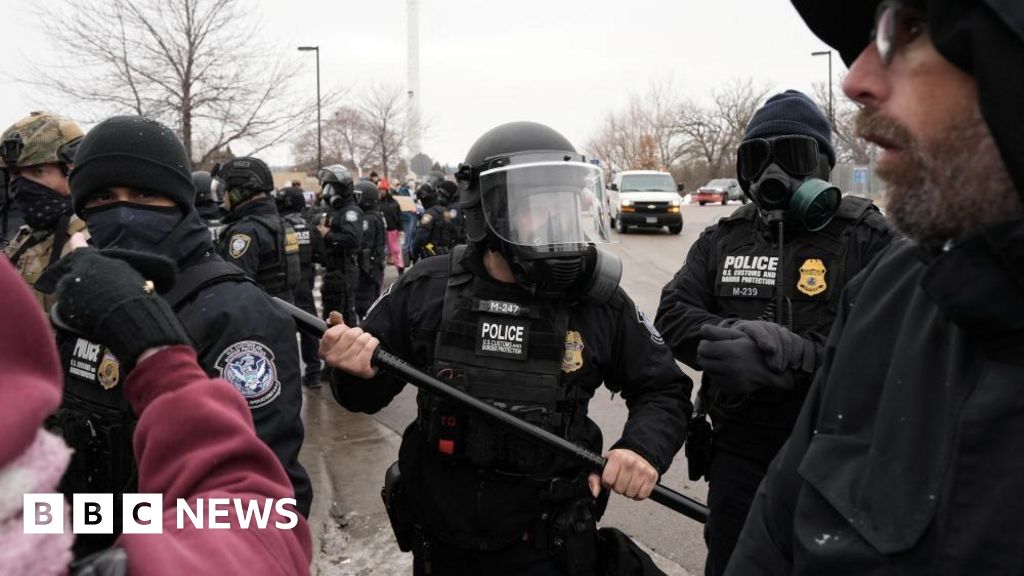
    Reuters a Customs and Border Patrol agent holding up a baton as more agents gather behind himReuters

    Customs and Border Patrol agents gather as protests continue outside Minneapolis’ Whipple Federal Building, which has become a de-facto ICE headquarters

    The US justice department is investigating two prominent Minnesota officials over alleged attempts to impede federal immigration operations, in an escalation of the Trump’s administration’s clash with Democrats.

    Gov Tim Walz and Minneapolis Mayor Jacob Frey, both liberals, are facing an inquiry over statements they made about Immigration and Customs Enforcement (ICE), according to the BBC’s US partner CBS News.

    It comes as new details emerged in the death of a Minneapolis woman shot last week by an ICE agent in the city, which drew nationwide protests.

    Renee Good, 37, was found with at least three gunshot wounds and possibly a fourth to the head, according to official reports viewed by CBS.

    Governor Walz responded on Friday to news of the inquiry against him by posting on X: “Weaponizing the justice system against your opponents is an authoritarian tactic.

    “The only person not being investigated for the shooting of Renee Good is the federal agent who shot her.”

    In a statement to the BBC, Mayor Frey said “I will not be intimidated”.

    “This is an obvious attempt to intimidate me for standing up for Minneapolis, our local law enforcement, and our residents against the chaos and danger this Administration has brought to our streets,” he said.

    The BBC has reached out to the justice department about the apparent investigation.

    The governor has urged Minnesotans to protest peacefully, but members of the Trump administration have accused him of inflammatory rhetoric, like describing ICE as a “modern-day Gestapo”. Frey has demanded that immigration agents get out of Minneapolis.

    The inquiry is focused on a federal statute, 18 U.S.C. § 372, which makes it a crime for two or more people to conspire to prevent federal officers from carrying out their official duties through “force, intimidation or threats”, a US official told CBS.

    Protests continued in Minneapolis on Friday after new details emerged about the death of Good, and local officials appealed for calm on the streets over this public holiday weekend.

    An incident report from the Minneapolis Fire Department, which was viewed by CBS News, said when they responded to the shooting scene last week, it appeared Good had been shot twice in the chest, once in her left forearm and a fourth wound, possibly from a gunshot, was seen “on the left side of the patient’s head”.

    Paramedics found Good unresponsive with an irregular pulse, and she was pronounced dead in the ambulance on the way to hospital, according to the report seen by CBS.

    The Trump administration has said that Good was impeding federal law enforcement and tried to run the agent over. Local officials say Good was a legal observer who posed no danger.

    Video of the incident show ICE agents approaching a car, which is blocking traffic and parked in the middle of the street. An officer instructs her to get out of the car.

    As Good turns her wheel apparently trying to drive away, her Honda Pilot SUV pulls forward with one of the agents standing near the front of the vehicle. He pulls his gun and fires.
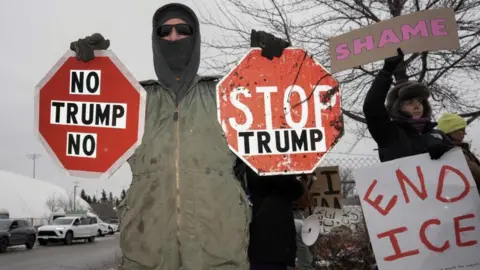
    Reuters a protester hold up stop signs with the words "Stop Trump" and "No Trump no"Reuters

    Footage from the scene shows the agent walking off afterwards.

    But Department of Homeland Security (DHS) officials have told CBS the officer suffered internal bleeding to the torso following the incident. No further details have been disclosed.

    The FBI is investigating the incident, although there is no federal civil rights inquiry into the agent who opened fire. Local officials and authorities say they have been shut out of the investigation.

    Meanwhile, President Donald Trump blasted demonstrators and local leaders on Friday.

    On Truth Social, he accused protesters of being “highly paid professionals”, adding that Walz and Frey had “totally lost control”.

    Later, the Republican president told reporters at the White House that he did not plan to invoke the Insurrection Act and send in troops to quell unrest in Minnesota, after earlier this week suggesting he might do so.

    “If I needed it, I’d use it. I don’t think there’s any reason right now to use it,” he said. “It’s very powerful,” he added.

    Bloomberg via Getty Images lawmakers stand in front of podium with Rep. Pramila Jayapal speaking into a microphoneBloomberg via Getty Images

    Democratic lawmakers held a hearing and press conference in Minnesota on Friday, led by Washington Rep. Pramila Jayapal (center)

    Thousands of ICE officers remain deployed in the state.

    Democratic lawmakers travelled to the city for a hearing there and spent Friday condemning federal immigration operations in the state, accusing ICE of reckless and lawless actions.

    Ilhan Omar, a congresswoman from Minnesota who has long feuded with Trump, said that ICE was trying to “provoke chaos and fear”.

    Adriano Espaillat, a congressman from New York, said ICE had become a “deadly weapon”.

    Washington congresswoman Pramila Jayapal said ICE agents should not be allowed to wear masks, or make arrests without warrants, and should be required to have body cameras and name tags.

    The Democratic lawmakers also interviewed several residents who alleged they had been shackled and detained by ICE for hours until they could prove they were US citizens.

    The BBC has contacted the DHS and ICE for comment.

    DHS spokeswoman Tricia McLaughlin told CNN on Friday that if there was “reasonable suspicion” of someone who is “in the vicinity” of a person being detained by a DHS operation, they might be asked to confirm their identity.

    She rejected suggestions such tactics could be discriminatory, saying “racial animus has no place in DHS”.
    Source link

  • Military man to be sworn in as a civilian president

    Military man to be sworn in as a civilian president


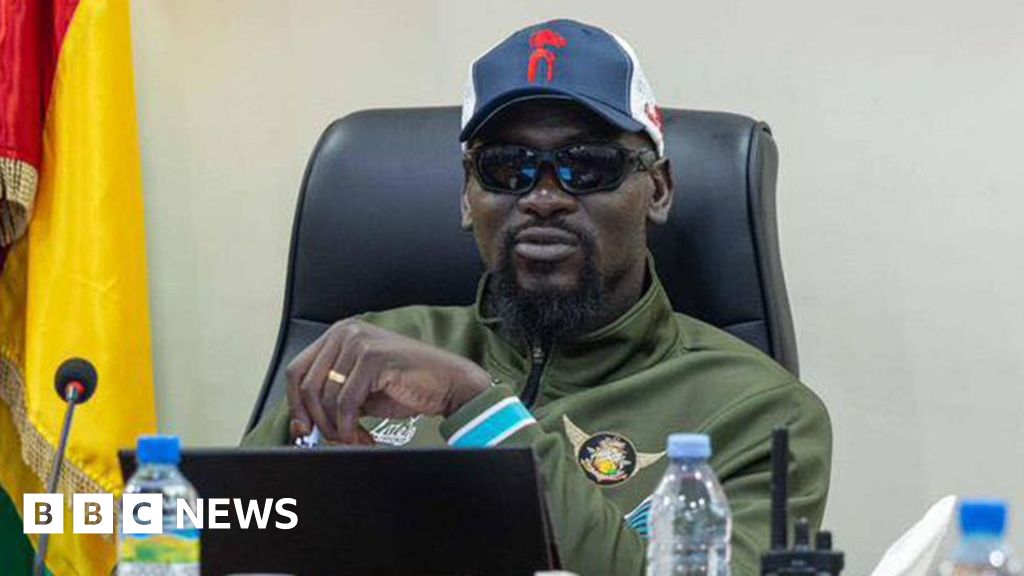
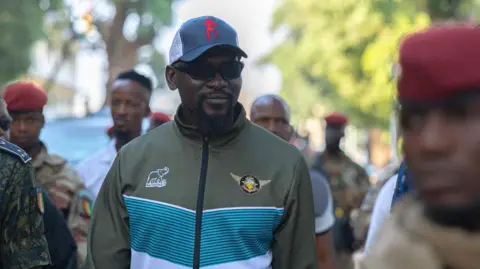
    Guinea Presidency Mamadi Doumbouya seen outside wearing a tracksuit, baseball cap and dark glasses. A soldier in a red beret is seen on the right in the foreground out of focus.Guinea Presidency

    Official pictures of Mamadi Doumbouya have portrayed him in a more relaxed mode

    From the moment he seized power in September 2021 Guinea’s Mamadi Doumbouya struck an imposing figure.

    Just 36 years old at the time, the broad-shouldered colonel, standing at well over six feet (1.8m), wearing military fatigues, mirrored sunglasses and a red beret certainly made an impression when announcing the coup.

    A relatively unknown member of an elite army unit, he declared that the government of ousted President Alpha Condé had disregarded democratic principles and that citizens’ rights were being trampled on.

    After more than four years of acting as interim president, and going back on a promise not to run for leadership of the country, Doumbouya, now 41, is set to be sworn in as the elected head of state on Saturday.

    The discreet, disciplined and private man won 87% of the vote in December’s election against a severely depleted field.

    Ex-Prime Minister Cellou Dalein Diallo, now in exile, described the process as a charade which generated “fabricated” results.

    While seemingly enjoying some popular support, critics have questioned Doumbouya’s democratic credentials as some political parties have been banned, activists have mysteriously disappeared and media outlets been shut down.

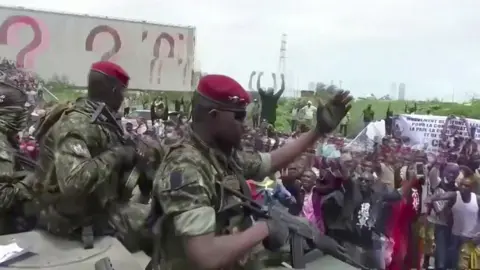
    Reuters A screengrab from a video showing Doumbouya atop a military vehicle in army uniform and holding a gun. He is waving to crowds on the street.Reuters

    Video footage shot in the aftermath of the 2021 coup showed Doumbouya being greeted by enthusiastic crowds

    Scrolling back through the social media accounts from the president’s office there is a sense of a carefully curated image.

    The army man, now a general, has, for the main, ditched the camouflage in favour of the baseball cap and tracksuit, or a boubou – traditional Guinean attire of loose-fitting robes with elaborate embroidery. The shades though are still at times in evidence.

    Pictures show him at the opening of schools, or transport and mining infrastructure or cycling through the streets of the capital, Conakry. The message is clear: this is a man of action who is working on behalf of the people.

    “This was presenting an image of someone who can be close to civilians, someone who is a civilian leader and can be representative of the people,” Beverly Ochieng, senior analyst with Dakar-based security intelligence firm Control Risks, told the BBC.

    “In some ways this is distancing himself from what brought him to power – a coup – and the fact that his entire career has been in the military.”

    In the 15 years before he took power, Doumbouya gained extensive international experience, including being educated to master’s level in France and serving in the French Foreign Legion. He was also in Afghanistan, Ivory Coast, Djibouti, Central African Republic and worked on close protection in Israel, Cyprus and the UK.

    But the donning of civilian clothes may not be entirely sincere, according to some analysts.

    “I’m not sure I’m convinced that he has transitioned from a military man. I think that the military costume will remain even if he is conducting the return to civilian order,” argued Aïssatou Kanté, a researcher in the West Africa office of the Institute of Security Studies.

    She referred to a ban on political demonstrations, the exclusion of Doumbouya’s main challengers in December’s election and the suspension of key opposition parties.

    Human rights campaigners have demanded to know the whereabouts of two activists – Oumar Sylla (known as Foniké Menguè) and Mamadou Billo Bah – who have not been seen since July 2024. They suspect the men were taken by the military.

    Press freedom organisation Reporters Without Borders has also expressed concern that journalist Habib Marouane Camara has been missing for more than a year. It has described how journalists are now censoring themselves and are fearful about what might happen to them.

    Nevertheless, the 2021 coup was widely welcomed in the country and since then Doumbouya appears to have remained a popular figure.

    Polling organisation Afrobarometer found that between 2022 and 2024 the proportion of people who trusted the president either “partially” or “a lot” grew from 46% to 53%.

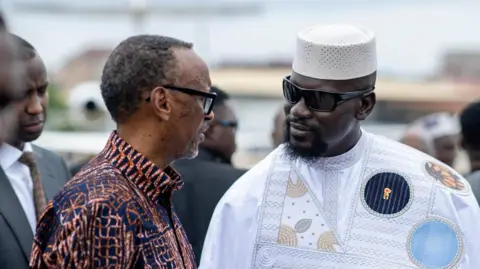
    Guinea Presidency A side view of Paul Kagame in a patterned African shirt talking to Mamady Doumbouya in a white boubou, white hat and dark glasses.Guinea Presidency

    Doumbouya (R) welcomed Rwandan President Paul Kagame to the country in November for the start of operations at the Simandou iron-ore mine

    The president-elect may not have a clearly defined ideology guiding him but for Kanté his emphasis on Guineans being in control of their own destiny has become very important.

    “It’s what keeps coming up in official speeches – this affirmation of political and economic sovereignty,” she told the BBC.

    In his address to the nation a few days into the new year, he struck a conciliatory tone, calling on all Guineans to build a nation of peace and “fully assumed” sovereignty.

    In a country that continues to grapple with high levels of poverty despite plentiful natural resources – including the world’s largest reserves of bauxite, which is used to make aluminium – this idea strikes a chord.

    The government’s messaging on the development of the vast iron-ore resources in Simandou underscores the possible benefits for the people.

    The three billion tonnes of ore available in a remote southern part of the country, which began to be exported last month, could transform the global iron market, as well as Guinea’s fortunes.

    The authorities say earnings from the project, partly owned by Chinese miners as well as the British-Australian corporation Rio Tinto, will be invested in new transport infrastructure as well as health and education.

    The success or otherwise of Simandou may define Doumbouya’s presidency.

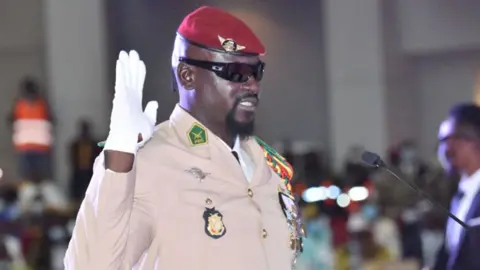
    AFP via Getty Images Doumbouya in formal military uniform and red beret holds up a white gloved hand to be sworn in in 2021.AFP via Getty Images

    In 2021, Doumbouya wore formal military dress when he was sworn in as interim leader

    He appears determined to keep some of the processing and added-value parts of the industry in Guinea to ensure greater benefits.

    Across the broader mining sector, his government has cancelled dozens of contracts over the past year where it was felt that the companies were not investing in Guinea – a move that has led one UAE-based firm to take the country to an international court.

    “This move towards resource nationalism makes him look like a local hero. He looks like he’s really fighting for the rights of his citizens, even if that means business disruptions,” said analyst Ochieng.

    The emphasis on sovereignty has also led to a pragmatic approach to international relations, observers say. Unlike coup leaders elsewhere in West Africa, Doumbouya has not outrightly rejected the former colonial power France in favour of Russia.

    Neither, despite his background in France and having a French wife, has he been accused of being a puppet of Paris.

    Doumbouya very much wants to be seen as someone running things in the interests of the country.

    Come Saturday, the president will preach a message of national unity and will hope that he can usher in a new era of prosperity for Guinea.

    You may also be interested in:
    Getty Images/BBC A woman looking at her mobile phone and the graphic BBC News AfricaGetty Images/BBC


    Source link

  • BBC reports from Iranian-Armenian border

    BBC reports from Iranian-Armenian border


    For over two weeks, demonstrations rocked Iran and, according to a human rights group, more than 2,600 protesters have been killed.

    Protesters have been met with deadly force by authorities, masked by a near total shutdown of the internet and communication services.

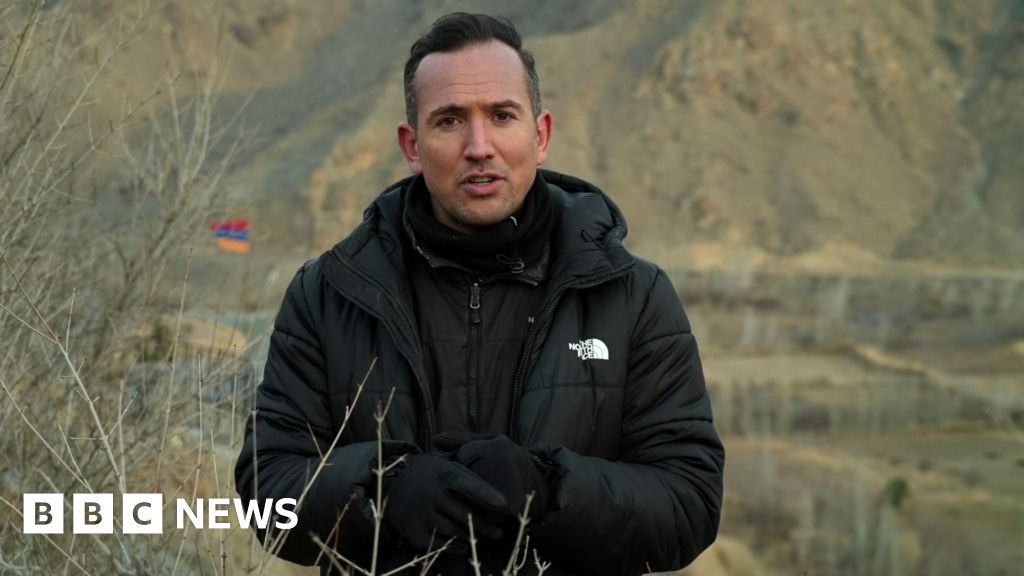
    Reporting from the Iranian-Armenian border, the BBC’s Middle East correspondent, Hugo Bachega, described the “anger and frustration” of Iranians and their concerns over the future.

    “People are simply terrified to join the demonstrations,” he added.

    The Iranian government has called the protests “riots” backed by Iran’s enemies.

    The demonstrations started over the economy on 28 December and turned into calls for the end of the rule of Iran’s Supreme Leader Ali Hosseini Khamenei.


    Source link