Senegal’s President Bassirou Diomaye Faye has declared Monday a public holiday after the national team won the Africa Cup of Nations after beating tournament hosts Morocco 1-0 in a dramatic final on Sunday.
A disallowed goal, players walking off the pitch and a saved penalty made it a tense night in the stadium in the Moroccan capital, Rabat.
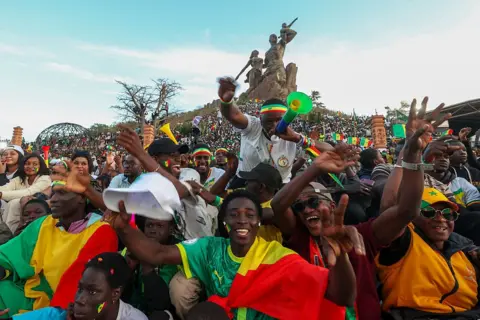
In Senegal’s capital, Dakar, supporters were excited as they gathered at an outdoor screen at the foot of the giant African Renaissance Monument.
As the match unfolded the tension was too much to bear for some.
Reuters
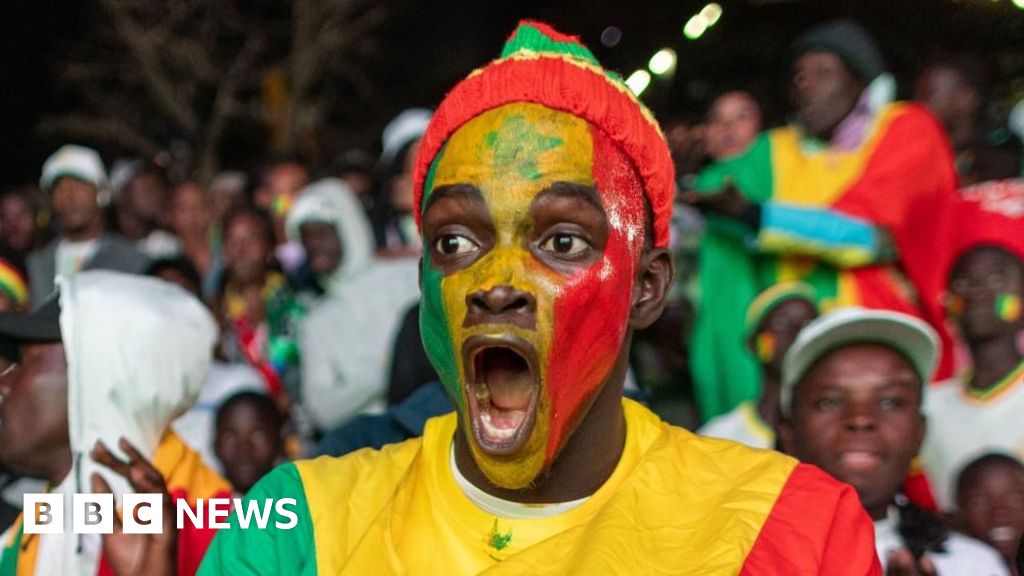
The moment Morocco’s Brahim Diaz stepped up to take the penalty that would have won his country the Afcon trophy for the first time in 50 years was unwatchable for this Senegal fan.
But his miss and Senegal’s subsequent goal in extra time were met with ecstasy in Dakar.
EPA
“What just happened is divine… a scenario as if it were a Netflix series is crazy,” fan Mohamed Diop told the Reuters news agency.
AFP via Getty Images
The other side of the coin, of course, was the devastation for Moroccans at a fan park in the city of Sale.
ANP via Getty Images
“Maybe next time,” one man told Reuters. “We have good players. Now we should get back to work so we can win in 2027.”
Moroccan fans watching in the Dutch city of Eindhoven were also shocked by Diaz’s penalty miss.
AFP via Getty Images
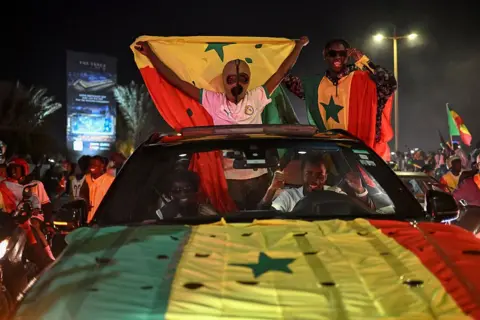
But back in Dakar, once the final whistle had blown, the party started.
Reuters
AFP via Getty Images
Reuters
AFP via Getty Images
“We really needed to win. This team showed me courage and seriousness. We gave everything we had. We really thank Sadio Mané, he gave us everything,” supporter Modou Yacine Diop told Reuters.
Senegal fans in the Italian city of Milan also came out on the streets.
Anadolu via Getty Images
People also celebrated in the Château Rouge area of the French capital, Paris, which some know as Little Africa.
NurPhoto via Getty Images
In the Spanish capital, Madrid, people followed the match in restaurants in the Lavapies neighbourhood.
NurPhoto via Getty Images
And at a watch party in New York, hosted by new city mayor Zohran Mamdani, Senegal fans joined the festivities.
Passengers caught up in a deadly train crash in Adamuz have described the moment a Madrid-bound train derailed and crossed over to neighbouring tracks, colliding with an oncoming train.
Survivors told of people and their belongings being “scattered” around the carriage, and described an “absolutely terrifying” scene.
At least 39 people were killed in the high-speed crash at 19:45 local time (18:45 GMT) on Sunday, about an hour after the train left Málaga.
US President Donald Trump has threatened to impose fresh tariffs on eight allies that oppose his demands for control of Greenland.
Last year, he placed taxes on goods reaching the US from countries around the world, arguing the move would boost American manufacturing and create jobs.
Critics warned of higher prices and damage to the global economy.
What are tariffs and how do they work?
Tariffs are taxes on imported goods.
Typically, the charge is a percentage of a good’s value.
For example, a 10% tariff on a $10 product would mean a $1 tax on top – taking the total cost to $11 (£8.17).
The tax is paid to the government by companies bringing in the foreign products.
These firms may pass some or all of the extra cost on to their customers, which in this case means ordinary Americans and other US businesses.
They may also decide to import fewer goods.
Why is Trump using tariffs?
Trump says tariffs increase the amount of tax raised by the government, encourage consumers to buy more American-made goods and boost investment in the US.
He wants to reduce the US trade deficit – the gap between the value of goods it buys from other countries and those it sells to them.
The president argues that the US has been exploited by “cheaters” and “pillaged” by foreigners.
Trump has also used tariffs to make other demands.
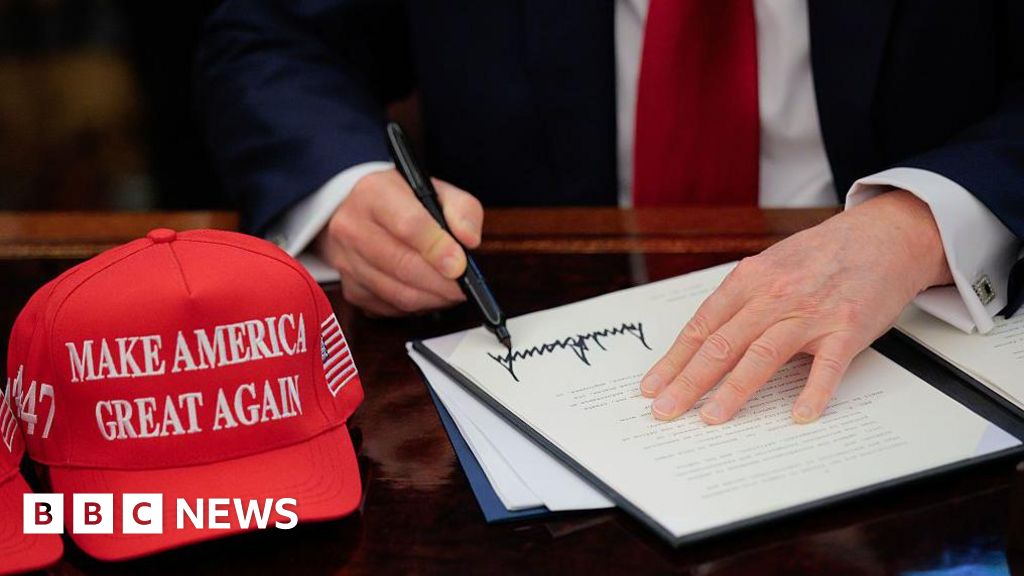
He has threatened fresh tariffs of 10% on the UK, Denmark, Norway, Sweden, France, Germany, the Netherlands, and Finland, because they oppose a US takeover of Greenland. Trump said the tariffs would be in place by 1 February and would rise to 25% by 1 June.
When announcing tariffs against China, Mexico and Canada, he said the countries must do more to stop migrants and the illegal drugfentanyl reaching the US.
Many tariffs have been amended or delayed after being announced.
Why has the Supreme Court been considering the legality of Trump’s tariffs?
Trump’s tariffs have faced numerous legal challenges.
Instead of getting Congressional approval, the Trump administration used the 1977 International Emergency Economic Powers Act. Declaring an emergency under the law meant Trump could issue immediate orders and bypass Congress.
The White House asked the US Supreme Court to overturn that decision. A ruling is expected in the coming weeks.
Trump has posted on social media that it would be a “complete mess” if the Supreme Court struck down his tariffs, and warned of difficulties if businesses were told they could claim refunds.
“It would take many years to figure out what number we are talking about and even, who, when, and where, to pay,” Trump said.
What are Trump’s tariffs on countries?
Negotiations are continuing with a number of countries, including America’s top three trading partners.
China, Canada and Mexico were all warned that they faced particularly high tariffs:
Mexico is facing 30% tariffs on its goods, plus the sector-specific levies and a 25% fentanyl tariff. However, like Canada, most of its goods are exempt under the USMCA. The tariffs were put on hold until the end of October to allow time to strike a deal. On 27 October, Mexican President Claudia Sheinbaum said she and Trump had agreed to extend this deadline by “a few more weeks”. Talks are ongoing
A patchwork of different rates is in place for other countries.
Many of these stem from Trump’s announcement in April 2025 that a “baseline” of 10% would apply to imports from all countries. Nations considered the “worst offenders” would face higher rates, as payback for unfair trade policies.
New tariff rates for dozens of countries were subsequently introduced in August, after delays to allow for trade talks.
The extra tariff on goods from Denmark, Norway, Sweden, France, Germany, the UK, the Netherlands and Finland would come into force on 1 February, but could later rise to 25% – and would last until a deal was reached.
The 10% rate applies to the first 100,000 UK vehicles exported every year – roughly the number of cars sold in 2024. Additional vehicles face the standard 25% tariff.
The agreement also lets the two countries sell beef to each other. Some US ethanol will face 0% tariffs, instead of 19%.
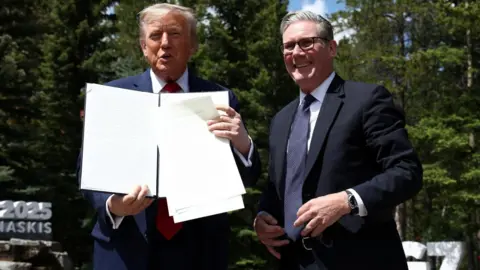
Trump announced “the deal was done” in June, but did not confirm the expected removal of all charges on steel imports from the UK.
The UK is the only country which does not face 50% tariffs on steel and aluminium. It pays 25% instead.
The BBC understands the plan to eliminate tariffs on UK steel exports entirely has now been put on hold.
However, speaking to reporters ahead of his second state visit to the UK in September, Trump said he was “into helping” Britain fine-tune the deal.
Which goods are affected by Trump’s tariffs?
Some taxes announced by Trump are on particular products, wherever they are made.
These include:
Reuters
The US is the biggest importer of steel in the world after the EU, with most coming from Canada, Brazil, Mexico and South Korea
In addition, Trump ended an exemption for imports valued at $800 (£592) or less.
It means low-cost goods are no longer duty-free – a move affecting millions of packages sent every day, including those from online retailers like Shein and Temu.
The companies shipping the parcels now have to pay duties based on the tariff rate which applies to the country the goods were sent from. Otherwise, for six months, they can choose to pay a fixed fee of between $80 and $200 per package.
The government had alleged that certain Italian-made goods were being sold at “less than normal value” in the US, undercutting local producers, but reduced the level of the tariffs after what it called constructive engagement with the firms in question.
It forecast global growth of 3.2% for 2025, and 3.1% in 2026. That was a slight increase from its July predictions, but still below the 3.3% it had projected for both years before Trump’s measures were announced.
It thinks the US economy will grow by 2% in 2025, and 2.1% in 2026. That’s down from the 2.8% growth recorded in 2024, but still the fastest among the world’s most advanced economies.
The economy grew at an annual rate of 4.3%, up from 3.8% in the previous quarter. That was better than expected, and marked the strongest growth in two years.
Imports – which count against growth – continued to decline during the period.

 Andalou via Getty Images
 Reuters
 EPA
EPA AFP via Getty Images
 ANP via Getty Images
 AFP via Getty Images
 Reuters
 AFP via Getty Images
 Reuters
 AFP via Getty Images
 Anadolu via Getty Images
 NurPhoto via Getty Images
 NurPhoto via Getty Images
 Bloomberg via Getty Images
 Getty Images/BBC