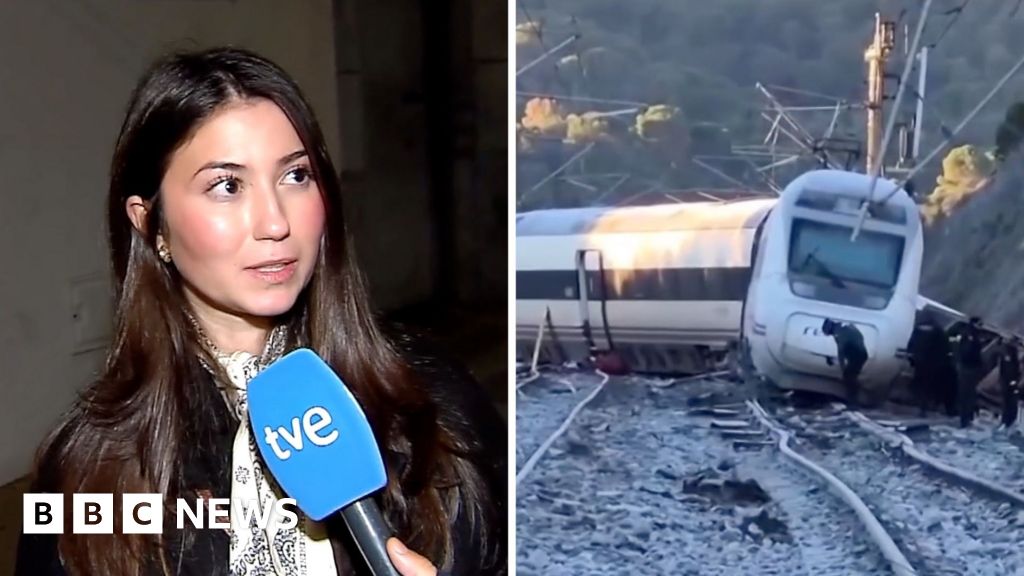
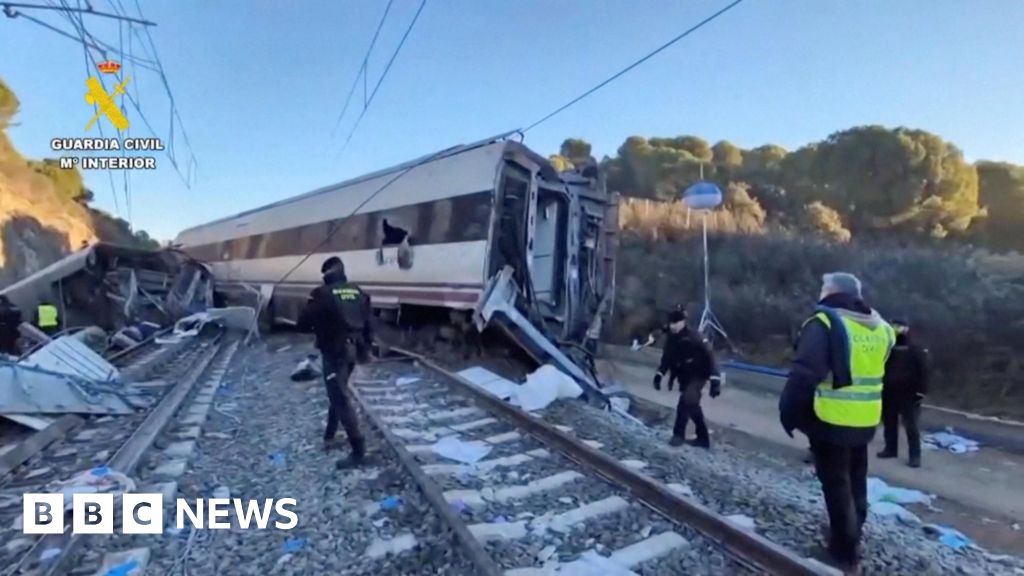
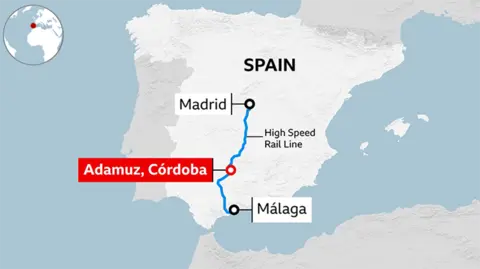
Passengers caught up in a deadly train crash in Adamuz have described the moment a Madrid-bound train derailed and crossed over to neighbouring tracks, colliding with an oncoming train.
Survivors told of people and their belongings being “scattered” around the carriage, and described an “absolutely terrifying” scene.
At least 39 people were killed in the high-speed crash at 19:45 local time (18:45 GMT) on Sunday, about an hour after the train left Málaga.
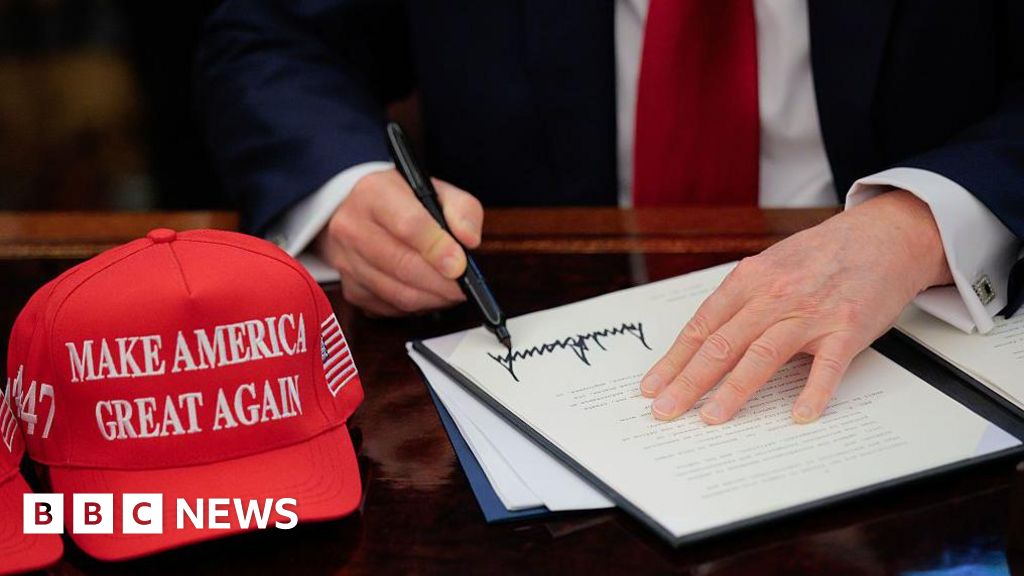
US President Donald Trump has threatened to impose fresh tariffs on eight allies that oppose his demands for control of Greenland.
Last year, he placed taxes on goods reaching the US from countries around the world, arguing the move would boost American manufacturing and create jobs.
Critics warned of higher prices and damage to the global economy.
What are tariffs and how do they work?
Tariffs are taxes on imported goods.
Typically, the charge is a percentage of a good’s value.
For example, a 10% tariff on a $10 product would mean a $1 tax on top – taking the total cost to $11 (£8.17).
The tax is paid to the government by companies bringing in the foreign products.
These firms may pass some or all of the extra cost on to their customers, which in this case means ordinary Americans and other US businesses.
They may also decide to import fewer goods.
Why is Trump using tariffs?
Trump says tariffs increase the amount of tax raised by the government, encourage consumers to buy more American-made goods and boost investment in the US.
He wants to reduce the US trade deficit – the gap between the value of goods it buys from other countries and those it sells to them.
The president argues that the US has been exploited by “cheaters” and “pillaged” by foreigners.
Trump has also used tariffs to make other demands.
He has threatened fresh tariffs of 10% on the UK, Denmark, Norway, Sweden, France, Germany, the Netherlands, and Finland, because they oppose a US takeover of Greenland. Trump said the tariffs would be in place by 1 February and would rise to 25% by 1 June.
When announcing tariffs against China, Mexico and Canada, he said the countries must do more to stop migrants and the illegal drugfentanyl reaching the US.
Many tariffs have been amended or delayed after being announced.
Why has the Supreme Court been considering the legality of Trump’s tariffs?
Trump’s tariffs have faced numerous legal challenges.
Instead of getting Congressional approval, the Trump administration used the 1977 International Emergency Economic Powers Act. Declaring an emergency under the law meant Trump could issue immediate orders and bypass Congress.
The White House asked the US Supreme Court to overturn that decision. A ruling is expected in the coming weeks.
Trump has posted on social media that it would be a “complete mess” if the Supreme Court struck down his tariffs, and warned of difficulties if businesses were told they could claim refunds.
“It would take many years to figure out what number we are talking about and even, who, when, and where, to pay,” Trump said.
What are Trump’s tariffs on countries?
Negotiations are continuing with a number of countries, including America’s top three trading partners.
China, Canada and Mexico were all warned that they faced particularly high tariffs:
Mexico is facing 30% tariffs on its goods, plus the sector-specific levies and a 25% fentanyl tariff. However, like Canada, most of its goods are exempt under the USMCA. The tariffs were put on hold until the end of October to allow time to strike a deal. On 27 October, Mexican President Claudia Sheinbaum said she and Trump had agreed to extend this deadline by “a few more weeks”. Talks are ongoing
A patchwork of different rates is in place for other countries.
Many of these stem from Trump’s announcement in April 2025 that a “baseline” of 10% would apply to imports from all countries. Nations considered the “worst offenders” would face higher rates, as payback for unfair trade policies.
New tariff rates for dozens of countries were subsequently introduced in August, after delays to allow for trade talks.
The extra tariff on goods from Denmark, Norway, Sweden, France, Germany, the UK, the Netherlands and Finland would come into force on 1 February, but could later rise to 25% – and would last until a deal was reached.
The 10% rate applies to the first 100,000 UK vehicles exported every year – roughly the number of cars sold in 2024. Additional vehicles face the standard 25% tariff.
The agreement also lets the two countries sell beef to each other. Some US ethanol will face 0% tariffs, instead of 19%.
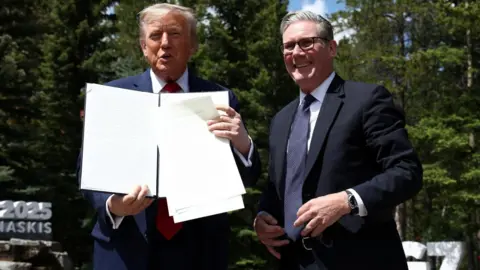
Trump announced “the deal was done” in June, but did not confirm the expected removal of all charges on steel imports from the UK.
The UK is the only country which does not face 50% tariffs on steel and aluminium. It pays 25% instead.
The BBC understands the plan to eliminate tariffs on UK steel exports entirely has now been put on hold.
However, speaking to reporters ahead of his second state visit to the UK in September, Trump said he was “into helping” Britain fine-tune the deal.
Which goods are affected by Trump’s tariffs?
Some taxes announced by Trump are on particular products, wherever they are made.
These include:
Reuters
The US is the biggest importer of steel in the world after the EU, with most coming from Canada, Brazil, Mexico and South Korea
In addition, Trump ended an exemption for imports valued at $800 (£592) or less.
It means low-cost goods are no longer duty-free – a move affecting millions of packages sent every day, including those from online retailers like Shein and Temu.
The companies shipping the parcels now have to pay duties based on the tariff rate which applies to the country the goods were sent from. Otherwise, for six months, they can choose to pay a fixed fee of between $80 and $200 per package.
The government had alleged that certain Italian-made goods were being sold at “less than normal value” in the US, undercutting local producers, but reduced the level of the tariffs after what it called constructive engagement with the firms in question.
It forecast global growth of 3.2% for 2025, and 3.1% in 2026. That was a slight increase from its July predictions, but still below the 3.3% it had projected for both years before Trump’s measures were announced.
It thinks the US economy will grow by 2% in 2025, and 2.1% in 2026. That’s down from the 2.8% growth recorded in 2024, but still the fastest among the world’s most advanced economies.
The economy grew at an annual rate of 4.3%, up from 3.8% in the previous quarter. That was better than expected, and marked the strongest growth in two years.
Imports – which count against growth – continued to decline during the period.
Watch: At the scene of Spain’s worst rail disaster in over a decade
Spanish Prime Minister Pedro Sanchez has promised to get to the bottom of why two high-speed trains collided in southern Spain killing at least 40 people, as rescuers continue to search the wreckage.
After visiting the site of the crash, Sanchez also announced three days of national mourning for victims.
More than 120 more people were injured as carriages on a Madrid-bound train derailed and crossed over to the opposite tracks, colliding with an oncoming train in Adamuz on Sunday evening.
The crash is the worst the country has seen in more than a decade.
Rail network operator Adif said the collision happened at 19:45 local time (18:45 GMT) on Sunday, about an hour after one of the trains left Málaga heading north to Madrid, when it derailed on a straight stretch of track near the city of Córdoba.
The force of the crash pushed the carriages of the second train into an embankment, according to Transport Minister Óscar Puente. He added that most of those killed and injured were in the front carriages of the second train, which was travelling south from Madrid to Huelva.
Rescue teams said the twisted wreckage of the trains made it difficult to recover people trapped inside the carriages.
Sanchez visited the site of the crash with senior officials on Monday afternoon.
“This is a day of sorrow for all of Spain, for our entire country,” he told reporters.
“We are going to get to the truth, we are going to find the answer, and when that answer about the origin and cause of this tragedy is known, as it could not be otherwise, with absolute transparency and absolute clarity, we will make it public.”
Puente said an investigation could take at least a month, describing the incident as “extremely strange”.
Reuters
Rescuers are still searching the wreckage at the crash site
EPA
Pedro Sánchez travelled to Spain to pay tribute to the people killed
But Reuters news agency quoted an unnamed source briefed on initial investigations as saying experts had found a faulty joint on the rails, which was causing a gap between rail sections to widen as trains travelled over it. They added that the joint was key to identifying the cause of the accident.
Spain’s El País newspaper said it was not clear whether the fault was a cause or a result of the crash.
Four hundred passengers and staff were on board the two trains, the rail authorities said. Emergency services treated 122 people, with 41, including children, still in hospital. Of those, 12 are in intensive care.
Puente said the death toll “is not yet final”. Officials are working to identify the dead.
The type of train involved in the crash was a Freccia 1000, which can reach top speeds of 400 km/h (250 mph), a spokesperson for the Italian rail company Ferrovie dello Stato told Reuters.
Salvador Jimenez, a journalist with RTVE who was on one of the trains, said the impact felt like an “earthquake”.
“I was in the first carriage. There was a moment when it felt like an earthquake and the train had indeed derailed,” Jimenez said.
Footage from the scene appears to show some train carriages had tipped over on their sides. Rescue workers can be seen scaling the train to pull people out of the lopsided train doors and windows.
A Madrid-bound passenger, José, told public broadcaster Canal Sur: “There were people and screaming, calling for doctors.”
All high-speed services between Madrid and the southern cities of Malaga, Cordoba, Sevilla and Huelva have been suspended until Friday.
Watch: Footage inside Spanish train as passengers evacuate from crash
King Felipe VI and Queen Letizia said they were following news of the disaster “with great concern” and offered their “most heartfelt condolences”.
The emergency agency in the region of Andalusia urged any crash survivors to contact their families or post on social media that they are alive.
The Spanish Red Cross has deployed emergency support services to the scene, while also offering counselling to families nearby.
Miguel Ángel Rodríguez from the Red Cross told RNE radio: “The families are going through a situation of great anxiety due to the lack of information. These are very distressing moments.”
In 2013, Spain suffered its worst high-speed train derailment in Galicia, north-west Spain, which left 80 people dead and 140 others injured.
Spain’s high-speed rail network is the second largest in the world, behind China, connecting more than 50 cities across the country. Adif data shows the Spanish rail is more than 4,000km long (2,485 miles).