
Category: Uncategorized

  • Who is Cilia Flores, Venezuela’s first lady captured by the US?

    Who is Cilia Flores, Venezuela’s first lady captured by the US?


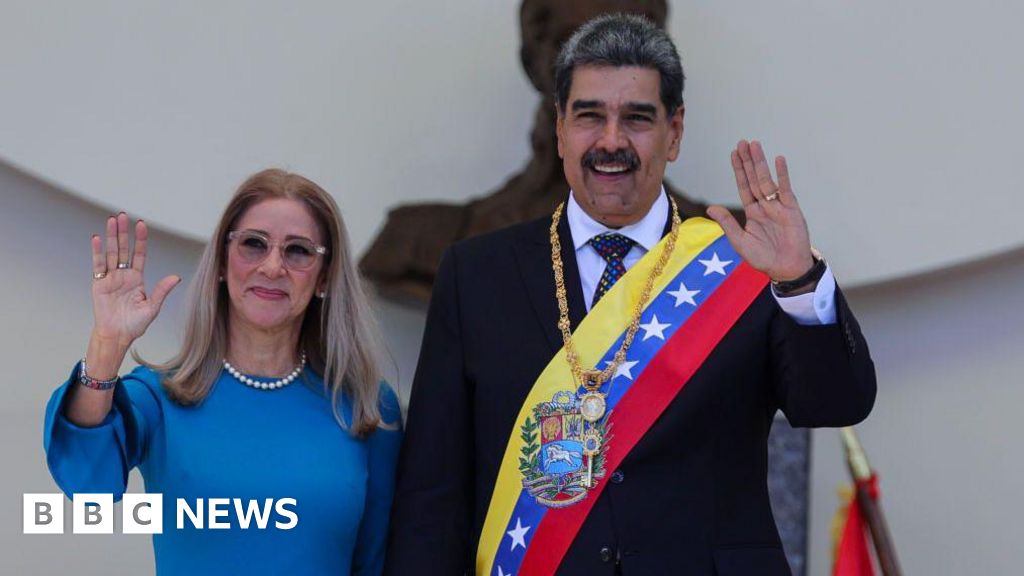
    Getty Images Flores and Maduro waving to a crowdGetty Images

    When US forces conducted a night raid on the Venezuelan capital Caracas, they didn’t just drag President Nicolás Maduro from his compound and put him on a boat to New York – they took his wife too.

    Cilia Flores, 69, has long been seen as one of the most powerful figures in Venezuela, a political operator in her own right who for decades has shaped the country’s fortunes.

    After years leading Venezuela’s National Assembly, she helped consolidate her husband’s grip on power after his 2013 presidential election victory.

    As First Lady, she was dubbed “First Warrior” by Maduro. But in that role she publicly took a backseat – presenting a more family-oriented face to what critics say was a brutal regime.

    She hosted a TV show, Con Cilia en Familia, and made occasional appearances on state television to dance salsa with her husband. But behind-the-scenes, she is thought to have been one of Maduro’s key advisers, and an architect of his political survival.

    Flores has faced allegations of corruption and nepotism, and in recent years her family members have been found guilty in US courts of cocaine smuggling.

    She will now face drug trafficking and weapons charges in a New York court, along with her husband.

    Flores met Maduro in the early 1990s, when – as a young up-and-coming lawyer – she took on the defence of the plotters of the failed 1992 coup attempt.

    Chief among them: Hugo Chávez, the man who would later become president.

    It was during those years that she met Maduro, who at the time was working for Chávez as a security guard.
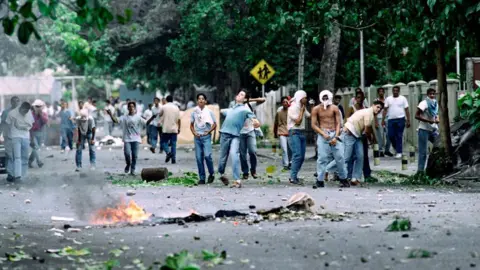
    AFP via Getty Images Students from a western Caracas technical school confront police on June 10, 1992 during anti-government riots.AFP via Getty Images

    Months of unrest followed Venezuela’s failed 1992 coup, which saw a number of military commanders, including Hugo Chávez, imprisoned

    “I met Cilia in life,” Maduro recounted. “She was the lawyer for several imprisoned patriotic military officers. But she was also Commander Chávez’s lawyer and, well, being Commander Chávez’s lawyer in prison… tough.”

    “I met her during those years of struggle, and then, well, she caught my eye.”

    From then, both their fates became linked to Chávez and his political movement, known as Chavismo.

    After Chávez won the presidency in 1998, Flores quickly rose through the political ranks, joining the National Assembly in 2000 and becoming its leader in 2006.

    For six years she led a virtually one-party parliament, with the main opposition parties refusing to participate in elections, saying they were not free and fair.

    When Chávez died in 2013, Flores threw her weight behind Maduro, who narrowly won the subsequent presidential election.
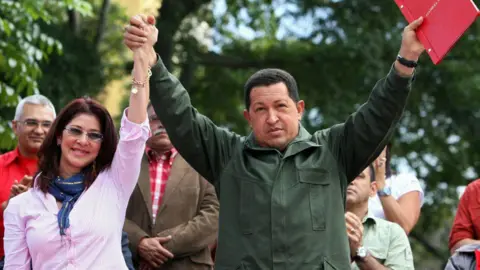
    AFP via Getty Images Venezuelan President Hugo Chavez (R) holds up the minutes of the constitutional amendment handed in by the president of the National Assembly Cilia Flores (L).AFP via Getty Images

    Flores remained close with Chávez until his death in 2013

    Months later the pair married, formalising a years-long relationship in which they’d lived together, raising children from previous relationships: three of hers and one of his.

    “She became a critical piece in Maduro’s regime,” said José Enrique Arrioja, a Venezuelan journalist and managing editor of Americas Quarterly.

    “She was not only the emotional confidant of Maduro, but the professional confidant too. And she was very power-driven.”
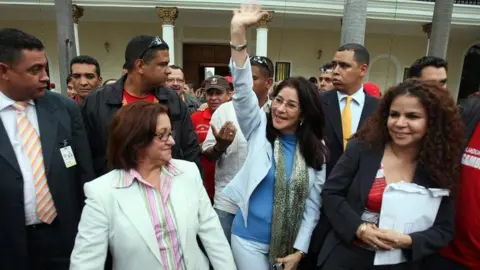
    Getty Images Flores with colleagues waving to a crowdGetty Images

    As president of the National Assembly, Flores was one of the most powerful figures in Venezuela

    Across her career, she has faced numerous allegations of corruption.

    In 2012, she was accused by unions of nepotism for influencing the hiring of up to 40 people, including numerous members of her family.

    “My family came here and I am very proud that they are my family. I will defend them,” she responded.

    In November 2015, she became embroiled in the “Narco nephews” case, when two of her nephews – Francisco Flores de Freitas and Efrain Antonio Campo Flores – were arrested in Haiti in a sting operation by the US Drug Enforcement Administration (DEA).

    They were caught trying to smuggle 800kg of cocaine into the US.

    Flores accused US authorities of having “kidnapped” her nephews – but a judge sentenced the two men to 18 years in prison for drug trafficking. They were returned to Venezuela in 2022 as part of a prisoner swap under the Biden administration.

    But last month, the Trump administration announced fresh sanctions on the two nephews – as well as a third nephew, Carlos Erik Malpica Flores – with US Treasury Secretary Scott Bessent saying: “Nicolás Maduro and his criminal associates in Venezuela are flooding the United States with drugs that are poisoning the American people.”

    “Treasury is holding the regime and its circle of cronies and companies accountable for its continued crimes,” he added.

    The newly unsealed indictment against Flores accuses her – among other things – of accepting hundreds of thousands of dollars in bribes in 2007 to arrange a meeting between “a large-scale drug trafficker” and the director of Venezuela’s National Anti-Drug Office.

    “To her detractors, she is seen as part of a deeply corrupt, human-rights-abusing and brutal government,” says Christopher Sabatini, Senior Fellow and Chatham House’s Latin America programme.

    “She was a power behind the throne,” he adds. “But like any good power behind the throne, you really didn’t see her hand that much, so no one really knew how powerful she was.”

    She is expected in court on Monday.

    Additional reporting by BBC Mundo


    Source link

  • Mourners gather at mass for Swiss bar fire victims

    Mourners gather at mass for Swiss bar fire victims


    Sarah RainsfordSouthern and Eastern Europe correspondent, Crans Montana

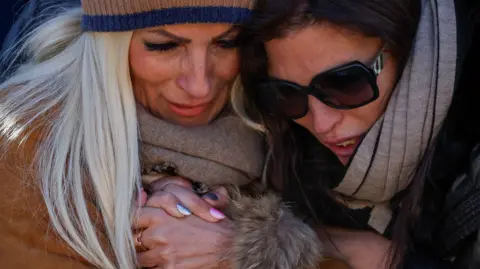
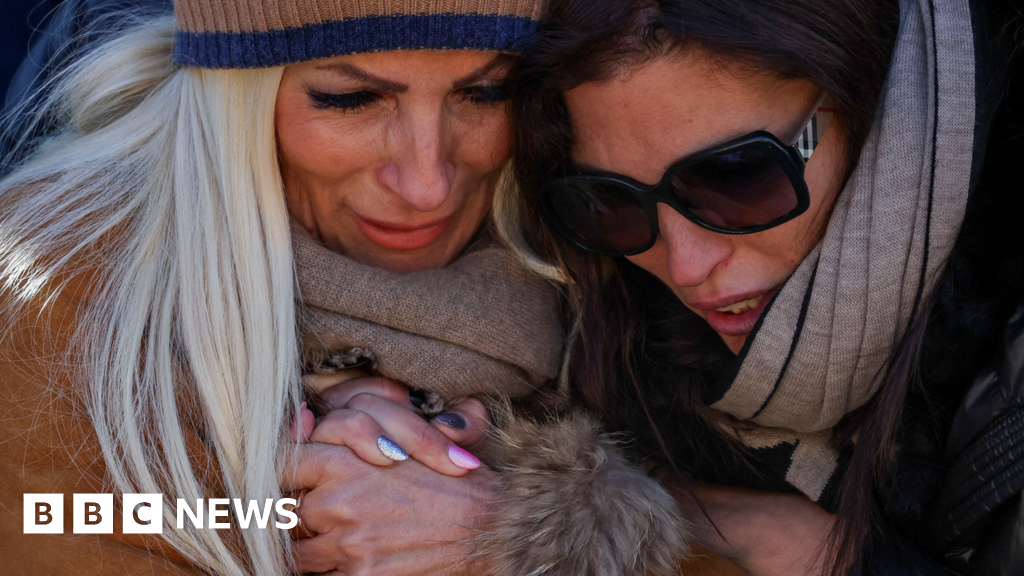
    Reuters Women hold hands at a makeshift memorial outside the Le Constellation barReuters

    Laetitia Brodard, whose teenage son Arthur died in the fire, was comforted by friends

    In the snow-dusted street outside St Christopher’s Church, hundreds joined a special Sunday Mass for the victims of the fire that tore through Le Constellation bar on New Year’s Eve.

    Many hugged each other, crying quietly, as they remembered the dozens killed and those still in hospital with severe burns, fighting for their lives.

    During the service, several in the crowd fainted and fell to the ground, overcome.

    All 40 of the dead have now been identified, although not named publicly. Their bodies are being returned to their families, some of whom who had been holding on to the hope their children might yet be found – injured, but alive.

    They’re now receiving the worst possible news.

    Ever since the fire, Laetitia Brodard had been posting pictures of her teenage son Arthur online and appealing for help to find him. On Sunday, she was at the memorial service, being comforted by friends.

    “He died that first day,” Laetitia confirmed to me.

    In an emotional statement on Facebook, she said that Arthur had “gone to party in paradise”.

    The victims’ bodies were so badly burned by the fire they are difficult to identify. Even some of those injured and in hospitals haven’t been named yet – they remain unconscious and unrecognisable.

    For the dead, forensics experts are having to use DNA samples and dental records, and for the families the wait is agonising.

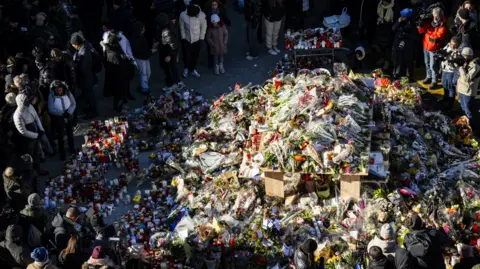
    EPA Mourners gather around flowers and candles to commemorate the victims of the fire at the "Le Constellation" barEPA

    Mourners gathered around a shrine of flowers and candles

    The bar was packed full of young people that night, many of them just teenagers. The drinking age in Switzerland is 16.

    Some of the survivors joined a silent procession after the Sunday Mass from the church towards the bar itself. Above, in the stunningly beautiful Swiss Alps, cable cars went on sliding up the mountain carrying tourists to ski.

    The site of the fire is still screened off behind white plastic sheets, but in front of it are heaps of flowers and soft toys at a shrine that keeps growing.

    Among the bouquets, there are handwritten notes with names and photographs.

    At one point, the crowd burst into applause: a large group of firefighters and rescue workers in uniform had reached the memorial and stood arm in arm, sobbing for those they couldn’t save.

    For the people of Crans, they are heroes.

    The local fire commander – who considered leaving his job after what he experienced here – told us he and his colleagues were now a giant family.

    “I need them, and they need me,” David Vocat said, very tearful. “All my thoughts are for the victims and their families. I am so sorry.”

    We’ve spoken to teenagers who saw people running from the burning bar and describe horrific scenes they say they can never forget.

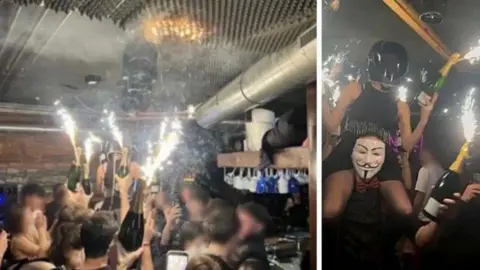
    SUPPLIED Video from inside the bar appears to show the moment the ceiling covering caught fire

SUPPLIED

    Video from inside the bar appears to show the moment the ceiling covering caught fire

    A criminal investigation has now been opened. The bar owners, a French couple, are suspected of killing and causing arson and bodily harm through negligence.

    Police and prosecutors have been examining images filmed inside Le Constellation that show the moment the fire started, with bar staff carried on others’ shoulders, delivering champagne bottles with sparklers attached.

    The sparks appear to set fire to the ceiling, which was covered with foam for soundproofing, and the flames spread very quickly.

    Investigators will examine whether the foam and other materials met safety standards.

    They will look into possible overcrowding, access to emergency exits from the basement and whether there were fire extinguishers.

    Some videos show teenagers trying, hopelessly, to put the fire out with their T-shirts. Initially, many didn’t realise the immense danger and went on dancing and even filming the fire, instead of fleeing.

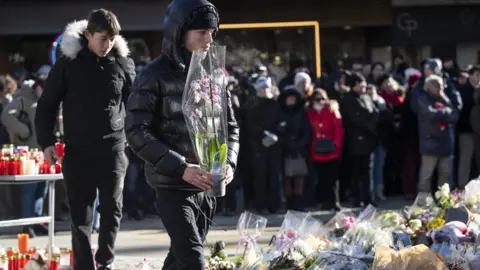
    EPA A young man in a black puffer coat takes a plant to the shrine EPA

    Teenagers have described horrific scenes they say they can never forget

    On Sunday, a group of men – some with their faces covered in black scarves – formed a semi-circle to remember one man killed at the bar which locals call “Stefi”.

    “We’re here for our colleague,” one of them said, struggling to speak. “Stefi was his final path. May he now rest in peace.”

    “It was important to be here, with the families. We can’t change things, we can only be here,” Diana said, after praying hand-in-hand with two other women for a group of friends who are still in hospital.

    “We only hope they make it.”

    “We are not angry,” Diana told me. “But we believe the police will do their work well and we hope there is justice.”


    Source link

  • At least 30 killed in Kasuwan-Daji village attack in Nigeria

    At least 30 killed in Kasuwan-Daji village attack in Nigeria


    Tiffany Wertheimer,

    Makuochi Okaforand

    BBC Hausa

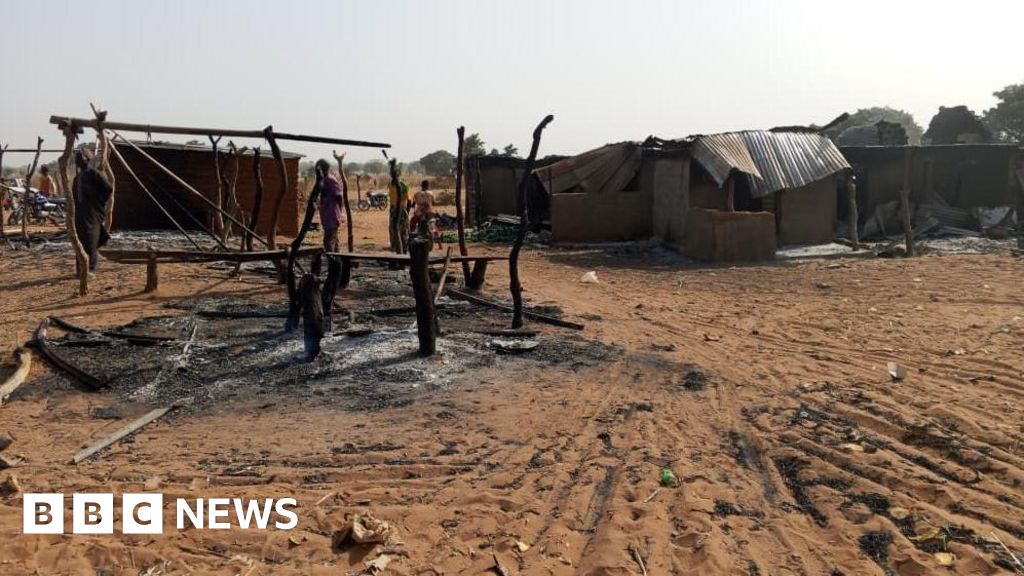
    Zakari Kontagora A remote village in red sand, with burnt out, tin-rooved buildings.Zakari Kontagora

    Bandits set fire to the village market and looted goods

    Armed men have violently stormed a village in Nigeria’s Niger state, killing at least 30 people and looting shops, state authorities have said.

    The attackers emerged from a forest near the village of Kasuwan-Daji on Saturday and set fire to the local market, looted shops and kidnapped an unspecified number of people, police said.

    “The gunmen entered the town on motorcycles carrying weapons, rounded up people and then proceeded to slaughter them, while others were shot dead,” a local journalist told the BBC’s Hausa service.

    Attacks and kidnappings by armed criminal gangs, known as bandits, have been a problem in Nigeria for years, but reports in western and central regions have spiked recently.

    Abdullahi Rofia, an official with the Niger State Emergency Management Agency, confirmed the journalist’s report that villagers were rounded up and killed.

    He told the BBC that people in the community were terrified: “They are hiding, they are too afraid to talk to anybody.

    “They are scared that if you talk, they will turn and do the same to you.”

    Niger state police spokesperson, Wasiu Abiodun, said an emergency team has been deployed to help the injured and security forces are working to rescue those kidnapped.

    It is illegal to pay ransom money to the criminal groups, which the government has classified as terrorists, but there are claims this is often ignored.

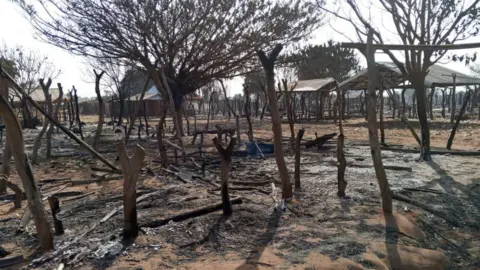
    Zakari Kontagora A burnt out village, showing blackened trees and some simple structures in the background.Zakari Kontagora

    The attack on Kasuwan-Daji is the latest is a spike of violent attacks against villages in Niger state

    A witness to the attack told BBC Hausa that there were no security forces in the village.

    “We want the government to help us. In the past, we used to hear about this problem in other places, but now it is happening in our villages,” he said.

    The fear is driving people from their homes where they were born and raised.

    “We are dying like chickens, and does the government care about us?

    “The government hears and sees what is happening, but it is not doing anything about it. What can we do as ordinary people?”

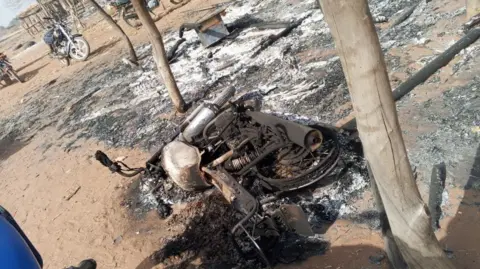
    Zakari Kontagora A burnt out motorbike lying on its side.Zakari Kontagora

    Villagers say the attacks are driving people away from the villages they grew up in


    Source link