Category: Uncategorized

  • Police identify 16 more victims of Swiss bar fire

    Police identify 16 more victims of Swiss bar fire


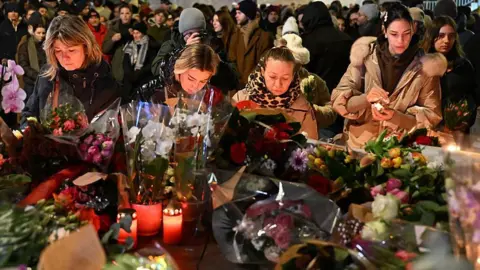
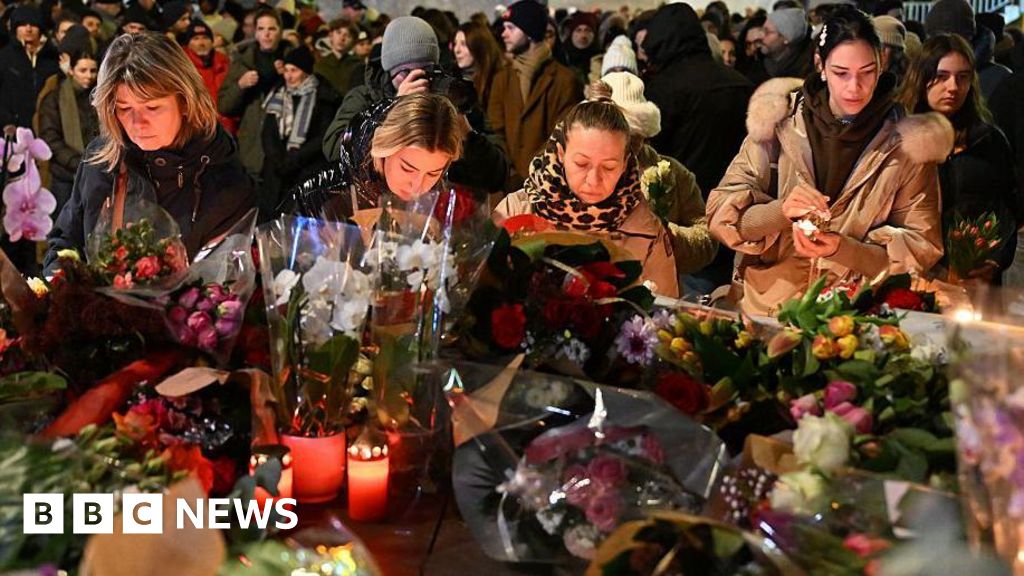
    Getty Images People gather at the scene of a deadly bar fire in Switzerland. They are stood in front of a huge pile of flowers and candles.Getty Images

    The bodies of 16 more victims of a bar fire in the Swiss ski resort of Crans-Montana have been identified by police.

    The youngest person was a Swiss girl aged 14, with nine aged under 18. The group includes people of Swiss, Italian, Romanian, Turkish and French nationalities, police said.

    This brings the number of people identified who have been killed as a result of the fire to 24, authorities said in a statement. Eight Swiss citizens were identified on Saturday.

    A criminal investigation into the people who ran Le Constellation bar is under way, while victim’s families are enduring an agonising wait for information about loved ones who are still considered missing.

    Police said no further details will be released about the victims they had identified out of respect for their relatives.

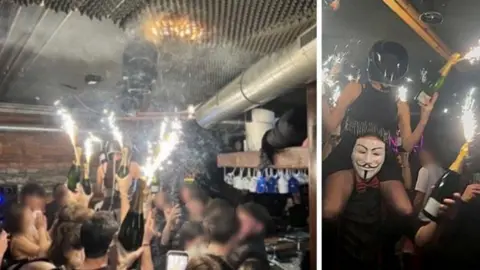
    Sparklers on bottles being carried too close to the ceiling is the likely cause of the fire during New Year’s celebrations at the bar, a preliminary investigation found.

    SUPPLIED Revellers hold up botles of champagne in a barSUPPLIED

    Video from inside the bar appears to show the moment the ceiling covering caught fire

    The devastating fire killed at least 40 people and injured 119 others.

    Many of the dead and missing are teenagers. Le Constellation was a venue known to be popular with a younger crowd in the ski resort town, where the drinking age is 16.

    The eight identified and returned to their families on Saturday were all aged between 16 and 24, Swiss authorities said.

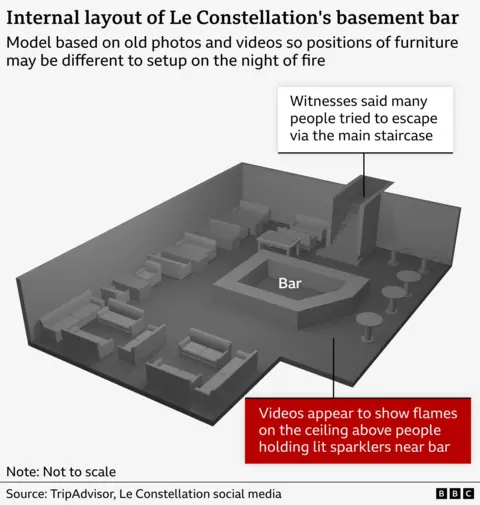
    A 3D model showing the internal layout of Le Constellation’s basement bar, based on older photos and videos. It shows one staircase leading down to the basement, which is labelled as witnesses saying people tried to escape via the main staircase, and a large bar in the middle of the room. There are various sofas, chairs and tables in the space but the exact configuration that was in place on the night of the fire in unknown. A red label shows where the fire is thought to have broken out, close to the bar and the staircase.

    On Saturday, the Italian ambassador to to Switzerland, Gian Lorenzo Cornado, said the identification process was slow because of the severity of the burns many victims had suffered.

    The French couple who own the bar – named by the media as Jacques and Jessica Moretti – are suspected of manslaughter by negligence, bodily harm by negligence and arson by negligence, the prosecutors’ office for the Valais region said.

    Beatrice Pilloud, Valais canton lead prosecutor, said in a statement that investigators were looking into whether the acoustic foam on the venue’s ceiling was “the cause of the problem”, as well as “whether it complies with regulations”.

    Italian media named junior golfer Emanuele Galeppini, 16, as the first identified victim of the fire following a statement from the Italian Golf Federation paying tribute to the “young athlete who carried with him passion and authentic values”.

    His father is quoted as saying his son was at Le Constellation. A spokesperson for the Italian foreign ministry previously told the BBC it would not confirm the death.


    Source link

  • International aid groups grapple with what Israel’s ban will mean for their work in Gaza

    International aid groups grapple with what Israel’s ban will mean for their work in Gaza


    TEL AVIV (AP) — Israel’s decision to revoke the licenses of more than three dozen humanitarian organizations this week has aid groups scrambling to grapple with what this means for their operations in Gaza and their ability to help tens of thousands of struggling Palestinians.

    The 37 groups represent some of the most prominent of the more than 100 independent nongovernmental organizations working in Gaza, alongside United Nations agencies. Those banned include Doctors Without Borders, the Norwegian Refugee Council, Oxfam and Medical Aid for Palestinians.

    The groups do everything from providing tents and water to supporting clinics and medical facilities. The overall impact, however, remains unclear.

    The most immediate impact of the license revocation is that Israel will no longer allow the groups to bring supplies into the Gaza Strip or send international staffers into the territory. Israel says all suspended groups have to halt their operations by March 1.

    Some groups have already been barred from bringing in aid. The Norwegian Refugee Council, for example, said it has not been allowed to bring in supplies in 10 months, leaving it distributing tents and aid brought in by other groups.

    Israel says the banned groups make up only a small part of aid operations in Gaza.

    But aid officials say they fulfill crucial specific functions. In a joint statement Tuesday, the U.N. and leading NGOs said the organizations that are still licensed by Israel “are nowhere near the number required just to meet immediate and basic needs” in Gaza.

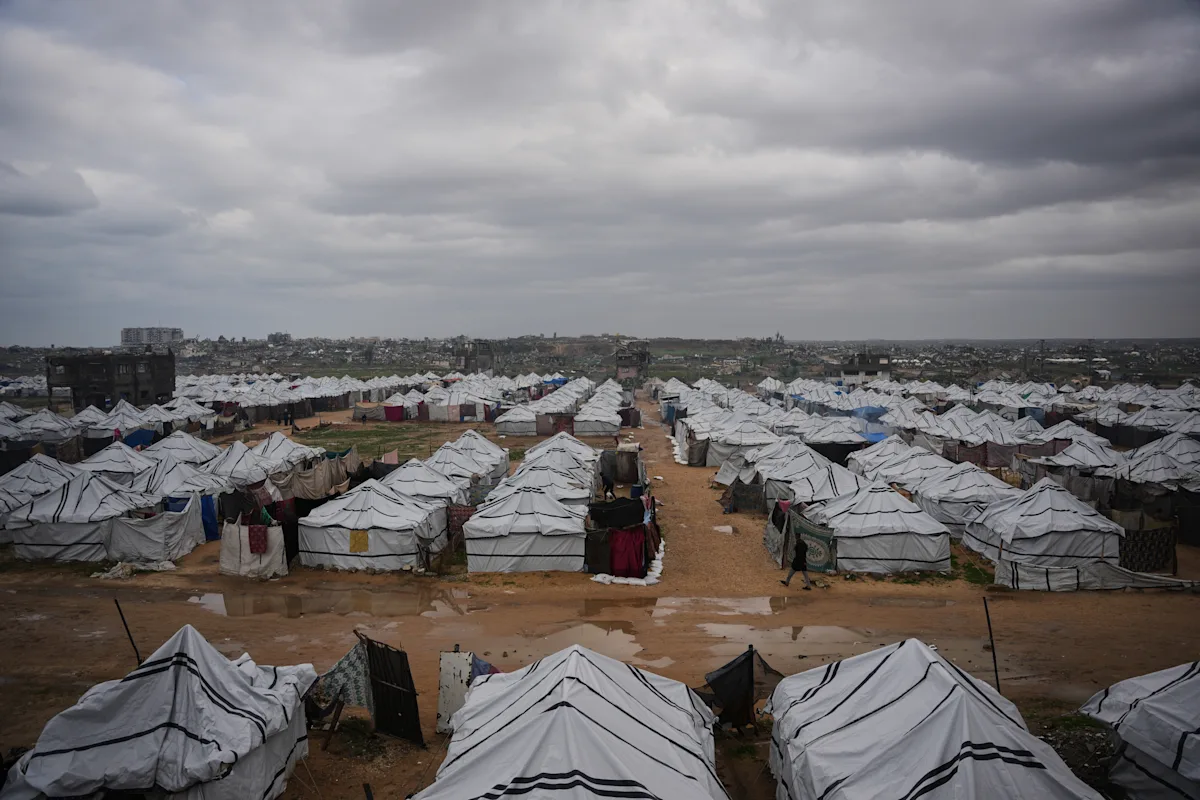
    The ban further strains aid operations even as Gaza’s over 2 million Palestinians still face a humanitarian crisis more than 12 weeks into a ceasefire. The U.N. says that although famine has been staved off, more than a quarter of families still eat only one meal a day and food prices remain out of reach for many; more than 1 million people need better tents as winter storms lash the territory.

    Why were their licenses revoked?

    Earlier this year, Israel introduced strict new registration requirements for aid agencies working in Gaza. Most notably, it required groups to provide the names and personal details of local and international staff and said it would ban groups for a long list of criticisms of Israel.

    The registration process is overseen by Israel’s Ministry for Diaspora Affairs and Combating Antisemitism, led by a far-right member of the ruling Likud party.

    Israel says the rules aim to prevent Hamas and other militants from infiltrating the groups, something it has said was happening throughout the 2-year-old war. The U.N., which leads the massive aid program in Gaza, and independent groups deny the allegations and Israeli claims of major diversion of aid supplies by Hamas.

    Aid organizations say they did not comply, in part, because they feared that handing over staff information could endanger them. More than 500 aid workers have been killed in Gaza during the war, according to the United Nations.

    Israel denies targeting aid workers. But the group say Israel has been vague about how it would use the data.

    The groups also said Israel was vague about how it would use the data.

    “Demanding staff lists as a condition for access to territory is an outrageous overreach,” Doctors Without Borders, known by its French acronym MSF, said Friday. It said Israeli officials had refused its attempts to find alternatives.

    A December report on MSF issued by an Israeli government team recommended rejection of the group’s license. It pointed primarily to statements by the group criticizing Israel, including referring to its campaign in Gaza as genocide and calling its monthslong ban on food entering the territory earlier this year as “a starvation tactic.” It said the statements violated neutrality and constituted “delegitimization of Israel.”

    The report also repeated claims that an MSF employee killed in by an Israeli airstrike in 2024 was an operative with the Islamic Jihad militant group. That, it said, suggested MSF “maintains connections with a terrorist group.”

    MSF on Friday denied the allegations, saying it would “never knowingly employ anyone involved in military activities.” It said that its statements cited by Israel simply described the destruction its teams witnessed in Gaza.

    “The fault lies with those committing these atrocities, not with those who speak of them,” it said.

    Aid groups have a week from Dec. 31 to appeal the process.

    Medical services could see biggest impact

    Independent NGOs play a major role in propping up Gaza’s health sector, devastated by two years of Israeli bombardment and restrictions on supplies.

    MSF said Israel’s decision would have a catastrophic impact on its work in Gaza, where it provides funding and international staff for six hospitals as well as running two field hospitals and eight primary health centers, clinics and medical points. It also runs two of Gaza’s five stabilization centers helping children with severe malnutrition.

    Its teams treated 100,000 trauma cases, performed surgeries on 10,000 patients and handled a third of Gaza’s births, the group says. It has 60 international staffers in the West Bank and Gaza and more than 1,200 local staff — most medical professionals.

    Since the ceasefire began in early October, MSF has brought in about 7% of the 2,239 tons (2,032 metric tonnes) of medical supplies that Israel has allowed into Gaza, according to a U.N. tracking dashboard. That makes it the largest provider of medical supplies after U.N. agencies and the Red Cross, according to the dashboard.

    Medecins du Monde, another group whose license is being halted, runs another four primary health clinics.

    Overburdened Palestinian staff

    Aid groups say the most immediate impact will likely be the inability to send international staff into Gaza.

    Foreign staff provide key technical expertise and emotional support for their Palestinian colleagues.

    “Having international presence in Gaza is a morale booster for our staff who are already feeling isolated,” said Shaina Low, communications adviser for the Norwegian Refugee Council, which is one of the main NGOs providing shelter supplies and fresh water to displaced people.

    NRC has roughly 30 international staff who rotate in and out of Gaza working alongside some 70 Palestinians.

    While any operations by the 37 groups in the West Bank will likely remain open, those with offices in east Jerusalem, which Israel considers its territory, might have to close.

    Halt on supplies

    Many of the 37 groups already had been blocked from bringing supplies into Gaza since March, said Bushra Khalidi, Oxfam’s policy lead for Israel and the occupied Palestinian territories.

    What changes with the formal license revocation is “that these practices are now formalized, giving Israel full impunity to restrict operations and shut out organizations it disagrees with,” she said.

    Some of the groups have turned to buying supplies within Gaza rather than bringing them in, but that is slower and more expensive, she said. Other groups dug into reserve stocks, pared down distribution and had to work with broken or heavily repaired equipment because they couldn’t bring in new ones.

    Amed Khan, an American humanitarian philanthropist who has been privately donating medicine and emergency nutrition for children to Gaza, said the impact extends beyond the aid groups.

    He relies on NGOs to receive and distribute the supplies, but the fewer groups that Israel approves, the harder it is to find one.

    “It’s death by bureaucracy,” he said.


    Source link

  • Donald Trump says US will ‘run’ Venezuela and ‘fix oil infrastructure’

    Donald Trump says US will ‘run’ Venezuela and ‘fix oil infrastructure’


    Watch: How the US attack on Venezuela unfolded

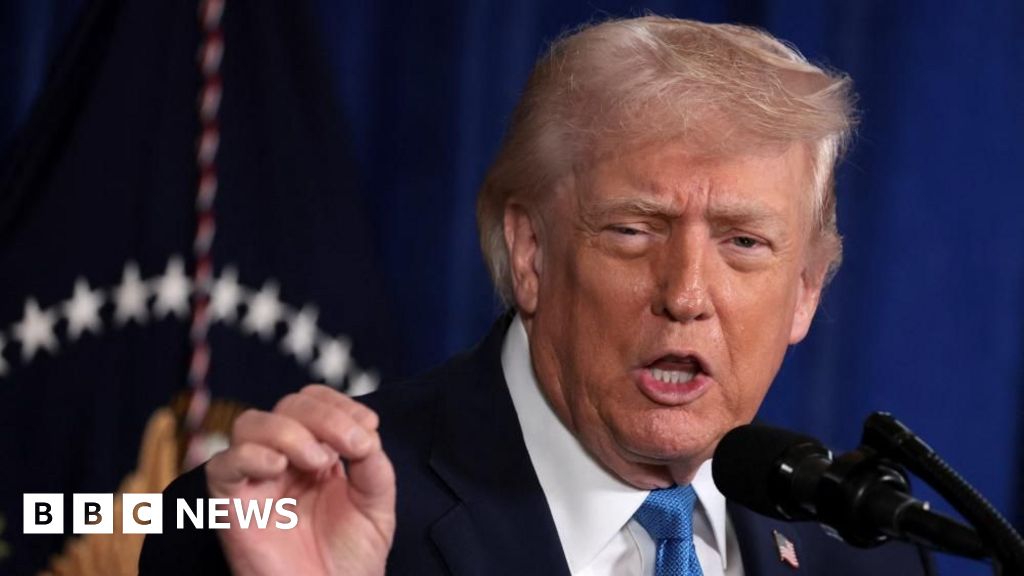
    The US will “run” Venezuela until a “safe, proper and judicious transition” can be ensured, Donald Trump has said, after US strikes led to the capture of country’s President Nicolas Maduro.

    US oil companies would also fix Venezuela’s “broken infrastructure” and “start making money for the country”, the US president said.

    The US launched strikes on Venezuela on Saturday morning in which Maduro and his wife, First Lady Cilia Flores, were captured by US forces and removed from the country.

    Venezuela announced a state of national emergency and denounced the “military aggression”, with the country’s vice president saying Maduro is its only leader.

    Maduro and Flores were flown out of the capital, Caracas, on a US helicopter in the early hours of Saturday morning and taken aboard the USS Iwo Jima at an unknown location in the Caribbean Sea.

    They were later flown to the Guantanamo Bay US Naval Base in Cuba before being transferred to another plane to head to New York state, and then flown by helicopter into New York City’s Metropolitan Detention Center in Brooklyn.

    US Attorney General Pam Bondi said Maduro and Flores had been indicted in the Southern District of New York.

    The pair have been charged with conspiracy to commit narco-terrorism and import cocaine, possession of machine guns and destructive devices, and conspiracy to possess machine guns and destructive devices against the US.

    “They will soon face the full wrath of American justice on American soil in American courts,” Bondi wrote on X.

    Previously, Maduro has vehemently denied being a cartel leader and has accused the US of using its “war on drugs” as an excuse to try to depose him and get its hands on Venezuela’s vast oil reserves.

    Trump told a news conference ahead of Maduro’s arrival in New York: “The oil business in Venezuela has been a bust, a total bust for a long period of time.

    “We’re going to have our very large United States oil companies, the biggest anywhere in the world, go in, spend billions of dollars, fix the badly broken infrastructure, the oil infrastructure, and start making money for the country.”

    The South American country has approximately 303 billion barrels’ worth of crude, accounting for about 20% of the world’s oil resources, according to the US Energy Information Administration.

    Trump on Venezuela: “We are going to run the country”

    It is unclear exactly how the US plans to “run” Venezuela, but the president said it will be a “group” of people leading the charge.

    “We’re going to be running it with a group, and we’re going to make sure it’s run properly,” Trump said.

    When pressed by reporters as to who inside Venezuela would form part of that group, Trump said US Secretary of State Marco Rubio had been talking to Delcy Rodríguez, the country’s vice-president.

    Trump said Rodríguez – who has since been named interim president by Venezuela’s Supreme Court – had expressed her willingness to do “whatever the US asks”.

    However, speaking on state TV after Trump’s remarks, Rodríguez called Maduro the “only one president in Venezuela”, adding that the government was ready to defend itself.

    Trump also said he had not spoken to Venezuela’s opposition leader, María Corina Machado, who was barred from last year’s presidential election but was instrumental in galvanising support for a rival candidate to Maduro believed to have won the poll.

    The US president said Machado “doesn’t have the support within or the respect within the country” needed to run Venezuela.

    Explosions were heard around Caracas early on Saturday morning as military bases were targeted by US forces. Over the following two hours and twenty minutes, dozens of US aircraft were seen in the skies as special forces penetrated Maduro’s safe house to retrieve him.

    Watch: Smoke, bangs and helicopters in Caracas

    Venezuela’s long-term allies strongly condemned the US actions. Russia accused the US of committing “an act of armed aggression” that was “deeply concerning and condemnable”. China’s foreign ministry said it was “deeply shocked and strongly condemns” the use of force against a sovereign country and its president.

    Many Latin American countries, including Venezuela’s neighbours, Colombia and Brazil, also condemned the actions. Cuba’s President Miguel Diaz-Canel described them as a “criminal attack”, while Trump’s ally in Argentina, Javier Milei, wrote “freedom moves forward” on social media.

    US allies were more reserved in their responses, urging a peaceful transition of power. Sir Keir Starmer said the UK “regarded Maduro as an illegitimate president” and “shed no tears about the end of his regime”, but called for a “safe and peaceful transition to a legitimate government”.

    The EU’s top diplomat Kaja Kallas and France’s president Emmanuel Macron offered similar sentiments calls for peace. A new government must be “respectful of the will of the Venezuelan people”, Macron wrote in a post on X.

    German Chancellor Friedrich Merz said the legality of the US operation was “complex” and warned that “political instability must not be allowed to arise in Venezuela”.

    The taking of Maduro is the culmination of an escalating pressure campaign against his government by the Trump administration over the past 12 months that has included sanctions and placing a large naval force in the region.

    Since September, the US has launched more than 30 strikes on what it says are boats being used for drug trafficking in the Pacific and the Caribbean, killing more than 100 people.

    The Trump administration has described the strikes as attacks against terrorists attempting to bring fentanyl and cocaine to the US, however it has provided no evidence for this claim.

    With the exception of two survivors – a Colombian and an Ecuadorean national – none of the identities of those aboard have been made public.

    Earlier this week, the conflict escalated further when the US carried out a strike on a “dock area” linked to alleged Venezuelan drug boats.

    Fentanyl is produced mainly in Mexico and reaches the US almost exclusively via land through its southern border.

    Counter-narcotic experts have also described Venezuela as a relatively minor player in global drug trafficking, mainly acting as a country through which drugs produced elsewhere are smuggled.


    Source link