You must have heard of Dubai chocolate: the sticky, indulgent confectionary filled with pistachio cream, tahini and shreds of knafeh pastry, which has become a global sensation.
Now the decadent bar has inspired South Korea’s latest dessert craze. The Dubai chewy cookie has been selling like wildfire – and even restaurants that don’t usually offer baked goods are trying to get a nibble of the market.
Despite its name, the cookie’s texture more closely resembles a rice cake, and is made by stuffing pistachio cream and knafeh shreds into a chocolate marshmallow.
Shops are selling hundreds of cookies within minutes and the frenzy has sent prices of key ingredients surging, local media reported.
This South Korean twist on the viral Dubai dessert first took off last September, after Jang Won-young from the girl band Ive posted a photograph of the chewy cookie on Instagram.
While they currently sell for between 5,000 ($3; £2.5) and 10,000 won, prices are expected to climb due to strong demand.
And apart from dessert shops and bakeries, other restaurants – from sushi bars to cold-noodle shops – are now offering the dessert.
Local convenience store chain CU launched its Dubai chewy rice cake in October, and has sold some 1.8 million pieces of it in the last few months.
“Our manufacturing plant’s production capacity cannot keep up with demand,” a company representative told Yonhap News.
So obsessed are the South Koreans with the cookie that someone even created a map that tracks shops selling the dessert, as well as their stock levels, in real time.
Some stores have started imposing limits on how many cookies each customer can buy. The trend has also sparked online chatter among gig workers on whether hardware stores and cleaning companies should also start cashing in on Dubai chewy cookies, The Korea Herald reported.
Such demand has driven up the price of pistachios, with local media reporting that a major supermarket chain has raised prices by 20% this year.
Counterfeits have also emerged, spurring some consumers to call them out in their online reviews.
“I bought two for 11,000 Korean won, but there’s no knafeh, and the exterior isn’t marshmallow. It’s heartbreaking,” wrote one, in a review quoted by The Chosun Daily.
Several food critics say the Dubai chewy cookies have taken off in South Korea because of how thick and dense they are.
“It reflects Korean food culture, where visual overwhelmingness matters more than balance or harmony of ingredients and flavours,” food critic Lee Yong-jae told The Chosun Daily.
Ukraine’s “Invincibility Trains” run their diesel engines to provide relief and boost morale
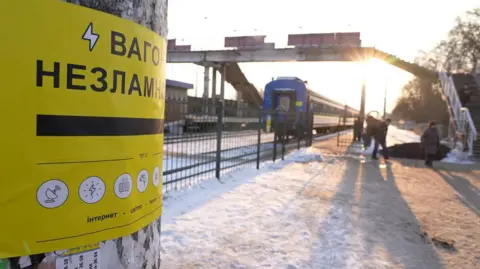
At a suburban Kyiv railway station, two carriages painted in the blue and white livery of Ukrainian Railways sit on the main platform, their diesel engines running as snow steadily falls. The train is not going anywhere but it is providing a vital service for dozens of people who have been left without power and basics like running water or heating.
These are Ukraine’s “Invincibility Trains”, designed to boost public morale and provide some comfort as a bitter winter coincides with intensifying Russian attacks.
In one of the carriages, Alina sits watching her infant son Taras playing with toys provided by international charities who help run the service.
“It’s winter and it’s rather cold outside,” says Alina which is something of an understatement. With the effect of the wind-chill, temperatures this week in Kyiv have hit -19C. It is bitterly cold.
“I live in a new building on the 17th floor, but we have no elevator, no electricity and no water supply,” says Alina. As Taras plays with his toys, she says it is also a relatively safe and comfortable place for her daughter to meet friends.
It is also a welcome distraction for Alina, whose husband works all day in a factory, but she suddenly starts to stutter and weep as she tells me about her 54-year-old father who was killed at the front two years ago in a summer offensive near Bakhmut.
As she regathers her composure, Alina says she will definitely come back here and welcomes the relief the train brings from the weather and the nightly Russian strikes.
For Alina and Taras, the train is a distraction from the hardship of daily life
Ukraine’s President Volodymyr Zelensky has accused Russia of deliberately exploiting the bitter winter to target power stations, energy storage facilities and other critical infrastructure. Kyiv’s Mayor, Vitali Klitschko, somewhat controversially this week also suggested that city residents, who could, should leave Kyiv to help ease pressure on critical resources.
It was a comment seized upon by Russia as a sign of resignation and defeatism.
But despite such obvious hardships, most people here in Kyiv remain stoic and are prepared to put up with them.
For Yulia Mykhailiuk, Ihor Honcharuk and their one-year-old son Markiian, that means heating building bricks on a gas stove to try to warm up the rest of their small apartment.
The flat, in an old Soviet-era apartment block on the east side of the Dnipro river, is a temporary move because their own home was partially damaged in a Russian attack last August.
“We’ve had electricity today for something like four minutes,” Ihor tells me. “All of our charging stations and power banks have no energy left in them.”
“For the first time in a while we have a real winter in Ukraine,” says Yulia somewhat ironically. “With this -12 to -16 cold and no heating, the apartment gets cold pretty soon.”
Ihor and Yulia say they will leave Kyiv temporarily because of the energy crisis
The large batteries the couple have bought, like many city residents, to charge up when electricity does return are of no use when it comes to heating appliances because they run down so quickly.
For now, dressing the baby up in multiple layers of clothing is the only solution, but Yulia says at the weekend they will heed Mayor Klitschko’s call and temporarily move away from Kyiv to her parents’ home outside the city, although she says it’s a decision they have made for themselves and not because of pressure from the mayor’s office.
The energy crisis is not the only reason to move. Just across the courtyard from their new, temporary home, a recent Russian drone strike hit an apartment block, badly damaging several homes.
Kyiv’s problems are exacerbated by the fact it has borne so many Russian airstrikes against homes and critical infrastructure installations and, as home to more than three million people, the power shortages impact many people.
The most recent Russian attacks against energy installations in the capital and other big cities have had a cumulative effect that is much worse than before.
Klitschko said strikes on Monday night had caused the worst electrical outage the city had yet seen, and on Tuesday more than 500 residential buildings were still without power.
“Compared to all previous winters, the situation now is the worst,” Olena Pavlenko, president of the Kyiv-based think tank DiXi Group, told the Kyiv Independent website.
“Every time it’s harder to recover. Everything is under ice, and repairs of cables and grids are now two to four times more complicated,” she said.
Engineers are working to locate and repair damaged cables
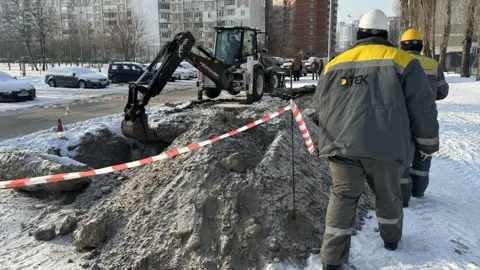
Around the clock and across the city, engineers from private energy companies and the municipal authority are repairing power plants hit directly in Russian strikes or installations indirectly affected by them.
On another bitterly cold morning we found hardy engineers using mechanical diggers and working with their bare hands to locate and repair damaged power cables which serve the huge multi-occupancy tower blocks on the river’s east bank.
The city authorities have repeatedly asked people and business not to use high-energy consumption devices because they use so much power, and when the electricity supply returns, the surge in demand for power causes the system to collapse – hence the damaged power cables we saw being repaired.
But the engineer in charge here acknowledged it was a temporary fix.
“It will take years and years. We are currently working literally in emergency modes,” says Andrii Sobko from Kyiv Electric Networks. “The equipment is literally operating at its critical parameters so that at least the residents have light.”
As the war drags on, it’s hard to find anyone in Ukraine who has not been directly impacted by the conflict.
Kyiv is enduring its fourth winter since Russia’s full-scale invasion began
Stanislav or “Stas” has also come down to the Invincibility Train to get warm, meet friends and get some power for his phone. The eleven-year-old says his home is very cold and there’d recently been no power in the family’s apartment for 36 hours.
He recalls with clarity the opening day of the war almost four years ago when he could see bright flashes in the sky – a “bright orb” – as Russia launched its attacks.
These days it is the threat of Russian drones that keeps him awake at night.
“When I hear something flying it’s really scary, because you don’t know if it will explode now, or if it will fly on and you survive.” As we perch on the top bunk of the carriage where he is sitting with another friend, Stas is frank about the impact of the war on his generation.
“I forget the times when there was no war, I don’t remember those moments – life is difficult,” says Stas, his smile wide and demeanour remarkably bubbly.
There are all kinds of people seeking warmth, comfort or company on the train. But my next conversation with an elderly lady, who says her discomfort is nothing compared with what soldiers on the front are enduring, is abruptly cut short as the familiar high-pitched sound of an air raid alert rings out on our phones.
The conductor orders everyone off the train and directs them to a shelter, about a kilometre away. Most head home instead, to the cold and their interrupted power supplies but all – including Stas and Alina – say they’ll be back tomorrow.
Everyone in Kyiv is putting a brave face on things.
This extraordinarily cold winter, even by Ukrainian standards, will not last for much more than a couple of months and the energy crisis will ease. What most people fear is that, despite some optimism at the end of last year, there is no end in sight to the war itself and the inevitable loss of life.
Additional reporting by Firle Davies and Mariana Matviechuk.