Category: Uncategorized

  • Finnish police seize ship suspected of sabotaging undersea telecoms cable

    Finnish police seize ship suspected of sabotaging undersea telecoms cable


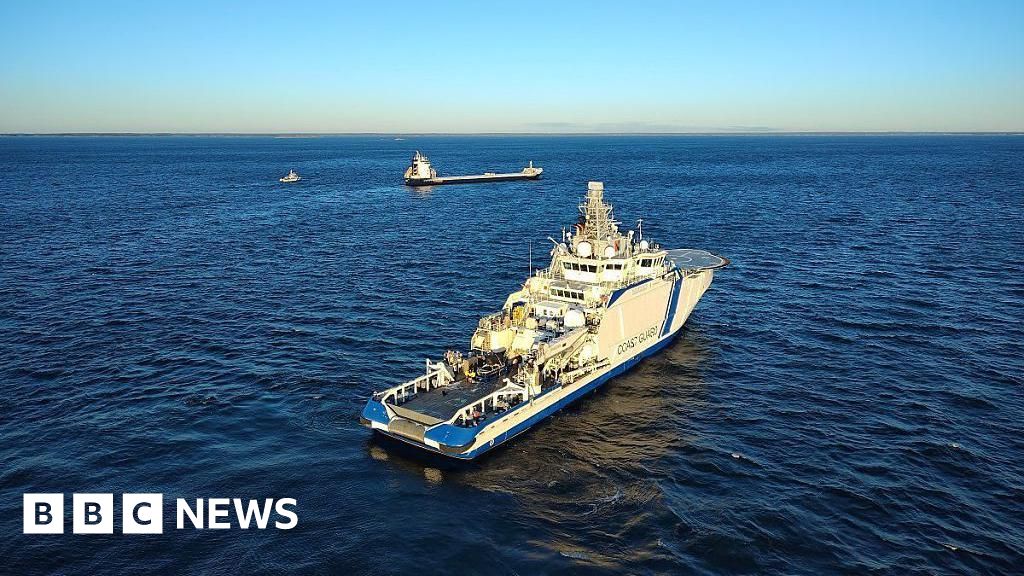
    Finnish police have detained a vessel suspected of damaging an undersea telecoms cable running from Helsinki to Estonia across the Gulf of Finland.

    The cargo vessel, the Fitburg, was sailing from St Petersburg to the port of Haifa in Israel, under the flag of St Vincent and Grenadines.

    All 14 crew members were arrested after the cable owned by Finnish telecoms operator Elisa was damaged. The operator said in a statement that the damage had “not affected the functionality of Elisa’s services in any way”, and that its services had been re-routed.

    Police said they were investigating “aggravated disruption of telecommunications” and “aggravated sabotage and attempted aggravated sabotage”.

    The detained crew members were Russian, Georgian, Kazakh and Azerbaijani, police added.

    Undersea cables carry crucial electricity and data between countries, and keep people connected to the internet. The Baltic Sea has seen a series of incidents in recent years in which underwater cables have been damaged or completely cut.

    On Wednesday morning, the Finnish authorities sent a helicopter and a patrol ship to the area, where they found the vessel was dragging its anchor in the sea, Finland’s coastguard said.

    They said they had “launched operations this morning to investigate the suspected cable damage” after telecoms provider Elisa detected a fault.

    Finnish police said the authorities had “taken control of the vessel as part of a joint operation”.

    “At this stage, the police are investigating the incident as aggravated criminal damage, attempted aggravated criminal damage, and aggravated interference with telecommunications,” the police added.

    “Finland is prepared for security challenges of various kinds, and we respond to them as necessary,” Finnish President Alexander Stubb said in a statement on social media.

    At a press conference, police were asked by journalists if the cable was damaged on behalf of another country, local media reported.

    Police Chief Ilkka Koskimäki replied that “the police or other authorities do not speculate on these matters. The police’s job is to investigate what happened.”

    Eight Nato countries border the Baltic Sea – Finland, Estonia, Denmark, Germany, Latvia, Lithuania, Poland and Sweden – which also borders Russia.

    Estonia’s government said a second telecoms cable connecting it to Finland also suffered an outage on Wednesday. The country’s President Alar Karis said “hopefully it was not a deliberate act, but the investigation will clarify”.

    The European Commission was closely monitoring the incident, EU technology commissioner Henna Virkkunen posted on X, adding that it was prepared to counter “hybrid threats”.

    Many experts and political leaders have viewed the recent incidents of suspected cable sabotage as part of a “hybrid war” carried out by Russia against Western countries. The issue has come under increased focus since the Russian invasion of Ukraine in 2022.

    “We’re already talking about national security. Critical infrastructure is the front line,” the Finnish MP Jarno Limnell commented on the incident, in a post on X.


    Source link

  • Trust Wallet Chrome Extension Hack Drains $8.5M via Shai-Hulud Supply Chain Attack

    Trust Wallet Chrome Extension Hack Drains $8.5M via Shai-Hulud Supply Chain Attack


    Dec 31, 2026Ravie LakshmananSoftware Security / Data Breach

    Trust Wallet on Tuesday revealed that the second iteration of the Shai-Hulud (aka Sha1-Hulud) supply chain outbreak in November 2025 was likely responsible for the hack of its Google Chrome extension, ultimately resulting in the theft of approximately $8.5 million in assets.

    “Our Developer GitHub secrets were exposed in the attack, which gave the attacker access to our browser extension source code and the Chrome Web Store (CWS) API key,” the company said in a post-mortem published Tuesday.

    “The attacker obtained full CWS API access via the leaked key, allowing builds to be uploaded directly without Trust Wallet’s standard release process, which requires internal approval/manual review.”

    Cybersecurity

    Subsequently, the attacker is said to have registered the domain “metrics-trustwallet[.]com” and pushed a trojanized version of the extension with a backdoor that’s capable of harvesting users’ wallet mnemonic phrases to the sub-domain “api.metrics-trustwallet[.]com.”

    The disclosure comes days after Trust Wallet urged about one million users of its Chrome extension to update to version 2.69 after a malicious update (version 2.68) was pushed by unknown threat actors on December 24, 2025, to the browser’s extension marketplace.

    The security incident ultimately led to $8.5 million in cryptocurrency assets being drained from 2,520 wallet addresses to no less than 17 wallet addresses controlled by the attacker. The first wallet-draining activity was publicly reported a day after the malicious update.

    Trust Wallet has since initiated a reimbursement claim process for impacted victims. The company noted that reviews of submitted claims are ongoing and are being handled on a case-by-case basis. It also stressed that processing times may vary with each case due to the need to distinguish between victims and bad actors, and further protect against fraud.

    To prevent such breaches from occurring again, Trust Wallet said it has implemented additional monitoring capabilities and controls related to its release processes.

    Cybersecurity

    “Sha1-Hulud was an industry-wide software supply chain attack that affected companies across multiple sectors, including but not limited to crypto,” the company said. “It involved malicious code being introduced and distributed through commonly-used developer tooling. This allowed attackers to gain access through trusted software dependencies rather than directly targeting individual organizations.”

    Trust Wallet’s disclosure coincides with the emergence of Shai-Hulud 3.0 with increased obfuscation and reliability improvements, while still remaining laser-focused on stealing secrets from developer machines.

    “The primary difference lies in string obfuscation, error handling, and Windows compatibility, all aimed at increasing campaign longevity rather than introducing novel exploitation techniques,” Upwind researchers Guy Gilad and Moshe Hassan said.


    Source link

  • Passenger describes ‘chaos’ after head-on Machu Picchu train collision

    Passenger describes ‘chaos’ after head-on Machu Picchu train collision


    Reuters A woman screams as she exits a crashed train through the window. Others beneath her try to help, reaching up towards her. There is a clear sense of panic on their faces. Behind them, a crashed train and a large cliff. Reuters

    A passenger has described “chaos” after two trains collided head-on near Peru’s most popular tourist attraction, Machu Picchu.

    Niels Honkoop, 33, told the BBC he had switched seats part-way through the journey from the middle of the train to the back, before it crashed, injuring many of those sitting near the front.

    “I saw staff running around and people crying and people on the floor and chaos erupted,” he said. “We got off the train and I saw people bleeding with very severe injuries.”

    A train driver was killed and at least 40 others were injured in the crash, which took place at around 13:20 local time (18:20 GMT) on Tuesday.

    Mr Honkoop said the table in front of him broke in two. Shattered glass littered the floor of the carriage, and many were lying wounded in the aisle. One woman he saw was trapped “between a bench and a table”.

    He tried to assist by moving luggage and handing out painkillers, as, by coincidence, “I’d had a wisdom tooth removed recently so I had lots of painkillers on me”.

    AFP via Getty Images Rescue workers transport an injured person alongside a rail line. AFP via Getty Images

    The UK Foreign Office said it was “supporting a number of British nationals involved” in the crash, while the US embassy in Peru said that US citizens were injured.

    After the crash, Mr Honkoop said another train arrived with medical assistance. He and his tour group were taken to a nearby village where they were given food and medical care and taken to a hotel.

    The collision occurred on the track linking Ollantaytambo Station and Aguas Calientes, the closest town to Machu Picchu. The journey between the two stations usually takes around 90 minutes.

    The two trains involved were operated by PeruRail and Inca Rail respectively.

    Watch: Injured passengers helped from train after collision near Machu Picchu

    “We deeply regret what has happened,” PeruRail said in a statement, adding that its staff had “immediately” provided first aid to the train driver, the train conductor and the passengers involved in the incident.

    The cause of the accident has not yet been made clear.

    It comes amid an ongoing dispute between providers of transport to the Unesco world heritage site, with local communities unhappy with what they say is an insufficiently open bidding process.

    The trains and buses that take tourists to the ancient town have steep ticket prices and can be highly lucrative for operators due to its limited accessibility.

    Built in the Peruvian Andes in the 15th Century, the Incan city of Machu Picchu is one of the Seven Modern Wonders of the World.

    Visitors can take a series of trains and buses to reach the site, or hike along the Inca trail with a registered tour operator.

    In 2011, officials implemented a daily cap on visitors to protect and preserve the site, but concerns remain about over-tourism.


    Source link