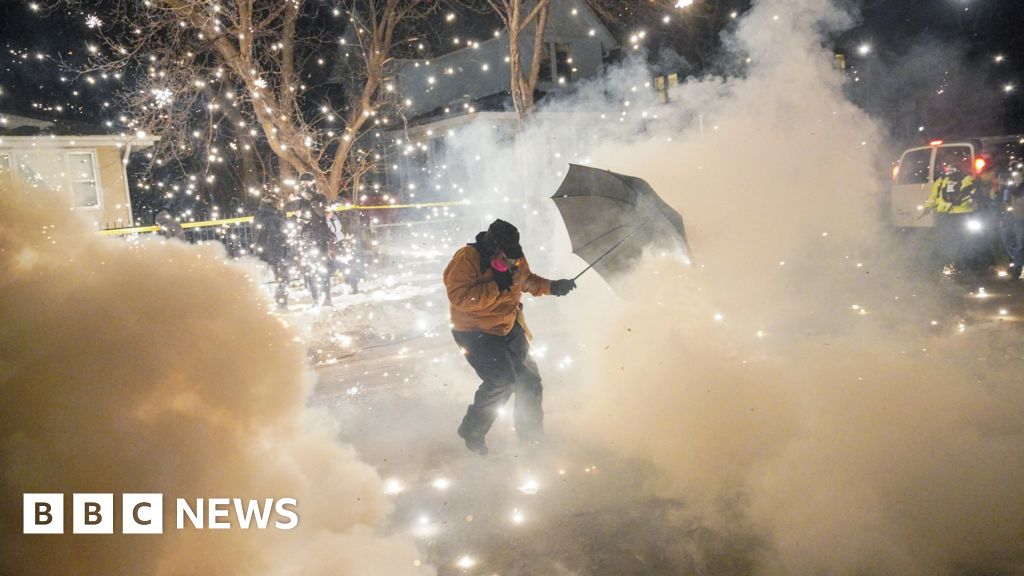
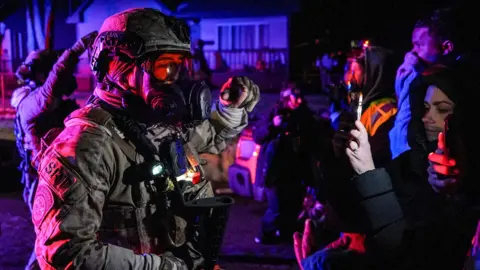
Protester shielding themself from tear gas in Minneapolis
An Immigration and Customs Enforcement (ICE) officer has shot a man in the leg in the US city of Minneapolis, where an ICE agent shot dead a woman last week.
In a statement, the Department of Homeland Security (DHS) said federal officers initially pursued the man in a car chase because he was illegally in the US from Venezuela.
The City of Minneapolis confirmed a man was shot and taken to hospital for non-life threatening injuries. An ICE officer was also taken to hospital to be treated for injuries, the DHS said.
Minneapolis city officials said on X: “We understand there is anger. We ask the public to remain calm.”
“The City of Minneapolis again demands that ICE leave the city and state immediately,” they added.
The man got out of his car and an altercation took place between him and an ICE official, the DHS said. It added that during the incident two other people emerged from a nearby apartment building and allegedly “attacked” the officer.
“Fearing for his life and safety as he was being ambushed by three individuals, the officer fired defensive shots,” the DHS statement said, adding “both attackers are in custody”.
The BBC could not immediately independently verify details in the statements. Minneapolis Police chief Brian O’Hara said the FBI is investigating the incident.
In response to the latest ICE shooting, Minneapolis mayor Jacob Frey accused federal officers of “creating chaos” across the state.
Protesters gathered at the scene of the shooting soon after the news first emerged, condemning ICE raids in Minneapolis, the largest city in the state of Minnesota.
Around 3,000 ICE officers have been deployed to Minnesota over recent weeks.
Reuters
Protesters gathered at the site of the second ICE shooting in Minneapolis
Demonstrations also took place there last week after 37-year-old Renee Nicole Good was shot dead by an ICE agent.
Federal officials accused Good of trying to run over immigration agents with her car, but Frey said the agent who shot her had acted recklessly.
Videos of the incident show ICE agents approaching a car, which is in the middle of the street. As it attempts to drive off, one of them points his gun at the driver and at least two shots are heard.
The FBI is investigating the incident.
In a statement on X responding to reports of ICE shooting the man in the leg, US Deputy Attorney General Todd Blanche said: “Minnesota insurrection is a direct result of a FAILED governor and a TERRIBLE mayor encouraging violence against law enforcement. It’s disgusting.”
Shortly before news of the latest shooting emerged, Minnesota Governor Tim Walz urging Trump to end the “occupation” of ICE officers in the state in a video on social media.
“Angry is not a strong enough word,” Walz said during his address.
Warning: this story contains content which some readers might find distressing
Distressing new videos have emerged from a mortuary in Tehran showing rows of bodies, blood soaked floors and crowds of people searching for loved ones following a deadly government crackdown on protesters in Iran.
The videos analysed by BBC Verify and BBC Persian, which are too graphic to show, contain some of the most shocking examples so far of how brutal the government’s retaliation has been since the unrest began on 28 December.
Forensic examination of the footage reveals nearly 200 bodies laid throughout the mortuary complex, many with visible wounds and one victim identified as young as 16.
Anti-government demonstrations have spread to more than 68 towns and cities, verified videos show, though the true figure is likely to be much higher. The near total internet blackout imposed by the government since last week has left more than 90 million Iranians almost completely cut off from the outside world.
The number of people who have been killed in the protests is not fully known. US-based Human Rights Activists News Agency (HRANA) places the estimate at more than 2,500. An Iranian official previously told Reuters 2,000 people have been killed but claimed “terrorists” were to blame.
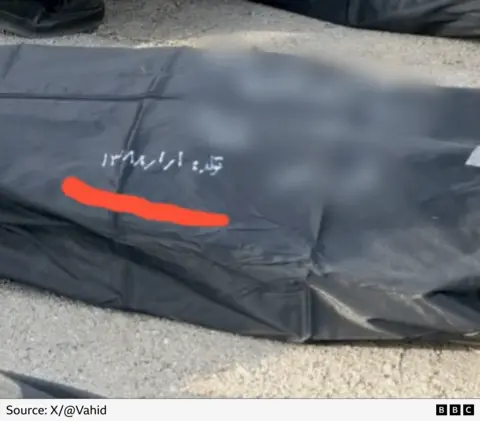
A black body bag shows the date of birth of a 16-year-old victim
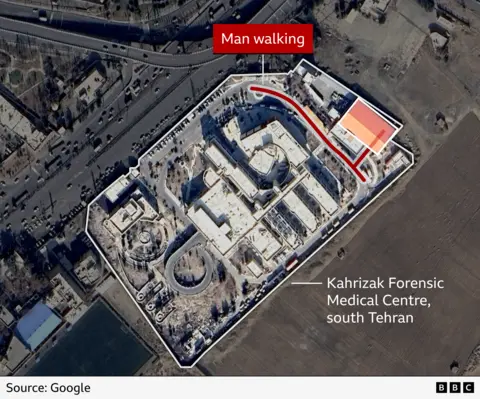
The footage was posted on Tuesday by Vahid, a US-based Iranian social media influencer and activist, who said they were filmed on 10 January inside the Kahrizak Forensic Medical Centre in south Tehran.
Vahid said the videos were filmed by a man who had travelled nearly 1,000km to find internet access. The man told BBC Persian he used mobile networks from neighbouring countries to upload the footage. Vahid has been posting dozens of videos documenting events inside the country for the outside world to see.
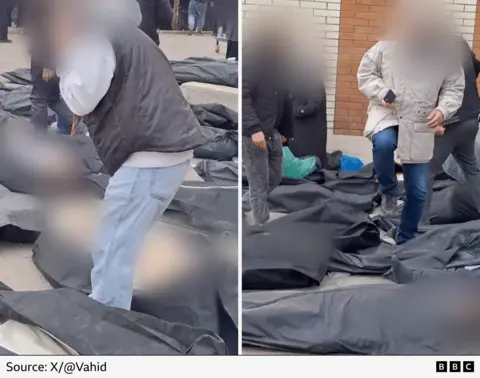
Two of the videos show rows of body bags on the floor as the man walks up and down a road that runs through the northern section of the vast mortuary complex. He later moves through a courtyard and inside a large warehouse, and walks in and out of adjacent rooms filled with more body bags. At one point he is heard describing the scene as “the apocalypse”.
The man filming is heard saying, “Today is Saturday, a day after the call”. He is referring to the call made by Reza Pahlavi, the exiled son of the late Shah, for nationwide protests that took place last Thursday and Friday night.
Two more clips contain a collection of photos taken from the mortuary showing several bodies wrapped in the zip-up bags, including one which appears burnt.
BBC Verify and BBC Persian have counted at least 186 bodies in the five-minute video and at least 178 bodies in the 16-minute clip. The two videos likely show some of the same bodies so we cannot be definitive, but the true figure is likely to be much higher.
The videos contain at least nine separate clips edited together. The positions of shadows in the footage indicate these sections were likely filmed at different times throughout the day. We have matched identifiable features from the complex, including separate buildings, the red roof of a warehouse and fences with satellite images on Google.
The man films as he moves around inside the centre, where more bodies are kept on stretchers as well as the floor. The footage shows some body bags fully zipped up while others are either half or entirely unzipped, revealing victims’ faces and injuries. Some are completely uncovered. We can see blood-soaked towels and sheets scattered around the complex with streaks of blood on the floor.
Body bags laid outside in the courtyard of the mortuary complex
A number of the bodies have visible wounds. Two bodies appear to be soaked in blood, and another is seen with a deep stomach wound.
Some body bags have papers attached to them or details written on the body bags in a white marker such as a name, national ID number, date of birth and death, and in some cases their father’s name. At least two men are described as unidentified on a sheet of paper attached to their bag, and at least one woman and one teenager are among the victims.
The date of death on three of the male victims’ body bags states 9 January. Another body bag shows a date of birth using the Iranian calendar. It says 1/1/1388, which corresponds to 21/3/2009, indicating that it belongs to a 16-year-old.
During one moment in the 16-minute clip the man points his phone at a building to his right and a voice can be heard saying: “There are many [bodies] inside. It’s not possible to go inside… this is the women’s area”. Iranian mortuaries separate the bodies of men and women for religious reasons.
At a different point we can see a body bag at the back of a hearse and a man nearby is heard telling a female official that it is his sister.
Verifying Iran protest footage as internet blackout passes 100 hours
Several ambulances, hearses and vans are filmed around the grounds. Officials are seen inspecting the rows of bodies, taking swabs from the victims, and talking to potential loved ones.
It is not clear why the bodies of those killed in anti-government protests may have been transferred to the centre, but eyewitness accounts provided to BBC Persian suggest hospitals have been overwhelmed with the number of casualties in the protests.
HRANA, which has been tracking the death toll since the unrest began, has reported that 2,403 protesters, 147 people affiliated with the government, nine civilians and 12 children have been killed so far.
Crowds of people, many who appear to be family members and friends, are seen walking in and out of the complex as they try to identify the bodies. Cries and wails are repeatedly heard throughout the videos as people mourn the loss of their loves ones.
“Some of our best people have been killed,” the man filming is heard saying.
Iranian state TV has since reported that a “substantial” number of bodies had been taken to the mortuary. It claimed the majority of the victims were members of Iran’s security forces or passers-by who had nothing to do with the demonstrations.
Most international news organisation, including the BBC, are restricted from operating inside the country so we have to rely on verifying footage on social media.
Additional reporting by Roja Assadi and Richard Irvine-Brown
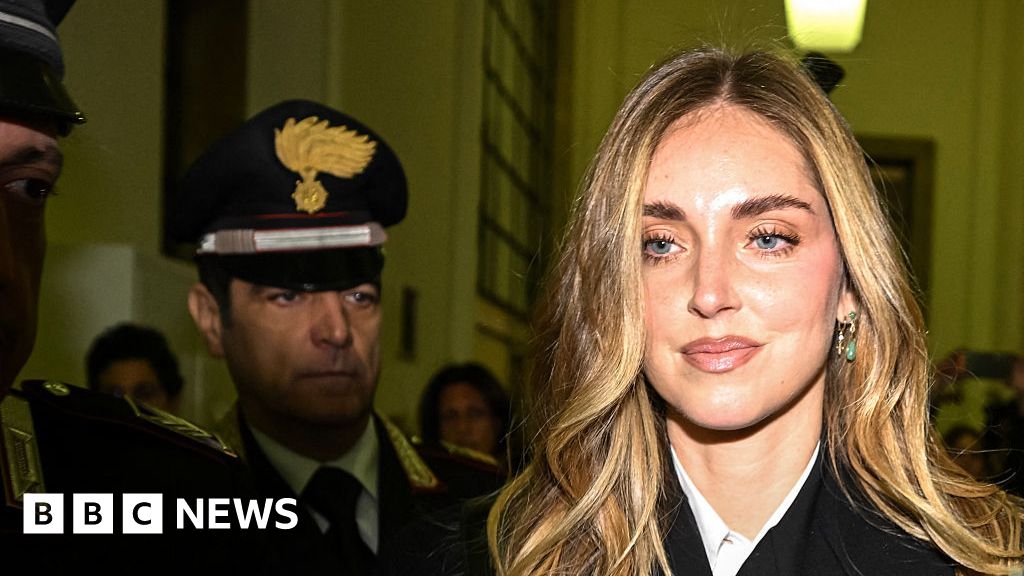
An Italian fashion influencer has been acquitted of aggravated fraud, bringing a long-running scandal involving a charity Christmas cake to an end.
Chiara Ferragni had been accused of misleading consumers by promoting the sale of a designer pink pandoro as well as Easter eggs that were said to be helping to raise money for a children’s hospital and a charity.
After a fast-track trial in Milan, a judge found her and two other defendants not guilty. Had she been convicted, she could have faced a jail term.
Ferragni, 38, told reporters the judgment marked “the end of a nightmare that lasted two years”.
The scandal – dubbed “pandorogate” – started with the sale of pink special edition Christmas cakes in 2022.
Consumers were led to believe that sales of the pandoro would go towards raising funds for a children’s hospital in Turin. But it turned out that the cake’s producer, Balocco, had given a one-off €50,000 (£43,300) donation to the hospital before the cake’s launch.
Ferragni has 28 million followers on Instagram and, after her companies made €1m from the promotion, she pledged to donate the same sum to the hospital.
The outcry led authorities to initiate a formal investigation and the influencer was handed a €1m fine in 2023 by Italy’s competition authority over the pandoro cakes, branded with her name and mentioning the children’s hospital.
Ferragni-branded Easter eggs also became part of the scandal, leading the influencer to agree to pay €1.2m to a children’s charity to settle complaints that the eggs’ sales allegedly misled consumers.
She was later indicted on the aggravated fraud charges, along with business associate Fabio Damato.
Prosecutors had asked for a sentence of one year and eight months in prison for Ferragni but the judge rejected their accusation that the fraud should be seen as aggravated.
The Milan court found that no aggravation had been involved as a consumer group had withdrawn its original complaint. Ferragni had agreed with consumer organisation Codacons that she would compensate consumers and donate money to a charity for women who had suffered gender violence.
“We are all moved,” Ferragni told reporters at the end of the trial. “The last two years have been very hard. I had faith in justice, and justice has been done.”
Despite her acquittal the scandal has proved damaging to Ferragni’s brand and affected her personal life. Her marriage to Italian rapper Fedez fell apart last year.
It has also led to tighter rules for Italian influencers to show greater transparency in their fund-raising initiatives.

 Reuters
 Reuters