Moneywise and Yahoo Finance LLC may earn commission or revenue through links in the content below.
Inheriting a windfall may seem like a dream come true, but it can cause tremendous anxiety and guilt, and it can even leave you financially worse off.
For instance, Mike and Noel, both 34 and recently married, burned through a $171,000 inheritance in about a year. You can imagine how that left them feeling.
“We are super screwed,” Noel told Ramit Sethi on an episode of his podcast, I Will Teach You To Be Rich (1).
And it’s not like they are in dire circumstances. Mike earns a six-figure salary and is supporting Noel while she finishes law school — but they have always struggled with debt and money management, even before the inheritance.
While they used some of the inheritance to pay off debt, they quickly accumulated more: Noel spent $30,000 on furniture, $10,000 on clothes and $10,000 on a trip to Mexico. Mike purchased a hair transplant and Pokémon cards, which he considered an “investment.”
Now, they have $30,000 in assets, another $30,000 in investments and zero savings after spending the inheritance, but they are also $244,000 in debt, leaving them with a negative net worth of roughly -$200,000.
Because of it, Noel said she regrets treating the money like “guilt-free spending,” while Mike said he feels anxious and stressed, leading to tension and fights over finances.
While there are a lot of issues to unpack here — from Mike’s anxiety around money to Noel’s addiction issues — their situation demonstrates how quickly a windfall can disappear without clear priorities, budgeting and an investment plan. It also underscores the risks of lifestyle creep and impulsive spending.
If you’re in line for a significant financial windfall, here are some tips to make that inheritance last.
Even if you aren’t in line for multigenerational wealth, large inheritances might become more common than you think.
Through 2048, Gen X and millennials are projected to inherit $124 trillion in assets — what’s referred to as America’s Great Wealth Transfer — with Gen X expected to receive the largest share of assets over the next decade, according to the latest Cerulli Associates report (2).
However, the problem is that some heirs treat inheritances like regular income rather than long-term capital.
Part of the reason could be psychological. Noel, for example, inherited the money from her dad, with whom she had a difficult relationship. “He was an alcoholic and addict and was really not in my life, and so I had a lot of guilt [about inheriting his assets],” she told Sethi.
And she’s not alone. A Harris Poll report found that inheritances come with complex emotions: A third (33%) of younger recipients feel stress managing larger or more complex assets, and a similar share (34%) worry about mismanaging those assets (3).
According to the same report, while most inheritors feel grateful and relieved by newfound financial security, 20% feel pressure, 18% feel anxiety and 15% feel guilt.
This phenomenon is sometimes called Sudden Wealth Syndrome, a psychological condition affecting people who suddenly acquire wealth — through an inheritance, lottery, legal settlement or other windfall. Causes can include feeling disconnected from one’s previous life or an intense fear of losing it all.
These feelings can lead to decision paralysis or poor financial choices.
In short, inheriting a windfall can be overwhelming. While a large inheritance can help you pay off debt and invest for the future, it can also be very tempting to go on a spending spree.
Friends and family might also offer unsolicited advice — regardless of whether you ask for it.
That’s why having a plan in place — one tailored to your specific circumstances — can go a long way in helping you make your inheritance last. Without one, even a six-figure windfall can quickly evaporate.
FINRA also recommends holding off on any big moves — like quitting your job or making a major purchase — for the first six to 12 months (4). Consider it a cooling-off period.
Finally, it may be wise to seek guidance from a registered financial advisor, insurance agent and tax professional, especially when the windfall is substantial.
Finding an expert near you is now easier than ever with Advisor.com.
The best part? This process is completely free. And since Advisor.com’s roster consists of fiduciaries, they are legally obligated to act in your best interests.
Consulting an expert is not the only thing you can do.
During this time, you could set aside money immediately for taxes on your windfall. And if you don’t already have one, establish an emergency fund covering three to six months of income.
To do that, you could place cash in a safe account, such as a high-yield savings account or certificate of deposit (CD). If the sum is large, try spreading it across multiple accounts to stay within federal insurance limits (4).
A high-yield account, such as a Wealthfront Cash Account, can be a great place to grow your emergency funds, offering both competitive interest rates and easy access to your cash when you need it.
A Wealthfront Cash Account can provide a base variable APY of 3.30%, but new clients can get a 0.75% boost over their first three months for a total APY of 4.05% provided by program banks on your uninvested cash. That’s nearly ten times the national deposit savings rate, according to the FDIC’s February report.
With no minimum balances or account fees, as well as 24/7 withdrawals and free domestic wire transfers, you can ensure your funds remain accessible at all times. Plus, Wealthfront Cash Account balances of up to $8 million are insured by the FDIC through program banks.
Once you have some advice and an emergency fund in place, you can start to think about what to do with the rest of that cash.
The first option to consider is not exactly a “sexy” one — paying off your debts. While it isn’t as exciting as going out and buying your dream car, it is the prudent choice if you have high-interest debt like credit cards or personal loans charging 20% to 25% interest.
Paying off your debts first “gives you an immediate guaranteed return that’s almost impossible to beat through any investment strategy,” according to Sethi (5).
One way of doing this is by consolidating your existing high-interest debt through one personal loan, ideally at a lower interest rate. This can help you save thousands of dollars in interest payments throughout the lifetime of each high-interest debt.
If that appeals to you, now there’s a way you can check the rates offered by various lenders on debt consolidation loans through Credible in just two minutes.
This way, instead of juggling multiple monthly payments, you’ll have one predictable payment to manage each month.
Even better? This process is fast and easy, completely free and won’t impact your credit score.
And Credible offers a best rate guarantee — if you close at a rate lower than the one you prequalify for, Credible will give you a $200 gift card.
Of course, most people will want to invest some of their inheritance — and it’s hard to argue with that logic.
But Sethi warns against getting too fancy with investments.
“Boring index funds and target-date funds are perfect for most of your investment allocation,” he says, giving you broad market exposure without requiring you “to become a stock-picking expert overnight (5).”
You can also stay ahead of the market by putting your spare cash to work. Consistently investing even small amounts in index funds can add up over time — thanks to the powers of compounding interest.
For instance, investing just $30 each week for 20 years could grow to over $93,000 — assuming it compounds at 10% annually. That assumption isn’t far-fetched — the S&P 500 index’s compound annual growth rate (CAGR) over the past 33 years is 10.8% (6).
In other words, you don’t have to reinvent the wheel to make financial gains. You can start small.
That’s where platforms like Acorns come in. Acorns allows you to turn your spare change from everyday purchases into an investment opportunity.
It works like this: link your cards and Acorns will round up each purchase to the nearest dollar, investing the difference — your spare change — into a diversified portfolio managed by experts at leading investment firms like Vanguard and BlackRock. This way, your everyday purchases can start working for you behind the scenes.
Assuming you’ve already invested part of your inheritance, the next step is figuring out how to fund your higher living expenses.
You can start by thinking about your financial goals. Are you putting away enough for retirement? Buying a house? Reducing work hours or retiring early? Starting a business, going back to school or traveling?
While these are all great options, you might want to keep lifestyle inflation in mind at the same time. For example, inheriting a windfall doesn’t necessarily justify buying a mansion or luxury car. Factor in ongoing costs such as property taxes, insurance and maintenance to ensure sustainability.
And that’s where you might try going back to the basics of personal finances: Sethi’s conscious spending plan recommends putting aside 50% to 60% for needs, 10% for investments, 5% to 10% for savings and another 20% to 35% for guilt-free spending (5). This, too, can be applied to a windfall.
By following this kind of structured spending, you can still have a bit of fun with your money — without going broke a year later.
If you’re looking for a way to structure your spending, you can consider creating a custom budget to track where your money is going at all times with Monarch Money.
Monarch Money puts all your finances under one roof, from your banking statements to your investments. Once you link your accounts — including investments and real estate — you will be able to view every transaction through one clean, searchable list.
This way, you can spot any unexpected charges, such as unwanted subscriptions, quickly and seamlessly. You can also get custom notifications regarding upcoming bills, allowing you to stay on top of your bills and reducing your chances of missing a payment or incurring late fees.
Members of the IRGC, the Basij, and other repressive forces still deployed in the streets have become fatigued and desperate, the officer said.
After a week of American and Israeli strikes on the command centers of the Islamic Revolutionary Guard Corps (IRGC), and the elimination of the leader of the Islamic Republic, the figure who served as the nexus linking the IRGC to Iran’s political and economic power structure, there are growing signs that this military organization, which also exerts control over Iran’s economy, may be approaching the point of collapse.
An expert in Tehran familiar with the operations of the IRGC told The Media Line that, beyond the fact that the IRGC capacity to respond has diminished in recent days – despite repeated threats to deploy advanced missile weapons and other indirect measures, and despite their failure to inflict meaningful blows on American and Israeli military bases – the central issue is that the IRGC appears to be steadily losing its grip on the situation inside the country and its ability to manage wartime conditions.
While the IRGC still appears to be launching missiles at Israel, firing missiles and drones toward countries in the region, threatening to close the Strait of Hormuz, and carrying out other disruptive measures, it has reserved its most important capabilities for suppressing armed opponents. At a moment when the authorities face the immediate danger of protesters returning to the streets, armed opposition groups capable of leading people in direct action against the IRGC, the Basij, and other organs of repression are viewed by the regime as a serious threat.
For this reason, the IRGC has, since the outset of the war, continuously fired missiles and drones at the positions and bases of Kurdish opposition groups in the Kurdistan Region of Iraq. The formation of a front uniting the principal Kurdish parties active against the Islamic Republic has also become a major source of anxiety for the Islamic regime.
Emily Blout, an Iran specialist with policy and research experience at the Pentagon, told TML: “Dispersal of IRGC into these unusual locations, including hospitals and schools, is a core part of their strategy for survival. And the strategy actually makes sense by decentralizing command into local autonomous units and by dispersing munitions across the country, the IRGC aims to maintain control even though its central leadership is eliminated. But hiding in places, especially in hospitals, is a page out of the Hamas playbook.”
EMILY BLOUT, PhD. (credit: SCREENSHOT/X)
Blout predicts that the overthrow of the Islamic Republic would come through armed urban conflict that would shatter the IRGC: “They may enter weeks or even months of guerrilla warfare,” viewing this as their “Karbala moment,” a regime fighting for its survival, willing to endure heavy losses and even die. “But this will not be an easy endgame.”
In total, the IRGC has roughly 250,000 personnel, with reserve forces numbering about twice that. Including the Basij, the total number of armed personnel stands at roughly 900,000 nationwide. Yet after one week of war, the IRGC’s internal communications have been severely disrupted, and signs of organizational disorder have become visible.
Many of these forces, who recently had staged a conspicuous show of strength in the streets with armored equipment and, in some cases, opened fire on civilians, are now exhausted, worn down, and left without secure bases or headquarters. Even their makeshift cover locations, such as sports stadiums, have come under air or missile attack. With the loss of central command, they appear to be moving toward breakdown.
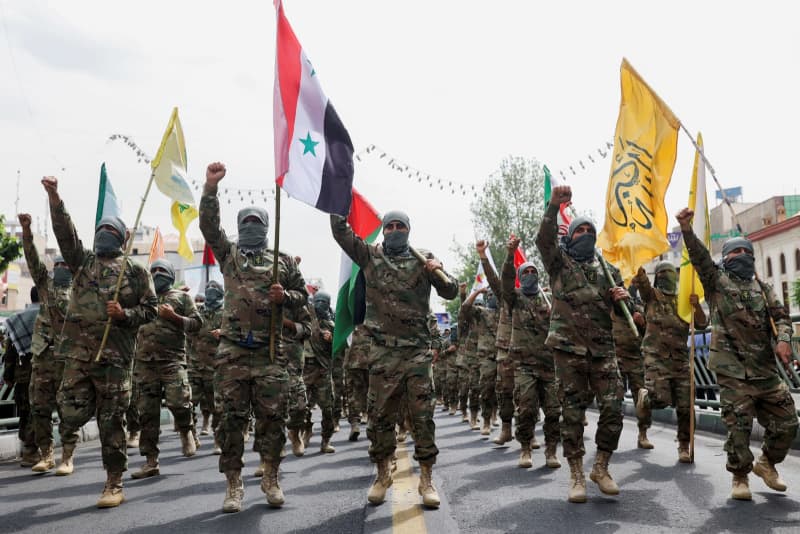
An officer in one of Iran’s military forces told The Media Line that the fall of the Islamic Republic is inevitable because members of the IRGC, the Basij, and other repressive forces still deployed in the streets have become fatigued and desperate.
He said the tactic of wearing down and rendering the Islamic Republic’s military and security apparatus effectively homeless in the cities has begun to work within a matter of days, and it is unlikely they will be able to sustain this condition for the coming weeks; they may collapse even sooner.
This Iranian military member said the repeated bombardment of the leader’s residence and the cover sites used for the deployment of IRGC forces indicates an effort to crush the organizational structure of these forces so that they can no longer maintain coherent resistance or command. That, he said, would facilitate defections from the ranks of the IRGC, the Basij, and other repressive bodies. If the government descends into deeper disintegration, the IRGC will soon collapse.
According to this military source, Iranian protesters could seize the initiative at a decisive moment and enter a phase of armed insurrection. But one weakness in the minds of some people is the prospect of foreign military intervention, along with the pull of nationalism, and the negative perception of an “external leader” once again arriving in the country by airplane under the protection of foreign-backed forces.
One week after the outbreak of war, the IRGC has lost its commander and nearly all of its field commanders. It is said that at least 800 of its members have been killed, and that in terms of military capacity and organizational cohesion, it has reached the terminal phase of its 47-year existence.
Even if the IRGC avoids total collapse in the coming weeks, it is likely to face mounting internal rivalries, the erosion of its vast economic privileges, and the possible rupture of its ties to the wider financial networks on which it has long relied. Together, these pressures could seriously weaken the IRGC’s financial base and, in turn, further destabilize the government.
At present, the only armed force the IRGC appears to regard as a serious threat consists of the thousands of Kurdish peshmerga fighters who, following the Iran-Iraq security agreement, have been compelled to reside in areas of the Kurdistan Region far from the border. These Kurdish parties, which have recently united, enjoy broad support in Iranian Kurdistan.
Shukriya Bradost, a security analyst in the Middle East, stresses that the capacity to mobilize the public is stronger in Kurdistan, and this opportunity can be used for the liberation of all of Iran. She argues that the “Kurdish card” can be used to bring down the Islamic Republic.
In the first step, Bradost says, the creation of a free zone in Kurdistan could provide a base from which to expand the battle and ultimately crush the regime. She recently wrote that this opportunity for the “Kurdish card” still exists.
Mojahedin-e Khalq only other armed force standing against Iran regime
Apart from the Kurds, the only other organized force capable of carrying out armed operations is the Mojahedin-e Khalq (MEK). Although the MEK, in a striking report published a few days before the war began, claimed responsibility for an attack on the Leader’s residence (Beyt e Rahbari), and although they maintain an organized support base inside the country, their cult-like nature, isolationism, lust for domination, religious roots, and deep unpopularity among many Iranians inside the country have in practice led them to be set aside as a potentially armed opposition force. Their supporters, under the banner of “rebel units,” do carry out limited disruptive operations and send footage to Simaye Azadi television. However, their claim of an attack on the Khameni’s residence by hundreds of armed fighters has been widely met with skepticism.
More than 44 years have passed since the MEK was engaged in urban warfare with the IRGC and Islamic Police (Committee). Their military operations, such as mortar attacks on security centers and the assassination of officials, ended years ago, with their activities now largely confined to infiltration and the exposure of the regime’s secret nuclear information.
Iran, however, is a country of multiple nations, ethnic communities, tribes, and minorities, some of whom, particularly in western and southwestern Iran, are armed and could, at a critical moment, play a vital role alongside the “Kurdish card,” tying down the IRGC on several fronts.
If protesters once again pour into the streets and confrontations spread across the capital and other major cities, as they did during the January uprising, the regime’s military and security bodies could begin to fracture rapidly under the pressure of a war it seems increasingly incapable of managing. That experience left many Iranians not only enraged but also determined to exact retribution, with some now openly saying that their aim is to strike directly at the regime’s machinery of repression.
An Iranian protester who was detained for several days during the January protests also told The Media Line that after hours of trying to gain internet access, the practical field leaders of a nationwide uprising are now available, and there is deep concern about political prisoners.
Those who possess revolutionary experience and knowledge, and who have devoted their lives to Iranian society and to the struggle for freedom, are fully capable of carrying this revolution forward until it achieves an “Iranian Republic” with all the characteristics laid out in the Woman, Life, Freedom manifesto, she said.
Quite apart from the deeply radicalized Woman, Life, Freedom movement, student groups, labor activists, syndicates and trade groups, and elements of the remnants of left-wing parties crushed in Iran during the 1980s, could also play a significant role in the course of a final uprising. It can be said that, although the Left is not united, it still retains a latent capacity for mobilization, organization, and leadership.
The IRGC, despite its nearly half-century grip on power, its multilayered structure, and its deep entrenchment in Iran’s political and economic order, may ultimately prove more fragile than it appears. Sustained by vast economic interests, patronage networks, logistical reach, propaganda, proxy forces, and, above all, the regime’s clerical and financial core, it could still be shattered if its underlying structure takes a sufficiently severe hit.
If the war drags on while the Guards are drawn into direct confrontation with protesters in the streets, the notorious force could begin to collapse with remarkable speed and vanish from history altogether.
Foreign Secretary Yvette Cooper has hit back at President Trump’s criticism of the UK response to the conflict in Iran.
Appearing on Sunday with Laura Kuenssberg, Cooper said: “It won’t surprise you that we don’t agree with President Trump on every issue.”
It’s the prime minister’s job to “take decisions in the UK’s national interest… not in the interest of any other country”, she added.
In a social media post, the US president had earlier said the UK was considering sending aircraft carriers to the Middle East. He appeared dismissive of the move, writing: “We don’t need people that join Wars after we’ve already won!”