Category: Uncategorized

  • Happy 16th Birthday, KrebsOnSecurity.com! – Krebs on Security

    Happy 16th Birthday, KrebsOnSecurity.com! – Krebs on Security


    KrebsOnSecurity.com celebrates its 16th anniversary today! A huge “thank you” to all of our readers — newcomers, long-timers and drive-by critics alike. Your engagement this past year here has been tremendous and truly a salve on a handful of dark days. Happily, comeuppance was a strong theme running through our coverage in 2025, with a primary focus on entities that enabled complex and globally-dispersed cybercrime services.
    Image: Shutterstock, Younes Stiller Kraske.

    In May 2024, we scrutinized the history and ownership of Stark Industries Solutions Ltd., a “bulletproof hosting” provider that came online just two weeks before Russia invaded Ukraine and served as a primary staging ground for repeated Kremlin cyberattacks and disinformation efforts. A year later, Stark and its two co-owners were sanctioned by the European Union, but our analysis showed those penalties have done little to stop the Stark proprietors from rebranding and transferring considerable network assets to other entities they control.

    In December 2024, KrebsOnSecurity profiled Cryptomus, a financial firm registered in Canada that emerged as the payment processor of choice for dozens of Russian cryptocurrency exchanges and websites hawking cybercrime services aimed at Russian-speaking customers. In October 2025, Canadian financial regulators ruled that Cryptomus had grossly violated its anti-money laundering laws, and levied a record $176 million fine against the platform.

    In September 2023, KrebsOnSecurity published findings from researchers who concluded that a series of six-figure cyberheists across dozens of victims resulted from thieves cracking master passwords stolen from the password manager service LastPass in 2022. In a court filing in March 2025, U.S. federal agents investigating a spectacular $150 million cryptocurrency heist said they had reached the same conclusion.

    Phishing was a major theme of this year’s coverage, which peered inside the day-to-day operations of several voice phishing gangs that routinely carried out elaborate, convincing, and financially devastating cryptocurrency thefts. A Day in the Life of a Prolific Voice Phishing Crew examined how one cybercrime gang routinely abused legitimate services at Apple and Google to force a variety of outbound communications to their users, including emails, automated phone calls and system-level messages sent to all signed-in devices.

    Nearly a half-dozen stories in 2025 dissected the incessant SMS phishing or “smishing” coming from China-based phishing kit vendors, who make it easy for customers to convert phished payment card data into mobile wallets from Apple and Google.

    In January, we highlighted research into a dodgy and sprawling content delivery network called Funnull that specialized in helping China-based gambling and money laundering websites distribute their operations across multiple U.S.-based cloud providers. Five months later, the U.S. government sanctioned Funnull, identifying it as a top source of investment/romance scams known as “pig butchering.”

    Image: Shutterstock, ArtHead.

    In May, Pakistan arrested 21 people alleged to be working for Heartsender, a phishing and malware dissemination service that KrebsOnSecurity first profiled back in 2015. The arrests came shortly after the FBI and the Dutch police seized dozens of servers and domains for the group. Many of those arrested were first publicly identified in a 2021 story here about how they’d inadvertently infected their computers with malware that gave away their real-life identities.

    In April, the U.S. Department of Justice indicted the proprietors of a Pakistan-based e-commerce company for conspiring to distribute synthetic opioids in the United States. The following month, KrebsOnSecurity detailed how the proprietors of the sanctioned entity are perhaps better known for operating an elaborate and lengthy scheme to scam westerners seeking help with trademarks, book writing, mobile app development and logo designs.

    Earlier this month, we examined an academic cheating empire turbocharged by Google Ads that earned tens of millions of dollars in revenue and has curious ties to a Kremlin-connected oligarch whose Russian university builds drones for Russia’s war against Ukraine.

    An attack drone advertised the website hosted on the same network as Russia’s largest private education company — Synergy University.

    As ever, KrebsOnSecurity endeavored to keep close tabs on the world’s biggest and most disruptive botnets, which pummeled the Internet this year with distributed denial-of-service (DDoS) assaults that were two to three times the size and impact of previous record DDoS attacks.

    In June, KrebsOnSecurity.com was hit by the largest DDoS attack that Google had ever mitigated at the time (we are a grateful guest of Google’s excellent Project Shield offering). Experts blamed that attack on an Internet-of-Things botnet called Aisuru that had rapidly grown in size and firepower since its debut in late 2024. Another Aisuru attack on Cloudflare just days later practically doubled the size of the June attack against this website. Not long after that, Aisuru was blamed for a DDoS that again doubled the previous record.

    In October, it appeared the cybercriminals in control of Aisuru had shifted the botnet’s focus from DDoS to a more sustainable and profitable use: Renting hundreds of thousands of infected Internet of Things (IoT) devices to proxy services that help cybercriminals anonymize their traffic.

    However, it has recently become clear that at least some of the disruptive botnet and residential proxy activity attributed to Aisuru last year likely was the work of people responsible for building and testing a powerful botnet known as Kimwolf. Chinese security firm XLab, which was the first to chronicle Aisuru’s rise in 2024, recently profiled Kimwolf as easily the world’s biggest and most dangerous collection of compromised machines — with approximately 1.83 million devices under its thumb as of December 17.

    XLab noted that the Kimwolf author “shows an almost ‘obsessive’ fixation on the well-known cybersecurity investigative journalist Brian Krebs, leaving easter eggs related to him in multiple places.”

    Image: XLab, Kimwolf Botnet Exposed: The Massive Android Botnet with 1.8 million infected devices.

    I am happy to report that the first KrebsOnSecurity stories of 2026 will go deep into the origins of Kimwolf, and examine the botnet’s unique and highly invasive means of spreading digital disease far and wide. The first in that series will include a somewhat sobering and global security notification concerning the devices and residential proxy services that are inadvertently helping to power Kimwolf’s rapid growth.

    Thank you once again for your continued readership, encouragement and support. If you like the content we publish at KrebsOnSecurity.com, please consider making an exception for our domain in your ad blocker. The ads we run are limited to a handful of static images that are all served in-house and vetted by me (there is no third-party content on this site, period). Doing so would help further support the work you see here almost every week.

    And if you haven’t done so yet, sign up for our email newsletter! (62,000 other subscribers can’t be wrong, right?). The newsletter is just a plain text email that goes out the moment a new story is published. We send between one and two emails a week, we never share our email list, and we don’t run surveys or promotions.

    Thanks again, and Happy New Year everyone! Be safe out there.



    Source link

  • Why has Israel recognised the breakaway African state as independent?

    Why has Israel recognised the breakaway African state as independent?


    Wedaeli Chibelushi,

    Ameyu Etana,BBC Afaan Oromooand

    Farah Lamane,BBC Somali

    AFP via Getty Images Young men crowd together holding Somaliland flagsAFP via Getty Images

    Residents of Somaliland’s capital city, Hargeisa, have been celebrating Israel’s declaration

    Israel has taken the controversial decision to recognise the breakaway state of Somaliland as an independent nation, sparking condemnation from many other countries.

    China is the latest to condemn the decision, with its foreign ministry spokesperson Lin Jian telling reporters: “No country should encourage or support other countries’ internal separatist forces for its own selfish interests.”

    China outlined its position ahead of the UN Security Council holding an emergency session to discuss Israel’s decision.

    Israel on Friday became the first country in the world to acknowledge Somaliland as a standalone republic, more than 30 years after the region declared independence from Somalia.

    Somaliland’s president called the development “a historic moment”, but Somalia furiously rejected Israel’s move as an attack on its sovereignty.

    Dozens of countries and organisations, such as Turkey, Saudi Arabia and the African Union, have also condemned Israel’s surprise declaration.

    Why does Somaliland want independence?

    A breakaway, semi-desert territory on the coast of the Gulf of Aden, Somaliland declared independence after the overthrow of Somali military dictator Siad Barre in 1991.

    The move followed a secessionist struggle during which Siad Barre’s forces pursued rebel guerrillas in the territory. Tens of thousands of people were killed and towns were flattened.

    Though not internationally recognised, Somaliland has a working political system, government institutions, a police force, and its own currency.

    Its history as a distinct region of Somalia dates back to nineteenth century colonial rule. It was a British protectorate – known as British Somaliland – until it merged with Italian Somaliland in 1960 to form the Somali Republic.

    Those in favour of Somaliland’s independence argue that the region is predominantly populated by those from the Isaaq clan – an ethnic difference from the rest of Somalia.

    Also, Somaliland, home to roughly six million people, enjoys relative peace and stability. Its proponents argue that it should not be shackled to Somalia, which has long been wracked by Islamist militant attacks.

    However, Somalia considers Somaliland to be an integral part of its territory. The government in Somalia’s capital city, Mogadishu, has repeatedly said that any recognition of Somaliland’s independence would contravene Somalia’s sovereignty.

    Somali President Hassan Sheikh Mohamud has also characterised Israel’s declaration as an “existential threat” to his country’s unity.

    Why did Israel recognise Somaliland as an independent state?

    In a phone call with Somaliland President Abdirahman Mohamed Abdullahi on Friday, Israeli Prime Minister Benjamin Netanyahu said his country was acknowledging Somaliland’s “right of self-determination”.

    He also said official recognition would be “a great opportunity for expanding” the countries’ partnership.

    However analysts say there are strategic reasons for Israel’s declaration.

    “Israel requires allies in the Red Sea region for many strategic reasons, among them the possibility of a future campaign against the Houthis,” Israeli think tank the Institute for National Security Studies said, referring to Yemen’s Iran-backed rebels, in a paper last month.

    “Somaliland is an ideal candidate for such cooperation as it could offer Israel potential access to an operational area close to the conflict zone.”

    Israel repeatedly struck targets in Yemen after the Gaza war broke out in October 2023, in response to Houthi attacks on Israel that the rebels said were in solidarity with Palestinians in the Gaza Strip.

    In response to Israel recognising Somaliland, the Houthis warned that any Israeli presence in Somaliland would be considered a “military target” for their forces.

    A few months ago, a number of news outlets reported that Israel had contacted Somaliland over the potential resettlement of Palestinians forcibly removed from Gaza.

    Israel did not comment on the reports, but at the time, Somaliland said that any move by Israel to recognise its independence would not have anything to do with the Palestinian issue. Both Somalia and the Palestinian Authority have suggested Israel’s recognition of Somaliland could be linked to a plan to displace Palestinians.

    “Somalia will never accept the people of Palestine to be forcibly evicted from their rightful land to a faraway place,” Somalia’s president told his parliament on Sunday.

    Offering his perspective, US-based Africa analyst Cameron Hudson told the BBC that Israel has recognised Somaliland primarily because it is trying to counter Iran’s influence in the Red Sea region.

    “The Red Sea is also a conduit for weapons and fighters to flow up the Red Sea into the Eastern Mediterranean. It has traditionally been a source of support and supply to fighters in Gaza. And so having a presence, having a security presence, having an intelligence presence at the mouth of the Red Sea only serves Israel’s national security interests,” he said.

    Why has Israel’s move been condemned so widely?

    Israel has been criticised by the likes of Egypt, Turkey, Saudi Arabia, the African Union, Yemen, Sudan, Nigeria, Libya, Iran, Iraq and Qatar.

    In their condemnations, many of these countries have referred to Somalia’s “territorial integrity” and the breaching of international principles.

    The African Union has long been concerned that recognising Somaliland could set off a chain reaction, where separatists could demand recognition for the territories they claim.

    “Regions could attempt to establish external alliances without the consent of central governments, creating a dangerous precedent that risks widespread instability,” Abdurahman Sayed, a UK-based analyst for the Horn of Africa, told the BBC.

    Is there any support for Israel’s declaration?

    Countries considered to be allies of Somaliland, or sympathetic to its campaign for recognition, have largely remained quiet.

    For instance, the United Arab Emirates (UAE), which operates a military port in Somaliland, has not released a statement.

    Mr Hudson told the BBC that the UAE is “very much aligned with the Israelis on this question of Somaliland”.

    “I think even now today you’re going to see an alignment of Israeli and Emirati interests across the entire Red Sea region,” he added.

    Ethiopia’s government has also refrained from commenting. Last year Somaliland agreed to lease part of its coastline to landlocked Ethiopia – a move that angered Somalia.

    Mr Abdurahman said Turkey stepped in to mediate between Somalia and Ethiopia. It led Ethiopia to sign an agreement with Somalia’s government, committing to respect its territorial integrity.

    “As a result, although Israel’s unilateral recognition of Somaliland may be quietly welcomed by Ethiopia, Addis Ababa appears to have adopted a cautious “wait-and-see” approach,” the analyst added.

    Somalilanders had hoped the US would recognise it as an independent state following signals given before Donald Trump began his second term as president.

    But in response to Israel’s declaration, Trump suggested to the New York Post that he would not swiftly follow Netanyahu’s lead.

    “Does anyone know what Somaliland is, really?,” he reportedly said.

    More BBC stories on Somaliland:

    Getty Images/BBC A woman looking at her mobile phone and the graphic BBC News AfricaGetty Images/BBC


    Source link

  • Catching the hunters trapping rare songbirds

    Catching the hunters trapping rare songbirds


    Laura BickerChina correspondent , Beijing

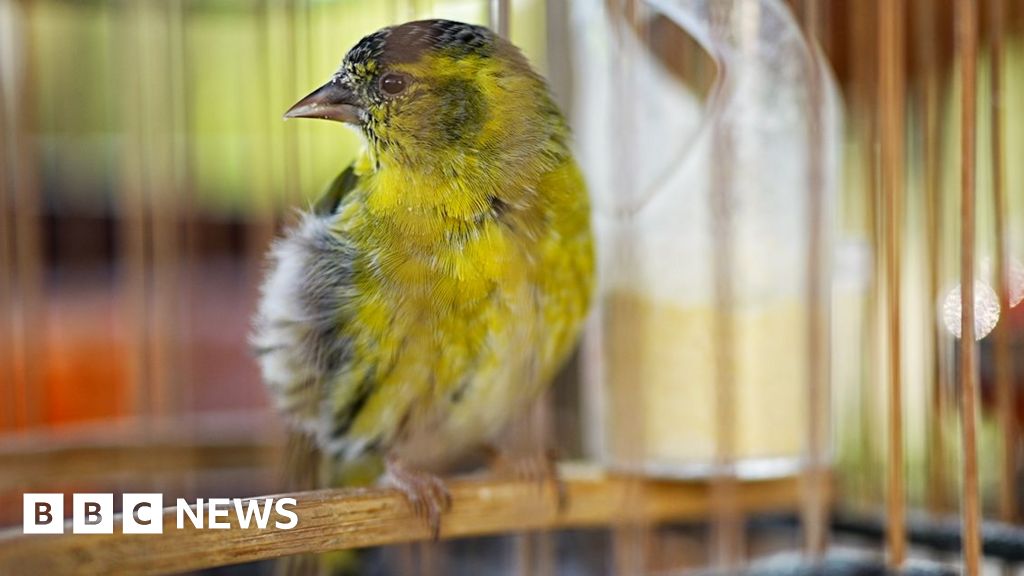
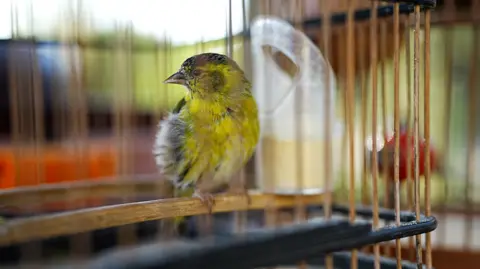
    BBC A yellow bird with shots of grey in its plumage is perched inside a round metal cage. BBC

    Silva Gu’s eyes dart back and forth across miles of tall grassland, scouring it for signs of life in the darkness.

    He speaks in less than a whisper as we try to find a spot to hide in the fields. Behind us, the vast metropolis of Beijing has yet to wake. As we wait, we hear only our own breath.

    And then, as the sky starts to lighten ahead of sunrise, we hear footsteps. The poachers are here.

    Slim and stealthy, Silva heads out first. We eventually follow with our cameras.

    Slowly, we tread through a line of trees, into a small clearing. We only spot the bird net when it is a few inches from our faces.

    Each year, tens of thousands of birds are caught in nets across China for the pet trade, or for meat.

    The pandemic and a property crisis have turned the economy sluggish – so catching and selling songbirds on the black market is a low-cost and often low-risk way of making a large profit.

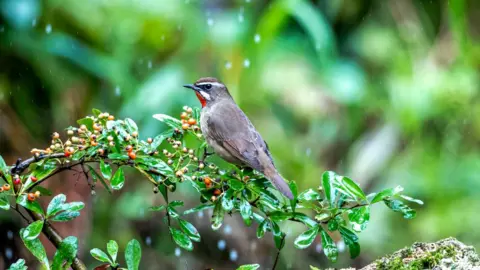
    A pretty songbird, such as a Siberian rubythroat, can often sell for nearly 2,000 yuan (£210; $280), which is more than many farmers earn in a month.

    “I want to protect them on this Earth controlled by humans,” Silva says. Birds, for him, are a passion.

    “I often dream. And in my dreams, I’m always flying.”

    Trapped

    In the skies above us, billions of birds, many so small that they can fit in the palm of your hand, are migrating south for winter.

    They have taken advantage of the long summer days in Siberia, or Mongolia, feasting on bugs and berries. As the year comes to a close and icy winds bring the first frosts of winter, they are flying to warmer places to nest and feed.

    This was back in October, when flying through China is the equivalent of rush hour for migratory birds heading to Australia, New Zealand or southern Africa.

    China is home to 1500-plus bird species, which is about 13% of the global population – more than 800 of those are migratory birds. Four of the nine major routes they follow intersect in China.

    These are long, often perilous journeys, where the birds navigate through storms and evade predators, while looking for the ideal spot to spend the night.

    The patch of grassland where we were, on the outskirts of the Chinese capital, is an oasis for small birds – any further and the city skies offer few options to rest among towering rows of concrete.

    It is also an oasis for the poachers and their “mist nets”, so thin you can barely see them.

    Watch the moment BBC stumbles upon bird poachers in Beijing

    The one we nearly walked into was stretched across half the length of the field and propped up with bamboo poles. In the middle, a small finch was desperately trying to free his legs, but the more it moved, the more its claws became tangled.

    It was a meadow pipit, a protected bird in China, and an important “indicator species” – that means if its numbers are thriving, so is its environment.

    The poacher spotted us and started to run. From a small pouch on his hip, he threw around half a dozen small birds into the air before sprinting deeper into the shrubs.

    Our cameras caught the moment he was stopped by Silva whose years of experience have taught him how to detain poachers while he calls the police. He stops the poacher from leaving, simply by continuing to block his path.

    “At the beginning I had no experience and at that time I was quite afraid,” he later says. “But if you really want to do something, those fears will all be forgotten.”

    The police arrived about 40 minutes later to arrest the poacher.

    Hunting the hunters

    Silva, who in his 30s, does this work for free using his own savings. He has given up on many nights of sleep to set songbirds free, and he has spent the last 10 years persuading the police in Beijing to take this crime seriously.

    “Back in 2015, no-one cared,” he says.

    So he recruited volunteers who did care and launched a group called the Beijing Migratory Bird Squad. He held public meetings and invited the heads of the local police and forestry bureau. These small and persistent acts of persuasion appear to have worked. The police discovered that catching poachers also led to tracking down other kinds of criminal activity in Beijing.

    “We found our goals were partially aligned,” Silva says, adding the caveat that enforcement is still patchy.

    Silva Gu in a white cap and grey shirt speaks as he faces the camera.

    Silva Gu has spent the last decade fighting to protect and free rare songbirds

    Silva’s love of birds started in childhood. He grew up in the 1990s in a very different Beijing – grand and imposing, but not the capital of an economic giant.

    He remembers roaming through the grasslands on the city’s edges where he found birds, frogs and snakes. “But starting from the 2000s, everything changed.”

    China’s booming economy brought millions of rural workers to cities as they sought jobs in factories or in construction. This rapid urbanisation meant grasslands were seen as empty places to build, not sanctuaries to conserve.

    The change stunned Silva. The grasslands began to shrink, as did the habitats they supported.

    “I decided back then to work in conservation and I took this path,” he says.

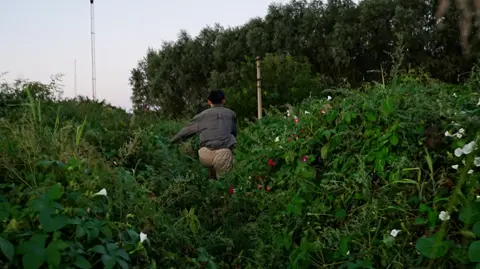
    A photo of Silva taken from behind as he runs through the bushes in pursuit of the poacher.

    Silva chasing the poacher in the grassland outside Beijing

    It has not been an easy life.

    One of Beijing’s biggest bird dealers found out he was being investigated by Silva and retaliated.

    “He gathered several of his accomplices who surrounded me and beat me up,” Silva recalls. He says he went to the police but those responsible were not brought to justice.

    He has also lost his army of volunteers over the years. This work requires stealth and sleepless nights to stalk poachers in the dark. Silva says few people are willing to take on the difficult – and sometimes dangerous – job.

    “I do this full-time,” he says. “I made it a project because if you want to solve this big problem, you must devote yourself wholeheartedly. You can’t do it part-time.”

    He says fundraising pays for some of the costs – more than 100,000 yuan, $14,000 a year – but donations have dipped because of the slowing economy.

    So he has found new ways to hunt the hunters.

    He studies satellite imagery to find the paths worn away by the poachers through large fields and grasslands. He maps those against the bird’s migratory routes and looks for areas where they may stop for the night. The satellite images can even show lines of net traps which can catch hundreds of small birds at night.

    That’s what the mist nets do. They trap a variety of small birds even if the poachers are after prized versions, like the Siberian rubythroat.

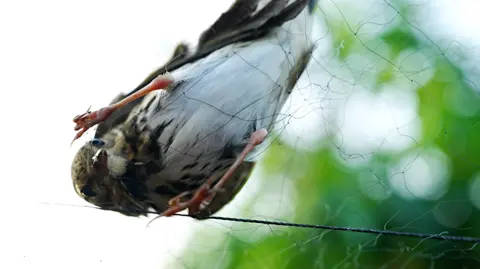
    Bird caught in net

    Catching and selling protected songbirds is a profitable business in China

    “Siberian rubythroats and bluethroats sell for a high price,” Silva says. “In big cities like Beijing and Tianjin, those who want to keep birds are now quite wealthy.”

    Although there are wildlife laws in place, Silva reckons the fines to punish the crime do not outweigh the financial benefits of catching and selling songbirds.

    Owning a pet bird was – and for some generations in China, still is – a status symbol. This dates back to the Qing dynasty, which ruled China from the mid-17th to early 20th Century. Nobles and elites would build ornate bamboo cages for their birds to display their elegance and wealth.

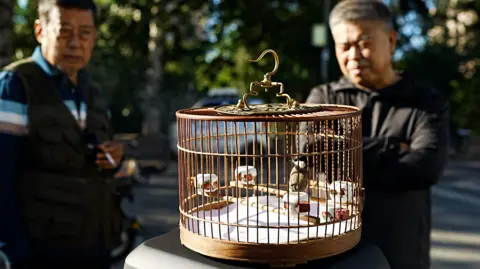
    It’s a tradition that continues mainly among retired men in their 60s or 70s. Silva says older Chinese people don’t realise they are committing a wildlife crime, or understand that so many more birds had to die in a trap so they could buy a caged bird.

    “This generation didn’t even have enough to eat growing up. Now with a little money, they have inherited the habit and custom of caging birds,” he says. “China developed so fast, there was no time to educate people about ecology and once adults values are formed, they’re really hard to change. Maybe they can’t be changed in a lifetime.”

    Silva feels alone in this fight.

    “Sometimes, I am so tired. I want to find someone, maybe a group of people and we could combine our strength – but right now there is no-one.”

    Busted

    On a long low wall alongside the Liangshui river in Beijing, a trader has several small cages with tiny twittering birds.

    Another man stands outside the nearby vegetable market holding a bird cage shrouded in a black veil. He tells passers-by quietly that his songbird is rare, worth nearly 1900 yuan, or about $270.

    This is a glimpse of an old Beijing where small unofficial traders have created their own market.

    An elderly trader is sitting by a low wall, smoking a pipe and selling small birds in round cages. On the other side of the cages is another elderly man on an electronic scooter.

    An old-school market in Beijing, selling everything from crickets to caged birds

    The path by the river stretches for several miles and on a sunny weekday morning, there were shoppers browsing everything from vintage jewellery to false teeth, all laid out at makeshift stalls.

    We were told we would be able to buy a wild songbird in a small park just off the path. It was easy to find.

    Music was blasting from a speaker under the low trees where a troop of elderly ladies were choreographing a fan dance routine. Nearby several men, all over 50, had gathered with bird cages – some had two or three in their hands. Most were covered in dark cloth.

    But today there would be no sales because the police had arrived. They were questioning the bird owners and taking names. Defiant, one man said he was taking his caged bird for a walk. This does happen in many Beijing parks, where songbird owners gather with their caged pets to chat and compare notes.

    This police visit was part of a wider campaign by the Ministry of Public Security that was announced earlier in the year.

    Qu Mingbin via Getty Images A Siberian Rubythroat stands on a branch in the Jfo Mountain National Nature Reserve in Chongqing, China, on Oct. 10, 2021.Qu Mingbin via Getty Images

    A Siberian rubythroat can fetch more than $250 on the black market

    Wildlife trade is big business. Interpol estimates the illegal portion of the trade to be worth nearly $20bn and, according to Animal Survival group, China is the largest consumer of wildlife products, both illegal and legal.

    Officials in Beijing have repeatedly denied accusations that the Covid-19 pandemic originated through animal-to-human transmission at a wet market in Wuhan, where wildlife was also being sold. Conservation groups have been pressuring the Chinese government to ban trade in wildlife.

    This year, Chinese state media described the protection of wild birds as crucial for safeguarding ecosystems vital to human survival.

    This shift in authorities’ attitudes is also why Silva has had success working with the police.

    Two older men are visible behind a round bird cage holding a small bird. It is grey with a white throat and a black crest and beak.

    It’s mostly older men who still keep caged birds – in the cage is a Chinese bulbul, also a songbird

    That day in the field outside Beijing, Silva managed to keep the poacher at arm’s length until the police arrived. The man appeared to be in his 50s and was wearing old construction overalls. Don’t move, Silva warned him.

    The poacher offerered to kneel and apologise, telling Silva that he only came to the field to look at birds. But Silva grabbed his phone, where he found photos and videos of dozens of caged birds.

    Later, when Silva and the police searched his home, they found them all still there, waiting to be sold.

    Many of the wildlife poaching rings in China are much bigger. In Dalian earlier this year, the police arrested 13 suspects, and seized more than 12,000 yellow-breasted buntings, a wild bird with the highest protection level in China.

    Silva worries that despite the renewed efforts to catch poachers, they face few penalties. But he is also encouraged. He has rescued more than 20,000 birds on site for the past 10 years and disrupted the nets of countless poachers.

    “I think there’s hope,” he says, pinning his on a generational change – when more young people will understand and appreciate China’s rare songbirds and the need to protect them.

    Until then, he says, he will keep at it himself: “This is my ideal. If you have this ideal, you must persist. You can’t not.”

    And so each night during the annual migration, he will patrol the fields of Beijing in the hope that he can bring back the dulcet tones of songbirds to the city’s skies – he wants his city to sound like it did in his childhood.


    Source link