Category: Uncategorized

  • Trump to meet Netanyahu in Florida as focus turns to Middle East

    Trump to meet Netanyahu in Florida as focus turns to Middle East


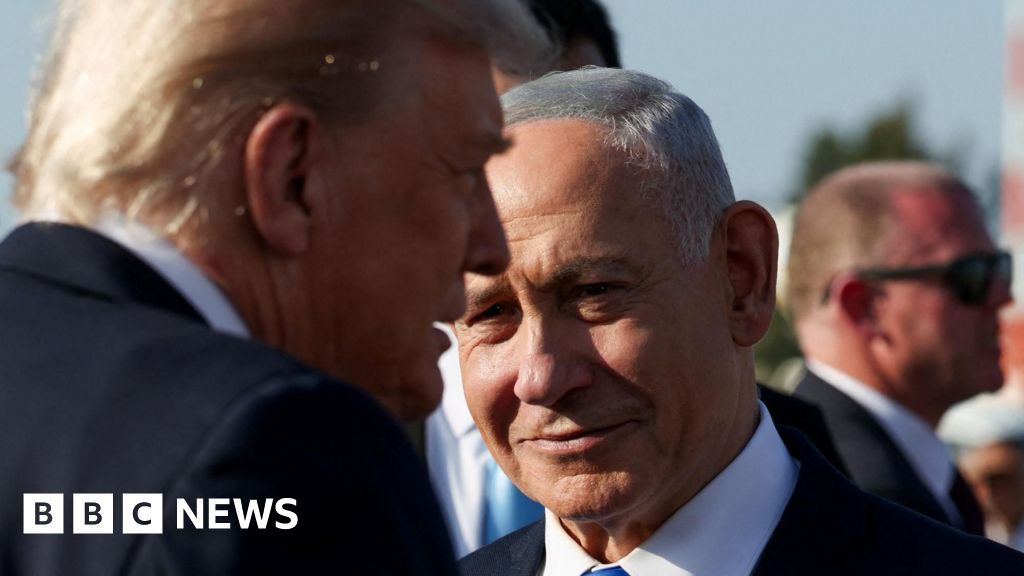
    US President Donald Trump will turn his focus to the Middle East on Monday, as he hosts Israeli Prime Minister Benjamin Netanyahu in Florida for talks that are expected to cover Gaza and a range of other pressing issues.

    Any decisions made could have a potentially momentous impact on questions that determine the future of the region.

    The US has been Israel’s strongest military and political backer throughout two years of war in Gaza and many are now looking to the meeting as a test of the leaders’ relationship and how aligned they are on key topics.

    It will be their sixth meeting since Trump’s return to office 11 months ago.

    Among the expected points of discussion is the future of relations with Syria’s new government, Iranian rearmament, and Hezbollah’s role in Lebanon.

    Perhaps most critically, they will discuss progress of the Gaza ceasefire deal, where Israel’s government has taken several positions diverging from those of the US government.

    The talks will take place as storms continue to lash Gaza, where hundreds of thousands of displaced Palestinians remain living in basic tents that offer little protection from the cold and flooding.

    On Monday, the death of a two-month-old baby due to the severe cold was reported by the Hamas-run health ministry, bringing the total killed by the wintry weather since 10 December to three, while another 17 people have been killed by damaged buildings collapsing in the storms.

    The UN and numerous aid agencies have accused Israel of not meeting its ceasefire obligations by continuing to restrict full access to basic supplies and equipment. Israel has said it is meeting its obligations in facilitating an increase in aid deliveries.

    The Trump administration wants to see the ceasefire progress to its second phase in January, whereby a Palestinian technocratic government would be established alongside the deployment of an international security force, Hamas would disarm, Israeli troops would withdraw, and the reconstruction of the devastated territory would begin.

    Critics have suggested that Netanyahu may instead seek to delay the progress of the ceasefire, saying he does not want to engage seriously with questions of a political future for Palestinians and will instead push for Hamas to fully disarm before Israeli troops withdraw from Gaza. Hamas officials have repeatedly said that its full disarmament should take place alongside progress towards an independent Palestinian state.

    The 20-point peace plan promoted by Trump and signed by both Israel and Hamas recognises Palestinian aspirations to a sovereign state, however Netanyahu and his ministers have consistently rejected Palestinian statehood since the ceasefire came into effect in October.

    Last week, Defence Minister Israel Katz said his country would build settlements in Gaza and would “never fully withdraw” from the territory even if Hamas disarms, despite this being a key tenet of the ceasefire deal.

    Breaking out of the current impasse is seen as crucial by many in the region as near-daily deadly attacks by the Israeli military continue to take place in Gaza despite the declared ceasefire.

    In the 80 days since it came into effect, at least 414 Palestinians have been killed by the Israeli military in the territory, according to its health ministry.

    The Israeli military, which controls more than half of Gaza, has said it has only opened fire in response to ceasefire violations.

    Three Israeli soldiers have been killed in attacks that the military has blamed on Hamas over the same period.

    Israel also continues to wait for Hamas to return of the body of Ran Gvili, the last remaining dead hostage in Gaza. All living and decease hostages taken during the Hamas-led 7 October 2023 attacks on Israel, which sparked the war, should have been returned three days after the ceasefire came into effect.

    Trump’s intervention and US mediation could be brought upon the fraught and unresolved sticking points, pushing Netanyahu to take a softer line on certain positions.

    For instance, the Israeli government has opposed Turkey taking part in the International Stabilisation Force to be deployed in Gaza. However, few other countries have been willing to take part.

    Netanyahu is also expected to meet US Secretary of State Marco Rubio, who is seen as supportive of the positions of the Israeli government.

    Last week, Israeli media reported that there may be an attempt by the prime minister to rediscuss Israel annexing the occupied West Bank – something President Trump has spoken against.

    Israeli ministers have recently described their expansion of Israeli settlements in the West Bank as a de facto annexation of the territory aimed at burying the possibility of an independent Palestinian state.

    Both the settlements and annexation are illegal under international law.

    It is also expected that Netanyahu may use his meeting with Trump on Monday to seek US permission for further military strikes on Iran.

    The Israeli government is said to believe Iran is rearming its missile capabilities after their 12-day war this summer, which saw Iran’s nuclear facilities bombed by both Israeli and US fighter jets.

    The Iranian president said this weekend that said his country was in “all-out war” with Israel, the US and Europe. “They don’t want our country to remain stable,” Masoud Pezeshkian said.


    Source link

  • Thailand accuses Cambodia of breaking newly signed ceasefire

    Thailand accuses Cambodia of breaking newly signed ceasefire


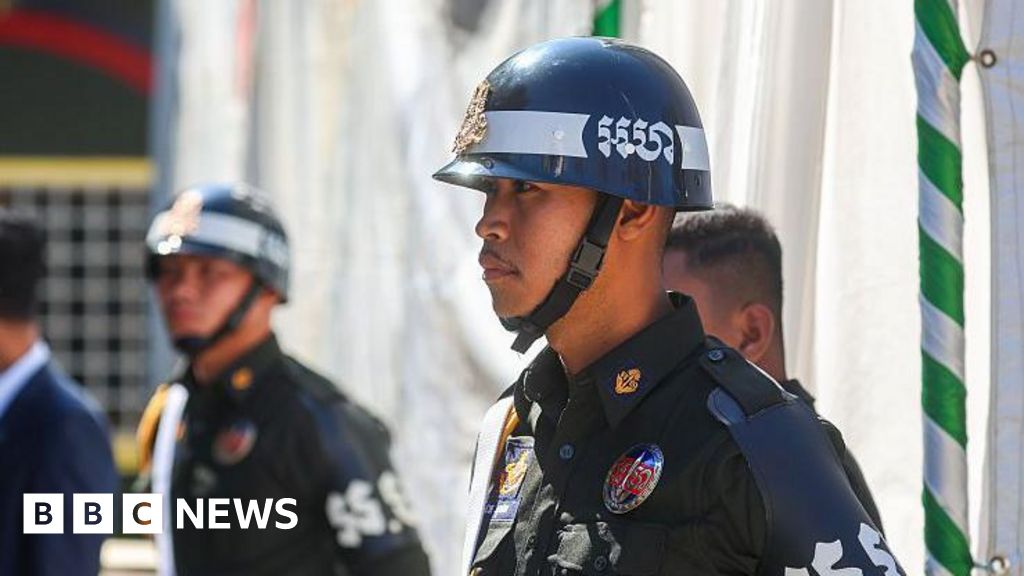
    Getty Images Cambodian military police officers stand guard Getty Images

    The Thai army said than more than 250 unmanned aerial vehicles (UAVs) were detected flying from the Cambodian side

    Thailand’s army has accused Cambodia of breaching a newly-signed ceasefire deal reached after weeks of deadly clashes that forced nearly one million people from their homes.

    In a statement, the Thai army said than more than 250 unmanned aerial vehicles (UAVs) were detected flying from the Cambodian side on Sunday night.

    The ceasefire took effect at noon local time (05:00 GMT) on Saturday. Both sides agreed to freeze the front lines where they are now, ban reinforcements and allow civilians living in border areas to return as soon as possible.

    It had been seen as a breakthrough, which came after days of talks between both countries, with diplomatic encouragement from China and the US.

    In a statement on Monday, the Royal Thai Army said Cambodia’s actions “constitute provocation and a violation of measures aimed at reducing tensions”, adding that they were “inconsistent” with the terms of the ceasefire.

    It also said it “may need to reconsider” the release of 18 Cambodian soldiers held in Thailand since July.

    Thailand would be “obliged to act in accordance… [if] violations of agreements and national sovereignty continue”, it added.

    Cambodia has not yet commented.

    It comes just hours after China’s Foreign Minister Wang Yi praised the “hard-won” ceasefire, and US President Donald Trump praised the “rapid and fair conclusion”.

    The dispute between Thailand and Cambodia is not new, dating back more than a century.

    The latest tensions ramped up earlier this year, after a group of Cambodian women sang patriotic songs in a disputed temple.

    A Cambodian soldier was killed in a clash in May. This plunged relations between the countries to their lowest point in more than a decade.

    There were five days of intense fighting along the border, which left dozens of soldiers and civilians dead. Thousands more civilians were displaced.

    A fragile ceasefire deal was agreed in July and signed in October. It then collapsed earlier this month, when fresh clashes erupted.

    Both sides blamed each other for the breakdown of the truce.


    Source link

  • MongoDB Vulnerability CVE-2025-14847 Under Active Exploitation Worldwide

    MongoDB Vulnerability CVE-2025-14847 Under Active Exploitation Worldwide


    Dec 29, 2026Ravie LakshmananDatabase Security / Vulnerability

    A recently disclosed security vulnerability in MongoDB has come under active exploitation in the wild, with over 87,000 potentially susceptible instances identified across the world.

    The vulnerability in question is CVE-2025-14847 (CVSS score: 8.7), which allows an unauthenticated attacker to remotely leak sensitive data from the MongoDB server memory. It has been codenamed MongoBleed.

    “A flaw in zlib compression allows attackers to trigger information leakage,” OX Security said. “By sending malformed network packets, an attacker can extract fragments of private data.”

    Cybersecurity

    The problem is rooted in MongoDB Server’s zlib message decompression implementation (“message_compressor_zlib.cpp”). It affects instances with zlib compression enabled, which is the default configuration. Successful exploitation of the shortcoming could allow an attacker to extract sensitive information from MongoDB servers, including user information, passwords, and API keys.

    “Although the attacker might need to send a large amount of requests to gather the full database, and some data might be meaningless, the more time an attacker has, the more information could be gathered,” OX Security added.

    Cloud security company Wiz said CVE-2025-14847 stems from a flaw in the zlib-based network message decompression logic, enabling an unauthenticated attacker to send malformed, compressed network packets to trigger the vulnerability and access uninitialized heap memory without valid credentials or user interaction.

    “The affected logic returned the allocated buffer size (output.length()) instead of the actual decompressed data length, allowing undersized or malformed payloads to expose adjacent heap memory,” security researchers Merav Bar and Amitai Cohen said. “Because the vulnerability is reachable prior to authentication and does not require user interaction, Internet-exposed MongoDB servers are particularly at risk.”

    Data from attack surface management company Censys shows that there are more than 87,000 potentially vulnerable instances, with a majority of them located in the U.S., China, Germany, India, and France. Wiz noted that 42% of cloud environments have at least one instance of MongoDB in a version vulnerable to CVE-2025-14847. This includes both internet-exposed and internal resources.

    Cybersecurity

    The exact details surrounding the nature of attacks exploiting the flaw are presently unknown. Users are advised to update to MongoDB versions 8.2.3, 8.0.17, 7.0.28, 6.0.27, 5.0.32, and 4.4.30. Patches for MongoDB Atlas have been applied. It’s worth noting that the vulnerability also affects the Ubuntu rsync package, as it uses zlib.

    As temporary workarounds, it’s recommended to disable zlib compression on the MongoDB Server by starting mongod or mongos with a networkMessageCompressors or a net.compression.compressors option that explicitly omits zlib. Other mitigations include restricting network exposure of MongoDB servers and monitoring MongoDB logs for anomalous pre-authentication connections.


    Source link