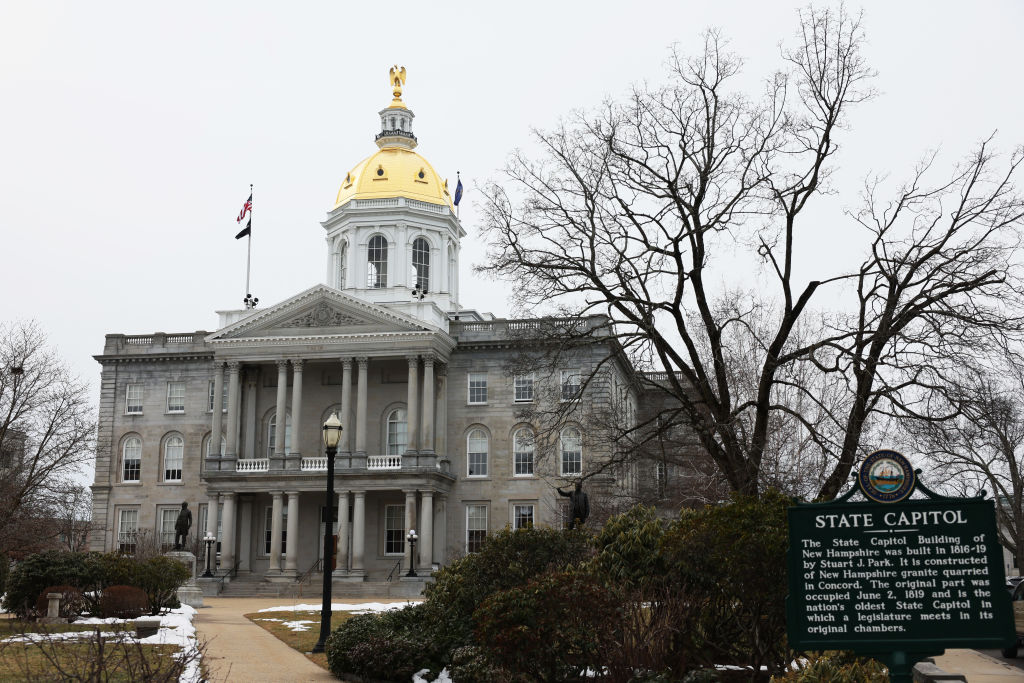
The proposal would fine transgender people up to $5,000 for using bathrooms aligned with their gender identity.
Did you know that Truthout is a nonprofit and independently funded by readers like you? If you value what we do, please support our work with a donation.
Bathroom bans targeting transgender people have been spreading rapidly across the United States. In previous years, adult bathroom bans in public buildings were limited to a handful of states with extreme laws. This year, they have become one of the primary vehicles for anti-trans legislation nationwide. Kansas was the first to act, passing a bathroom bounty hunter system and invalidating transgender people’s IDs. Idaho and Missouri began advancing their own bills. Now, the New Hampshire House of Representatives has passed its own version — one of the most extreme in the United States, which states that a trans person using the bathroom of their gender identity is a crime under the state civil rights act, violations of which carries hefty penalties. The bill passed 181-164 on Wednesday night, just weeks after Governor Kelly Ayotte vetoed a separate bathroom ban. Republicans are now sending her something far more aggressive — raising the question of whether they are trying to move the goalposts or simply daring her to veto again.
“Notwithstanding any other provision of law, with the exception of RSA 21:3, RSA 21:54, and paragraph II below, all multi-user facilities, including bathrooms, restrooms, and locker rooms located in buildings owned, leased, or operated by any municipality shall be used based on the individual’s biological sex,” reads the new bill. This prohibition is expansive: it applies to parks, rest stops, airports, civic buildings, and more, and could leave transgender people struggling to find a public place to use the restroom across the state.
The bill contains a novel enforcement mechanism not seen in any other state. It declares that a transgender person “asserting” that their gender identity allows them to use the bathroom is against the law under the state civil rights act, turning civil rights protections that were meant to be protective of transgender people into a weapon against them. “It shall be unlawful for any person to assert that their gender identity is a sex other than that defined in RSA 21:3 for the purposes of accessing places or services restricted on the basis of sex,” reads the bill. Such violations could result in fines of up to $5,000 per incident and even jail time if a person violates a resulting court injunction by continuing to use the restroom.
The bill also contains provisions for private businesses. It permits any owner or operator of a “place of public accommodation” — a category that under New Hampshire law includes hotels, restaurants, theaters, retail stores, bars, and concert venues — to restrict bathrooms by assigned sex at birth. The bill then immunizes those businesses from discrimination claims: “Adoption or enforcement of a policy pursuant to this section shall not be deemed discrimination under RSA 354-A or any other state law,” it reads.
A separate bill, HB 1217, also passed on Wednesday. That bill permits governmental buildings and businesses to classify bathrooms and locker rooms by assigned sex at birth — similar to the bathroom bans Ayotte has already vetoed. It passed by an even wider margin, 187-163. It contains no enforcement mechanism, but rather, states that bathroom bans and sports bans are not discriminatory towards transgender people under New Hampshire law.
The bills are part of a larger movement towards bathroom bans for transgender people. Just last month, Kansas passed a bathroom ban that allows every citizen in the state to become a bounty hunter, where reporting transgender people in bathrooms can net them $1,000 per trans person caught. This law also invalidated trans people’s drivers licenses in the state. Meanwhile, Idaho and Missouri are both advancing extreme anti-trans bathroom bans of their own, with Idaho’s ban even applying to private businesses, making it against the law for a private business to allow a trans person to use the bathroom that matches their gender identity.
The bills are substantially more extreme than the one vetoed by Governor Ayotte just weeks ago. In a veto statement of a bathroom ban last month, Ayotte stated, “I believe there are important and legitimate privacy and safety concerns raised by biological males using places such as female locker rooms and being placed in female correctional facilities… At the same time, I see that House Bill 148 is overly broad and impractical to enforce, potentially creating an exclusionary environment for some of our citizens.”
It remains unclear why Republicans are pushing an even more extreme version of a bill their own governor has already vetoed three times. The bill still needs to pass the New Hampshire Senate and be signed by Ayotte to become law. One possibility is that the more extreme HB 1442 is designed as cover for HB 1217 — making that bill appear moderate by comparison and improving its chances of earning a signature. Another is that Republicans believe they can pressure Ayotte into signing, or are simply laying the groundwork for an override attempt down the line. Regardless, HB 1442 is one of the most extreme bathroom bans moving through any state legislature in the country, and transgender people across New England will be watching closely as it advances to the Senate.
Press freedom is under attack
As Trump cracks down on political speech, independent media is increasingly necessary.
Truthout produces reporting you won’t see in the mainstream: journalism from the frontlines of global conflict, interviews with grassroots movement leaders, high-quality legal analysis and more.
Our work is possible thanks to reader support. Help Truthout catalyze change and social justice — make a tax-deductible monthly or one-time donation today.