Category: Uncategorized

  • Iran Hostage Crisis Brought Ronald Reagan to Power

    Iran Hostage Crisis Brought Ronald Reagan to Power


    If war with Iran becomes the issue that fractures the MAGA coalition, the historical irony would be considerable.

    Iran’s central role in Republican politics is nothing new. The modern Republican coalition—forged by Ronald Reagan with the 1980 presidential election, when he defeated President Jimmy Carter—was defined by antipathy toward Iran and coincided precisely with the rise of the current regime in Tehran.

    What followed were decades that shaped the political worldview of millions of Americans, including Donald Trump. Now they are in their senior years, watching to see whether the regime that took hold in that era finally collapses, and at what cost to the United States and its allies.

    Ironically, the war against Iran that every president since Reagan avoided may prove to be what breaks that MAGA coalition apart—and opens the door to a Democratic resurgence.


    The 1970s were a difficult decade for Americans. Vietnam’s shadow lingered long after the last troops came home. A deep skepticism toward elected officials took hold and there was little appetite for another ground war, even a limited one. The world’s most awesome military force, the very same one that had defeated global fascism in the 1940s, had failed to prevent Vietnam’s unification under communist rule, and the United States’ sense of its own place on the world stage had shifted accordingly. At home, the nation was fracturing along social and cultural lines. And stagflation—the punishing combination of high unemployment and inflation—had shattered the economic expectations that postwar prosperity had made to seem permanent.

    As if all of that were not enough, an energy crisis that spiked twice, in 1973 and again in 1979, made the country feel economically hostage to far smaller and weaker governments in the Middle East, as the oil-producing cartel OPEC squeezed U.S. prices and supplies.

    The modern conservative movement that gained strength during this period, a coalition of Evangelical Christians, New Right intellectuals, Wall Street and business interests, neoconservative Democrats, and traditional anti-government Republicans, laid the blame for all of it squarely on the Democratic Party. The Democrats had controlled Congress since 1955, and conservatives charged that together with Presidents Lyndon Johnson and Jimmy Carter—as well as middle-of-the-road Republicans Richard Nixon and Gerald Ford—they had driven the nation into the ground by overregulating the economy; taxing and spending without restraint; and refusing to support a strong defense against communism.

    Then came the Iran hostage crisis. In January and February 1979, a revolution toppled the monarchy of Shah Mohammad Reza Pahlavi and ushered in a new era of Islamic rule under Ayatollah Ruhollah Khomeini. As historian David Farber writes in Taken Hostage: The Iran Hostage Crisis and America’s First Encounter with Radical Islam, many high-level U.S. policymakers, so used to seeing the world through the lens of the Cold War, missed the growing strength of Islamic fundamentalism.

    When Carter allowed the shah, whose repressive secret police had terrorized Iranians for decades, into the United States in October of that year to receive cancer treatment in New York, the situation exploded. On Nov. 4, a group of Iranian students broke into the U.S. Embassy in Teheran, seizing 66 Americans, including diplomats, as hostages. (The captors released women and Black hostages later in November, and another hostage who became seriously ill in July 1980.) They saw Carter’s decision as yet another example of U.S. interference in Iranian affairs. Many had learned how the CIA, under President Dwight Eisenhower, had backed the 1953 coup that overthrew Iran’s prime minister, Mohammad Mosaddeq. Carter’s chief of staff, Hamilton Jordan, instantly predicted that the hostages would become a pivotal issue in the election.

    The hostage crisis lasted 444 days, with 52 Americans kept in captivity, and consumed the Carter administration. The president spent much of his time trying to negotiate the hostages’ release, working through third parties and freezing Iranian assets held in U.S. banks. He abandoned the campaign trail, adopting a “Rose Garden strategy” whereby he remained visibly at work in the White House to demonstrate that he put governing above politics, and hoping that posture would be enough to defeat the primary challenge from Massachusetts Sen. Ted Kennedy before carrying him through to the general election. He was hesitant to use military force. As he told State Department personnel: “I am not going to take any military action that would cause bloodshed or arouse the unstable captors of our hostages to attack them or to punish them. I’m going to be very moderate, very cautious.”

    The media continually reminded the country of the crisis. ABC television broadcast nightly updates via The Iran Crisis: America Held Hostage, which became a permanent late-night news show called Nightline in 1980, hosted by Ted Koppel. Many communities hung yellow ribbons on trees, doors, and streetlights to show their support. Cars were decorated with bumper stickers and local rallies called for retribution. The World Wrestling Federation introduced the Iron Sheik, a heel whose persona was hating the United States; he had little trouble goading live audiences into hating him.

    Carter was already struggling with a battered economy when the hostage crisis started. Each night, ABC broadcast its updates and reminded viewers how long the standoff had dragged on—and his approval ratings kept sinking. With most of the negotiations taking place in secret, it looked to many Americans as if Carter was doing nothing. The hostages came to symbolize something larger: U.S. impotence and the Democratic Party’s chronic inability to project strength against its adversaries. First small oil-producing states had held the country hostage economically. Now they were holding Americans hostage literally. When the Soviet Union invaded Afghanistan in December 1979, opening a second front of crisis, Carter grasped just how severely foreign policy was destroying his presidency.

    Reagan, who had emerged as the frontrunner for the Republican nomination, wielded the Iran crisis as a cudgel against Carter. He hammered the president’s failure to free the hostages and framed it as the inevitable result of an administration too weak to stand firm against its adversaries. This was a line of attack that Reagan had honed during his 1976 primary challenge against Ford, when he criticized the Republican establishment over detente, the policy of easing tensions with the Soviet Union through arms agreements, diplomacy, and trade. Now he had a Democrat in his crosshairs, and any lingering hesitation about going on the attack fell away. During a speech on Jan. 24, 1980, in South Carolina, Reagan said: “The Iranians bet that Mr. Carter would be weak in responding to an act of war. They were right.” He connected Iran to the Soviets in Afghanistan, saying, “I cannot doubt that our failure to act decisively at the time that this happened provided the Russians with the final encouragement to invade Afghanistan.”

    Public confidence in Carter fell even further after Carter’s effort to launch a military rescue in April 1980, Operation Eagle Claw, ended in disaster, leaving eight U.S. servicemen dead and more injured.

    In a campaign ad paid for by a group called Democrats for Reagan, viewers saw images of Iranians at the U.S. embassy as a narrator warned: “Ayatollah Khomeini and his men prefer a weak and manageable U.S. president, and have decided to do everything in their power to determine our election result.” The ad quoted a New York Times column by William Safire, which claimed that Iranian officials were on U.S. television urging voters to oppose Reagan. By the end of his term, the initial “rally around the flag” boost Carter had enjoyed had disappeared. By September 1980, his approval ratings had fallen to about 37 percent.

    Knowing how much the issue mattered, Reagan’s advisors feared an “October surprise”—a last-minute hostage release which, according to internal polls, would hand Carter the election. It did not occur. Whether Reagan’s advisors actually contacted Iranian officials to delay the release remains historically contested; what is beyond dispute is how severely the crisis had already damaged Carter.

    Donald Trump, then a real estate developer in New York, agreed. On Oct. 8, Trump told a television interviewer: “The Iranian situation is a case in point. That they hold our hostages is just absolutely and totally ridiculous. That this country sits back and allows a country such as Iran to hold our hostages, to my way of thinking, is a horror. I honestly don’t think they’d do it with other countries.”

    Shortly before the election, Carter noted in his diary, “The anniversary date of them having been captured absolutely filled the news media. Time, Newsweek and U.S. News all had front-cover stories on the hostages … Almost all the undecideds moved to Reagan.” On the morning of Election Day, Carter’s pollster, Pat Caddell, told Hamilton Jordan: “The sky has fallen in. We are getting murdered … It’s the hostage thing.”

    Ronald Reagan defeated Jimmy Carter in a decisive Republican victory, winning 489 Electoral College votes and more than 50 percent of the popular vote. Many factors contributed to the outcome, but most observers agreed that Iran loomed large. Even after Carter negotiated the hostages’ freedom, the Iranians delivered a final humiliation by delaying their release until Reagan’s inauguration. Reflecting in 2014, Carter told CNBC,  “I think I would have been reelected easily if I had been able to rescue our hostages from the Iranians.”


    The hostage crisis left a lasting impression on Trump. In 1990, Trump told Playboy: “We’re still suffering from a loss of respect that goes back to the Carter Administration, when helicopters were crashing into one another in Iran.” In a 2011 interview with Steve Forbes, he said, “People forget Iran. They had our hostages, and Jimmy Carter was the president, and it was pathetic. We’d still have those hostages there today if Jimmy Carter were still president.”

    Yet many decades later, Trump has left his own conservative coalition politically exposed by launching the kind of attack Carter avoided and which Reagan never undertook. (In fact, Reagan’s administration secretly sold arms to Iran in exchange for help securing the release of hostages in Lebanon.)

    Trump is learning the hard way that military action, especially if not carefully planned and coordinated with a majority of allies, is rarely simple in this volatile region; it can quickly ignite instability that ripples across the globe and draws the United States deeper into conflict. Those shocks inevitably reverberate at home—and this time, it is Republicans under Trump who may bear the political fallout.



    Source link

  • How Many People Have the U.S. & Israel Killed in Iran? – Consortium News

    How Many People Have the U.S. & Israel Killed in Iran? – Consortium News


    The fact that our government and institutional media downplay accurate casualty figures only makes it more urgent to find them, write Medea Benjamin and Nicolas J.S. Davies.

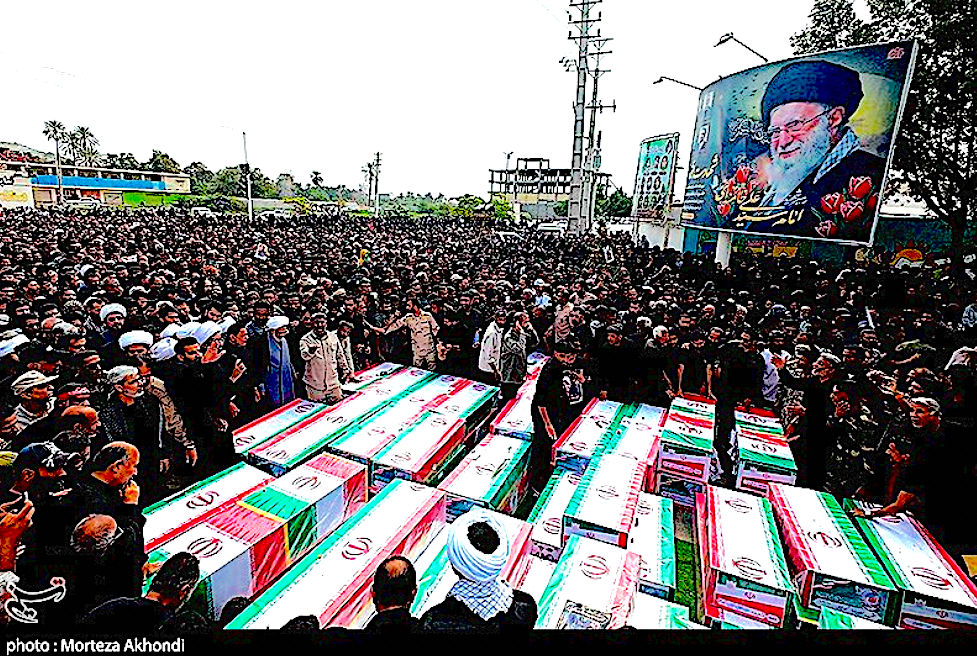
    The funeral on March 3, for the victims of the U.S.-Israeli attack on the Shajareh Tayyebeh girls’ elementary school in Minab, Iran. (Tasnim News Agency/ Wikimedia Commons/ CC BY 4.0)

    By Medea Benjamin and Nicolas J. S. Davies
    Common Dreams

    After the breakdown of talks in Pakistan, the ceasefire between the U.S. and Iran is more fragile than ever, and now seems likely to give way to a new phase of the war.

    The ceasefire and talks have failed to end Israel’s devastating attacks on Lebanon or to negotiate international access to the Strait of Hormuz, now under Iran’s control.

    The world must use this pause in the war to push for a permanent ceasefire and peace agreement, but we must also start to assess the true human cost of the war –- something the U.S. is always reluctant to do in its wars, from Vietnam to Iraq to Afghanistan.

    While we always know the exact number of Americans killed in these wars, we never have an accurate tally of how many people the U.S. has killed – not only because it is often hard to get the data, but also because the U.S. systematically downplays civilian casualties and treats their lives as less valuable.

    We saw this from the very first day of this war. The U.S. carried out a double-tap strike on a girls’ elementary school in Minab, killing 175, mostly young girls.

    Trump’s response was to blame Iran: “In my opinion, based on what I’ve seen, that was done by Iran,” he said, and later suggested that Iran might have gotten hold of a Tomahawk missile and used it to kill its own people.

    No Accurate Figures

    Minab is not an isolated case — it is a window into a much broader failure by the U.S. government and media, as well as the Iranian government and international media, to honestly reveal the human toll of this 40-day war.

    The Iran Health Ministry’s casualty figures have not been updated in any detail since March 29, when it put Iranian casualties at 2,076 killed and 26,500 wounded, and there is an obvious mismatch between these two numbers.

    The ratio between them is much higher than in other wars, or even when compared with the Israeli assault on Lebanon in this war, where Lebanon’s Health Ministry reported 1,830 people killed and 4,927 wounded by April 10, a ratio of 2.7 to 1 between the wounded and the dead.

    For further comparison, U.N. figures for civilian casualties in the war in Ukraine are 15,172 and 41,378 wounded, which is also a ratio of 2.7 to 1. These are certainly under-estimates, like civilian casualty counts in every war, but the ratio between deaths and injuries is realistic, unlike that in Tehran’s casualty figures.

    If the Iran Health Ministry’s casualty figures were accurate, it would mean that only one person is being killed for every 13 people wounded. But if the figure of 26,500 people wounded was accurate, and the ratio between dead and wounded was similar to what is found in other wars, we would expect that around 10,000 people have probably been killed.

    Looking at other sources, the U.K.-based Iran International website, on March 31, reported Iranian military, militia and police casualties of 4,770 killed and 20,880 wounded, but did not divulge its sources.

    Two human rights groups, Human Rights Activists News Agency (HRANA) and Hengaw, have also published mortality estimates. HRANA, based in Fairfax, Virginia, in the U.S., is partly funded by the U.S. government, the aggressor in this war. So, its data on war casualties are as suspect as its data for casualties during protests in Iran in December and January that the U.S. used as a pretext for the war.

    The other human rights group, Hengaw, is based in Norway and Iranian Kurdistan. It reports a total of at least 7,650 people killed by the time of the ceasefire on April 8, of whom 6,620 were military personnel and 1,030 were civilians.

    If the Iranian government’s figure of 26,500 people wounded is correct, Hengaw’s count of 7,650 war deaths would amount to a ratio of 3.5 people wounded for each person killed, which would be closer to what one would expect by comparison with other wars.

    File:Attack on Shahid Beheshti University of Iran 14 Avash.webp

    Aftermath of U.S. strike on Shahid Beheshti University in April. (Mohammad Reza Abbasi, Avash News Agency, Creative Commons Attribution – 4.0 International)

    But the Health Ministry’s figure of 26,500 wounded is also suspect. The Pentagon claims that U.S. and Israeli airstrikes have hit more than 13,000 “targets,” so 26,500 injuries would amount to only two people wounded for each target attacked. This suggests that the count of 26,500 people wounded is itself an undercount, and that the true numbers of casualties in Iran, killed and wounded, military and civilian, are therefore likely to be much higher than any of the numbers reported so far.

    While it is easy to understand why the U.S. government doesn’t want to talk about casualties, it seems that the Iranian government doesn’t want to either. If, as we suspect, the true casualty figures are much higher than the health ministry has reported, it may be hiding and downplaying them to prevent panic among the population and keep up the country’s morale, especially in light of the recent large protests in the country. That could also explain why it has not updated its casualty report since March 29.

    We would encourage all sides, and independent groups, to cooperate in efforts to accurately count the dead and wounded. Why does this matter? In an illegal war, every death is a crime, while every person killed or maimed is somebody’s husband, wife, father, mother, son or daughter. They should all still be alive and whole.

    The U.S. armed forces should not be killing or wounding any of them. So some might ask what difference it makes whether they’ve killed 2,000 people, 7,000 or even 70,000.

    Decades of Downplaying Mass Casualties

    We would say that it is precisely because each life is precious, and because the pain and horror each person suffers in these violent deaths and injuries is so unacceptable, that each one deserves to be counted and considered.

    Americans, and their neighbors around the world, need to fully grasp the scale of the mass murder that the U.S. government is committing, so that we can all respond appropriately.

    The fact that the U.S. government and institutional media downplay the importance of accurate casualty figures and make no effort to discover them only makes it more urgent to find them, as we and others have tried to do during previous U.S. wars.

    In 2006, three years into the extraordinarily violent U.S. military occupation of Iraq, public health experts from Johns Hopkins University in the U.S. and Mustansiriya University in Baghdad conducted the second of two epidemiological studies of mortality in Iraq since the U.S. invasion.

    The study was published in the Lancet medical journal, and it estimated that, during just the first three years of war and occupation in Iraq, they had caused about 650,000 deaths, including 600,000 violent killings. That was more than ten times higher than previously published figures, which were based on compilations of western news reports and reports from the occupation government’s health ministry.

    The study’s results were disputed by those responsible for the war and the mass casualties it caused, including U.S. President George W. Bush and British Prime Minister Tony Blair.

    But leaked emails revealed that the British government’s chief scientific adviser described the study’s methodology as “close to best practice,” and its design as “robust.”

    Emails from panicking British officials asked, “Are we really sure the report is likely to be right? That is certainly what the brief implies,” and “…the survey methodology used here cannot be rubbished. It is a tried and tested way of measuring mortality in conflict zones.”

    In 2015, the Nobel Peace Prize-winning groups Physicians for Social Responsibility (P.S.R.) and International Physicians for the Prevention of Nuclear War (I.P.P.N.W.) published a report titled Body Count: Casualty Figures After 10 Years of the War on Terror.

    In discussing the widely varying mortality estimates for the war in Iraq, the report noted, “Despite the furious criticism it attracted, most experts see the second Lancet study of October 2006 as the most solid estimate of the number of casualties, up to the period of its publication.”

    No such comprehensive studies were ever conducted in Afghanistan. The U.N. published annual civilian casualty figures, but these were only compilations of civilian casualties confirmed by the U.N. Human Rights Office as it followed up on reports of war crimes and human rights violations reported to its office in Kabul, which excluded any deaths not reported to its office, or that it did not have time to fully investigate.

    Graves of unknown martyrs at the Behesht-e Zahra cemetery in Tehran, 2017. (Saff V. CC BY-SA 4.0)

    As is happening with the Iran Health Ministry reports today, the U.N.’s fragmentary reports were uncritically repeated by the world’s media as if they were realistic estimates of total war deaths in Afghanistan.

    Finally, in 2019, after 18 years of war and military occupation, Fiona Frazer, the head of the U.N. Human Rights office in Kabul, admitted to the BBC that the U.N.’s reports were not providing a full picture of civilian casualties in Afghanistan.

    “United Nations data strongly indicates that more civilians are killed or injured in Afghanistan due to armed conflict than anywhere else on Earth,” Frazer said, but then added, “Although the number of recorded civilian casualties are disturbingly high, due to rigorous methods of verification, the published figures almost certainly do not reflect the true scale of harm.”

    Hundreds of thousands of Afghans were also killed fighting as combatants on both sides in that war. The world’s media were surprised when President Ashraf Ghani revealed in January 2019 that 45,000 Afghan government troops had been killed since he took office in September 2014. But the U.S. relied on Afghans to fight other Afghans throughout its failed 20-year war in their country.

    Whatever the result of the current ceasefire and negotiations, and for however long the U.S. and Israel keep waging war on Iran, the people of the United States and the world must demand a complete and truthful accounting for the human costs of this war, for which Americans and their government bear the prime moral and legal responsibility.

    At best, that should include the same kind of independent, scientifically-based epidemiological study conducted in Iraq in 2006.

    But the demand for accountability starts with a skeptical public and media who can tell the difference between partial, fragmentary casualty reports and serious estimates of total deaths in a violent war zone, and who care enough to want to know how many people their armed forces are really killing and maiming in this illegal war.

    Medea Benjamin is co-founder of Global Exchange and CODEPINK: Women for Peace. She is the co-author, with Nicolas J.S. Davies, of War in Ukraine: Making Sense of a Senseless Conflict, available from OR Books in November 2022. Other books include, Inside Iran: The Real History and Politics of the Islamic Republic of Iran (2018); Kingdom of the Unjust: Behind the U.S.-Saudi Connection (2016); Drone Warfare: Killing by Remote Control (2013); Don’t Be Afraid Gringo: A Honduran Woman Speaks from the Heart (1989), and with Jodie Evans, Stop the Next War Now (2005).

    Nicolas J. S. Davies is an independent journalist and a researcher with CODEPINK. He is the co-author, with Medea Benjamin, of War in Ukraine: Making Sense of a Senseless Conflict, available from OR Books and the author of Blood On Our Hands: the American Invasion and Destruction of Iraq.

    This article is from Common Dreams

    The views expressed are solely those of the author and may or may not reflect those of Consortium News.


    Source link

  • ISC Stormcast For Tuesday, April 14th, 2026 https://isc.sans.edu/podcastdetail/9890

    ISC Stormcast For Tuesday, April 14th, 2026 https://isc.sans.edu/podcastdetail/9890


    (c) SANS Internet Storm Center. https://isc.sans.edu Creative Commons Attribution-Noncommercial 3.0 United States License.


    Source link