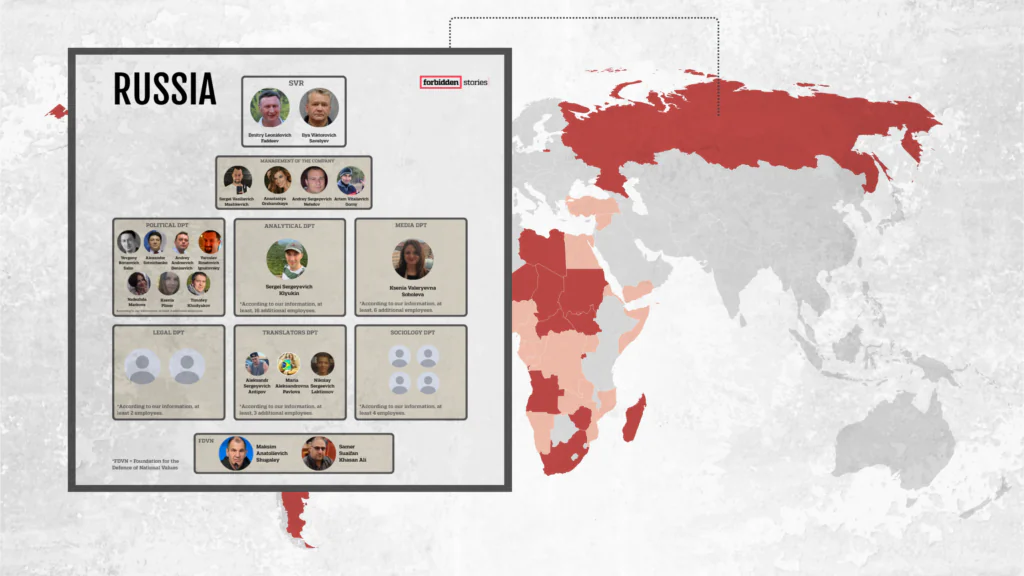
At the “Company”, a group of “34 specialists,” sometimes referred to as “sociologists” or “political technologists,” work under Klyukin’s supervision. Responsible for monitoring and analyzing the political situation in 15 countries, they write briefing notes and conduct telephone surveys with thousands of respondents — 1,133 in the Democratic Republic of the Congo in June 2024, another 1,024 in Mali in August, and so on.
Additional teams carry out online manipulation campaigns, in line with the Lakhta Project troll factory, which the “Company” partly initiated. In August 2024, according to internal invoices, someone named Ksenia Valeryevna Soboleva placed an order for fake Facebook accounts under the pseudonym “sobolevaksenia31.” She wrote, “Please create accounts with these names. Profiles of women: Aminata Djerma, Mariam Barka … and men: Oumar Koudou, Ali Barka … And for another man, if possible, (write the name) directly in Arabic.”
Soboleva, along with a woman named Dina Trumm, also made payments to pro-Russian Telegram accounts like the one run by journalist Abbas Djuma, who had 61,175 followers in August 2024 and was sanctioned by the United States. Since then, Soboleva has risen through the ranks and now heads the “Company”’s media department, according to Forbidden Stories’ information.
Fake websites are another tool in the “Company”’s arsenal. Aside from a missing “R,” the link to the site https://www.lobitocoridor.org/ is identical in appearance to that of the official Lobito Corridor website, https://www.lobitocorridor.org/. This strategic railway linking the port of Lobito in Angola to the Democratic Republic of Congo is crucial for the transport of minerals and for European and American investments. But with its false URL, the “Company” intends to spread increasing disinformation against Western interests.
Thousands of miles away from headquarters, Russian agents take charge in the field. In light of the data leak, Forbidden Stories can reveal that in addition to the Bolivian premises, offices were rented in Mali, Libya, South Africa and Rwanda in 2024. Sometimes, non-governmental “Russian Houses” — supposed cultural centers, unlike the Russian Houses attached to the Ministry of Foreign Affairs — serve as a rear base for Russian agents. Internal documents from the “Company” mention the opening of four new structures of this type in 2024, notably in Niger, Angola, Chad and Guinea.
Leave a Reply