To stay up to date on our latest investigations, join Bellingcat’s WhatsApp channel here.
Child soldiers linked to Sudan’s warring factions have gained viral fame on TikTok, with their videos attracting millions of views.
A Bellingcat investigation has found that the young boys – widely referred to as “lion cubs” – have become celebrated figures of the rival groups that have been fighting for control of the country since 2023.
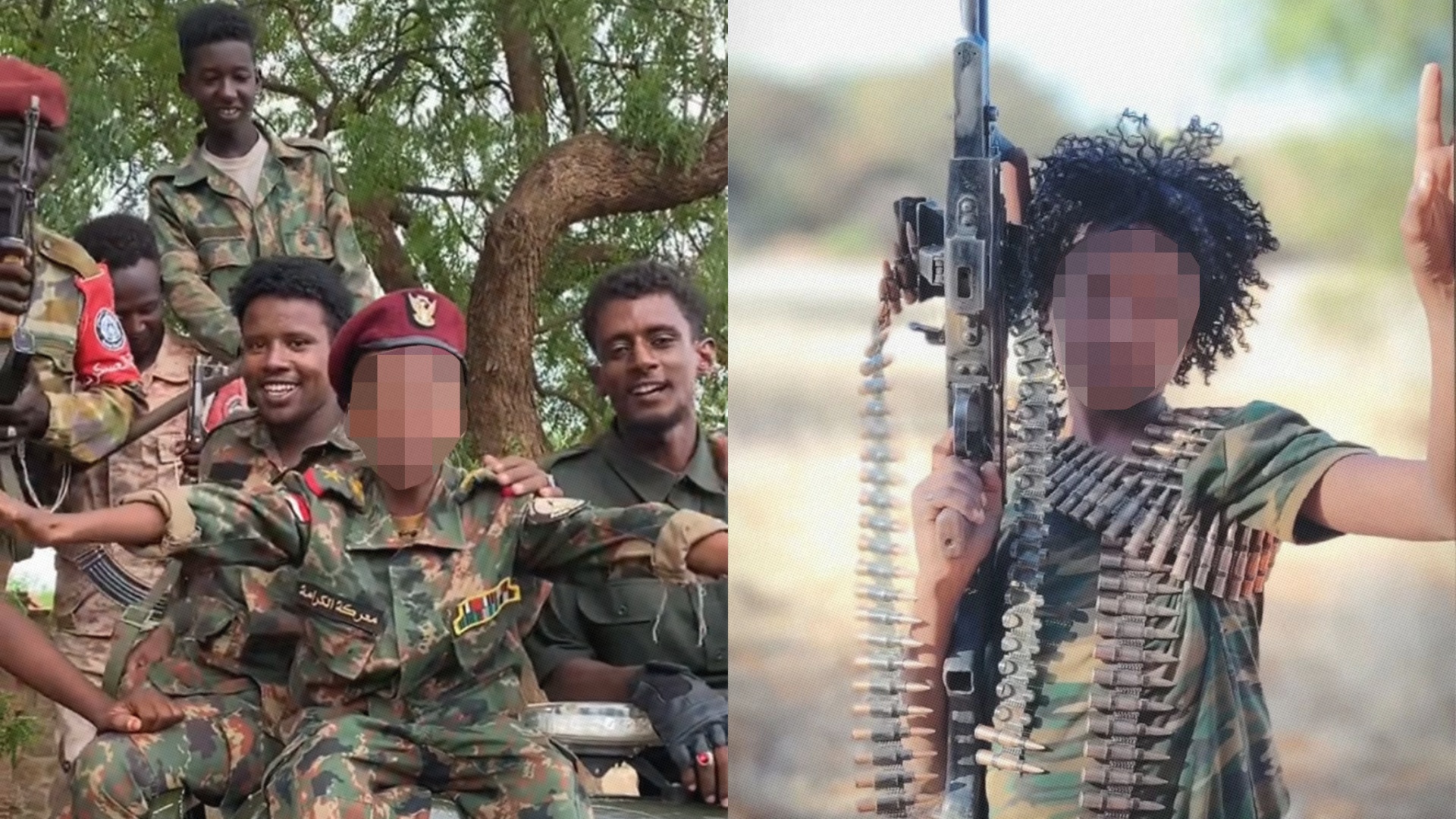
Many of the videos we reviewed show the children in military uniforms posing with fighters and senior officials from both sides of the conflict – the Rapid Support Forces (RSF) and the Sudanese Armed Forces (SAF). They are seen celebrating battlefield victories, delivering motivational speeches, and making violent threats. In some footage the children are armed.
Child soldier experts told Bellingcat that the visibility and popularity of this content, which portrays fighting as normal, celebrated and aspirational, could lead to the recruitment of more young people in the conflict.
Bellingcat flagged 12 TikTok accounts that had each posted viral content of child soldiers through the platform’s internal reporting mechanism. After more than 48 hours without action, we emailed TikTok to request comment, providing links to the reported content. This was done to give TikTok a further opportunity to review and remove the accounts, in order to minimise the risk of amplification by reporting on it.
Following our inquiry, TikTok removed seven of the reported accounts. The remaining active accounts continue to host more than a dozen videos featuring child soldier content, which, according to TikTok’s own guidelines, breaches its content policies.
Under the Paris Principles, to which Sudan is a state party, a child soldier is defined as a person under the age of 18 “who is or who has been recruited or used by an armed force or armed group in any capacity”, whether or not they are directly involved in hostilities.
Support Bellingcat
Your donations directly contribute to our ability to publish groundbreaking investigations and uncover wrongdoing around the world.
Bellingcat focused on two prominent “lion cubs” from opposing sides of the civil war to reveal how this content circulates across social media and gains traction – mostly on TikTok – despite platform rules that restrict content involving the exploitation and militarisation of children.
In some cases, the children film themselves near combat scenes, including in at least one instance with the bodies of recently deceased people. In others, they are filmed in choreographed appearances with high-profile commanders and political figures. The children are honoured as heroes by armed groups and their supporters, and their content is re-shared across hundreds of TikTok accounts, some of which have millions of followers.
Bellingcat is not including the names of the TikTok accounts or unblurred images of the children featured in the content due to their age. We also do not link to any of the accounts or posts to avoid amplification.
‘People Say I Will Die’: RSF Child Soldier
Bellingcat geolocated multiple TikTok videos showing an RSF “lion cub” – who appears to be a young teenager – celebrating the capture of the 22nd infantry division SAF base in Babanusa, a city in West Kordofan, in early December 2025.
The videos, posted by pro-RSF TikTok accounts and viewed millions of times, show the child’s movements on the ground in the aftermath of the takeover. In the weeks that followed, the child’s TikTok account gained tens of thousands of followers and recent posts amassed hundreds of thousands of views.
In a TikTok video posted to the child’s account on Jan. 1, 2026, in response to social media comments, the child says: “I see people on the [social] media saying that I will die. The person who dies is as if he has paid his debt” This video received more than 1,6 million views before TikTok removed the account following Bellingcat’s inquiry.
A video posted by a pro-RSF TikTok account in early
December, geolocated by Bellingcat, places the child at the
North entrance of the SAF base, holding an assault rifle and
celebrating alongside adult RSF fighters.
A second TikTok video shows him approximately 100 metres
away, running toward the base’s main entrance amid
audible gunfire, chanting “Allahu Akbar” and claiming the
takeover of the SAF’s 22nd Infantry Division.
A crowd gathered outside the main entrance is also
visible in the satellite image, consistent with RSF activity
in the immediate aftermath of the takeover.
In a third, particularly graphic TikTok video geolocated by
Bellingcat, the child films himself among what appears to be a group of close to ten dead bodies spread out on the ground inside of the SAF base.
Bellingcat identified objects consistent in size and placement with the grouping of bodies visible in the video on a high-resolution satellite image from Dec. 2. 2025.
Graphic imagery of bodies covered by Bellingcat. Number labels provided to show how we matched the positions of the bodies visible in the video to the satellite image.
The second TikTok video in which the child is running had been viewed more than two million times before it was removed. Its audio has since been reused in 200 additional videos on the platform, significantly amplifying its reach across pro-RSF networks.
A shorter version of the same audio appeared in more than 70 additional videos. These included dozens of AI-generated clips, characterised by an animated style and visible inaccuracies in uniform badges and flags. Many of these TikToks depicted the child alongside senior RSF figures, such as the group’s leader, known as Hemedti, and an officer known as Abu Lulu. On Feb. 19, 2026, Abu Lulu was placed under sanctions by the US Treasury Department for his actions during the RSF’s takeover of Al Fashir, as analysed by Bellingcat.
The RSF “lion cub” appears in another TikTok video posted the day of Babanusa’s takeover, alongside what appear to be captured SAF soldiers whom he mocks as he leads chants praising the RSF. This post received hundreds of supportive comments, many of which appear to come from RSF fighters.
Footage posted on Dec. 5. shows the child being celebrated by RSF fighters as he sits on the shoulder of RSF commander Salih Al-Foti. Two popular pro-RSF TikTok accounts, with a combined 1,4 million followers, reposted the video with the caption: “Commander Colonel Salih Al-Foti honours the hero Al-Shibli [the lion cub]”.
In the video, Al-Foti praises the bravery of the “lion cub”, a term the commander uses three times as he describes how the child was on the battlefield during the first entry of the 22nd infantry division SAF base. “I see that the whole world is talking about this lion cub,” Al-Foti says in the video. He also states that the RSF does not recruit children or ask individuals of such a young age to fight, claiming instead that minors sometimes appear among RSF forces without prior knowledge or approval, acting voluntarily and fighting alongside adult fighters.
Subscribe to the Bellingcat newsletter
Subscribe to our newsletter for first access to our published content and events that our staff and contributors are involved with, including interviews and training workshops.
Al-Foti’s commanding role during the takeover of Babanusa is confirmed in an official RSF video in which he discusses the operation. Salih Al-Foti was previously named in a 2023 report by the UN Joint Human Rights Office in Sudan. The document cites testimonies accusing RSF forces under his command of intentionally killing civilians in Nyala based on tribal or ethnic affiliation. Following the RSF takeover of Babanusa, Al-Foti was promoted to the rank of Major General according to social media reports. The RSF “lion cub” congratulated him in a TikTok video posted on Jan. 10, 2026.
In response to Bellingcat’s findings, El Basha Tebeig, a media representative and advisor to RSF leadership, stated that the Rapid Support Forces maintains a dedicated human rights unit within its military structure and is committed to international humanitarian law and the Geneva Conventions, which prohibit the use of children in armed conflict. He said the RSF commander had issued standing orders prohibiting the participation of anyone under the age of 18 in military operations.
Tebeig told Bellingcat that the incident at the 22nd Division base in Babanusa, in which a young child appeared in videos following the capture of the base, was unrelated to the RSF. When asked why the child sat on the shoulders of RSF commander Salih Al-Foti, Tebeig responded: “The child was present with his father to celebrate the liberation of the 22nd Division in Babanusa, and it is quite normal for children and women to attend such celebrations to participate in the festive atmosphere.” He also said that allegations concerning the use of child soldiers formed part of efforts by hostile political actors to damage the RSF’s reputation, and reiterated that the RSF remains committed to not using children in armed conflict.
‘Kill Every Traitor and Coward’: SAF Child Soldier
Bellingcat also identified the social media accounts of a viral SAF child soldier with more than 700,000 TikTok followers. The account name includes the term Shibli (شبلي), meaning “lion cub,” and its bio describes it as the “official account” of the child, alongside a note inviting advertising inquiries. This child appears to be younger than the RSF “lion cub”.
Unlike the RSF-linked child, the videos posted to this account show no activity near a frontline and appear to be carefully staged. The boy’s videos, which have amassed millions of views, repeatedly feature him in the SAF uniform (with SAF insignia on his beret, Sudanese flags and SAF camouflage) alongside armed soldiers and senior military figures, often in ceremonial or public settings.
In one TikTok video viewed nearly nine million times before it was taken down, the child recites a poem mocking RSF leader Hemedti. In another video, which received four million views, he delivers a speech in which he affirms Sudan’s unity from a raised platform surrounded by soldiers.
The “lion cub” also appears alongside senior figures in the Sudanese government. In one TikTok video, viewed more than seven million times, he is seen with Khaled Al-Aiser, Sudan’s information minister, declaring: “Our age does not allow us to take part in the war or to be mobilised alongside the army. Yet we wish to go to the front lines, carrying the DShK and the Goryunov machine guns, and driving a battle tank … We are small children, but in anger we are like a volcano: we erupt and kill every traitor and coward.”
Another TikTok video shows him with Minni Minawi, the leader of the largest faction of the Sudanese Liberation Army and the current governor of Darfur, whom he praises in a poem. The child also appears alongside Major General Abu Agla Keikel, a former RSF commander who defected to the SAF and now leads a force known as Sudan Shield, which has been accused of human rights violations, while reciting poetry in support of the group.
The visibility of child soldiers on both sides of the conflict has become a point of comparison and competition online. Several TikTok accounts, including a pro-RSF one with nearly one million followers, have posted videos inviting users to vote in the comments on which of the two viral child soldiers they support.
Bellingcat reached out to the SAF for comment through multiple channels but had received no response by the time of publication.
Child Soldiers on Facebook
The Facebook pages of both the SAF and RSF-affiliated child soldiers are less active and popular, with each having about 7,000 followers. However, in contrast to the children’s own TikTok accounts, the content posted on the Facebook pages of the children themselves shows them carrying weapons.
In one video posted to the Facebook page of the SAF “lion cub”, he is shown holding an assault rifle while reciting a poem threatening the RSF, saying that “slaughtering with a knife is sufficient, without the need for bullets”. Another video, from April 2025, shows the child standing beside a destroyed tank in Khartoum International Airport (15.60108, 32.54597), declaring the city liberated.
Meanwhile, a Facebook story posted to the page of the RSF “lion cub” in December 2025 shows him posing with a light machine gun and wrapped with ammunition belts.
Although Bellingcat found evidence of child soldier content visible on other social media platforms, we focused on TikTok and Facebook due to the higher level of user engagement surrounding the individual “lion cubs”.
How ‘Lion Cub’ Content Encourages Recruitment
Experts told Bellingcat that videos showing child soldiers in conflict helped to encourage recruitment, with armed groups using visibility and praise to draw other young people in.
Michael Wessells, professor of Clinical Population and Family Health at Columbia University, is a psychosocial and child protection practitioner who advises UN agencies on child soldiers and the psychological impacts of war on children. He said the public celebration of the children in these videos can directly encourage recruitment.
“What seems to be going on is the recruitment of children by honoring children who are willing to fight,” Wessells said. “They are given names such as ‘lion cubs’ that honor their strength and warrior nature, while bringing them into the fold at an early age.”
Wessells warned that online praise and virality can strengthen violent identities and normalise participation in armed conflict, particularly among adolescents seeking recognition, belonging, and purpose. He said the online presence of child soldiers had increased their reach and influence as recruitment tools.
Mia Bloom, professor of Communication and Middle East Studies at Georgia State University, and a leading expert on the exploitation and recruitment of children by armed groups, said the public elevation of child soldiers also turns them into powerful role models, used to motivate both adults and youth to join armed groups.
“They’ve become famous, almost equivalent to Disney child stars in the US, where everybody knows their name,” Bloom told Bellingcat. “The message becomes: look how famous he got by doing that – maybe if I join the movement, I can also be famous.”
Bloom warned that this kind of visibility can trigger a well-documented copycat effect among young audiences. When children go viral for their association with armed groups, she said, it helps legitimise participation in violence and presents it as normal, celebrated, and aspirational.
On youth-oriented platforms such as TikTok, the viral child soldiers give armed groups what Bloom described as an “attractive face” for younger audiences, signalling that participation can bring status, recognition, and fame. In this way, the elevation of child soldiers as online celebrities risks encouraging other young people to emulate them, transforming children into powerful recruitment symbols.
Dr Gina Vale, who has published research on the Islamic State’s recruitment and use of child soldier “cubs” in propaganda, added that the prominent depiction of armed children at combat scenes makes for very effective propaganda. Vale explained that the images of militarised children are designed to be shocking and emotive, while conveying the power and control of an armed group over future generations.
Children Increasingly Drawn into Sudan’s Civil War
Bellingcat’s findings come amid longstanding concerns about the recruitment of child soldiers in Sudan’s civil war. In 2023, the UN Special Rapporteur on trafficking in persons, Siobhán Mullally, warned that unaccompanied and impoverished children were being targeted by the RSF, as worsening food shortages, displacement, and the collapse of basic services left them vulnerable to recruitment, including into combat roles.
The UN Human Rights Council Fact-Finding Mission for Sudan reported in October 2024 that the RSF had “systematically recruited and used children in hostilities”, including in combat roles and in activities such as manning checkpoints and recording and disseminating abuses on social media.
With regard to the SAF, the Fact-Finding Mission said it had received credible reports of children joining youth groups under the banner of “popular mobilization” following leadership calls to counter RSF advances. The mission reported that videos circulated online showed youth and children under 18 being trained by SAF officers, and that children were observed manning checkpoints in SAF-controlled areas. It said further investigation was required to determine whether children had been formally recruited and used by the SAF.
In January 2026, Volker Türk, the UN High Commissioner for Human Rights, said he was: “deeply alarmed by the increasing militarisation of society by all parties to the conflict, including through the arming of civilians and recruitment and use of children” following a five-day mission to Sudan. Witnesses interviewed by Reuters also described 23 incidents in which at least 56 children were abducted by the RSF and allied militias in attacks dating back to 2023.
Social Media Platforms ‘Falling Short’
TikTok’s Community Guidelines say the platform is intended to “bring people together, not promote conflict,” and that it does not allow content involving “threats, glorifying violence, or promoting crimes that could harm people”. TikTok’s Youth Safety policies further states: “We don’t allow content that could harm young people—physically, emotionally, or developmentally.”
Marwa Fatafta, a tech policy expert at digital rights organisation Access Now, told Bellingcat that the content identified in this investigation violates multiple TikTok policies. She pointed out that TikTok’s human rights commitments include the Convention on the Rights of the Child, which require states to take all feasible measures to ensure protection and care of children who are affected by armed conflict.
Fatafta added that content involving child soldiers is prohibited under TikTok’s Human trafficking and Smuggling policy. She noted that it may also violate platform rules on violence and criminal behavior, given that the use of child soldiers can constitute a war crime under international law.
Facebook’s Human Exploitation policy also prohibits content that facilitates or exploits people through forms of human trafficking, including the recruitment of child soldiers. However, Fatafta told Bellingcat that Meta’s enforcement falls short of its stated commitments, saying: “Meta’s approach to moderating content coming from armed conflicts remains severely inadequate, ad-hoc and non-transparent.”
Sarah T. Roberts, Director of the Center for Critical Internet Inquiry at UCLA, said that while companies face intense scrutiny over child sexual exploitation material, especially from EU and US regulators, content involving child soldiers does not carry the same regulatory consequences and is therefore more likely to be deprioritised.
“If they can’t see the value, the tendency within these firms is to want to reduce the costs,” Professor Roberts said. Roberts added that social media companies tend to focus on areas where regulatory pressure is strongest, saying: “Are they going to cut content moderation around child sexual exploitation, or will they let things go under the wire in parts of the world that don’t frankly matter to them?”
Sheldon Yett, UNICEF representative to Sudan, told Bellingcat: “Regardless of if a child is portrayed in uniform or otherwise, the recruitment of anyone under 18 is a grave violation of child rights. Social media platforms have an obligation to ensure effective content moderation to prevent platforms from being used to facilitate such exploitation. As this war grinds on into the third year, children in Sudan are particularly vulnerable, and social media platforms must do more to keep children safe.”
Responses to Bellingcat’s Findings
Bellingcat reported 12 TikTok accounts, as well as two viral audios featuring the RSF child soldier that had been used in more than 270 additional videos, through TikTok’s internal reporting mechanism. The reports were submitted under the category “Exploitation and abuse of people under 18,” which explicitly prohibits content that shows or promotes the recruitment of child soldiers.
The reported content included accounts of the child soldiers themselves, as well as ten additional RSF- and SAF-aligned accounts with large followings that had shared or amplified videos depicting the children.
After more than 48 hours had passed without action, Bellingcat contacted TikTok by email to request comment, providing direct links to the accounts and audios that had been reported.
Following our inquiry, TikTok removed seven of the 12 accounts flagged, including the pages of the child soldiers and both of the viral audios. In the remaining five cases, TikTok removed only the specific posts referenced in our correspondence, leaving the accounts active. At the time of publication, four of those accounts continued to host content depicting the child soldiers identified in this investigation. One video of the SAF “lion cub” has more than 3,5 million views and a separate account is still hosting nine videos of the RSF “lion cub” that have collectively been viewed hundreds of thousands of times.
In response to Bellingcat’s findings, a TikTok spokesperson said: “We’ve removed content and accounts that violated our strict rules against facilitating and depicting human trafficking, including child soldiers. Of the content we removed for breaking these Community Guidelines, 98,2% was taken down before it was reported to us.”
Bellingcat also reported three Facebook accounts through the internal reporting mechanisms, including accounts belonging to the two identified child soldiers and an account belonging to an RSF fighter with more than 10,000 followers that had posted multiple videos featuring the RSF “lion cub”. After more than 48 hours had passed without action, Bellingcat contacted Meta directly to request comment, sharing our findings and providing links to the reported accounts, which were subsequently removed.
In response, Meta said it had removed the content for violating its policies, stating: “We do not allow content, activity or interactions that recruit people for, facilitate or exploit people through the recruitment of child soldiers.” The company also pointed to a 2025 safety messaging campaign in Sudan aimed at raising awareness among young users about the risks of child soldier recruitment.
At the time of publication, one week after reaching out to TikTok and Facebook, more than a dozen posts featuring the “lion cubs” remained accessible across both platforms simply by searching for the boys’ names.
This investigation was carried out in close cooperation with Radio Dabanga.
Merel Zoet, Galen Reich and Carlos Gonzales contributed to this report.
Riccardo Giannardi, a member of Bellingcat’s Volunteer Community, contributed research to this piece.
Bellingcat is a non-profit and the ability to carry out our work is dependent on the kind support of individual donors. If you would like to support our work, you can do so here. You can also subscribe to our Patreon channel here. Subscribe to our Newsletter and follow us on Bluesky here and Mastodon here.
Leave a Reply