By Daniel Hunter & Stephanie Guilloud
This article was originally published by Truthout
Our neighbors who confronted ICE in Minnesota have taught us how grieving gives us the courage to continue our dissent.
Fascism depends on our compliance. Authoritarians know they cannot sustain rule by individually repressing each person in the country. They use threats and violence to inflict fear — a primary weapon to force compliance.
If fear is their strategy for compliance, then we need a strategy for sustaining dissent.
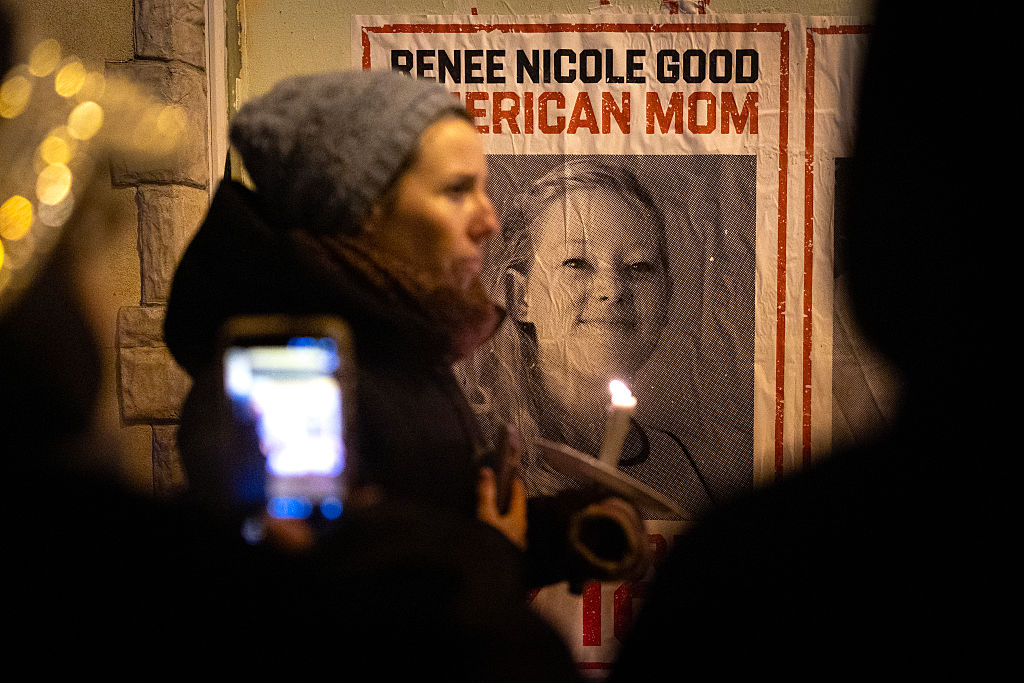
Amid Trump’s unjustified and illegal war on Iran, many of us need space to grieve — for the 150 children murdered by U.S. bombs, the many lives lost to Israeli and U.S.-backed genocide, and the long arc of imperialism and colonialism. Our neighbors who confronted the ongoing ICE siege in Minnesota with tenacity have taught us how grieving helps us cultivate the courage to continue our dissent. This lesson is evident in the way community members and organizers held Renee Good’s memorial ceremony in public while placing her killing within a broader political and historical context.
Fear Is the Authoritarian’s Strongest Weapon
Fear is the intended effect of the Trump regime’s paramilitary killings of Ruben Ray Martinez, Keith Porter Jr., and Julian Marquette Bailey. It’s why Border Patrol agents abandoned Nurul Amin Shah Alam, a nearly blind legal refugee from genocide in Myanmar, to die. And inside deportation facilities, deaths like those of Geraldo Lunas Campos and Wael Tarabishi grow out of the government’s deliberate neglect and deliberate indifference, the kind of cruelty that sends a message to everyone watching: This could be you.
So when Trump’s paramilitary forces killed Renee Good and Alex Pretti, they hoped people would get obedient and compliant with his version of law and order. They did not.
Unlike the apathy of corporations, political leaders, and those implicated in the Epstein files, the peoples’ reaction to violence looked like more urgency to resist, more action, more risk, more dedication.
They were not just reacting from a place of outrage, which can only motivate us for a brief time until the bone-tiredness sets in, followed by another wave of awful news. Outrage will not sustain. Their efforts took courage.
One ingredient for sustaining courage is the reminder that we are part of a longer history than just ourselves and that we must double down on love even in the face of loss and destruction. This is what intentional acts of public grief can provide.
As the U.S. and Israel create more death and destruction in an aggressive, violent, imperialist war, our connection to our humanity is tested again. We have a responsibility to access our emotional stamina, and that requires practicing grief with one another.
Grief is not just the processing of our losses — of our hopes and dreams, of people killed and lives ruined — or merely an attempt to find an acceptance. It’s a path to strengthen our resolve.
In a national call on how to organize a general strike, Korean labor leader Wol-san Liem from KPTU TruckSol said, “In Korea every time we have a protest, a strike or other meeting, we start by remembering our martyrs. We have a moment of silence and then we sing a song about remembering the martyrs of the democracy movement … [so] you are in fact inheriting the spirit of your martyrs and using that to mobilize.”
There are many ways of practicing grief. In the U.S. South, as a part of the Black radical tradition, community members pour libations and call out the names of people they have lost when they gather. We remember that we are not alone, we are not the first, and we are not the last to engage in this fight for dignity and justice. Remembering that truth and the names of people who bequeathed us this movement grows our collective courage.
As part of the farmworker movement, organizers with United Farm Workers held rosaries, masses, and funeral processions for fallen compañeros, turning mourning into marches for dignity and contracts. Irish resistance movements used funerals to organize when British colonialists criminalized meetings. In Argentina, the Madres de Plaza de Mayo carried photos of their disappeared children in weekly silent marches, turning grief into a living procession that refused to let the dead be forgotten.
In Iran, funerals against the regime held before the war were organized as deliberate acts of political protest, especially after the torture and death of Mahsa Amini in 2022. Families would announce burial times on social media and organized quickly to keep ahead of security forces. Following Shi’a tradition, gatherings would be held on the 3rd, 7th, and 40th day after death, creating built-in cycles of recurring protests where religious prayers would be said alongside anti-regime chants and acts of public defiance that included removing headscarves and holding signs.
Grieve in Public
Grief is the body protesting against what feels wrong — it is love persisting and enduring after that loss.
Understanding this truth helps us recognize why grief in public can be so important: To mourn and memorialize our loved ones and double down on continuing the practice of love.
Organizers’ initial efforts to support Renee Good’s family and community grew into something far larger than any of us anticipated. With their support and blessing, the idea evolved into a ceremony that shared Good’s capacity for love and her belief in the human spirit.
The memorial itself was a collaborative effort, initiated by Indigenous leaders who offered a spiritual ceremony for Good’s family, neighbors, and frontline defenders. National, local, and regional movement organizations participated by incorporating many elements of mourning and witness to include cross-racial and cross-community connections. We wanted to create something big enough and significant enough that the grief and memory could carve paths forward in this escalating fight against fascism.
Many decisions for the memorial felt fraught with such emotional weight. During a Saturday planning meeting, we received word that a nurse was shot and killed by ICE. We did not know his name at the time — Alex Pretti — but we asked ourselves, “Should we proceed? Do we need to shift to bring in his story?” In reality, grief for one person can open up space for grief for all. We already knew the ceremony would honor all those killed by ICE and other federal agents, so we invited Alex Pretti’s family and Keith Porter’s family and did our best to include the many layers of grief happening. We continued on.
We realized quickly we needed to go beyond traditional vigil formats. We did not want a passive audience watching others talking or singing. The answer came from NDN Collective, an Indigenous-led organization dedicated to building Indigenous power. Embodying resistance through generational lineages, they incorporated dance, drumming, and ritual into the memorial. We wove in other practices with a Minneapolis-based group called Singing Resistance leading the park in song and over 80 Grief Tenders, people who wore literal hearts pinned on their sleeves and moved through the crowd to offer personal witness to any who wanted to share a word, a hug, or tears.
Our bodies hold the tension, the pain, the suffering — and so we have to release through our bodies, too. In our planning meetings, we were reminded of this again and again as we needed to be present to each other and process while organizing. It’s not enough to strategize with our minds alone. We had to create space for movement, for touch, for tears, for the physical manifestation of collective mourning.
From the Core Team’s Message from the Frontlines:
NDN Collective held the first half of the ceremony with Chief Arvol Looking Horse, the 19th keeper of the Sacred White Buffalo Calf Pipe and Bundle. The ground vibrated. Dozens of Indigenous jingle dress dancers moved to songs rooted in a long tradition of prayers for healing; the drums echoing the heartbeat of Mother Earth and all of us. Scattered around the dense crowd, bundled in the cold. People fell into their arms in tears while others talked or shared silence together. More than one person told a grief tender that Saturday was their first time sobbing in public.
Giant star puppets graced the field of Powderhorn Park, billowing birds moved among 200 stars in the crowd, echoes of the beloved annual Mayday parade but this time on a frozen lake and a park full of snow. Gifts of sequined arm and head bands circulated through the crowd and glistened off winter hats — an homage to Renee’s sparkle.
The memorial for Renee Good was a chance for family members to receive medicine and healing and witness. Renee Good’s wife and sister offered words of gratitude — another act of courage. They noted their loved one’s name will be better known because of the dynamics of white supremacy in the U.S., and they ensured the memorial named every person killed by ICE in this Trump regime.
We hope that this memorial serves as a model for future acts of public grieving. We created a toolkit to help others lead their own ceremonies to name those killed by ICE, with the goal not of creating an exclusive ceremony but an inclusive and additive movement. We want to see memorials in every city where ICE has stolen a life. We want communities everywhere to reclaim the power of public grieving as an act of resistance.
Already, folks in D.C. have held a public vigil for Julian Marquette Bailey, killed by a U.S. Marshal. Because of the situation and his Black skin, the story did not resonate as widely across the media or the movement. But his family and the community feel no less pain and hardship, and they deserve all the love and support that can be mustered.
There have been vigils in Georgia for Heber Sanchez, in Alabama for people killed in state prisons, and a candlelight vigil honoring Keith Porter Jr. in California. Many have already used our toolkit — such as folks who held a ceremony of remembrance in Georgia, who proclaimed, “Every one, oh every one of these people are ours. Just like we are theirs.”
We Practice Our Grief in Public
These murders happen in public. They are sanctioned and paid for by public dollars and public institutions. And they aim to make us more afraid.
We will not let them. We will grieve the people we are losing, the futures lost, and the lives destroyed, to resist erasure, and to strengthen our nervous systems to continue our resistance. We do it to strengthen our collective resolve and remind us of the what the state is willing to do to defeat us. And we do it to challenge the way these deaths may be individualized or exceptionalized so we can remain courageous and together.
When we do this, it becomes impossible for the fascists to win. Not because we’ve defeated them in one final climactic battle, but because we’ve already built something better in the spaces between acts of state violence.
Standing in Minneapolis’s Powderhorn Park on February 7, thousands gathered to grieve and rage and dance and heal together. Those folks understood viscerally the truth shared by one of the frontline organizers, Becka Tilsen, a community defender and member of the memorial’s core organizing team: “We live in a world where Renee could be killed the way she was. But right here, right now, what we see around us, is also the world we live in. A world we are building with each other.”
This article was originally published by Truthout and is licensed under Creative Commons (CC BY-NC-ND 4.0). Please maintain all links and credits in accordance with our republishing guidelines.
Leave a Reply