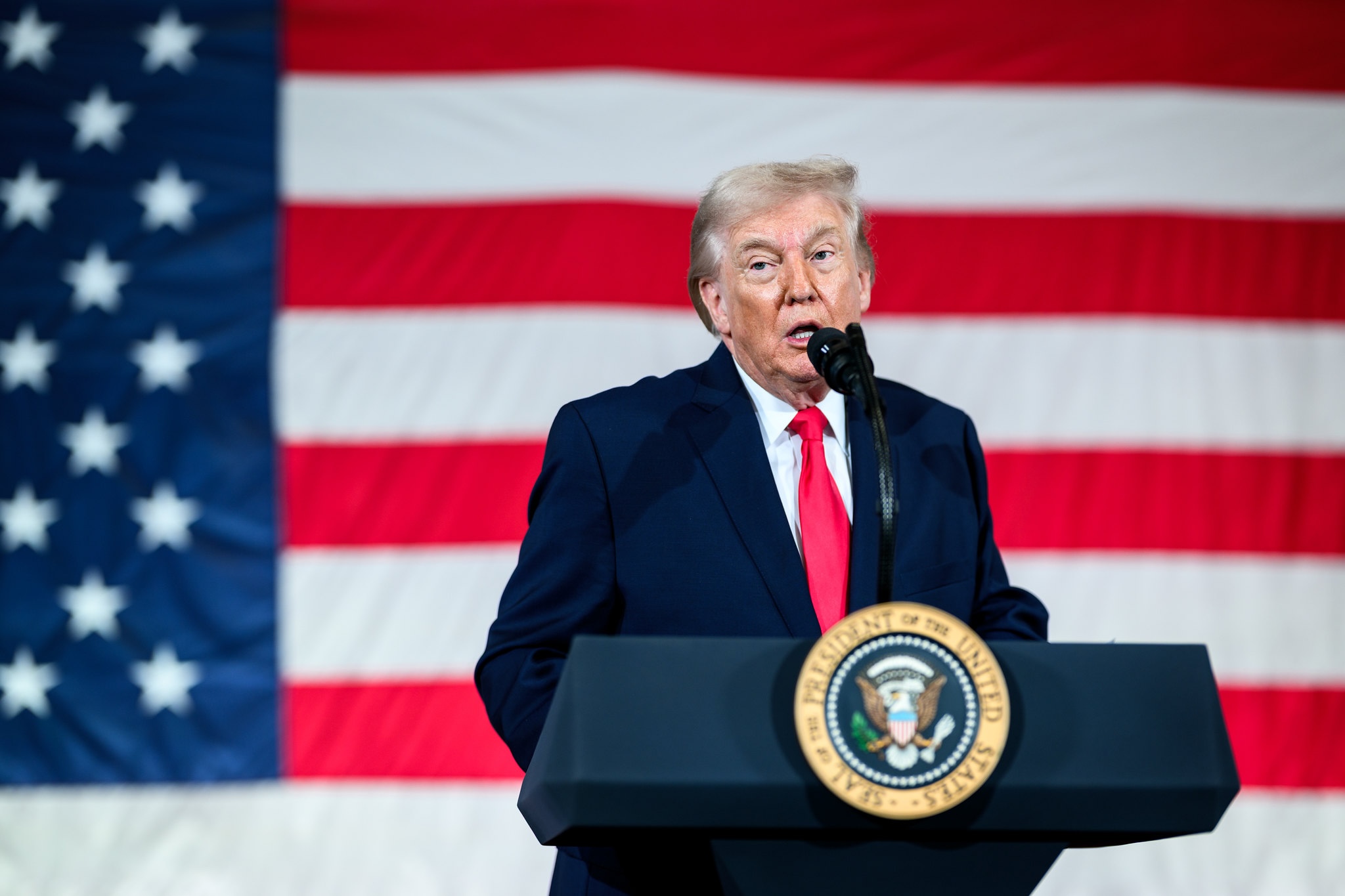
Even if war breaks out before he and Thomas Massie can bring a vote in the House next week, Ro Khanna says it’s important to get lawmakers on the record so voters can see where they stand.
President Donald Trump addressing military families at Fort Bragg, North Carolina, last week. (White House /Daniel Torok)
As U.S. President Donald Trump appears poised to launch a massive war against Iran, Reps. Ro Khanna and Thomas Massie say they will attempt to force the House to vote on a war powers resolution next week when Congress returns from recess.
“Trump officials say there’s a 90 percent chance of strikes on Iran. He can’t without Congress,” Khanna (D-CA) wrote on social media following reports of a massive U.S. military build up in the Middle East.
He said he and Massie (R-KY) “have a War Powers Resolution to debate and vote on… before putting U.S. troops in harm’s way,” adding, “I will make a motion to discharge to force a vote on it next week.”
It’s not the first time the progressive Khana and the libertarian Massie have teamed up in an attempt to check the White House, including on attacking Iran.
In June, days after Trump launched strikes against three Iranian nuclear sites in the 12-day war with Israel, the pair cosponsored a resolution along with 75 other representatives to require congressional approval for any further military actions. The bill stalled after a ceasefire between Iran and Israel.
This time full-scale war appears more likely. “Trump is positioning two aircraft carriers, a dozen warships, and hundreds of fighter jets to prepare for a possible war with Iran,” Khanna said.
“A war with Iran would be catastrophic,” he went on. “Iran is a complex society of 90 million people with significant air defenses and military capabilities. We also have 30,000 to 40,000 U.S. troops in the region who could be at risk of retaliation. Congress must do its job and stop this march to war.”
Trump officials say there’s a 90% chance of strikes on Iran. He can’t without Congress. @RepThomasMassie & I have a War Powers Resolution to debate & vote on war before putting U.S. troops in harm’s way. I will make a motion to discharge to force a vote on it next week. https://t.co/FWQ245D6B8
— Ro Khanna (@RoKhanna) February 18, 2026
Massie emphasized that Article I, Section 8 of the U.S. Constitution gives Congress the explicit authority “to declare war.”
Under the 1973 War Powers Resolution, the president is allowed to deploy military force without authorization from Congress, but only in narrow circumstances — when there is a “national emergency created by an attack upon the United States.”
Massie said: “There’s no imminent threat from Iran to invoke [this exception in] the 1973 War Powers Act.”
A discharge petition, which would force a war powers resolution onto the floor for a vote even without approval from the Republican majority, would require 218 members of the House.
Article I, section 8, clause 11
[The Congress shall have Power] To declare War, grant Letters of Marque and Reprisal, and make Rules concerning Captures on Land and Water
Which means, to initiate war requires Congress.
There’s no imminent threat from Iran to invoke 1973 WPA.
— Thomas Massie (@RepThomasMassie) February 19, 2026
It would not be the first war powers resolution to reach a floor vote. Multiple resolutions to rein in Trump’s ability to strike boats in the Caribbean and to wage war on Venezuela have come up just short in recent months.
In January, weeks after Trump’s operation to overthrow Venezuelan President Nicolás Maduro and commandeer the nation’s oil, a resolution requiring him to seek congressional approval for U.S. military presence there failed by a vote of 215-215, just one yes vote short of passing in the House, where a deadlock means legislation cannot be approved.
Massie was joined by one other Republican, Don Bacon (R-NE), in crossing party lines to vote with Democrats. [This time, Bacon told Axios, he is going to vote against it.]

U.S. Rep. Don Bacon, a retired U.S. military officer, with U.S. soldiers in Adazi, Latvia, May 24, 2022. (Eliezer Melendez /DoD/Public Domain)
Another prominent Republican critic of Trump’s warmongering, former Rep. Marjorie Taylor Greene (R-GA), had also joined in voting for previous war powers resolutions. However, she resigned from her seat in early January amid a falling out with Trump.
To take effect, the bill would also have to pass the GOP-controlled Senate.
Congress is currently on recess and will not return until Monday, by which time a war may already have begun. However, Khanna said the vote is still important.
“If Trump is preparing to bomb Iran soon and others call for troops on the ground, Congress must get on the record, so Americans know where their representatives stand,” he said.
Polls suggest that a war with Iran is overwhelmingly unpopular with the American people. A YouGov survey from earlier this month found that 48 percent said they strongly or somewhat oppose military action in Iran, compared with 28 percent who supported it and 24 percent who weren’t sure.
“Like the votes before the Iraq War, this could be one of the most consequential votes in the history of Congress,” Khanna said. “Are we going to stop another endless dumb foreign war? Or will the neoconservatives mislead us once again?”
The Trump administration has provided little in the way of a public justification for a new war with Iran, while Democratic leadership has been criticized for failing to forcefully stand against it.
“The American public hasn’t even gotten a semblance of a rationale from Trump as to why we have to attack Iran now,” said Nathan Thompson, a senior policy adviser at Just Foreign Policy. “Congress needs to call up a war powers vote and do its job immediately to stop this disaster from unfolding.”
Jake Johnson is a senior editor and staff writer for Common Dreams.
This article is from Common Dreams.
Views expressed in this article and may or may not reflect those of Consortium News.
Leave a Reply