The first time by her father, Reza Zarei, 47, as he rummaged through rubble, dust, and body parts in the chaotic minutes after several missiles struck the Shajareh Tayyebeh elementary school in the southern Iranian city of Minab. Raha’s body was limp, and half of her face was covered in blood.
It had barely been an hour since Minab’s residents realized a war had begun in their country, and just about 30 minutes since teachers had frantically started calling parents, urging them to pick up the roughly 300 children inside the school.
The second time, two days later, in a morgue.
Raha’s aunt, Farzaneh Bastami, 40, had begged to wash the lifeless body herself, a last act of care for her 7-year-old niece she had loved so dearly. But the traditional burial washers told her they’d be doing the washing later instead. They would cleanse Raha with soap and water, recite prayers over her, and wrap her small body in white cloth.

Bastami reacts to seeing the clothes Raha was wearing on the day of the attack for the first time, on March 28.
Still, Bastami moved through rows of the dead, lifting shrouds one by one, hoping for a last glimpse of her niece. There were children without limbs. Bodies without heads. And then, finally, Raha.

A green desk is visible amid rubble at the Shajareh Tayyebeh school in Minab on March 31.

An Iranian flag is draped over what is left of the Shajareh Tayyebeh school in Minab on March 31.

Children’s art hangs on a wall inside the damaged Shajareh Tayyebeh school in Minab on March 31.
It has been one month since the start of the U.S.-Israeli war against Iran, and since what appeared to be several Tomahawk cruise missiles—the United States is the only party in the conflict known to possess these weapons—struck Shajareh Tayyebeh school on Feb. 28, killing at least 171 people, most of them children.
The school sat next to the Sayyid al-Shuhada complex, a base that belongs to Iran’s Islamic Revolutionary Guard Corps (IRGC) but that has, since 2016, been clearly and visibly separated from the corps. Minab is a relatively conservative town near the Strait of Hormuz, home to self-described Bandai, or “port people.” According to teachers and several residents, the entire IRGC base had been inactive for about 15 years, with its buildings repurposed for civilian use including a clinic and a pharmacy. (An official with the education ministry in Minab to NBC News that the base was closed and all military personnel moved around 15 years ago.)
The Pentagon has said a probe into the incident is ongoing. Reuters has reported that U.S. military investigators believe U.S. forces were responsible for the strike, and that outdated targeting data may have been to blame.

An object, identified as a drone by a weapons expert, is seen in the sky above Minab on March 28.
The Feb. 28 bombing has not been the only attack on Minab since the start of the war. A month later, on March 28, drone strikes hit the area around the school and the nearby clinic, with at least one drone reportedly shot down. By then, the buildings had long been evacuated, and no one was injured.
Several weapons and drone experts, including conflict analyst Nick Waters, told Foreign Policy that, based on photos, the March 28 drones were likely previously undisclosed U.S. or Israeli models that may even still be in a testing phase.

Fariba Zarei, Raha’s mother (left), touches Raha’s backpack after seeing her daughter’s belongings for the first time since the Feb. 28 attack, on March 30. Mourning with her at the family’s home in Minab are Bastami and Raha’s grandmother.
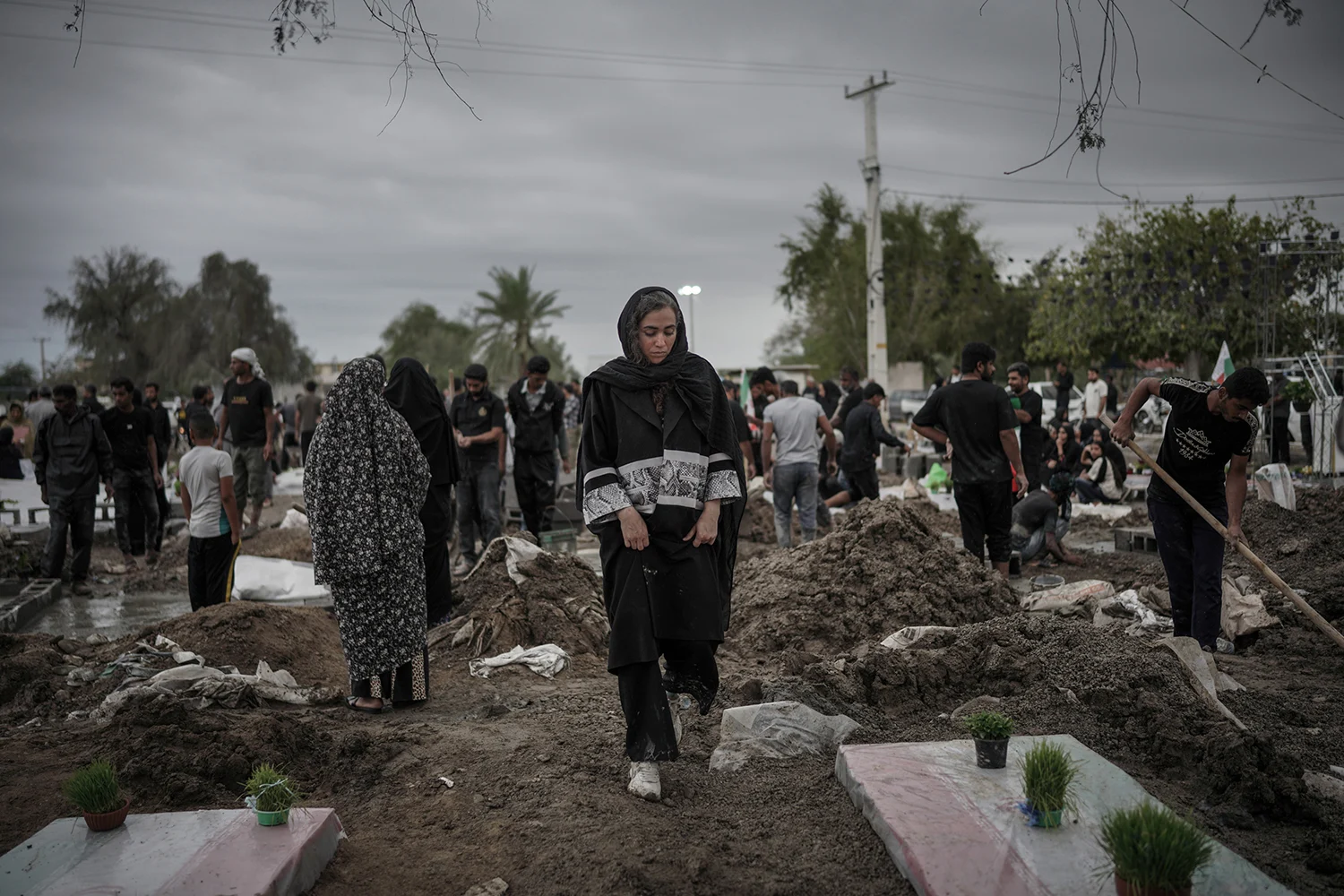
The recent attack has stirred new fear in Minab as the areas around freshly dug graves remain crowded with families who return daily, weeping and lingering in shock. With the war raging across the country, there has been little opportunity to process.
Raha Zerai, with her thick curly hair and contagious laugh, was an only child. Her mother, Fariba Zarei, 43, had prioritized her career as a midwife for 15 years before she met Reza, a salesman, through one of her colleagues. Neither of them had been sure they would ever have children; when Raha was born, she became the center of their world.

Bastami holds a portrait of Raha in Minab on March 30.
“She was silly, full of energy, always laughing, singing, making up little poems,” Bastami, Raha’s aunt and Fariba’s sister, told Foreign Policy. “Together we were always up to mischief. She loved school, and especially her teacher, and she kept telling us she wanted to study to become a dentist.”
In the family’s spacious apartment in the center of Minab, everything is a reminder of Raha: her carefully decorated room with Hello Kitty wallpaper; a hula hoop resting on the corner of her bed; colorful pens neatly arranged on her desk; a unicorn-patterned backpack.

Reza Zarei sits in his daughter’s bedroom among her things on March 30.
The family has few words left. Reza sits on Raha’s bed, his head buried in his hands, crying. Bastami shows a video from the funeral: relatives weeping, and Fariba nearly breaking down as they bid farewell to Raha in her open casket. Then another video: Raha standing on a lookout hill above Minab, smiling and dancing. “This is Minab, Iran,” she sings. “We have a beautiful city.”
Addressing the United Nations Human Rights Council in Geneva last week, U.N. Human Rights Chief Volker Türk called on Washington to accelerate its investigation into the strike and publish the result. “There must be justice for the terrible harm done,” he said.
Meanwhile, U.S. President Donald Trump in a Truth Social post threatened strikes “completely obliterating” Iran’s power stations and freshwater plants if Iran did not “shortly” agree to a deal of unspecified terms. In an address to the United States on Wednesday night, Trump seemed to double down on the prospect of U.S. strikes. “We are going to hit them extremely hard over the next two to three weeks,” he said. “We’re going to bring them back to the stone ages where they belong.”
On the ground in Minab, there’s little patience for Trump’s threats; there are still bodies to be buried.

Family members and loved ones gather at a burial site to mourn those killed in the Feb. 28 air strike, on March 26. Some hold portraits of the children killed.
The family of 10-year-old Mohammad Jafari had been waiting and searching for answers for an entire month.
While mass funerals were organized across the small city, Mohammad was one of three people still missing. His body has since been identified, but two others, including one student and one teacher, remain unaccounted for.
Mohammad’s father, Masoud Jafari, 33, said the family had searched for days alongside local authorities without finding any trace of their eldest son.
“Eventually, my wife, Khadijeh, and I were taken to Bandar Abbas for DNA testing, with our samples sent to Shiraz,” he said, referencing two larger cities in Iran. “Because of the war, everything was delayed.”
The weeks that followed were marked by sleepless nights and uncertainty for the family, including for Mohammad’s younger brother, Ilia Jafari, 5.
On March 29, just over a month after the attack, the call finally came. Masoud and Khadijeh’s DNA had been matched to a pair of legs. No head, and only part of a torso.

Mostafa sits on his motorbike looking over Minab on March 27.
Mostafa, 40, a Minab resident who only wanted to be referred to by his first name, witnessed the second missile strike on the school that was triple tapped and helped with rescue efforts, said many of the bodies were unrecognizable.
“Children had been torn apart, body parts flung into the distance,” he said. “We tried to rescue as many people as possible, but many were buried under heavy rubble.”
On March 29, in a mosque in Minab where the entire family had gathered, Mohammad was returned to his parents: wrapped in white cloth, laid in a simple plywood coffin adorned with red flowers. Khadijeh Jafari sat cross-legged on the floor, holding her firstborn son one last time before placing him back inside the coffin. He would be buried alongside dozens of other children killed in the strike.

Khadijeh Jafari places the shroud-wrapped body of her son into a coffin as she mourns alongside her husband and other family members at a mosque in Minab on March 29.
There were tears, silence, and a quiet, unbearable relief.
Mohammad had finally been found.
Leave a Reply