Support justice-driven, accurate and transparent news — make a quick donation to Truthout today!
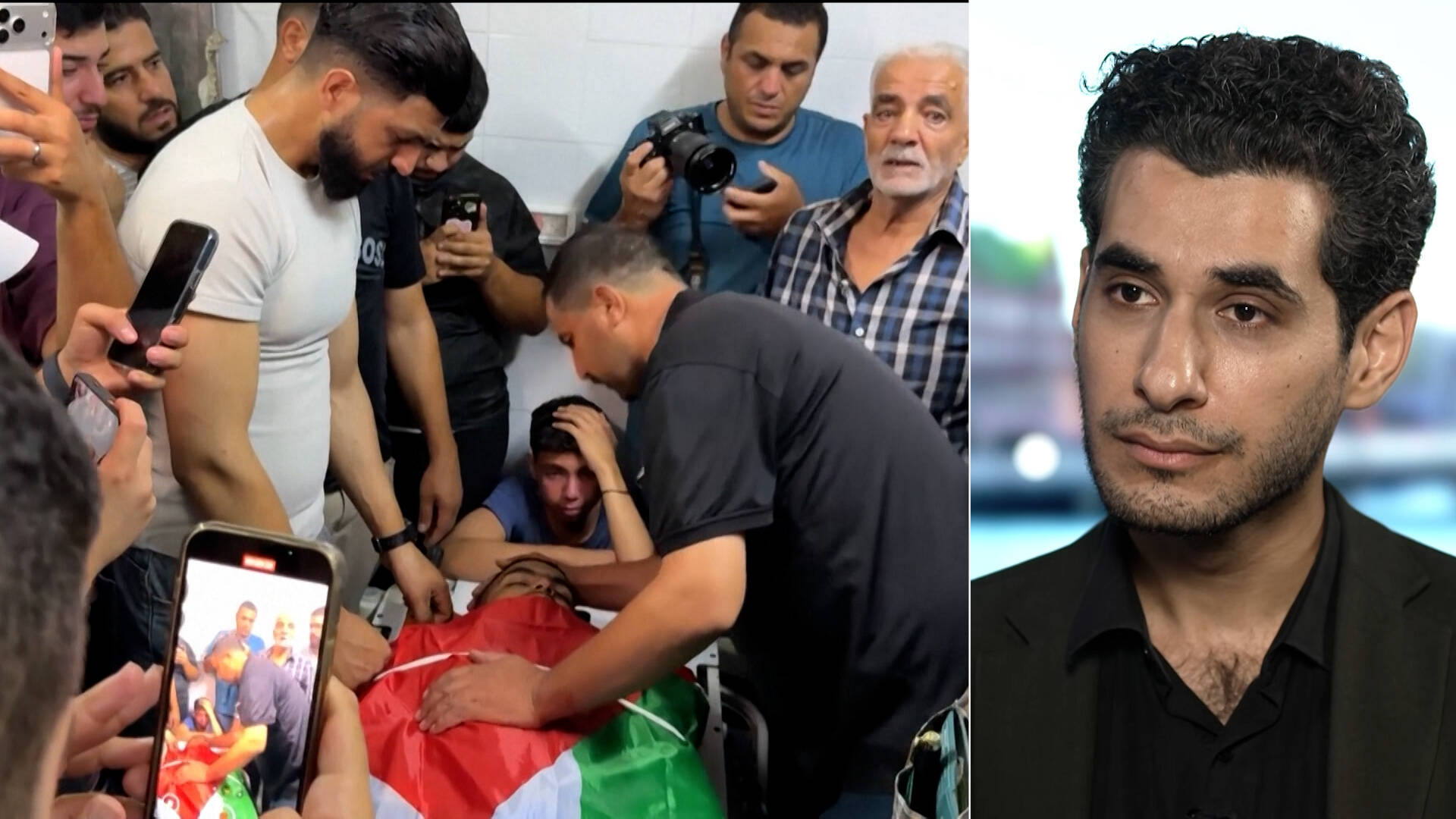
The Palestinian death toll from Israel’s war on Gaza has surpassed 74,000, according to the Ministry of Health in Gaza. While this figure represents the official death toll as confirmed by local authorities, the true number could be much higher when missing people and indirect deaths are taken into account, such as from disease, exposure, denial of medical treatment and the destruction of civic infrastructure. And since the so-called ceasefire brokered by Trump last October, nearly 1,400 Palestinians have been killed in Israeli attacks.
“The [ceasefire] plan ended up just buying more time for the genocide,” says Muhammad Shehada, a writer and analyst from Gaza speaking to Democracy Now! in Copenhagen. “Instead of suspending attacks on Gaza, Israel has been bombing Gaza every day.”
“The idea of the plan was to divide the reconstruction, rehabilitation, Israeli withdrawal, decommissioning of Hamas and Palestinian statehood into three phases,” says Shehada. “So far, only one item of the 20 items on the Trump plan has been fulfilled, and that is the release of every single Israeli hostage in Gaza.”
TRANSCRIPT
This is a rush transcript. Copy may not be in its final form.
AMY GOODMAN: This is Democracy Now!, democracynow.org, The War and Peace Report. I’m Amy Goodman. We are broadcasting from Copenhagen, Denmark.
The Palestinian death toll from Israel’s war on Gaza has surpassed 74,000. According to Gaza’s Health Ministry, Israeli attacks since the so-called ceasefire last October have killed more than 1,100 Palestinians. Gaza’s Government Media Office puts the toll even higher at more than 1,400. On Sunday, two Palestinians were killed in an Israeli airstrike on downtown Gaza City. Meanwhile, in the occupied West Bank, settler violence has killed at least 1,107 Palestinians since October 7, 2023.
On Monday, a senior U.N. official condemned what he called “the relentless expansion of Israeli settlements” in the occupied West Bank. This is U.N. Deputy Special Coordinator for the Middle East Peace Process Ramiz Alakbarov addressing the U.N. Security Council.
RAMIZ ALAKBAROV: I strongly condemn the relentless expansion of Israeli settlements in the West Bank, which fuels tensions, impedes access by Palestinians to their land and threatens the validity, viability of a fully independent, sovereign and contiguous Palestinian state. The rapidly expanding settlement footprint, including outposts, is taking place in conjunction with the rise in settler attacks.
AMY GOODMAN: Well, Democracy Now! is broadcasting from Denmark, which recently joined 20 other countries, as well as the European Commission, in signing a declaration opposing Israel’s planned settlement expansion in the occupied West Bank. Denmark, along with 11 other countries, is also backing sanctions on trade with Israeli settlements in the occupied West Bank. On Monday, Denmark’s permanent representative to the United Nations, Christina Markus Lassen, addressed the U.N. General Assembly.
CHRISTINA MARKUS LASSEN: In Gaza, civilians continue to pay the price. Far more must be done to secure humanitarian access and long-term peace. And in the occupied West Bank, settler violence and settlement expansion threaten the daily lives of Palestinians and undermine the prospects for a future Palestinian state. This has to stop.
AMY GOODMAN: That was Denmark’s ambassador to the United Nations, Christina Markus Lassen.
For more, we’re joined here in Copenhagen by Muhammad Shehada, writer and analyst from Gaza, visiting fellow at the European Council on Foreign Relations.
Muhammad Shehada, welcome back to Democracy Now! It’s wonderful to be here with you in the studio in Copenhagen. We’re usually interviewing you by Zoom. These are extremely harrowing times. It’s been almost a year since the Trump plan for Gaza was created, October 9, 2025. Can you explain what that plan is and what has been fulfilled so far?
MUHAMMAD SHEHADA: Thanks so much, Amy. Great to finally see you in person, one of my favorite heroes.
So, the idea of the plan was to divide the reconstruction, rehabilitation, Israeli withdrawal, decommissioning of Hamas, and Palestinian statehood into three phases. The first one was related to early recovery, so it would see Israel suspending its attacks, allowing 600 trucks per day of food and humanitarian aid into Gaza, rehabilitating basic infrastructure — water, electricity, hospitals, roads, sanitation — and basically opening up the Rafah border crossing for people to be able to travel in and out. The second phase was the one that relates to Hamas decommissioning and Israeli withdrawal from Gaza, as well as the reconstruction, the rebuilding of the enclave. And the third one is the long-term one that relates to Palestinian statehood.
So far, only one item of the 20 items on the Trump plan has been fulfilled, and that is the release of every single Israeli hostage in Gaza and the remains of dead hostages. Nothing else was completely fulfilled. Israel either violated its obligations completely or fulfilled some of them extremely partially, to the point that it does not have any significant impact on the ground. For example, food, instead of 600 trucks of humanitarian aid per day, we are getting an average of 95 trucks per day, which is less than 20%. Instead of suspending attacks on Gaza, Israel has been bombing Gaza every day — as you mentioned, 1,400 people killed since the so-called ceasefire started.
And the idea here is that the plan ended up just buying more time for the genocide, allowing Israel to continue it with sort of low intensity, low profile, amid a facade and promises of progress. But those promises, if there is no enforcement mechanism behind them, they read mostly as a wish list. They don’t read as a plan.
AMY GOODMAN: Why did Palestinians sign this deal? You’re a Palestinian from Gaza.
MUHAMMAD SHEHADA: I’ve asked Palestinian negotiators and Arab mediators, as well, what was the highest expectation behind the deal, and the answer is unanimous. Nobody expected it to be fulfilled completely. The highest ambition was three things: allowing more food to go in, at a point when Israel manufactured famine in Gaza, reducing the Israeli killing machine in Gaza as much as possible — so, before that ceasefire was put in place, Israel was killing an average of a hundred people per day. Now it’s about five people per day, which is still monstrous and atrocious. But the idea was to reduce the rate of the killing. And the third one was to prevent the mass migration or the mass ethnic cleansing in Gaza. That was the ambition from the Palestinian end and Arab side.
The other dimension is that they were blackmailed very openly by the Trump administration, that if they don’t sign onto that deal before the Nobel Peace Prize was announced on Friday in that October 2025, that Netanyahu would get a total free hand to decimate Gaza and annihilate it. So, Arab mediators told us that Steve Witkoff, Jared Kushner would keep nudging them daily to say, “You need to get a deal by Wednesday. You need to get a deal by Thursday. The Nobel Peace Prize is going to be announced tomorrow, and we want to make the big guy happy.” That was the idea of the deal.
AMY GOODMAN: And, of course, President Trump was not the winner of the Nobel Peace Prize.
MUHAMMAD SHEHADA: Precisely, but he managed to steal it anyways from Machado.
AMY GOODMAN: Yes, from the Venezuelan woman who won the Peace Prize. She handed her trophy to him, though the Nobel Committee said, “Doesn’t matter who hands a trophy to anyone. We give out the prize.” If you can talk about at this point what role Netanyahu is playing?
MUHAMMAD SHEHADA: Well, Netanyahu is doing two things. Number one, he is using Gaza, the destruction there, the settler terrorism that we see in the West Bank, as his election campaign. So, he’s promising the Israeli public that if he’s reelected, he will finish the job in Gaza. We’re seeing him, his Minister of Defense Israel Katz, his Minister of Finance Bezalel Smotrich, all of them promising, one after the other, that Israel’s plan for Gaza remains resuming military operations back to full scale, doing even more destruction than what we have seen before, because now Israel doesn’t have any hostages in there, so they can accelerate the damage and destruction exponentially, and basically ethnically cleansing Gaza completely and rebuilding Jewish-only settlements in the enclave. So, that is number one.
The other thing is that Netanyahu is trying to show that he’s stronger than the United States and the international community, that he cannot be pressured by Trump. So, when the Trump plan was announced and the Trump roadmap was then announced this year, I think in July, when Hamas accepted to disarm, lay down its arms, in return for Israel’s withdrawal, Netanyahu used it for his theatrics to pretend to be stronger than Trump, to pretend to be the Winston Churchill of Israel, that he can stand on his own against a storm and not bend at all. And one of the reasons for this is because opposition parties in Israel are attacking Netanyahu from the right, not from the left. So, Gadi Eisenkot, the next premier in Israel, supposedly, the one with the highest chance of winning and becoming prime minister, has been telling the Israeli public that Netanyahu will, quote, “squander” and waste away the achievements, the military achievements, of the IDF in Gaza and capitulate to Trump and fulfill his roadmap. So, Netanyahu is stuck in the position of pretending that, “No, I am actually stronger than Trump, and I can prevent any progress.”
AMY GOODMAN: I wanted to get your response to the foreign minister of the U.K. We were just in London yesterday. Ed Miliband was in Liverpool addressing the Labour Party.
ED MILIBAND: And I want to say to the millions of people in this country, and indeed elsewhere, who have been moved and outraged by the plight of the Palestinian people: We hear you. You were right. … We call out ethnic cleansing by the settler terrorists in the West Bank. We call out the evidence of war crimes in Gaza. We call out Israel’s illegal occupation of Palestine. And we match words with action. We will ban the import of goods from illegal settlements. We will disrupt the supply lines of British finance, British construction and British services for illegal settlements. And when it comes to the attempt to destroy the two-state solution, this party, this movement, this government says: We will not let you succeed.
AMY GOODMAN: So, that’s the British Foreign Minister Ed Miliband on Monday, saying there will be new economic sanctions on Israeli settlements. The speech came a day after police, though, arrested more than 50 protesters outside the Labour Party conference in Liverpool, with demonstrators nonviolently urging support for the banned direct action group Palestine Action in the U.K. Muhammad Shehada?
MUHAMMAD SHEHADA: It’s extraordinary and very surprising to me. A few years ago, before October 7th, before the genocide in Gaza, the idea of even demanding from those governments to impose sanctions on Israeli settlements was so laughable, so impossible and unthinkable, that no one would even try to bring it up. And what we see now with Ed Miliband, it’s an extraordinary speech. It was very heartwarming to watch, especially from someone that comes from a Jewish background, that grew up in a household that was very supportive of Israel. And to see that transformation, it shows even more deeply that it’s not about Ed Miliband himself. It shows the fundamental shift in public opinion in the United Kingdom, that now those in power are trying basically to catch up with where public opinion is.
Nonetheless, what we see here is an extraordinary shift in rhetorics, but not an equally strong shift in actions. There’s still more that needs to be done: banning weapon exports to Israel, basically sanctioning Israeli government officials, Netanyahu himself, his entire Cabinet, the Israeli army. If Ed Miliband is saying that war crimes were committed in Gaza, that incriminates the chain of command.
And the last point is that I hope that Miliband’s speech is the future of the Democratic Party in the next few months.
AMY GOODMAN: The son of the imprisoned Palestinian leader Marwan Barghouti — his name is Arab Barghouti — was recently interviewed by Piers Morgan and shared his reaction to seeing National Security Minister Itamar Ben-Gvir taunting his father in prison in a video.
ARAB BARGHOUTI: As a son, it was a shock to me to see my father in this condition. And this is important to highlight, that my father has been put in solitary confinement right after October 7th, even though, obviously, he has nothing to do with it. He has been tortured, assaulted multiple times, attacked.
PIERS MORGAN: Do you ever get to see him or speak to him?
ARAB BARGHOUTI: I haven’t been able to see him in four years. I haven’t been able to speak to him in four years. I haven’t been able to hug or even touch my father in 25 years. And this is an experience —
PIERS MORGAN: In 25 years?
ARAB BARGHOUTI: Yes, and this is an experience that thousands of Palestinians go through.
AMY GOODMAN: So, that was the son of Marwan Barghouti. And for a global audience, if you can talk about Marwan Baghouti’s significance? On Saturday, you wrote on social media, quote, “Releasing Marwan Barghouti would be the most consequential event in Palestinian politics since the death of Yasser Arafat. He’s the only leader that can unify Palestinians, & that’s precisely why Netanyahu told John Kerry he’d never release him!” That’s what you wrote. Explain.
MUHAMMAD SHEHADA: Absolutely. So, I remember exactly the day when the Israeli security minister, Ben-Gvir, stormed Marwan Barghouti’s prison cell, and that video showed up. And I remember being at a conference with fellow Palestinians, some of whom were very critical of Fatah, the party that Marwan Barghouti comes from. And as soon as we watched that footage, it felt like a dagger that was basically stabbing you straight to the heart, to everyone around the table. It was so shocking, because Barghouti has been established in our minds, in our collective memory, as the father of the Palestinian nation, as our own Nelson Mandela.
And basically, that legend allows him, when he comes out, to do things that other Palestinian leaders in today’s political mainstream are incapable of doing, one of which is to unify the Palestinian factions, to heal the divide and accomplish total reconciliation. We see that in every poll, Marwan Barghouti is, by a giant margin, leading against any opponent from Fatah or Hamas or any other political party, for that matter. And that’s precisely why you have people even in the Israeli lobby in the United States or in the Israeli army and the Israeli government that are in favor of releasing him, because from their perspective, the power of Barghouti allows him to take steps of reconciliation and compromise vis-à-vis Israel that no other Palestinian leader would be able to without his legitimacy coming into question. From our perspective, it’s basically we see that he would revitalize the Palestinian street. He would reestablish the connection between the leadership and the public and energize our movement again. And that’s precisely why Netanyahu told John Kerry in 2013 that he would never release him, because he’s the only one that can unify Palestinians.
Releasing him at this stage is the single most consequential event in reviving Palestinian politics, that has been long murdered by a veto from the United States, from Israel, from the international community, that heavily invested in maintaining the divide between Gaza and the West Bank, Hamas and Fatah, the diaspora and Palestinians in the occupied territory. And that’s precisely why we need to add it as an agenda item for the Democratic Party in the United States. I saw Ro Khanna already advocating for his release, and that is the right thing to do at this stage.
AMY GOODMAN: Finally, NAZA has just been released, the documentary by Yuval [Abraham] and Rachel Szor, a film that portrays the Israeli military’s use of secret AI-powered systems to deliberately and systematically target and kill civilians in Gaza, received this record ovation at the Venice Film Festival, exposing Where’s Daddy? and Lavender, something Yuval has been reporting, and others, Palestinians and Israelis, have been talking about, but all in this film — Yuval Abraham. If you can, finally, comment on the significance of this film and the Israeli — some officials in the Israeli government threatening to remove the citizenship of these filmmakers?
MUHAMMAD SHEHADA: So, the movie NAZA, it perfectly captures the distinction between disproportionate warfare, in which you are attacking an enemy and then civilians in high numbers are getting killed, and genocide, in which the civilian population is the target. If you watch the movie, you can’t help but come out with the impression that Hamas, in that instance, Hamas militants that were being targeted, were basically the excuse or the alibi or even the collateral damage, that you see Israeli soldiers that are saying that they were authorized to drop a bomb that would kill 500 civilians, most of whom are children and women, to get to one junior Hamas militant that even may or may not be there in the first place. And the idea is to use that militant as an excuse for maximum damage. That’s why we saw the chief of staff of the IDF at the start of the war, Herzi Halevi, saying that “the focus for us is on the damage, not on the accuracy.” That’s why we’re seeing Israeli politicians and military generals and commanders throughout the genocide that were telling their soldiers explicitly, “Destroy everything. Don’t leave anything standing. Maximum destruction.”
I even met Israeli soldiers here in Copenhagen. A colleague of mine brought them here to testify before European decision-makers and politicians. And when I met them, their testimony was very simple. It was three things: We were told to destroy everything in our face, we were told to kill every single person that crosses an invisible line, and we were told to use people as human shields systematically. The problem is that most decision-makers refused to even meet with those soldiers to hear the testimony, because they wanted to maintain plausible deniability. So, now having that power being captured in image, in art, it is extraordinary, and that’s why Israel feels threatened.
AMY GOODMAN: Muhammad Shehada, I want to thank you so much for being with us, writer and analyst from Gaza, visiting fellow at the European Council on Foreign Relations, lives here in Copenhagen.
Next week marks the 25th anniversary of the 2001 U.S. invasion of Afghanistan. We’ll speak with the Danish Afghan journalist Nagieb Khaja. His most recent documentary on Afghanistan is titled Winning Hearts and Minds. In 2008, he was kidnapped by the Taliban, but escaped. Stay with us.
[break]
AMY GOODMAN: “Ella’s Song: We Who Believe in Freedom Cannot Rest Until It Comes,” Sweet Honey in the Rock, performing at the 2025 Peace Ball.
Media that fights fascism
Truthout is funded almost entirely by readers — that’s why we can speak truth to power and cut against the mainstream narrative. But independent journalists at Truthout face mounting political repression under Trump.
We rely on your support to survive McCarthyist censorship. Please make a tax-deductible one-time or monthly donation.
Leave a Reply