Israel is to revoke the licenses of 37 aid groups working in Gaza and the occupied West Bank, saying they failed to meet requirements under new registration rules.
Well-known international non-governmental organisations (INGOs) such as ActionAid, the International Rescue Committee and the Norwegian Refugee Council are among those that will have their licenses suspended on 1 January, with their operations to end within 60 days.
Israel said the groups, among other things, had failed to hand over “complete” personal details of their staff.
The move was heavily criticised by foreign ministers from 10 countries including the UK, who said the new rules were “restrictive” and “unacceptable”.
In a joint statement, the foreign ministers of the UK, France, Canada, Denmark, Finland, Iceland, Japan, Norway, Sweden and Switzerland said the forced closure of INGO operations would “have a severe impact on access to essential services including healthcare”.
They added that the humanitarian situation in Gaza remained “catastrophic” and called on Israel’s government to ensure INGOs were able to operate “in a sustained and predictable way”.
Israel’s Ministry of Diaspora Affairs, which is in charge of registration applications, said the new measures would not impact the flow of humanitarian assistance to Gaza.
It added that aid continued to be delivered through “approved and vetted channels”, including UN agencies, bilateral partners, and humanitarian organisations.
It said the primary reason aid groups were having their licences revoked was “the refusal to provide complete and verifiable information regarding their employees,” which it said was critical to preventing “the infiltration of terrorist operatives into humanitarian structures”.
Earlier this month, UN-backed experts said there had been improvements in nutrition and food supplies in Gaza since a ceasefire was brokered between Israel and Hamas in October, but 100,000 people still experienced “catastrophic conditions” the following month.
Israeli military body Cogat, which controls Gaza’s crossings, said the organisations that will be suspended “did not bring aid into Gaza throughout the current ceasefire”.
It added that “even in the past their combined contribution amounted to only about 1% of the total aid volume”.
The Ministry of Diaspora Affairs said that fewer than 15% of organisations providing humanitarian assistance to Gaza were found to be in violation of the new regulatory framework.
That framework includes several grounds for rejection, including:
Denying the existence of Israel as a Jewish and democratic state
Denying the Holocaust or the Hamas-led attacks on Israel on 7 October 2023
Supporting an armed struggle against Israel by an enemy state or terrorist organisation
Promoting “delegitimisation campaigns” against Israel
Calling for a boycott of Israel or committing to participate in one
Supporting the prosecution of Israeli security forces in foreign or international courts
The Humanitarian Country Team of the Occupied Palestinian Territory – a forum that brings together UN agencies and more than 200 local and international organisations – previously warned that the new registration system “fundamentally jeopardises” the operations of INGOs in Gaza and the West Bank.
“The system relies on vague, arbitrary, and highly politicised criteria and imposes requirements that humanitarian organisations cannot meet without violating international legal obligations or compromising core humanitarian principles,” it said.
It added: “While some INGOs have been registered under the new system, these INGOs represent only a fraction of the response in Gaza and are nowhere near the number required just to meet immediate and basic needs.”
According to the Humanitarian Country Team, INGOs currently run or support most of Gaza’s field hospitals and primary healthcare centres, emergency shelter responses, water and sanitation services, nutrition stabilisation centres for children with acute malnutrition, and critical mine action activities.
In a statement, Israel’s Minister of Diaspora Affairs and Combating Antisemitism, Amichai Chikli, said: “The message is clear: humanitarian assistance is welcome — the exploitation of humanitarian frameworks for terrorism is not.”
Other organisations to be suspended include CARE, Medico International and Medical Aid for Palestinians.
Ellie House and Mike WendlingGainesboro, Tennessee
BBC/Ellie House
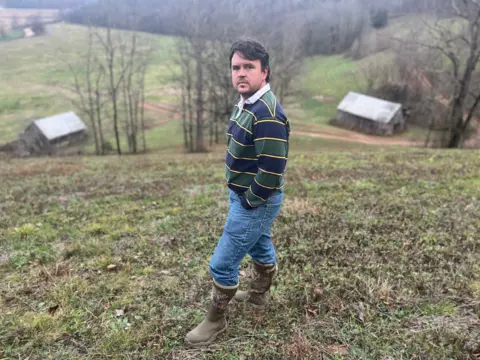
Real estate developer Josh Abbotoy on the site of his planned future development outside Gainesboro. Abbotoy’s customers, including two self-described Christian nationalists, have caused controversy locally.
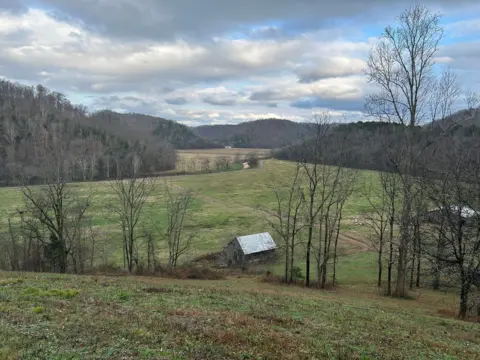
As Josh Abbotoy gazes out at lush green woods and pastureland nestled among Tennessee’s Appalachian hills, he describes what he intends to build here: a neighbourhood with dozens of residential lots, centred around a working farm and, crucially, a church.
“A customer might very well buy and build roughly where we’re standing right now,” he says as we hike up to the top of a ridge.
Mr Abbotoy is founder of the real estate company Ridgerunner, which has bought land here and in neighbouring Kentucky. But his is no garden-variety housing development.
Mr Abbotoy is prominent in US conservative circles and describes his development as an “affinity-based community” – marketed to people not only interested in the peace and quiet of rural life, but in a constellation of right-wing ideals.
“Faith, family and freedom,” he says. “Those are the values that we try to celebrate.”
BBC/Mike Wendling
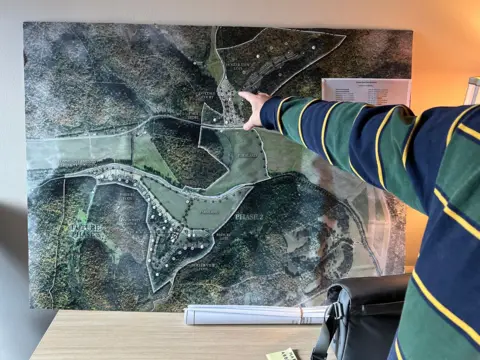
Josh Abbotoy points to a map of his development in the Ridgerunner offices in Gainesboro
Initially he didn’t attract much local attention after setting up shop in Jackson County.
But in late 2024, a local TV news report broadcast controversial statements made by two of Mr Abbotoy’s first, and most outspoken, customers: Andrew Isker, a pastor and author originally from Minnesota, and C Jay Engel, a businessman from California.
They are self-described “Christian nationalists” who question modern values, such as whether female suffrage and the civil rights movement were good ideas, and call for mass deportations of legal immigrants far in excess of President Donald Trump’s current plan. Another thing they sometimes say: “Repeal the 20th Century.”
The TV report raised an alarm bell amongst some local residents.
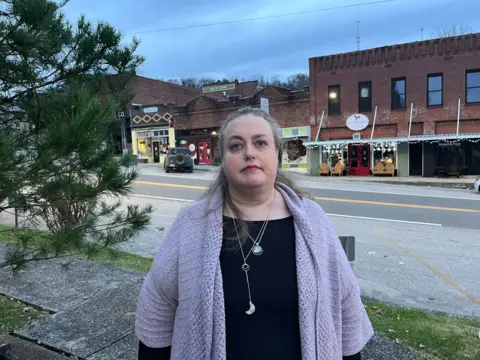
“You don’t know who these people are, or what they’re capable of,” says Nan Coons, a middle-aged woman who spoke in a firm southern accent during a recent interview near the town square in Gainesboro – of which this land is a part.
“And so it’s scary.”
Although Abbotoy himself does not identify as a Christian nationalist, he says concerns about his tenants are overblown.
The Ridgerunner development has since drawn national attention. And people in Gainesboro, home to around 900 people and one traffic light, have now found themselves in the middle of a dispute that is a proxy for much bigger political battles.
Podcasters move in
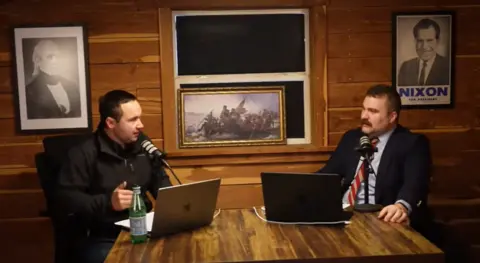
Mr Isker and Mr Engel announced their move to Gainesboro last year on their podcast Contra Mundum – Latin for “against the world”.
On their show, which is now recorded in a studio within Ridgerunner’s Gainesboro office, they have encouraged their fans to move into small communities, seek local influence, and join them in their fight to put strict conservative Christian values at the heart of American governance.
“If you could build places where you can take political power,” Mr Isker said on one episode, “which might mean sitting on the [board of] county commissioners, or even having the ear of the county commissioners and sheriff… being able to do those things is extremely, extremely valuable.”
Contra Mundum
C Jay Engel (l) and Andrew Isker (r) shown during an episode of their podcast
On X, Mr Engel has popularised the idea of “heritage Americans” – a fuzzy concept but one that applies mainly to Anglo-Protestants whose ancestors arrived in the US at least a century ago. He says it is not explicitly white, but it does have “strong ethnic correlations”.
He’s called for mass deportations of immigrants – including legal ones – writing: “Peoples like Indians, or South East Asians or Ecuadorians or immigrated Africans are the least capable of fitting in and should be sent home immediately.”
In their broadcasts and writings they have also expressed anti-gay sentiments. The podcasters deny they are white nationalists.
Both are Ridgerunner customers, and Mr Isker’s church will move into the community’s chapel when it’s complete.
The ‘resistance’
Their hardcore views have alarmed residents, with some locals setting up an informal resistance group.
“I believe that they have been attempting to brand our town and our county as a headquarters for their ideology of Christian nationalism,” says town matriarch Diana Mandli, a prominent local businesswoman who until recently owned a pub on Gainesboro’s central square
Late last year, Mandli led the charge by writing a message on a chalkboard outside her business: “If you are a person or group who promotes the inferiority or oppression of others, please eat somewhere else.”
BBC/Mike Wendling
More signs opposed to the new development followed. When people caught wind that the Ridgerunner guys were holding a meeting at a nearby fast food joint, dozens turned up to confront them.
Ms Coons, whose ancestors have lived in Gainesboro since around the time of the US Revolutionary War, says she engaged Mr Engel in conversation.
“He explained to me that what they’re promoting is what he called ‘family voting’… one vote per family, and of course, the husband in that family would be the one voting” with women frozen out of the electorate.
Mr Engel has since said publicly that it’s not “wrong” for women to vote, although he does support the idea of household suffrage.
BBC/Mike Wendling
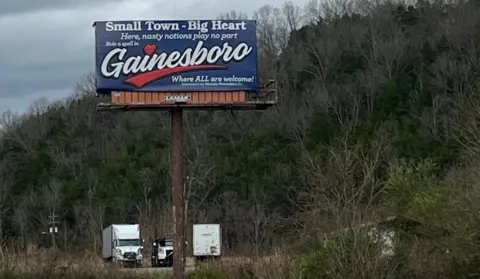
Local residents put up a billboard outside of town
In a county that voted 80% for Donald Trump in the last election, Ms Coons is used to living next door to neighbours with conservative views.
But she and others came away from the protest convinced more than ever that the beliefs of their new neighbours were too extreme.
They say they don’t want to run them out of town, but intend to sound the alarm about what they say are extreme views, as well as thwart any future attempt to take over the local government.
“This is where we have to draw the line,” Ms Coons says.
What is Christian nationalism?
Christian nationalism is a nebulous worldview without a single coherent definition.
At the extreme end, as outlined by theorists including author Stephen Wolfe, Christian nationalists advocate for rule by a “Christian prince” – an all-powerful religious dictator, who reigns over the civil authorities and leads his subjects to “godliness”.
Less extreme versions take the form of calls for Christian law to be explicitly enshrined in American legal codes, for religious leaders to get heavily involved in politics, or simply for an acknowledgement of the Christian background of America’s founding fathers.
This multiplicity of definitions has created a strategic ambiguity that experts say has helped Christian nationalism seep into the mainstream.
Big ideas or far-right plan?
Mr Abbotoy’s development is still in the early stages – his company is building roads and organising sanitation infrastructure. When the BBC visited in November, workers were busy knocking down a decrepit old barn, one of many that dot the Appalachian landscape.
But business is brisk. Around half of the lots are already under contract. Mr Abbotoy anticipates that the first houses will be built and new customers will begin moving in at the beginning of 2027.
BBC/Ellie House
Building on the Brewington Farms site will start within months, with new residents moving in soon, in just over a year
Many of his customers, he says, are moving to heavily Republican Tennessee from Democratic-majority states like California and New York.
“People want to live in communities where they feel like they share important values with their neighbours,” he says.
Mr Abbotoy says he doesn’t call himself a Christian nationalist, but describes the criticism of his customers as “absurd” and says they have no intention to try to take over local government.
“They’re talking about big ideas and books,” he says. As for some of their more controversial views, he insists that “rolling back the 20th Century can mean a lot of things. A lot of conservatives would say we took a lot of wrong turns.”
Mr Isker and Mr Engel did not respond to multiple requests for comment and a list of questions.
BBC/Ellie House
Nan Coons belongs to an informal group of Gainesboro residents who are alarmed at their new Christian nationalist neighbours
Small-town fight goes nationwide
The fight here in Gainesboro has drawn in players far from small-town Tennessee.
Mr Abbotoy, who was educated at Harvard Law School, is also a partner at a conservative venture capital fund, New Founding, and a founder of the American Reformer, a website that has published the writings of a number of other prominent Christian nationalists.
His opponents meanwhile have received research assistance and advice from a national organisation, States at the Core, established last year to tackle authoritarianism in small communities. It is funded by a constellation of left-wing organisations. States at the Core declined our request for an interview.
The men of Ridgerunner have pointed to the organisation as evidence that the pushback against their project has been orchestrated by powerful liberals. The locals say this is ridiculous.
“Nobody’s cut me a cheque to say anything,” Ms Coons says.
In Gainesboro, people on all sides see a much bigger story – one of large-scale political fights playing out in rural America.
Republicans have made huge gains in rural areas this century, and in 2024 Trump stretched his lead in rural communities, winning 69% of the vote. The Democratic Congressional Campaign Committee recently announced a reported eight-figure investment ahead of the 2026 midterm elections, a chunk of which will be dedicated to winning rural voters.
“There’s definitely a renewed, [Democratic Party] focus on rural engagement,” Mr Abbotoy says. “And at the same time, there’s been a wave of people moving to small town America precisely because they like the Bible Belt, they like the conservative traditional culture.”
But Nan Coons and her allies say they aren’t ready to concede rural areas like her hometown to Christian nationalists.
“If we are going to turn this tide, it starts on your street, it starts in your neighbourhood, it starts in your small town,” she says.
“I have to stand for something, and this is where I stand.”
Victoria Gill, Kate Stephens and Gwyndaf Hughes,BBC News science teamand
Ahmed Nour,BBC News Arabic
Getty Images
Great white sharks in the Mediterranean Sea are in danger of disappearing, with illegal fishing contributing to their decline.
This is according to research by US scientists, working in partnership with UK charity Blue Marine Foundation. They say some of the most threatened species – including great white sharks – are being sold in North African fish markets.
Great whites are one of more than 20 Mediterranean shark species protected under international law, meaning it is illegal to fish for them or to sell them.
By monitoring fishing ports on the Mediterranean coast of North Africa, however, researchers discovered that at least 40 great white sharks have been killed there in 2025 alone.
James Glancy/Blue Marine
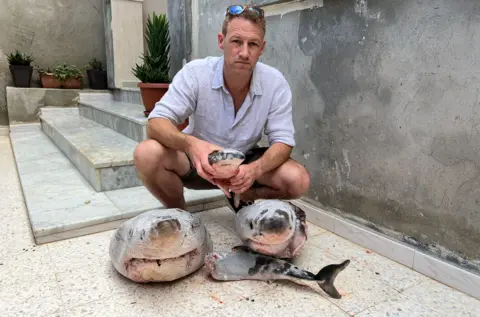
Conservationists and scientists say they have seen protected species for sale in fish markets in North Africa
The BBC has also found, and independently verified, footage from social media of protected sharks being brought dead into North African ports.
One video showed a large great white being hauled ashore from a fishing boat in Algeria. Another, filmed in Tunisia, shows heads and fins of what appears to be a short-finned mako shark, which is also a threatened and protected species, being prepared for sale.
Last shark stronghold
James Glancy/Martin Stalker
The researchers worked from a vessel in the Strait of Sicily
“No other stretch of water is fished like the Mediterranean Sea,” he said, speaking to the BBC News science team while working on a research vessel off the coast of Sicily in late 2025.
“The impact of industrial fishing has been intensifying… and it’s plausible that they will go extinct in the near future.”
In their latest attempt to find and study the predators, Dr Ferretti and his team worked in the Strait of Sicily – an area between Sicily and North Africa that has been identified as a “last stronghold” in the Mediterranean for several threatened shark species.
One key aim of their mission was to fit a satellite tracking tag onto a white shark – something that has never been done in the Mediterranean Sea.
To attempt this, the researchers brought more than three tonnes of fish bait – a shipping container packed with frozen mackerel and tuna scraps, as well as 500 litres of tuna oil to create a “fat slick” that many sharks would be able to smell from hundreds of metres away.
Despite working for two weeks – baiting the ocean, taking samples of seawater to search for shark DNA and using underwater cameras – the researchers did not manage to find any animals to tag.
They captured only a brief glimpse of one blue shark on their submarine cameras.
“It’s disheartening,” Dr Ferretti told us. “It just shows how degraded this ecosystem is.”
While the team was searching for surviving sharks, they also received reports that a juvenile great white had been caught and killed in a North African fishery – just 20 nautical miles from where they were working.
It is not clear whether that animal was accidentally caught in fishing gear, or if it was targeted.
Dr Ferretti and his team, though, estimate that more than 40 great white sharks have been caught around that coast. “This is a lot for a critically endangered population,” he said.
Sharks for sale
James Glancy/Blue Marine
James Glancy from Blue Marine visited fish markets in Tunisia in 2023 and discovered protected sharks being sold
The researchers, with their colleagues in North Africa are monitoring several fishing ports in the region. Our work, with the BBC Forensics team, also shows that protected sharks are caught, landed and offered for sale in countries including Tunisia and Algeria.
We found footage – posted on social media – of a great white being landed in a fishing port in Algeria and another large shark that appears to be a protected short-finned mako, being prepared for sale on a trolly in a fish market in Tunisia.
The rules that protect sharks are complicated. Currently, 24 threatened species have international legal protection – including mako, angel, threshers and hammerheads.
The EU and 23 nations around the Mediterranean have signed an agreement, which states that those species cannot be “retained on board, transhipped, landed, transferred, stored, sold or displayed or offered for sale”.
The international agreement states “they must be released unharmed and alive [where] possible”. Those rules do not tackle accidental bycatch and enforcement is variable from country to country.
Virginia Tech/Blue Marine
The researchers used baited underwater cameras to search the area for sharks
James Glancy from Blue Marine told BBC News that his own investigation found multiple white sharks on sale in Tunisian fishing markets. But, he said, there was a paradoxical element of hope in the fact that white sharks were turning up for sale.
“It shows that there is wildlife left,” he told BBC News. “And if we can preserve this, there is a chance of recovery.”
What can be done?
In poorer communities in North Africa, fishers who catch sharks might face the choice of whether to feed their family, or return a threatened species to the ocean.
Sara Almabruk from the Libyan Marine Biology Society says that most of the catches happening in North African waters are accidental, but adds: “Why would they throw sharks back into the sea when they need food for their children?
“If you support them and train them in more sustainable fishing, they will not catch white sharks – or any sharks.”
James Glancy from Blue Marine added that if countries around the Mediterranean worked together, “there is hope.